National Lampoon’s Animal House (1978)

NATIONAL LAMPOON’S ANIMAL HOUSE (1978) Four stars

There are few comedies I have enjoyed as much as NATIONAL LAMPOON’S ANIMAL HOUSE.

I have watched it many times over the years and that’s not even counting all those times on TBS, because, let’s face it, one misses so many “good parts” of a movie like ANIMAL HOUSE when it’s been edited for TV. It warped my fragile little mind seeing it on video the first time and I lost count of how many times I watched that VHS tape I bought circa 1997.

I loaned it to Brad Rich so he could watch Bluto’s infamous “Germans bombed Pearl Harbor” speech and remember it verbatim for his high school speech class. Mr. Rich earned an ‘A’ for his performance. Unfortunately, I did not have the opportunity to watch him act it out, though, fortunately, Mr. Rich returned the VHS tape. Bonus points for him.

College friend Don Stephens came over to my house about once a week to watch ANIMAL HOUSE it seemed like after Mr. Stephens joined a fraternity at Pittsburg State. Mr. Stephens and I started living ANIMAL HOUSE just a little bit so the viewings of the movie decreased significantly, especially after I continued my educational career in 2000 at Pitt State. Mr. Stephens eventually returned to the ranks of the independents and I remained one throughout both tours of college.

There was that one night when Mr. Stephens played Otter and I was Boon: “Hi, Don Stephens, damn glad to meet you,” then I hit ‘em with “Hi, that was Don Stephens, he was damn glad to meet you.” We only used it that one night, especially since it seemed like nobody got the reference. That’s when I started losing faith in the youth of America and have ever since.

Another time, Mr. Stephens and I went on a Thanksgiving break pilgrimage to Wichita to meet two young women (sisters) and, ahem, spend the night at their house. At some point, I believe it was early on at the bar, my date said that I was just like that Bluto guy from ANIMAL HOUSE, since I told her I’d been in college seven years. You win some, you lose some, and another time I’ll tell you about the six years off-and-on I knew my date from Wichita, although, to be honest, I really don’t want to do that.

Enough about that: ANIMAL HOUSE made a tremendous impact on the movie industry.

Every year, we get at least one raunchy, R-rated, gross out comedy.

ANIMAL HOUSE paved the parade route for PORKY’S, FAST TIMES AT RIDGEMONT HIGH, DAZED AND CONFUSED, AMERICAN PIE, OLD SCHOOL, WEDDING CRASHERS, and HANGOVER.

Every time I watch ANIMAL HOUSE, it holds up and it remains better than its followers.

First and foremost, it is superbly acted up and down the cast.

Tom Hulce and Stephen Furst (1954-2017) make a successful entry point into this world, as one snooty sorority sister calls them “the wimp and the blimp.” Tim Matheson and Peter Riegert play off each other so well as ladies man Otter and wing man Boon that we believe their characters have been friends for several years. James Daughton and Mark Metcalf, especially Metcalf as Niedermeyer, create thoroughly detestable characters that we love to hate.

Speaking of characters that we love to hate, Canadian actor John Vernon (1932-2005) had a knack for playing them better than just about anybody else. We enjoy every single appearance made by his Dean Wormer in ANIMAL HOUSE, every single time he gets his comeuppance, and especially every single time Vernon sinks his teeth into lines like “Fat, drunk, and stupid is no way to go through life, son” and “Put a sock in it, boy, or else you’ll be outta here like shit through a goose.” Vernon later played a similar character in KILLER KLOWNS FROM OUTER SPACE, retaining that bias against college kids.

John Belushi (1949-82) exploded into stardom with the success of ANIMAL HOUSE, one of the biggest hits of 1978. Outside action heroes Clint Eastwood, Charles Bronson, and Steve McQueen, we don’t find star-making performances built around fewer words. Belushi’s Bluto makes us laugh mostly through classic physical comedy and he irritates the comic villains every bit as effectively as the Marx Brothers and the Three Stooges did in their heyday.

Bluto definitely puts the animal in ANIMAL HOUSE, smashing acoustic guitars, downing full whiskey bottles in one fell swig (actually iced tea), pouring mustard on himself, starting food fights (by popping “zits”) and nationwide dance crazes, and peeping at cute coeds. Bluto’s predominantly silent act pays off with his big speech late in the pic for the Delta troops. It’s not quite George C. Scott as George S. Patton at the start of PATTON, but it’s close, real close in memorability.

Bluto has been described as a cross between Harpo Marx and the Cookie Monster.

Just about everybody has a memorable character in ANIMAL HOUSE, from Kevin Bacon in his motion picture debut (“Thank you sir, may I have another?”; how dare I forget a softball practice where I made every teammate who wanted another grounder hit their way ask that very question) to the lovely Karen Allen also in her debut, as well as Verna Bloom (1938-2019) as the ready and willing dean’s wife, Donald Sutherland as a hip professor, and DeWayne Jessie lip syncing his way through Otis Day on “Shout” and “Shama Lama Ding Dong.”

John Landis began a string of winners here, followed by THE BLUES BROTHERS, AN AMERICAN WEREWOLF IN LONDON, and TRADING PLACES over a few years. Universal wanted Chevy Chase to play the Otter role that went to Matheson, but Landis felt Chase was not right for the part and the director played a little Jedi mind trick by telling Chase that ANIMAL HOUSE would be an ensemble pic. That disinterested Chase, who instead made FOUL PLAY. Landis contributed to the anarchic atmosphere of ANIMAL HOUSE by throwing things at the actors, like an early scene when Bluto leads Flounder and Pinto into the Delta house and they’re greeted by a couple flying bottles.

Harold Ramis (1944-2014), Chris Miller, and Douglas Kenney (1946-80) combined on the screenplay and contributed their own collegiate and fraternal experiences.

George Lucas’ AMERICAN GRAFFITI famously asks “Where were you in ‘62?” ANIMAL HOUSE, released almost five years later to the day by the same studio, also takes place in ‘62 and Lucas, Ramis, Miller, and Kenney obviously had different answers to where they were in ‘62 and these different answers inform their respective movies and characters.

Both smash hit movies inform us what happened to their main characters. For example, in AMERICAN GRAFFITI, we’re told Terry the Toad is reported missing in action in Vietnam in December 1965. Meanwhile, in ANIMAL HOUSE, we read that Neidermeyer’s own troops kill him in Vietnam. Yes, indeed, they fragged Neidermeyer. Maybe even Terry the Toad took part in it.

Hercules in New York (1969)

HERCULES IN NEW YORK

HERCULES IN NEW YORK (1969) One-and-a-half stars

I remember first watching HERCULES IN NEW YORK, Arnold Schwarzenegger’s infamous motion picture debut, on “USA Up All Night” and I am trying to remember if it was Rhonda Shear or Gilbert Gottfried hosting that night.

I caught up with HERCULES IN NEW YORK about 10 years ago and wrote a rather negative review (that seems to be a pattern). I remember making fun of the ridiculous voice dubbed for Schwarzenegger and cracking multiple governor jokes.

I received “Arnold’s original classic” for Christmas and it’s hyped featuring his original audio track. That’s a vast improvement from dubbed Arnold, because it is infinitely more enjoyable to hear Mr. Schwarzenegger (billed as Arnold Strong, playing off co-star Arnold Stang) flub his lines than hear some mismatched voice for the world’s strongest man. We do hear Arnold’s voice except for the final scene. In that sense, we don’t leave HERCULES IN NEW YORK asking ourselves like Johnny Rotten, “Ever get the feeling you’ve been cheated?”

Where do we go now with HERCULES IN NEW YORK? The title basically sums up the plot, but unfortunately, there’s a lot more to it than that with scenes taking place in both New York City and Mount Olympus. On Earth, it’s a situation comedy with tons of slapstick and incredible feats by our title character, while on Mount Olympus, it’s a soap opera featuring Zeus, Juno, Venus, Hercules, Mercury, et cetera.

Hercules challenges Zeus, Zeus punishes Hercules, Hercules defies Zeus, Juno plots behind their back, Mercury attempts to bring Herc back, oh help us all, I just want more scenes like the infamous one where Hercules takes on a man-in-a-bear suit or even like the early one where he overpowers a car. Yes, I want more incredible feats and less soap opera.

If viewers at home decide to play a drinking game with HERCULES IN NEW YORK, please be careful which phrases and drinks are selected. For example, if you select “I am Hercules” and you’re drinking shots, you just might be passed out by the 30-minute mark. Then again, you just might prefer that over watching the rest of HERCULES IN NEW YORK, especially since the final 30 minutes are much worse than the first 30.

I wonder if there’s ever been a weirder screen pairing than Stang and Schwarzenegger.

The 5-foot-3 Stang and the 6-2 Schwarzenegger. The high-pitched motor-mouthed New Yorker and the Austrian who struggles with the English language. The scrawny bean pole and Mr. Olympia. They both enjoyed successful careers against the odds: Stang (1918-2009) described himself as a frightened chipmunk who’s been out in the rain too long, while Schwarzenegger’s mentor Joe Weider (1919-2013) falsely claimed the bodybuilder had extensive “stage” experience to get the big lug the Hercules part. Schwarzenegger returned to acting in Bob Rafelson’s STAY HUNGRY (1976) and later became perhaps the unlikeliest star after CONAN THE BARBARIAN and THE TERMINATOR. Stang continued to work into his 70s in a career that spawned more than 50 years.

It should be mentioned that Reg Park’s performance and physique in Mario Bava’s 1961 HERCULES IN THE HAUNTED WORLD inspired Schwarzenegger to become a bodybuilder. In turn, Park himself urged Schwarzenegger to take on the Hercules role. Too bad, Arnold did not have Bava (BLACK SUNDAY, TWITCH OF THE DEATH NERVE) for director.

Schwarzenegger’s friend and rival Lou Ferrigno played Hercules in two movies, HERCULES and THE ADVENTURES OF HERCULES. At the fourth annual Golden Raspberry Awards in 1984, Ferrigno won “Worst New Star” for his performance in HERCULES, beating out Loni Anderson in STROKER ACE, Reb Brown in YOR, THE HUNTER OF THE FUTURE, the shrieking dolphins Cindy and Sandy from JAWS 3, and Finola Hughes in STAYING ALIVE. Bet only this one time Ferrigno would have liked to have been beaten by two dolphins.

Schwarzenegger became more successful avoiding being typecast than any other bodybuilder turned actor. At one point, he was the biggest action star in the world, both physically and financially.

Even in a bad movie like HERCULES IN NEW YORK, one can see Arnold’s potential.

In all conscience, I cannot rate HERCULES IN NEW YORK lower than JUNO, because I laughed more at it than I did the overrated 2007 comedy.

The Thing with Two Heads (1972)

THE THING WITH TWO HEADS (1972) Three stars

Former NFL player Rosey Grier and 1946 Academy Award for Best Actor winner Ray Milland are the two heads. Let’s get that out of the way right from the start.

Top-billed Milland plays a brilliant scientist with terminal cancer who finds trial success with a two-headed gorilla (Rick Baker’s preparation for KING KONG). He comes up with a diabolical scheme to keep on living. Just like Spinal Tap lead singer David St. Hubbins once said, “It’s such a fine line between stupid, and clever.”

Second-billed Grier plays a convicted murderer on Death Row who has volunteered his body to medical science.

Doctors transplant Milland’s head onto Grier’s body, since both are running out of time. Maybe the wrong Grier, because just imagine Milland’s head, for example, on Pam Grier’s body. Now, that would be interesting. American International Pictures could have made it happen, at least for a sequel, but unfortunately it’s too late since Milland passed away in 1986.

You might not believe this, but Grier’s Jack Moss is an innocent man and Milland’s Maxwell Kirshner is an unapologetic racist. Try and imagine a TV show where they put Archie Bunker’s head on George Jefferson’s body.

Honestly, I don’t think THE THING WITH TWO HEADS takes off until it gets Milland and Grier out of the hospital and into the open after their transplant. That’s about the halfway point of the picture, when they kidnap black doctor Fred Williams (Don Marshall) and Moss and Kirshner both do their best negotiating to get the good doctor on their side. They both face challenges, in Moss being on Death Row and Kirshner being an unrepentant bigot. They both want the other head removed.

THE THING WITH TWO HEADS devotes several minutes to a chase scene with many police cars in hot pursuit of a “two-headed monster.” You really have not lived until you see this chase, especially after Grier and Milland commandeer a motor bike, make their way through a race course, and evade 14 crashing police cars en route to a safe haven. These policemen are incredibly incompetent: They cannot shoot, cannot drive, and cannot even close a trunk on their downtrodden squad cars. Yes, they do drive, but just look at their end results. Like a test reel for SMOKEY AND THE BANDIT and THE BLUES BROTHERS.

Milland plays basically the same character that he does in FROGS, another 1972 production from American International; FROGS came out on March 10 and THE THING WITH TWO HEADS on July 19. Milland sinks his teeth into the dialogue in both films and he gives off the feeling of an unhappy camper in both performances, but it works for his characters. Reportedly, Milland sweated so much during the production of FROGS, filmed in the Everglades, that his toupee fell off several times; additionally, he hated the production so much that he left it three days early.

Grier, meanwhile, has lived an interesting life to say the least and a starring role as one of the heads in THE THING WITH TWO HEADS barely scratches at the surface of that life, believe it or not. Grier played college football at Penn State and then professionally for the New York Giants and the Los Angeles Rams from 1955 through 1966. He served as a bodyguard for Robert Kennedy during the 1968 presidential campaign and it was Grier who subdued assassin Sirhan Sirhan. Grier hosted a TV show, enjoyed a recording career, became an ordained minister, spoke at the 1984 Republican National Convention, and entertained running for the Governor of California in 2018, lest we forget Grier’s 1973 book “Rosey Grier’s Needlepoint for Men.” He’s the last living member of the Rams’ “Fearsome Foursome,” a defensive line that included Deacon Jones (1938-2013) and Merlin Olsen (1940-2010).

Grier even gets to show off his singing ability just a little bit in the final moments of THE THING WITH TWO HEADS and let’s just say that, of course, the film ends on “Oh Happy Day.” It is just that kind of a movie.

NOTE: I would assign the film’s trailer four stars. It is 2 minutes, 21 seconds of greatness, especially with that dynamite opening line “It seemed like a good idea at the time,” which might just be exactly what many people have said after seeing THE THING WITH TWO HEADS.

Shrek (2001)

SHREK (2001) Four stars

I recently watched SHREK for the who knows how many times and it was every bit as fun as it was the first time all those years ago.

Watching it was just like catching up with an old friend who you have not seen in a long time. Sometimes, that’s a delightful experience as two people do not miss a beat despite the passing of time. Once in a while, it’s just two people in a room who have nothing to say to each other one way or the other. I connected with SHREK all over again.

There’s so many great characters, old friends if you will, in SHREK and I think that, more than anything else, is the secret to its success.

We might as well as start with the title character. The name Shrek itself calls to mind the surname Schreck, the German actor who played Dracula in the F.W. Murnau silent classic NOSFERATU (1922). Schreck means “a feeling of fear or alarm.” Ogre means a man-eating giant in folklore and a cruel or terrifying person in reality. None of those definitions fit the title character in SHREK, who thankfully is more of an ogre with a heart of gold than a man-eating giant. Granted, Shrek would just rather be left alone in his swamp, at least at the beginning of the picture. His privacy’s besieged upon first by a single annoyance and then by a slew of fairy tale characters who have been driven from their kingdom. Eventually, he takes on the assignment of slaying a dragon and rescuing a princess from an outsourcing overlord.

Princess Fiona is not the average princess and, for that matter, Dragon is not the average dragon. Of course, this is not a Disney picture, it’s a DreamWorks extravaganza, and the scene where Fiona unleashes her inner martial artist on Monsieur Robin Hood and his Merry Men proved to be a game changer for animated princesses. I could have lived without the MATRIX reference, since it seemed like every other picture made in the early 2000s referenced THE MATRIX, but it was a pleasant surprise to see her kick ass. She has even more surprises in store, especially for Shrek.

Surprises are SHREK in a nutshell, which puts entertaining and fresh spins and variations on durable storytelling traditions or that’s just another way of saying that SHREK breathed fresh life into fairy tale stories. It will remind viewers of THE PRINCESS BRIDE.

In other words, at times, SHREK absolutely skewers fairy tales. I mean, there’s the delightful scene where antagonist Lord Farquaad tortures the Gingerbread Man for information about the whereabouts of all his fellow fairy tale brothers and sisters. What will it take to make him crack? Lord Farquaad makes a move toward the Gingerbread Man’s gumdrop buttons and that’s going way, way, way too far. That’s a fun scene, and there’s probably about 50 more fun scenes in SHREK.

Children and adults both enjoy SHREK, and that’s because there’s jokes only more experienced viewers will understand. For example, when Shrek observes that Lord Farquaad must be overcompensating for something, we adults know what’s that something. SHREK is a film truly for the entire family, capable of placating the smart ass teenager, the lover of fairy tales and/or musicals, and the grumpy old man to name three demographics.

We have mentioned Lord Farquaad a couple times already in this review, and he makes for a great villain. He’s voiced by John Lithgow, who brings his expertise from live-action villainous roles in BLOW OUT, RAISING CAIN, and CLIFFHANGER. He’s one of those actors who we love to hate. This is also the same Lithgow, by the way, who released “John Lithgow’s Kid-Size Concert” on VHS in 1990, advertised on the box as “Award winning actor JOHN LITHGOW sings and strums his favorite songs for kids.”

If there’s a hero (and a leading lady and a villain), invariably there must be a loyal sidekick for the hero and that’s filled in SHREK by Donkey, voiced by Eddie Murphy. Donkey, of course, exists in sharp contrast to Shrek, meaning that he’s a motormouth who eventually wears down the resistance of the big ogre. Donkey even finds himself a very unlikely love interest.

Until now, I have skipped Mike Myers and Cameron Diaz, who voice Shrek and Princess Fiona. They were not the original choices. Nicolas Cage passed on the title character at one point and Chris Farley recorded nearly all of his lines as Shrek, but Farley died of a drug overdose before he could finish. SHREK paired Farley with Janeane Garofalo as Princess Fiona, but she was fired without an explanation after his death. Shrek and Fiona each received a rewrite and personality changes after the personnel changes to Myers and Diaz, and Myers finally decided upon his trademark Scottish accent for one of his three iconic characters (Wayne and Austin Powers the other two) … hard to imagine Shrek without one at this point. In fact, it’s hard to imagine Myers, Diaz, Murphy, and Lithgow not voicing their respective characters.

SHREK spawned a new wave of computer animated pictures built upon pop-culture references and just being too darn clever for their own darn good, including its own increasingly lackluster sequels (I stopped at SHREK THE TURD, er, SHREK THE THIRD). Apparently, there’s a reboot or sequel named SHREK 5 slated for 2022.

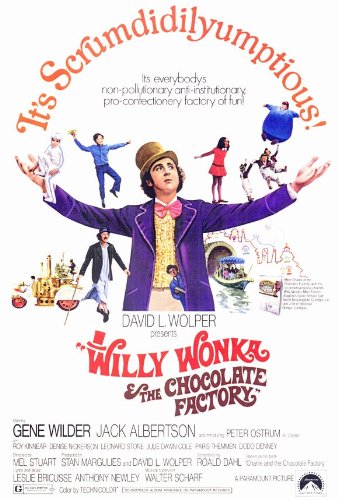
Willy Wonka & the Chocolate Factory (1971)

WILLY WONKA

WILLY WONKA & THE CHOCOLATE FACTORY (1971) Three-and-a-half stars

Over the years, many individual performers have walked away with a movie and made it their own. For example, Gene Wilder in WILLY WONKA & THE CHOCOLATE FACTORY.

Wilder provides one of the great movie entrances at about the 45-minute mark of the picture and it’s about darn time because it’s a bit of a slog before we reach the chocolate factory. Our expectations are very high by this point in the picture and Wilder’s Willy Wonka meets and even surpasses them. It was Wilder himself who insisted that he make such an entrance.

“When I make my first entrance, I’d like to come out of the door carrying a cane and then walk toward the crowd with a limp,” Wilder said. “After the crowd sees Willy Wonka is a cripple, they all whisper to themselves and then become deathly quiet. As I walk toward them, my cane sinks into one of the cobblestones I’m walking on and stands straight up, by itself; but I keep on walking, until I realize that I no longer have my cane. I start to fall forward, and just before I hit the ground, I do a beautiful forward somersault and bounce back up, to great applause.”

This entrance establishes Wonka’s unpredictability right from the start.

Wilder magnificently expresses all the sides of Willy Wonka’s personality. It turns on a dime from joy and wonder to malevolent anger at the selfish children who found their golden ticket in a Wonka bar. Their golden tickets earned the children a pass to Wonka’s factory. The five children are Augustus Gloop, Veruca Salt, Violet Beauregarde, Mike Teavee, and Charlie Bucket and they are each joined by one parent or grandparent in the case of final ticket winner Charlie Bucket. The bad children are punished in unspeakable, horrifying ways for their indiscretions. That’ll show ‘em and serves ‘em right, greedy little bastards.

When the beloved Wilder died in 2016 at the age of 83, I thought immediately of his performance as Willy Wonka and his spotlight song “Pure Imagination,” a number written by the British duo of Leslie Bricusse and Anthony Newley. “If you want to view paradise / Simply look around and view it / Anything you want to do it / Wanna change the world / There’s nothing to it / There is no life I know / To compare with pure imagination / Living there you’ll be free / If you truly wish to be.” At its very, very best, WILLY WONKA approaches THE WIZARD OF OZ and Wilder’s on par with Margaret Hamilton and Frank Morgan and gang. They all share a certain joy of performance that’s wonderful to behold.

Like THE WIZARD OF OZ, WILLY WONKA undoubtedly introduced multitudes of children to scary movies. The Haunted Forest, the Wicked Witch of the West, flying monkeys, et cetera, in the 1939 film and the Oompa-Loompas and the boat ride in WILLY WONKA.

“Charlie and the Chocolate Factory” author Roald Dahl (1916-90) absolutely hated the 1971 screen adaptation. Dahl received credit for writing the screenplay, but it was the uncredited David Seltzer who came in and made script changes that raised Dahl’s ire.

What did Mr. Dahl hate about the picture? The shift in focus from Charlie to Willy Wonka. Check. The musical numbers. Check. Casting Gene Wilder rather than Spike Milligan, Dahl’s stated preference. Check. Guess the question should be changed to what didn’t Mr. Dahl hate about WILLY WONKA. This whole situation reminds one that Stephen King hates Stanley Kubrick’s THE SHINING.

I saw WILLY WONKA for the first time in fifth grade (1990) and read Dahl’s novel the next school year. I loved Dahl’s novel, but I have not read it since completing it during sixth grade, roughly the same age as the precocious golden ticket winners. Meanwhile, I have seen the 1971 version several times since that first encounter nearly three decades ago, on cable TV (Teavee), VHS, and DVD. I do think of the film more often than I do the book, and I believe that it has almost everything to do with the Wilder performance.

I have skipped Tim Burton’s 2005 adaptation CHARLIE & THE CHOCOLATE FACTORY & I just remember being appalled from the start by still photographs of Johnny Depp’s take on Willy Wonka. Remember that scene in ANIMAL HOUSE when the older members of Delta Tau Chi pelt that picture of pledge Flounder with beer cans? That’s about how I feel every time I see a picture of Depp as Wonka. (Generally speaking, I have no problem with Burton and Depp movies. I love ED WOOD and like SLEEPY HOLLOW and SWEENEY TODD a lot.)

In a 2013 interview with Turner Classic Movies host Robert Osborne (1932-2017), Wilder shared his true feelings on the 2005 version.

“I think it’s an insult,” he said. “Johnny Depp, I think, is a good actor, but I don’t care for that director [Tim Burton]. He’s a talented man, but I don’t care for him doing stuff like he did.”

King Kung Fu (1976)

KING KUNG FU (1976) Three stars

The Empire State Building, completed just a couple years earlier, played a key role in the 1933 classic KING KONG. At this very moment, we can picture Kong fighting off them darn airplanes from the highest spot in the modern world. Very few endings in movie history can even approach the final minutes in KING KONG. Remains awesome nearly 90 years later.

Meanwhile, our gorilla King Kung Fu takes shapely Pizza Hut waitress Rae Fay to the top of the Holiday Inn Plaza, the tallest building in Wichita at a majestic height of 262 feet, for the grand finale of KING KUNG FU. King Kung Fu battles a stop-motion helicopter piloted by a police captain with a bad John Wayne impersonation. Awesome, in a completely different way.

You win some, you lose some, and often times it seems like Kansas loses on the cultural front, while New York City wins and wins again and again and wins forever more.

Both the Empire State and the Holiday Inn are no longer their cities’ tallest buildings. Heck, the latter is not even the Holiday Inn any more, it’s the 250 Douglas Place Apartments (a.k.a. the Garvey Center). They both are doing quite well for themselves, however, with the Empire State Building in the news in late 2019 for $165 million renovation and being a top tourist destination.

The duo of producer Bob Walterscheid and director Lance D. Hayes started filming KING KUNG FU in 1974 and finished in 1976, but it took another 11 years for Walterscheid to wrangle up the necessary funds to complete the editing on this half-King Kong, half-Kung Fu spoof that has its tongue planted firmly within its cheek. Hell, maybe every cheek in Wichita.

I watched the Korean KING KONG rip-off A*P*E and KING KUNG FU within basically the same 24-hour period.

Objectively, both are “bad” movies, but there’s a world of difference in what both achieve.

A*P*E plays exactly like a cheap, cynical KING KONG rip-off and it’s quite telling that its most famous scene is of the title character flipping the bird.

KING KUNG FU, meanwhile, feels more like a labor of love, an affectionate tribute to King Kong and Kung Fu. Plus, it has this undeniable goofball charm as it tries every lowbrow gag, at least one per minute. Most fail, others succeed, but that’s part and parcel with any sense of humor. I laughed out loud a few times during KING KUNG FU and that’s definitely far more than what I can say for A*P*E.

I laughed at the “Simian Scope” gag at the beginning of KING KUNG FU. This is the first and last movie filmed in “Simian Scope.” We’ve had many variations on CinemaScope over the years: The Shaw Brothers’ “Shaw Scope” being my all-time favorite. Also worth seeking out: The Shaw Brothers released their own take on KING KONG in 1977, MIGHTY PEKING MAN.

I laughed at the John Wayne impersonation, which eradicates the whole “bad” judgment I wrote a few paragraphs back about that impersonation since I believe it was intended to be funny … and … (for a third time) I laughed. We could have used even more scenes with this character played by Tom Leahy, a favorite in the Wichita area for his many years of work in radio and television. Since we have a subordinate officer surnamed Pilgrim, well, you can already guess about half of the dialogue from Mr. Leahy as Captain J.W. Duke. Leahy died in 2010.

The plot: Two would-be reporters Bo (Billy Schwartz) and Herman (Tim McGill) hatch a master plan to free King Kung Fu, a great big gorilla from China whose goodwill tour of the United States stops in Wichita and the Sedgwick County Zoo. Of course, having seen KING KONG, Bo and Herman bait King Kung Fu with Rae Fay (not Fay Wray or Link Wray, for that matter). Sounds like Bo and Herman want to make a movie, one with a happy ending.

Unfortunately, the movie drags just a little bit in the middle section. Plain and simple, it takes way too long for King Kung Fu to be unleashed on Wichita. We get too many scenes with Bo and Herman and their slapstick shenanigans, as the filmmakers seem to have forgotten their own title. Granted, Bo and Herman are likeable oddballs, but they do push endurance levels to breaking point with their schtick in this middle section.

Because we want to see King Kung Fu wreak good-natured havoc on the Old Cowtown Museum, the Joyland Amusement Park (no longer in operation), and Lawrence-Dumont Stadium (demolished for a new facility that will host a new Triple-A franchise named The Wichita Wind Surge, beginning 2020). These scenes are worth their weight in gold.

Never mind Bo’s line, “… Me as the karater and him as the karatee.”

Or the genius in Washington who says, “As you can see, Wichita is located in the center of this great country of ours and it means quite simply we have him surrounded.” That look on his face when he says “It means quite simply we have him surrounded,” I mean, wow, if you watch it now it would be great preparation for the next electoral season.

Guess it should be mentioned King Kung Fu utters dialogue like “I gotta make like a banana and split.” I once told somebody, “Why don’t you make like Michael Jackson and just beat it!”

Believe it or not, KING KUNG FU received a ‘G’ rating. Not many movies are ‘G.’ The Washington Post ran “Rated ‘G’ — For Gone?” in 1992, because a ‘G’ rating became at some point a kiss of death just like X or NC-17 on the other extreme of taste. Disney animated movies survive a ‘G,’ no problem, but little else can break through the stigma associated with ‘G.’

This ‘G’ rating was not a mistake for KING KUNG FU, like, for example, it was for the 1968 Hammer film DRACULA HAS RISEN FROM THE GRAVE. There’s no blood in KING KUNG FU.

You might never look at Wichita quite the same way again after seeing KING KUNG FU.

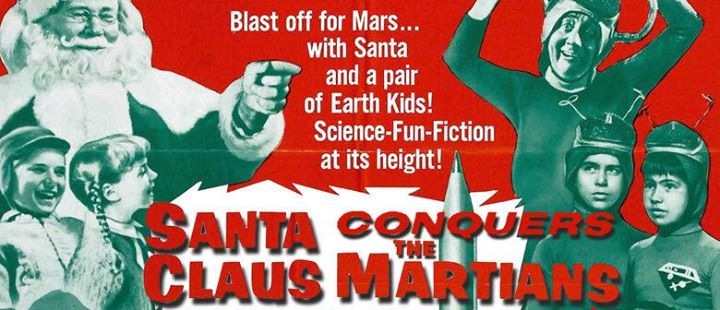
Santa Claus Conquers the Martians (1964)

SANTA CLAUS CONQUERS THE MARTIANS

SANTA CLAUS CONQUERS THE MARTIANS (1964) One star

IT’S A WONDERFUL LIFE. SCROOGE. A CHRISTMAS STORY. DIE HARD. CHRISTMAS VACATION. HOME ALONE.

There’s one movie title sure not to be heard in the discussion for “Best Christmas Movie”: SANTA CLAUS CONQUERS THE MARTIANS, which can be found instead on the IMDb’s Bottom 100. At last perusal, it’s No. 39 between STEEL (below) and THE EMOJI MOVIE (above).

SANTA CLAUS CONQUERS THE MARTIANS and I go a long way back.

I first watched this 1964 low-budget production during my last year of college, checking it out from the Leonard H. Axe Library alongside Ingmar Bergman’s PERSONA and Lucio Fulci’s DON’T TORTURE A DUCKLING. I wrote a review long ago and I apparently buried it within a time capsule deep inside Middle Earth.

Over time, I have acquired three VHS copies and I’ve already broken it out this holiday season, just like the Chipmunks and Star Wars.

I first read about SANTA CLAUS CONQUERS THE MARTIANS in John Wilson’s “The Official Razzie Movie Guide,” which honors the so-called best of Hollywood’s worst. The book’s front cover includes a still of that infamous man-in-a-suit ape with his middle finger uplifted from the Korean KING KONG rip-off A*P*E.

I suppose that I’ll start with the plot.

The children of Mars are not happy. Be warned that you could end up just like the children of Mars as you watch SANTA CLAUS CONQUERS THE MARTIANS.

The Martians all have dopey names: Kimar, Voldar, Dropo, Bomar, Girmar, Momar, and Rigna. Dropo is the laziest man on Mars and Voldar is the vulgar voice of doomy discontent in this cinematic confection. He’s an unrepentant Grinch, a real Scrooge, equipped with a ridiculous looking contraption on top of his head, just like all his fellow Martians. Voldar believes the Martians have gone soft. Mars was, you know, the god of war.

Fearless leader Rigna says to Voldar, “Chochem is 800 years old, you can’t dismiss the wisdom of centuries.”

Voldar mouths back, “I can.”

Chochem tells the Martian leaders the children are sullen and have trouble sleeping because there’s no joy on Mars. Martian children have become obsessed with TV, not unlike children from the Planet Earth, and they especially love this holly jolly Santa Claus fellow they see all the darn time on KID-TV. You can talk about evil liberal media bias and fake news all you want: Reporter Andy Henderson interviews Santa Claus, despite the fact that it’s 91-below zero up on the North Pole.

The Martians decide they must have this Santa Claus, who brings joy everywhere he goes, and come to Earth, but they run into a roadblock when they see a Santa Claus on virtually every street corner.

The Martians find Earth children Billy and Betty Foster and kidnap them, who lead the space invaders to Santa Claus.

Santa Claus eventually wins over the Martians, and that’s what they mean by the conquer part of the title rather than Santa Claus building an army to defeat the Martians in battle.

All’s well that ends well on both Mars and Earth, as well as KID-TV.

Pia Zadora made her screen debut as Girmar, one of the two main Martian children.

Vincent Beck’s IMDb biography starts, “Tall, deep-voiced character actor who started on screen in the lamentable SANTA CLAUS CONQUERS THE MARTIANS [as Voldar], which may have taken him some time to live down.” Beck, who passed away in 1984, made appearances on several famous sitcoms from the 1960s and 1970s: “Gilligan’s Island,” “Gunsmoke,” “Bonanza,” “The Monkees,” and “Mannix.”

Kentucky native Bill McCutcheon (1924-2002) did not let playing Dropo, the laziest man on Mars, stop him from roles in HOT STUFF and STEEL MAGNOLIAS.

SANTA CLAUS CONQUERS THE MARTIANS includes the infamous song “Hooray for Santa Claus,” which has been covered by Sloppy Seconds and the Fleshtones. I would not be surprised if one day we find out that “Hooray for Santa Claus” was used at Guantanamo Bay.

The Cannonball Run (1981)

CANNONBALL RUN

THE CANNONBALL RUN (1981) Two stars

THE CANNONBALL RUN is not a very good movie, but nonetheless it contains a certain undeniable value in the time capsule department.

That’s right, THE CANNONBALL RUN shows us a society that once highly valued Burt Reynolds, James Bond, crude foreign stereotypes, cameos, cleavage, NFL, TV, and stuntman turned director Hal Needham, not in that exact order. THE CANNONBALL RUN finished sixth in the 1981 box office sweepstakes.

However, it came a few years late in the cinematic car chase-and-crash department, not so hot on the wheels of such illustrious precursors as GONE IN 60 SECONDS, DEATH RACE 2000, CANNONBALL,THE GUMBALL RALLY, EAT MY DUST, GRAND THEFT AUTO, and SMOKEY THE BANDIT, by far the best of the six Needham and Reynolds productions that saw the light of multiplex from 1977 through 1984. Never mind John Landis’ THE BLUES BROTHERS, which should have been the final word on car chases and crashes.

Needham (1931-2013) made his directorial debut with SMOKEY AND THE BANDIT and that film contains just about everything you need to know about the director and his films: chases, races, curves, stunts, pile-ups, punch-ups, slapstick, Southern humor, and Reynolds. The great success of SMOKEY AND THE BANDIT, only behind STAR WARS at the box office in 1977, paved the road for the TV show “The Dukes of Hazzard” (1979-85).

On the Needham scale, THE CANNONBALL RUN finds itself halfway between the high point of SMOKEY AND THE BANDIT and the dual low points of STROKER ACE and CANNONBALL RUN II.

SMOKEY AND THE BANDIT had the benefit of the great performance of Jackie Gleason, a performance not matched in any of the other Needham and Reynolds productions, including Gleason again in SMOKEY AND THE BANDIT II. Gleason walked (or drove) away with the first movie.

Reynolds (1936-2018) more or less squandered his career on Needham films.

For example, he chose STROKER ACE over TERMS OF ENDEARMENT. Jack Nicholson won the Best Supporting Actor Oscar for playing former astronaut Garrett Breedlove, the role turned down by Reynolds. The $16.5 million STROKER ACE bombed at the box office as it earned $5 million less than its budget. TERMS OF ENDEARMENT won Best Picture and took in over $100 million, succeeding both commercially and critically.

Reynolds’ career was never quite the same after STROKER ACE.

It would not be until BOOGIE NIGHTS (1997) the name “Burt Reynolds” was spoken with respect again. Reynolds earned a Best Supporting Actor nomination (part of a tally of 12 awards and three more nominations) for his performance as porn director Jack Horner in Paul Thomas Anderson’s sprawling epic. BOOGIE NIGHTS showed us a glimpse of what could have been for Reynolds had the actor not chosen his friend Needham in cynical productions.

They are cynical because they believed that Reynolds’ trademark grin and laugh could get us through a series of tossed off stunts, gags, and in-jokes.

This cynicism hit its absolute worst in CANNONBALL RUN II, which ironically found Reynolds playing alongside TERMS OF ENDEARMENT star Shirley MacLaine.

Frank Sinatra phoned in his cameo appearance and animator-for-hire Ralph Bakshi worked harder on the race than any of the big-name performers.

Roger Ebert called THE CANNONBALL RUN “Hollywood Squares on Wheels.”

“I’ll take James Bond for the block, please.”

“I’ll take Adrienne Barbeau’s cleavage for the win, please.”

When Roger Moore passed on the sequel, they brought in Bond villain Richard Kiel. The 7-foot-2 actor played Jaws in THE SPY WHO LOVED ME and MOONRAKER.

Barbeau and her busty blonde counterpart Tara Buckman were replaced by Catherine Bach and Susan Anton for the sequel.

The best thing to come from the CANNONBALL RUN films was that Jackie Chan borrowed the closing credit gag reel for his productions. Chan showcased not only bloopers and cast members cracking up like the CANNONBALL RUN films, but also stunts like the one in ARMOUR OF GOD that nearly killed him.

“I try to grab every tree,” Chan said in a 2017 interview. “They just keep breaking. Breaking, breaking, breaking, breaking. Then, boom, I just hit on the rock. I get up, I thought, ‘It’s nothing.’ I just feel my back’s hurt. Then I get up, but everybody pushes me down because my whole body was numb. By the time the numb passed, then I feel my air and I see the blood. We go to the hospital … I almost died.”

Even in his worst films, Chan gives it everything he got, certainly more than what the vast majority of the cast members did in CANNONBALL RUN, CANNONBALL RUN II, and SPEED ZONE. Chan’s presence helped CANNONBALL RUN II make a killing in Japan.

All we need to know about the CANNONBALL RUN series is that Jamie Farr’s Sheik Abdul ben Falafel is the only character to appear in all three films.

Playing with Fire (2019)

PLAYING WITH FIRE

PLAYING WITH FIRE (2019) One star

Imagine our surprise when the opening credits began at the Flick Theatre in Anderson, Missouri, and it was PLAYING WITH FIRE and not JOKER that we had for our entertainment or, in this case, lack of entertainment pleasure.

I would like to start the long road to recovery by writing this review.

PLAYING WITH FIRE belongs to a rather dubious sub-genre where passable, let alone good, movies are nearly impossible to find: The Big Man vs. Bratty Children. Let’s see, in the past 25-odd years, we have seen Hulk Hogan in MR. NANNY, Vin Diesel in THE PACIFIER, Ice Cube in ARE WE THERE YET?, Dwayne Johnson in TOOTH FAIRY, and now the latest perpetrator John Cena in PLAYING WITH FIRE.

I doubt any of those movies even approach Arnold Schwarzenegger’s KINDERGARTEN COP, the CITIZEN KANE of The Big Man vs. Bratty Children sub-genre.

I say doubt in the previous sentence since luckily, I’ve missed most of those movies because life is short and I only have a finite amount of time watching movies, so why put myself through something that’s akin to a root canal without sedative.

Personally, I feel like every one of those movies barring one (the one starring Arnold) should be shortened to a poster, because everything we need to know about MR. NANNY, THE PACIFIER, ARE WE THERE YET?, TOOTH FAIRY, and PLAYING WITH FIRE can be contained in a 24 x 36.

Hell, I recommend watching KINDERGARTEN COP again every single time a new Big Man vs. Bratty Children movie slithers into multiplexes everywhere.

There’s not a single unpredictable moment in PLAYING WITH FIRE.

I must in all honesty report that I almost, almost, laughed out loud a couple times during PLAYING WITH FIRE. I smiled a couple times.

More often than not, however, the 96 minutes of PLAYING WITH FIRE afforded me the opportunity to practice my poker face or hone my groan.

The last firefighter movie we saw at the Flick was ONLY THE BRAVE and now we have one good firefighter movie and one bad firefighter movie on the dossier. I do wish the nearest fire department would have stopped in and put out PLAYING WITH FIRE.

PLAYING WITH FIRE should not be confused with the 1984 New World production THEY’RE PLAYING WITH FIRE … just as John Cena and his bust should not be confused with Sybil Danning and her bust.

Youngsters might not remember Ms. Danning. She and Lou Ferrigno clashed while making HERCULES and Ferrigno legendarily made Danning wear a cloak so she would not upstage the bodybuilder turned actor. The nerve of that big lug, who demanded that Danning be changed from the good princess to the villain and the picture be made kid-friendly because Ferrigno did not want to disappoint any fans he earned from “The Incredible Hulk.”

A strong female presence like Ms. Danning would have been welcomed in PLAYING WITH FIRE.

Instead, they just waste Judy Greer. Greer and Cena share no chemistry whatsoever.

That is true and here’s another truth: If you play with fire and watch PLAYING WITH FIRE, you will get burned.

Breaking Away (1979)

BREAKING AWAY

BREAKING AWAY (1979) Four stars

BREAKING AWAY is one of those films that makes me feel incredibly good inside and it belongs on a list with such films as ONE FLEW OVER THE CUCKOO’S NEST, ROCKY, THE BLACK STALLION, CHARIOTS OF FIRE, HOOSIERS, and THE SHAWSHANK REDEMPTION for being uplifting cinematic experiences of the highest order.

It would be enough that BREAKING AWAY ends on a high emotional note, but the film, written by Steve Tesich and directed by Peter Yates, gives us a half-dozen great characters who have left an indelible mark on so many viewers. I’ll discuss these characters far more than I will THE BIG RACE, because they are far more unique and special than a feel good finish that has unfortunately become an industry standard over the decades.

We shall begin with our four main protagonists, Dave (Dennis Christopher), Mike (Dennis Quaid), Cyril (Daniel Stern), and Moocher (Jackie Earle Haley). They are 19 years old and going nowhere fast. They have decided to waste away their lives together and not work or go to college. They are derogatorily known as “cutters” to Indiana University students in Bloomington, since they are the sons of the stone cutters that built the campus. BREAKING AWAY provides us a rare opportunity to hear working class sentiments expressed onscreen. This is also undoubtedly the best movie ever made in Bloomington, Indiana.

All four protagonists, as well as both of Dave’s parents, are developed and sharply delineated. They are as real as the people in our lives.

Dave becomes obsessed with all things Italian, especially cycling and Team Cinzano. Dave takes his obsession so far that the family cat Jake has been renamed Fellini, Dave speaks Italian and plays opera records, he shaves his legs, he wants his parents to have another child because Italians have big families, and he pretends to be an Italian exchange student named Enrico Gimondi to impress a cute coed because he feels that just regular old Dave Stoller won’t cut it with this beauty. Dave drives his parents up a wall, especially his former stone cutter and current used car salesman father; “I want some American food, dammit! I want French fries!” We’ll return to the father soon.

Mike and Cyril both discuss their former athletic careers, Mike football and Cyril basketball.

“You know, I used to think I was a really great quarterback in high school,” Mike said as the contemporary Hoosiers practiced in front of our protagonists at Memorial Stadium. “I still think so too. Can’t even bring myself to light a cigarette, cause I keep thinkin’ I gotta stay in shape. You know what really gets me though? I mean, here I am, I gotta live in this stinkin’ town and I gotta read in the newspapers about some hot shot kid, new star of the college team. Every year it’s gonna be a new one. And every year it’s never gonna be me. I’m just gonna be Mike. Twenty-year-old Mike. Thirty-year-old Mike. Old mean old man Mike.”

Cyril bemoans the fact that his athlete’s foot and jock itch have gone away. “I was sure I was going to get that scholarship. My dad, of course, was sure I wasn’t. When I didn’t, he was real understanding, you know. He loves to do that. He loves to be understanding when I fail.”

Moocher predates Marty McFly, only Moocher hates being called “shorty.” He gives a sound explanation for being short in stature, “It’s my metabolism. I eat three times a day and my metabolism eats five times a day.”

We mentioned Dave’s father earlier and he’s the best character in BREAKING AWAY. Paul Dooley should have won the Academy Award for Best Supporting Actor in 1980, but he was not even nominated for his performance as Dad. Barbara Barrie, who played Mom, did get nominated for Best Supporting Actress.

Please just take an opportunity and think in this moment about how often we see a positive father on film. We’ve seen so many deadbeat dads, absentee fathers, child abusers, goofballs from another planet, etc., that it almost seems like a miracle when we see a more positive portrayal of a movie father. It should not be that way.

Dave exasperates his father in ways that older teenagers and young adults have so often throughout history and then in a way unique to Dave with his Italian obsession. In the long run, though, father loves son and vice versa, most evident in a great scene when father and son take a walk and talk about how they really feel.

“I was proud of my work,” Father tells Son. “And the buildings went up. When they were finished, the damnedest thing happened. It was like the buildings were too good for us. Nobody told us that. It just felt uncomfortable, that’s all.”

After conflict between cutters and campus kids escalates and spills over into a fight in the student union, IU officials determine the cutters are allowed to enter a team in the Little 500 bicycle race. They become “The Cutters.”

IU graduate Tesich based his Academy Award winning screenplay on real people and real events: Dave Stoller takes root from Dave Blase, Tesich’s fraternity brother and Little 500 teammate who put together 139 of the 200 laps (a record) for the winning Phi Kappa Psi team in 1962. Blase also inspired Stoller’s love of everything Italian.

British director Yates (1929-2011) made a large claim of his fame on directing BULLITT, that 1968 Steve McQueen vehicle with the legendary car chase in San Francisco. The bicycle race that ends BREAKING AWAY, it’s every bit as thrilling as the chase in BULLITT. BREAKING AWAY is the better movie.

In closing, I leave BREAKING AWAY a little note.

Adoro BREAKING AWAY ed è una mossa speciale perché solleva gli spiriti e mi fa venire voglia di parlare una lingua straniera con il mio gatto.