

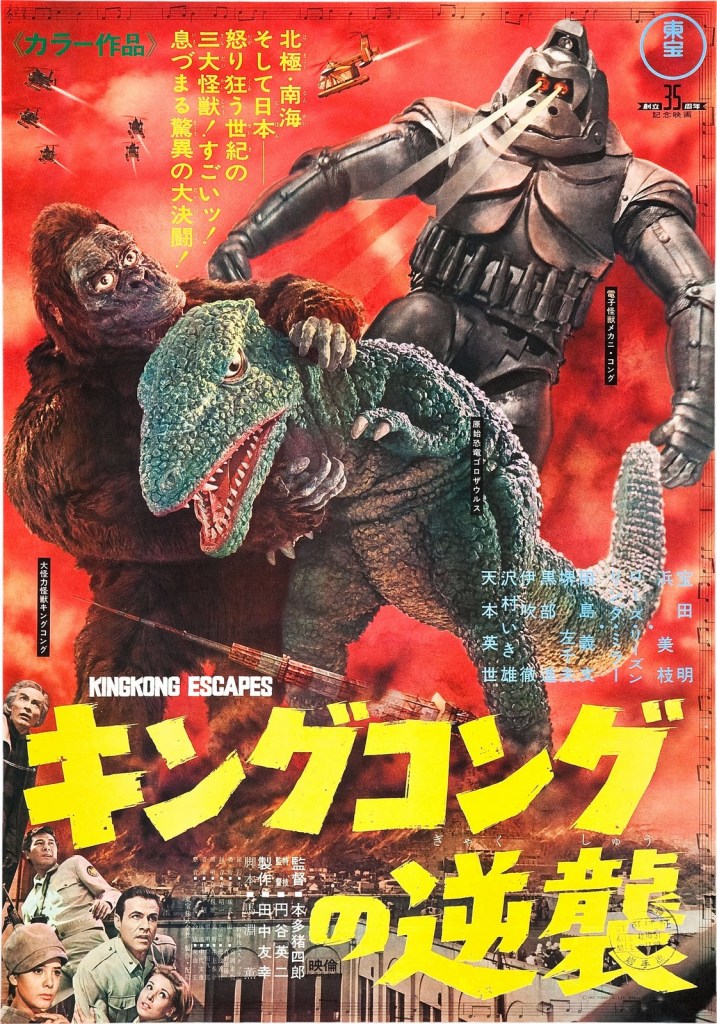
KING KONG ESCAPES (1967) ****
I must be a sucker for movies like King Kong Escapes, but I just can’t help myself when it features so many awesome characters, plot details, and scenes.
Of course, we have the title character who’s obviously back from King Kong vs. Godzilla, one of Japan’s biggest Solid Gold hits of the early ’60s.
King Kong Escapes, a Toho Studios and Rankin/Bass Productions co-production, topped King Kong vs. Godzilla for me and I’d like to share how it did just that.
Not only do we have the iconic man-in-a-suit Kong, rather than the Willis O’Brien stop motion Kong from the immortal King Kong, the one that started it all, but we have Mechani-Kong, a giant robot double of Kong that first appeared in the 1966 animated TV series The King Kong Show (hence the Rankin/Bass involvement) and returned for live-action duty in King Kong Escapes.
King Kong Escapes also gives us Gorosaurus and a giant sea serpent, and Kong battles them near their home Mondo Island. See, Kong’s become obviously smitten with the lovely nurse Susan Watson (Linda Miller) and he’ll take on any beast to protect her. She holds sway on the big lug, and that naturally puts her life in danger from the bad guys. Kong saves her several times over the course of a 100-minute spectacular. All in a day’s work.
I believe it’s the human villains who put King Kong Escapes over into greatness for me — the evil mad scientist Dr. Who (not that Doctor Who) and the shady representative of an unknown Asian nation, Madame Piranha. She’s also called Madame X, but I’m sticking with Madame Piranha because I like that name better and she’s played by the pretty Mie Hama. 1967 proved to be a vintage year for Hama, who turned 24 that year and played Kissy Suzuki in the fifth James Bond film, You Only Live Twice. I believe Madame Piranha wins over Kissy Suzuki and ditto for their respective films. Madame Piranha, in fact, belongs right up there with Pussy Galore and Princess Dragon Mom.
Anyway, back to Dr. Who, played by the veteran character actor Hideyo Amamoto (1926-2003). He’s a cross between, I don’t know, Dracula (it’s the cape) and a Bond megalomaniac. He’s one of those characters that we absolutely love to hate and we savor his inevitable demise late in the picture. He’s so vain, so darn smart, so reckless, so persistent, so evil. Dr. Who created Mechani-Kong and when it fails him about 30 minutes into King Kong Escapes, Dr. Who captures first Kong and then Susan Watson, Commander Carl Nelson (Rhodes Reason), and Lt. Commander Jiro Nomura (Akira Takarada), Watson’s human interest. Needless to say, Kong and Mechani-Kong and Watson and gang escape from Dr. Who and his henchmen, which leads us to a battle royale atop Tokyo Tower.
I admit upfront that King Kong Escapes is silly, preposterous, and outright bloody ridiculous, in everything from its plot to its English dubbing, but it came as such a rejuvenation to my spirit after I watched The Gorilla, The Screaming Skull, The Robot vs. The Aztec Mummy, and The Curse of the Aztec Mummy earlier that same day, four exploitation films that if added together still did not provide as much entertainment value as King Kong Escapes.
 Attack of the Killer Librarian