
When a Stranger Calls (1979)

WHEN A STRANGER CALLS (1979) **
The 1979 psychological horror film When a Stranger Calls has developed a certain reputation in horror movie circles.

Or we should say the first 20 or so minutes of the movie have become legendary.

When a Stranger Calls starts with the babysitter and the man upstairs urban legend, or a teenage girl babysitter keeps receiving phone calls from a stalking stranger who repeatedly asks her to check the children.

The film revisits the babysitter and the man upstairs seven years later for the final 20 or so minutes.

In between, we have many, many, many scenes that left me wondering how exactly I am supposed to be reacting to this bilge. What a waste!

I found When a Stranger Calls predominantly a dull experience, and it kept me thinking about superior and much superior films like Black Christmas, Halloween, and Dog Day Afternoon during even the film’s best moments.

First of all, Carol Kane plays the babysitter and seven years later the married young adult Jill Johnson. When a Stranger Calls tries to make her out to be high school in the first 20 minutes. Of course, that’s a fine showbiz tradition, like the thirtysomething Norma Shearer and fortysomething Leslie Howard playing tempestuous teenage lovers Romeo and Juliet in the 1936 MGM version, but it’s simply not convincing in the slightest bit and jars considerably.

I mean, for crying out loud, Kane received a nomination for Best Actress at the 1976 Academy Awards for her performance in Hester Street. We have the feeling that she shouldn’t be playing meek, timid, and cowering, even if she lost to Louise Fletcher for her performance as Nurse Ratched in One Flew Over the Cuckoo’s Nest.

Black Christmas did this phone caller and psycho killer number and big THE CALLS ARE COMING FROM INSIDE THE HOUSE reveal not only before but also better than When a Stranger Calls. Fred Walton (director and co-writer) and Steve Feke (co-writer) basically remade their 1977 short film The Sitter for the first 20 minutes of When a Stranger Calls, only with a much-larger budget and big-name cast members, and it’s possible they weren’t inspired by Black Christmas.

Seven years after murdering both children Jill was babysitting for Dr. and Mrs Mandrakis, Curt Duncan (Tony Beckley) escapes from the psychiatric facility and Dr. Mendrakis (Carmen Argenziano) hires former police officer and current private detective John Clifford (Charles Durning) to find Duncan. We first see Clifford in an early shock moment.

Are we supposed to feel sympathy for Duncan in the film’s long middle passages?

I only ask because I’m not buying it one bit, especially after Clifford goes into explicit detail about Duncan’s child killings, After the coroner’s investigation the bodies were taken to the mortuary where the undertaker took one look at them and said their bodies couldn’t be reconstructed for the burial without six days of steady work. Then he asked what had been the murder weapon, because looking at the mess in front of him he couldn’t imagine what had been used. The coroner told him there had been no murder weapon. The killer had used only his hands.

Before that monologue, we get to watch two awkward scenes between Duncan and the 54-year-old Colleen Dewhurst’s Tracy. Their first scene together culminates in one of their fellow bar patrons beating Duncan to a pulp. Tracy feels sympathy for Duncan after that.

Clifford’s dogged pursuit and obsession with Duncan calls to mind Dr. Loomis in Halloween and the opening 20 and closing 20 minutes place When a Stranger Calls near both Halloween and Black Christmas.

It’s the roughly 50-55 minutes in between that mostly lose and frustrate me. Imagine Halloween if it ditched Laurie Strode after 20 minutes in only to rejoin her later in the movie and instead, we spent 50 minutes following mostly babysitter killer Michael Myers in mostly awkward and (seemingly) pointless scenes.

That’s right, it would be painful to watch and that describes When a Stranger Calls, an otherwise well-made movie, for most of its duration.
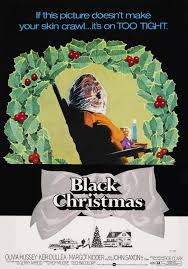
Black Christmas (1974)

BLACK CHRISTMAS

BLACK CHRISTMAS (1974) Three stars

Watching BLACK CHRISTMAS for the first time, one might be surprised just how many standards of the slasher film can be seen during this 1974 Canadian chestnut from director Bob Clark.

Let’s see, we have an opening shot later repeated by John Carpenter’s HALLOWEEN, a killer who racks up a rather impressive body count, POV shots from the killer’s perspective, obscene phone calls from the killer following every killing, plot twists (including the location of the caller), “The Final Girl,” and a shock ending, as well a holiday theme. BLACK CHRISTMAS basically synthesized elements that were already present during previous films like PSYCHO, PEEPING TOM, and Mario Bava movies BLOOD AND BLACK LACE and TWITCH OF THE DEATH NERVE into a single horror film narrative.

The plot also echoes “The Babysitter & The Man Upstairs” urban legend, so we already know the location of the caller. Still, the characters do not, so it’s a jolt hearing “The call is coming from inside the house.” Several movies, notably BLACK CHRISTMAS and WHEN A STRANGER CALLS, have relied on this angle for their chills and thrills.

A real-life case has been credited for inspiring the urban legend.

On Mar. 18, 1950, 13-year-old babysitter Janett Christman was raped and strangled to death in Columbia, Missouri, three days before her 14th birthday. Mr. and Mrs. Ed Romack found the body when they returned home, but, fortunately, their 3-year-old son Gregory was still alive, sleeping in his room. From the AP story, “Prosecuting Attorney Carl Sapp said blood was smeared through the house, indicating the girl put up a terrific struggle. … Footprints were found in a sleet-covered area near a broken window in the house. Police believe the intruder crawled through the window. The state highway patrol also is processing fingerprints found at the scene.”

More from the report, “An electric iron cord was twisted around the girl’s throat. Her scalp had been pierced several times by an instrument, apparently similar to a small lead pipe.”

Christman may have attempted to call the police around 11 p.m. the night of her death. Columbia policeman Roy McCowan took a call from a frightened girl who told him to “come quick.” “I urged her to calm down and just tell me where she was,” he said. “Then there was silence — not the sound of a receiver being hung up — just silence.” The Romacks’ phone was discovered “improperly placed on the instrument.”

Christman’s murder remains unsolved.

Just a few years earlier in Columbia, Stephens College student Marylou Jenkins, a white woman, was raped and murdered with an electric cord (reportedly from a lamp) twisted around her throat. An all-white jury convicted black man Floyd Cochran of the crime and he was executed Sept. 26, 1947 in the Missouri State Penitentiary Gas Chamber in Jefferson City. Cochran was originally arrested for murdering his wife with a shotgun and then he confessed to raping and murdering Jenkins.

For his last meal, Cochran ordered but did not partake in consuming a T-bone steak, french fries, scalloped corn, cream gravy, bread, butter, cake, and coffee. He died at the age of 36.

From 1938 through 1989, Missouri put to death 40 inmates in the gas chamber at Jefferson City, with John Brown the first on Mar. 3, 1938 and George “Tiny” Mercer the last on Jan. 6, 1989. Mercer was the first person from Missouri executed since 1965.

Just about seemingly every horror movie in existence shoots for a slambang ending, so we leave it discussing just what happened inside our heads or with all our friends and loved ones who have also seen this movie. BLACK CHRISTMAS gives us a rather unconventional ending, in that we are left unsure of the fate of protagonist Jess (Olivia Hussey) as she’s alone in the sorority house with the killer. Also, we never find out the real identity of the killer other than he’s named “Billy” and very rare indeed is the horror movie (especially a slasher) without a great big reveal in the grand finale. You just might have to be a fan or at least more forgiving of an ambiguous ending to appreciate BLACK CHRISTMAS. Either way, though, it will be discussed.

Like the later HALLOWEEN, BLACK CHRISTMAS thrives on atmosphere. That’s what they both do best and why fans appreciate them all these decades later.

Both films have rather distinguished casts for low-budget horror movies. Hussey came to fame during her teenage years for her performance as Juliet in Franco Zeffirelli’s 1968 ROMEO AND JULIET. Keir Dullea played astronaut Dave Bowman in both 2001: A SPACE ODYSSEY (1968) and later 2010 (1984); Dave uttered the famous words, “Open the pod bay doors please, HAL.” Margot Kidder (1948-2018) appeared previously in Brian De Palma’s 1973 shocker SISTERS and subsequently made her fame as Lois Lane in four Superman movies. Character actor John Saxon’s six-decade career includes ENTER THE DRAGON, TENEBRAE, A NIGHTMARE ON ELM STREET, and FROM DUSK TILL DAWN.

Director, screenwriter, and producer Clark (1939-2007) is best known for his two radically different nostalgia pieces, PORKY’S and A CHRISTMAS STORY. Yes, please wrap that magnificently designed brain around the fact that Clark directed both BLACK CHRISTMAS and A CHRISTMAS STORY. Louisiana born Clark found his greatest success up north in Canada. PORKY’S supporting actors Doug McGrath and Art Hindle both appear in BLACK CHRISTMAS.

Kidder almost steals the show in BLACK CHRISTMAS as the drunken, profane sorority girl Barb. She rips into her dialogue with extra relish. Hussey makes for a good entry point and rooting interest. Saxon knows how to maximize his screen time.

For horror movie fans who have not yet seen BLACK CHRISTMAS, I fully recommend amending it immediately.