
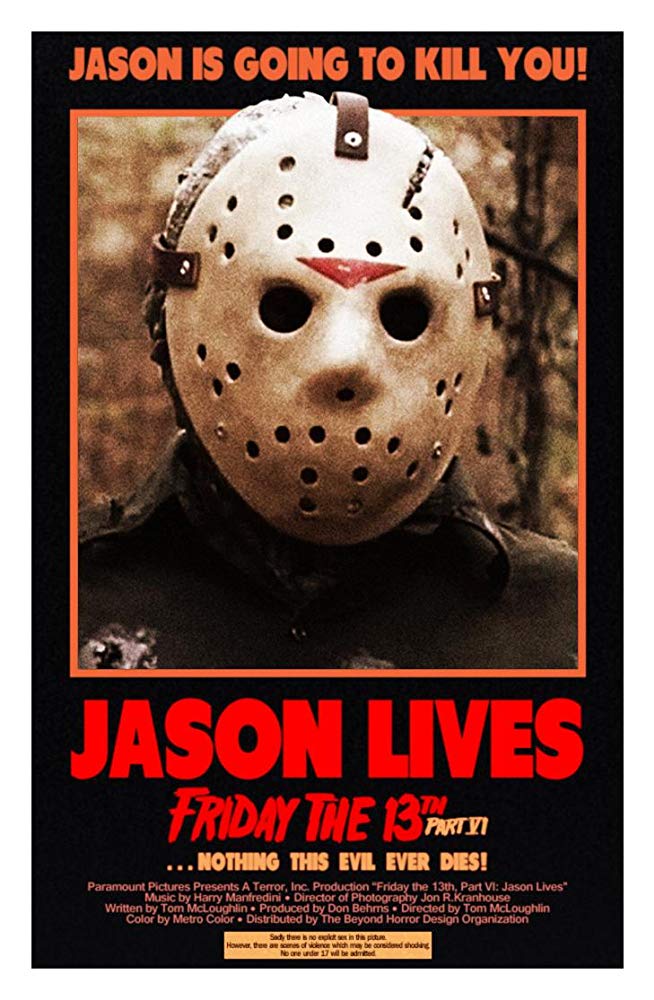
Friday the 13th Part VI: Jason Lives (1986)

JASON LIVES

FRIDAY THE 13TH PART VI: JASON LIVES (1986) Three stars

I find the FRIDAY THE 13TH movies that I like the most are the ones with the best sense of humor.

That’s why I’ll call PART VI: JASON LIVES the best film in the entire series, beating out PART III and THE FINAL CHAPTER. JASON LIVES includes several intentionally funny scenes and that helps its 86 minutes go down smoothly.

Director and writer Tom McLoughlin wanted to satirize a slasher movie all while making one, turn Jason into a supernatural zombie, and not simply churn out a carbon copy of the five previous movies in the series. There are moments intended to recall classic horror movies, like the beginning scene in the cemetery echoes the grave robbers at the beginning of FRANKENSTEIN MEETS THE WOLF MAN. Jason’s revival from the dead courtesy lightning also recalls Frankenstein’s Monster.

“I set up a lot of visual gags,” McLoughlin said in the book “A Strange Idea of Entertainment — Conversations with Tom McLoughlin.” “Like when my wife Nancy is killed by Jason. She tries to bribe him, offering him her wallet to keep him from killing her. She’s got money and a credit card in her wallet, and when Jason kills her in this giant mud puddle, the money sinks and the American Express card floats. I held on that shot for a few extra beats because I knew there would always be some joker in the theater that would yell, ‘Don’t leave home without it!’ And someone always did.”

McLoughlin’s background proved to have a strange influence on Jason Voorhees.

“I was recently interviewed about it, and someone said, ‘Your Jason seemed to be much more communicative,’” McLoughlin said. “I said, ‘That’s because I was dealing with a mime character.’ When he sees the motor home bouncing up and down because a couple are having sex in there, Jason just stands there and stares, with his head tilting back and forth — like a dog trying to figure out what’s going on. It got a big laugh. I wasn’t making fun of Jason … I just figured he would be processing what was going on in that motor home. Whenever I find a way to put my mime training to use in storytelling, I do it.”

Marcel Marceau influenced Jason Voorhees. Makes perfect sense to me.

McLoughlin sang in a rock band before he went to Paris to study mime under Marceau. Back in the States, several years later, McLoughlin had a part as the mutant bear monster in the 1979 horror film PROPHECY directed by John (MANCHURIAN CANDIDATE) Frankenheimer. All these experiences seemingly fed McLoughlin more insight into Jason than any other director.

Alice Cooper provided three songs for JASON LIVES:  “Teenage Frankenstein,” “Hard Rock Summer,” and “He’s Back (The Man Behind the Mask).” Unfortunately, they are not classic Alice Cooper songs, a la the four-album period from “I Love It to Death” through “Billion Dollar Babies” when the band cranked out some of the greatest hard rock ever made, but I still enjoy “He’s Back.” SCREAM later made great use of the Alice classic “School’s Out.”

Speaking of SCREAM, apparently screenwriter Kevin Williamson wanted McLoughlin to direct his hot commodity screenplay, before the project ended up with Wes Craven. Williamson told McLoughlin that JASON LIVES and its humor made a huge impact on Williamson during his youth, so much so that it served as one of the inspirational springboards for SCREAM.

There’s a James Bond gun barrel sequence parody, dialogue that breaks the proverbial fourth wall, a camper reading Jean-Paul Sartre’s existentialist play “No Exit,” a camper praying to God for the first (and only) time in the series, and even Jason surprised at his own astonishing strength. Also, for the first and only time in the series, young campers are in attendance at Camp Forest Green, er, Camp Crystal Lake.

“I’ve seen enough horror movies to know any weirdo wearing a mask is never friendly” and “Some folks sure got a strange idea of entertainment” are lines that display how JASON LIVES influenced SCREAM.

The young children, who Jason does not harm, have their moments, as well, especially when one boy asks his little friend, “So, what were you gonna be when you grew up?”

All these words so far and I have not even mentioned protagonist Tommy Jarvis, who figured in THE FINAL CHAPTER, A NEW BEGINNING, and JASON LIVES. He’s responsible for reviving Jason in the opening sequence and Tommy even makes sure to bring that infamous hockey mask with him. Originally, it had been planned for Tommy to become the antagonist, but it was the extremely negative reaction to A NEW BEGINNING and its non-Jason killer which truly brought Jason back from the dead. Tommy never panned out like he should have and part of the problem is that he’s played by three different actors, Corey Feldman (THE FINAL CHAPTER), John Shepherd (A NEW BEGINNING), and Thom Mathews (JASON LIVES).

Anyway, definitely by this point in the series, Jason became the focus of attention and the antihero extraordinaire of the late ‘80s. Dan Bradley played Jason in the paintball massacre sequence, but former soldier C.J. Graham handled the rest of the duties. He’s a lot more interesting than Tommy Jarvis. That’s why the series moved forward with Jason (Kane Hodder the man behind the mask for four more sequels) and without Tommy Jarvis.
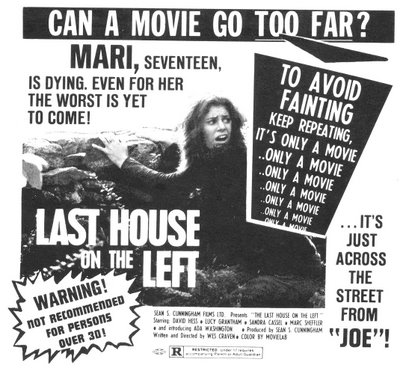
The Last House on the Left (1972)

LAST HOUSE ON THE LEFT

THE LAST HOUSE ON THE LEFT (1972) Three stars
Former academic Wes Craven (1939-2015), who also did some work on pornographic films under different aliases, made a big bang with his feature debut THE LAST HOUSE ON THE LEFT, one of the great shockers of the seventies.

It’s an exploitative American modern take on Ingmar Bergman’s THE VIRGIN SPRING (1960), a film itself based on a 13th Century Swedish folk ballad. THE VIRGIN SPRING won the Academy Award for Best Foreign Language Film at the 1961 Academy Awards.

The film’s classic tagline, “To avoid fainting, keep repeating: It’s only a movie, only a movie, only a movie. …” Viewers had a variety of extreme reactions, of course which only helped to hype the film en route to $3.1 million in returns on a $87,000 budget.

Theaters and drive-ins showed LAST HOUSE in many different prints, because individual machinists took it upon themselves to make their own cuts. Normally, the most shocking bits would end up missing. Good luck finding an uncut version of the film.

It received some of the nastiest reviews imaginable, which made seeing the film again seem like more of an event, a happening. Writing for the New York Times, Howard Thompson said, “When I walked out, after 50 minutes (with 35 to go), one girl had just been dismembered with a machete. They had started in on the other with a slow switch blade. The party who wrote this sickening tripe and also directed the inept actors is Wes Craven. It’s at the Penthouse Theater, for anyone interested in paying to see repulsive people and human agony.” Roger Ebert wrote just about the only positive review at the time of the film.

I first watched it about 10 years back and I thought it was a powerful work. I wrote a very positive review somewhere and I gave it three-and-a-half stars. I found it less powerful after subsequent viewings.

Craven and crew made some appalling choices that create a split personality movie.

Watching LAST HOUSE for the first time, you might notice the buffoonish antics of the Sheriff (Marshall Anker) and the Deputy (Martin Kove). Their comedic relief never works and in fact they play like failed slapstick comedy dropped in from another movie. I noticed this element upon first viewing and it was the reason I graded THE LAST HOUSE ON THE LEFT three-and-a-half rather than four stars.

PSYCHO. Herrmann. SUSPIRIA. Goblin. HALLOWEEN. Carpenter.

Well, you’ll never find THE LAST HOUSE ON THE LEFT soundtrack filed alongside those indelible horror movie scores and their composers. That’s why I started a new paragraph.

David Hess, who plays the main villain Krug, wrote and performed four songs for the movie: “The Road Leads to Nowhere” (the best song of the bunch), “Wait for the Rain,” “Sadie and Krug (Baddies’ Theme),” and “Now You’re All Alone.”

Upon more viewings, this music stuck out like a sore thumb, one that poked me right straight in the eye. I’m not sure why I overlooked the music the first time around.

Krug the character, played by Hess the actor, would have killed Hess the singer and songwriter, just slit his throat for singing one of those ridiculous songs. Believe it or not, Hess wrote “Speedy Gonzales,” which became a big hit for Pat Boone in the year 1962.

I still deduct one-half star from LAST HOUSE for the rumbling bumbling stumbling cops and a good quarter star for them Hess songs.

Hess (1936-2011) is so good as the bad guy in LAST HOUSE that we can understand precisely why he became typecast as villain. He played one of the henchmen in Craven’s SWAMP THING.

Sandra Peabody and Lucy Grantham play Mari and Phyllis, who are kidnapped, tortured, raped, and murdered by Krug and company. They have the most difficult roles.

Filming LAST HOUSE proved to be a horrifying ordeal for Peabody, especially since Hess believed in method acting and even threatened assaulting her for real during a rape scene. Peabody dropped out from acting in 1974, after being cast in movies like VOICES OF DESIRE and MASSAGE PARLOR MURDERS! She went into screenwriting, producing children-orientated entertainment, and being an acting coach.

Fred Lincoln (1936-2013) played Weasel, one of Krug’s nasty associates, and LAST HOUSE marked Lincoln’s only non-pornographic role. Lincoln directed more than 300 films; the Internet Movie Database lists 340 directorial credits for the New York native.

Jeramie Rain, who played the vicious Sadie, was married to Richard Dreyfuss from 1983 to 1995 and their union produced three children. She once hitched a ride with real-life serial killers Charles Manson and Tex Watson. That’s fitting because LAST HOUSE seems to have been heavily influenced by the Manson Family and their murders.

Richard Towers and Eleanor Shaw, under different names, play Mari’s parents Dr. John and Estelle Collingwood, highly respectable upper middle class folk. Krug and his gang disguise themselves as traveling salesmen and they call upon the Collingwoods. Both parties eventually discover the others’ identities: The Collingwoods find out their guests killed their daughter and Krug and company discover that Dr. John and Estelle are Mari’s parents.

Dr. John and Estelle devise some elaborate booby traps and Craven displays his fondness for booby traps for the first time. Booby traps also played a role in both THE HILLS HAVE EYES and A NIGHTMARE ON ELM STREET. I believe that Craven should have directed at least the first HOME ALONE, given his predilection for booby traps.

This juxtaposition of seeing a socially respectable upper middle class couple getting down-and-dirty to exact revenge has been one of the most fascinating elements at work in LAST HOUSE. You just might find yourself asking, “What would I do if I found myself in a similar situation?”

Though it’s not a classic on the same level as both NIGHT OF THE LIVING DEAD and THE TEXAS CHAINSAW MASSACRE, LAST HOUSE is essential viewing for horror fans.

Swamp Thing (1982)

SWAMP THING

SWAMP THING (1982) Three stars
This is the “green” movie I should have watched on St. Patrick’s Day.

Either that or perhaps any of the Incredible Hulk movies or the first SHREK.

Anything, just about anything, would have been preferred over LEPRECHAUN.

SWAMP THING rates as one of those indelible films that leave me with a goofy smile on my face and a warm glow in my heart, probably green colored in this particular case.

It’s been duly noted that filmmaker Wes Craven (1939-2015) earned an undergraduate degree in English and psychology from Wheaton College and a master’s in philosophy and writing from Johns Hopkins. He worked as English teacher before a four-decade film career predominantly associated with exploitation and horror.

Believe it or not, many of his films are informed by his educational, literary background.

Craven’s feature debut THE LAST HOUSE ON THE LEFT (1972) updated Ingmar Bergman’s THE VIRGIN SPRING (1960) for modern times in America; THE VIRGIN SPRING itself told a tale based on a 13th Century Swedish folk ballad incorporating rape, murder, and revenge.

Craven’s third film THE HILLS HAVE EYES (1977) took inspiration from 16th Century Scotland with Sawney Bean and His Cannibal Clan (45 members), responsible for the mass murder and cannibalization of over 1,000 people.

Even Craven’s arguably most famous film, A NIGHTMARE ON ELM STREET (1984), started after Craven read stories in the Los Angeles Times about how Southeast Asian refugees — who fled to the United States after the atrocities in Laos, Cambodia, and Vietnam — began experiencing terrifying nightmares and refused to sleep. Some of these men, ranging from age 19 to 57, even died in their sleep.

Based on a comic book, SWAMP THING, Craven’s fifth feature, was his first attempt to break away from the horror genre that would both be his blessing and his curse.

I suspect that one’s enjoyment of SWAMP THING depends on an individual’s level of sympathy for mad scientists, a megalomaniac and his nasty henchmen, a damsel-in-distress, secret formulas, mutations, comic book action, and Harry (FRIDAY THE 13TH) Manfredini’s relentless music that sounds echoes of his most famous work.

Busty actress Adrienne Barbeau proved to be at the peak of her film career at the time of SWAMP THING — it was the fifth picture in a six-picture run beginning with THE FOG (1980) and continuing with ESCAPE FROM NEW YORK, THE CANNONBALL RUN, THE THING (“Computer Voice”), and SWAMP THING before concluding later in 1982 with CREEPSHOW. She’s at her very best in SWAMP THING, and her very worst in CREEPSHOW.

Barbeau was married to filmmaker John Carpenter from 1979 to 1984, and half of those films listed in the above paragraph came from Carpenter in a flurry of films after HALLOWEEN.

Barbeau’s most famous talents are on display in the “international version” and the original DVD copies in America before viewers complained and had that “smut” recalled. Seriously, who would complain about Barbeau’s boobies, them magnificent mammaries? American DVD and Blu-ray issues since 2005 feature the American theatrical ‘PG’ version, and it would make America great again if we could have the “international version” of SWAMP THING.

Barbeau herself understands what makes SWAMP THING better than one more run-of-the-mill “creature feature.”

“When I read it, I fell in love with the screenplay,” Barbeau said of SWAMP THING. “It was whimsical, and charming, and lovely. I didn’t see it as a horror film. I guess I don’t see it as a horror film to this day, actually. It’s Beauty and the Beast — it’s more of a fantasy or a fairy tale, maybe, in my mind.”

I’ve long had admiration for Boris Karloff as Frankenstein’s Monster and Peter Weller as RoboCop. We can add stunt man and actor Dick Durock (1937-2009) as Swamp Thing to that list.

Like both Karloff and Weller, Durock creates great sympathy for Swamp Thing.

That human element — pieced together with Swamp Thing’s relationship with Alice Cable (Barbeau) — lifts SWAMP THING out of the swamp, if you will.

Just as when the Monster speaks in BRIDE OF FRANKENSTEIN, there’s poignancy when Swamp Thing says a line like “Much beauty in the swamp, if you only look.”

Swamp Thing and Cable have a better relationship than what the Monster and His Bride had in BRIDE OF FRANKENSTEIN. Cable gets far more screen time than the poor Bride, as well.

SWAMP THING has some of the same wit and same spirit as BRIDE OF FRANKENSTEIN.

I always say, “There’s much beauty in B-movies, if you only look.”