
Frankenstein Meets the Wolf Man (1943)

FRANKENSTEIN MEETS THE WOLF MAN (1943) ***1/2
Frankenstein Meets the Wolf Man starts with an absolute big bang and we have possibly the greatest five minutes in any classic Universal monster movie.

That includes such immortal movies as Frankenstein, The Bride of Frankenstein, Son of Frankenstein, Dracula, The Mummy, The Invisible Man, and The Creature from the Black Lagoon, all stone cold classics essential to every horror movie lover.

The opening gets everything absolutely right: two grave robbers, a cemetery in the middle of the night, Larry The Wolf Man Talbot’s crypt, a full moon, a whole bunch of wolfbane, the revived Wolf Man’s hand, and enough overall spooky atmosphere for approximately 50 scary movie scenes. Yeah, it’s such a phenomenal sequence that director Tom McLoughlin revived it for his opening in Jason Lives, the one film during that long-running series most influenced by classic monster movies.

The rest of Frankenstein Meets the Wolf Man does not quite measure up, especially once Frankenstein’s Monster enters the picture, but it’s still a great deal of fun.

Of course, it doesn’t hurt any that Lon Chaney Jr. (1906-73) returns as Larry Talbot, one of the greatest horror movie characters. Chaney Jr. played Talbot five times from 1941 through 1948 — the original Wolf Man, Frankenstein Meets the Wolf Man, House of Frankenstein, House of Dracula, and Abbott and Costello Meet Frankenstein.

Talbot’s a tortured soul — in fact, mondoshop.com hypes its Wolf Man poster, The most tortured soul in the Universal Monsters universe is unquestionably that suffering bastard Larry Talbot, a.k.a. The Wolf Man — and we feel great empathy for this character because he essentially doesn’t want any damn part of being the Wolf Man. Your own son Bela was a werewolf. He attacked me. He changed me into a werewolf. He’s the one that put this curse on me. You watched over him until he was permitted to die. Well, now I want to die to. Won’t you show me the way?

In that way, he’s different from Dracula, Frankenstein’s Monster, the Mummy, and the Invisible Man. Lon Chaney’s Phantom in the 1925 classic The Phantom of the Opera inspires similar feelings as Talbot and the Wolf Man. To his enduring credit, Boris Karloff (1887-1969) worked some pathos into Frankenstein’s Monster, especially in Frankenstein and The Bride of Frankenstein. Still, Talbot stands apart from most cinematic monsters and maybe it’s because he’s the most explicitly human.

Bela Lugosi (1882-1956) passed on Frankenstein’s Monster in Frankenstein, much to his eternal regret, and so he signed on for the Monster in Frankenstein Meets the Wolf Man after playing Ygor in Son of Frankenstein and The Ghost of Frankenstein. During the latter film, one might remember that Dr. Ludwig Frankenstein accidentally put Ygor’s brain into the Monster’s head — he speaks poetically at one point in the film, I am Ygor. In a series that paid minuscule attention to continuity from one film to the next, the Monster originally spoke and explained his plight in Frankenstein Meets the Wolf Man, but Universal studio heads apparently laughed their heads off at Lugosi’s dialogue and demanded it be excised from the final cut, rendering the monster absolutely ridiculous and his scenes basically a washout. I am not sure why Lugosi’s voice suddenly became laughable. Lugosi’s stunt double stands in for the 61-year-old man in many scenes. Ironically, though, whenever people imitate Frankenstein’s Monster, it’s the Lugosi version from Frankenstein Meets the Wolf Man. (Lugosi played Bela in The Wolf Man and Chaney Jr. was Frankenstein’s Monster in The Ghost of Frankenstein after Karloff bowed out.)

We’re not sure exactly why the Monster’s encased in ice or why there’s a production number that must have moseyed on over from MGM. The second half of Frankenstein Meets the Wolf Man often leaves us feeling awful perplexed.

Frankenstein Meets the Wolf Man finishes strong, thankfully, and we do see our titular monsters slug it out, though it presents an internal struggle because while we’d love more battle royale between the monsters we do love the 90 seconds they give us. This movie paved the highway for King Kong vs. Godzilla and Freddy vs. Jason.

In most every way possible, Frankenstein Meets the Wolf Man proves to be a red hot mess, but a lovable and thoroughly entertaining one nonetheless.
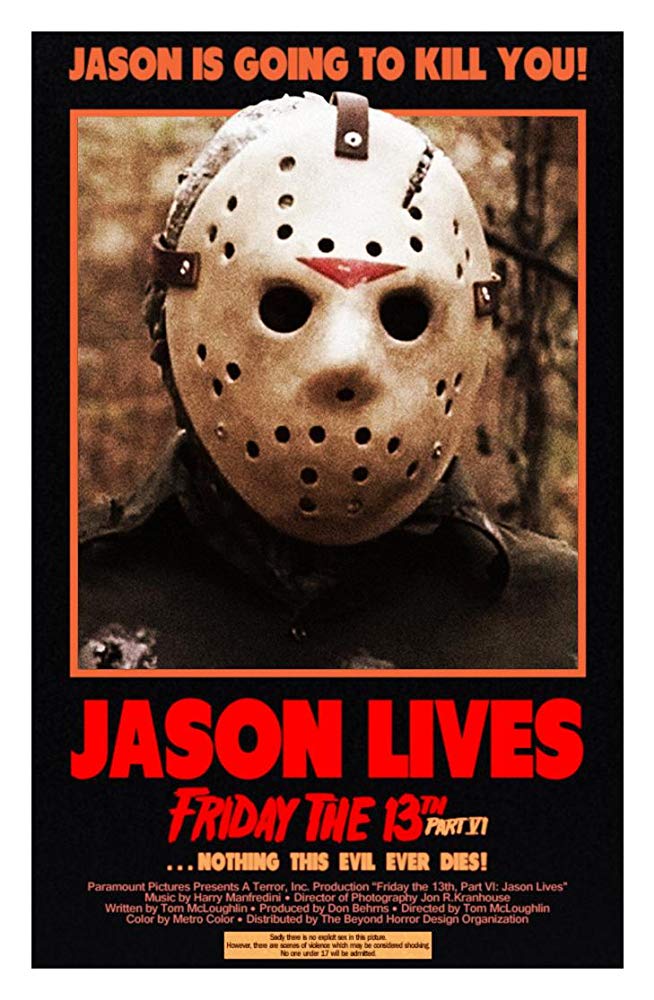
Friday the 13th Part VI: Jason Lives (1986)

JASON LIVES

FRIDAY THE 13TH PART VI: JASON LIVES (1986) Three stars

I find the FRIDAY THE 13TH movies that I like the most are the ones with the best sense of humor.

That’s why I’ll call PART VI: JASON LIVES the best film in the entire series, beating out PART III and THE FINAL CHAPTER. JASON LIVES includes several intentionally funny scenes and that helps its 86 minutes go down smoothly.

Director and writer Tom McLoughlin wanted to satirize a slasher movie all while making one, turn Jason into a supernatural zombie, and not simply churn out a carbon copy of the five previous movies in the series. There are moments intended to recall classic horror movies, like the beginning scene in the cemetery echoes the grave robbers at the beginning of FRANKENSTEIN MEETS THE WOLF MAN. Jason’s revival from the dead courtesy lightning also recalls Frankenstein’s Monster.

“I set up a lot of visual gags,” McLoughlin said in the book “A Strange Idea of Entertainment — Conversations with Tom McLoughlin.” “Like when my wife Nancy is killed by Jason. She tries to bribe him, offering him her wallet to keep him from killing her. She’s got money and a credit card in her wallet, and when Jason kills her in this giant mud puddle, the money sinks and the American Express card floats. I held on that shot for a few extra beats because I knew there would always be some joker in the theater that would yell, ‘Don’t leave home without it!’ And someone always did.”

McLoughlin’s background proved to have a strange influence on Jason Voorhees.

“I was recently interviewed about it, and someone said, ‘Your Jason seemed to be much more communicative,’” McLoughlin said. “I said, ‘That’s because I was dealing with a mime character.’ When he sees the motor home bouncing up and down because a couple are having sex in there, Jason just stands there and stares, with his head tilting back and forth — like a dog trying to figure out what’s going on. It got a big laugh. I wasn’t making fun of Jason … I just figured he would be processing what was going on in that motor home. Whenever I find a way to put my mime training to use in storytelling, I do it.”

Marcel Marceau influenced Jason Voorhees. Makes perfect sense to me.

McLoughlin sang in a rock band before he went to Paris to study mime under Marceau. Back in the States, several years later, McLoughlin had a part as the mutant bear monster in the 1979 horror film PROPHECY directed by John (MANCHURIAN CANDIDATE) Frankenheimer. All these experiences seemingly fed McLoughlin more insight into Jason than any other director.

Alice Cooper provided three songs for JASON LIVES:  “Teenage Frankenstein,” “Hard Rock Summer,” and “He’s Back (The Man Behind the Mask).” Unfortunately, they are not classic Alice Cooper songs, a la the four-album period from “I Love It to Death” through “Billion Dollar Babies” when the band cranked out some of the greatest hard rock ever made, but I still enjoy “He’s Back.” SCREAM later made great use of the Alice classic “School’s Out.”

Speaking of SCREAM, apparently screenwriter Kevin Williamson wanted McLoughlin to direct his hot commodity screenplay, before the project ended up with Wes Craven. Williamson told McLoughlin that JASON LIVES and its humor made a huge impact on Williamson during his youth, so much so that it served as one of the inspirational springboards for SCREAM.

There’s a James Bond gun barrel sequence parody, dialogue that breaks the proverbial fourth wall, a camper reading Jean-Paul Sartre’s existentialist play “No Exit,” a camper praying to God for the first (and only) time in the series, and even Jason surprised at his own astonishing strength. Also, for the first and only time in the series, young campers are in attendance at Camp Forest Green, er, Camp Crystal Lake.

“I’ve seen enough horror movies to know any weirdo wearing a mask is never friendly” and “Some folks sure got a strange idea of entertainment” are lines that display how JASON LIVES influenced SCREAM.

The young children, who Jason does not harm, have their moments, as well, especially when one boy asks his little friend, “So, what were you gonna be when you grew up?”

All these words so far and I have not even mentioned protagonist Tommy Jarvis, who figured in THE FINAL CHAPTER, A NEW BEGINNING, and JASON LIVES. He’s responsible for reviving Jason in the opening sequence and Tommy even makes sure to bring that infamous hockey mask with him. Originally, it had been planned for Tommy to become the antagonist, but it was the extremely negative reaction to A NEW BEGINNING and its non-Jason killer which truly brought Jason back from the dead. Tommy never panned out like he should have and part of the problem is that he’s played by three different actors, Corey Feldman (THE FINAL CHAPTER), John Shepherd (A NEW BEGINNING), and Thom Mathews (JASON LIVES).

Anyway, definitely by this point in the series, Jason became the focus of attention and the antihero extraordinaire of the late ‘80s. Dan Bradley played Jason in the paintball massacre sequence, but former soldier C.J. Graham handled the rest of the duties. He’s a lot more interesting than Tommy Jarvis. That’s why the series moved forward with Jason (Kane Hodder the man behind the mask for four more sequels) and without Tommy Jarvis.