
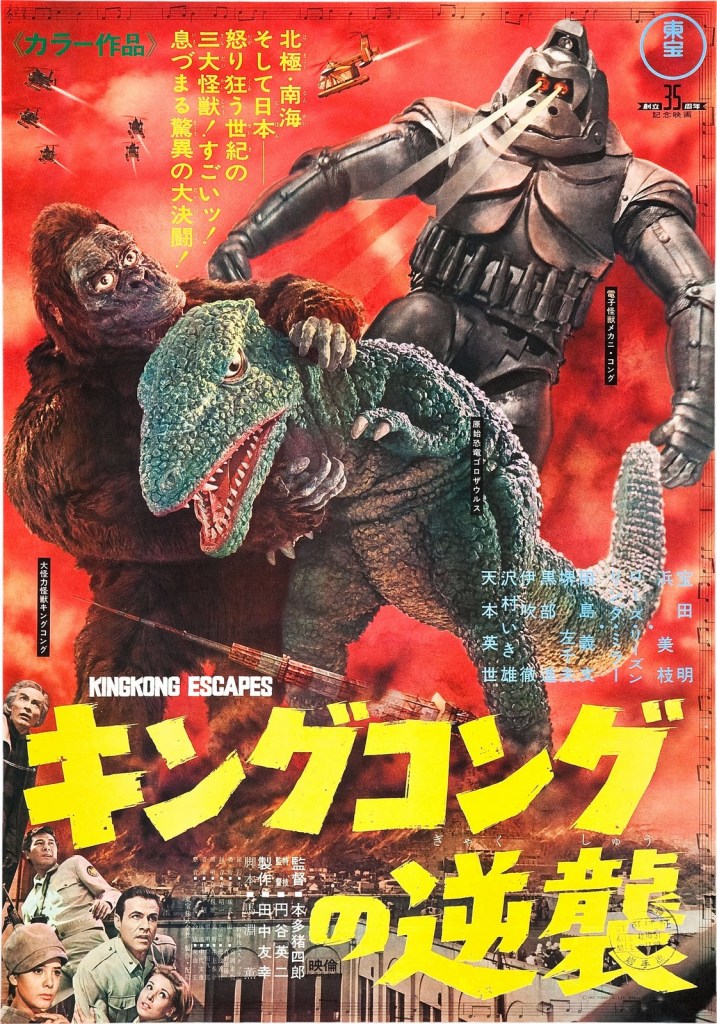
King Kong Escapes (1967)

KING KONG ESCAPES (1967) ****
I must be a sucker for movies like King Kong Escapes, but I just can’t help myself when it features so many awesome characters, plot details, and scenes.

Of course, we have the title character who’s obviously back from King Kong vs. Godzilla, one of Japan’s biggest Solid Gold hits of the early ’60s.

King Kong Escapes, a Toho Studios and Rankin/Bass Productions co-production, topped King Kong vs. Godzilla for me and I’d like to share how it did just that.

Not only do we have the iconic man-in-a-suit Kong, rather than the Willis O’Brien stop motion Kong from the immortal King Kong, the one that started it all, but we have Mechani-Kong, a giant robot double of Kong that first appeared in the 1966 animated TV series The King Kong Show (hence the Rankin/Bass involvement) and returned for live-action duty in King Kong Escapes.

King Kong Escapes also gives us Gorosaurus and a giant sea serpent, and Kong battles them near their home Mondo Island. See, Kong’s become obviously smitten with the lovely nurse Susan Watson (Linda Miller) and he’ll take on any beast to protect her. She holds sway on the big lug, and that naturally puts her life in danger from the bad guys. Kong saves her several times over the course of a 100-minute spectacular. All in a day’s work.

I believe it’s the human villains who put King Kong Escapes over into greatness for me — the evil mad scientist Dr. Who (not that Doctor Who) and the shady representative of an unknown Asian nation, Madame Piranha. She’s also called Madame X, but I’m sticking with Madame Piranha because I like that name better and she’s played by the pretty Mie Hama. 1967 proved to be a vintage year for Hama, who turned 24 that year and played Kissy Suzuki in the fifth James Bond film, You Only Live Twice. I believe Madame Piranha wins over Kissy Suzuki and ditto for their respective films. Madame Piranha, in fact, belongs right up there with Pussy Galore and Princess Dragon Mom.

Anyway, back to Dr. Who, played by the veteran character actor Hideyo Amamoto (1926-2003). He’s a cross between, I don’t know, Dracula (it’s the cape) and a Bond megalomaniac. He’s one of those characters that we absolutely love to hate and we savor his inevitable demise late in the picture. He’s so vain, so darn smart, so reckless, so persistent, so evil. Dr. Who created Mechani-Kong and when it fails him about 30 minutes into King Kong Escapes, Dr. Who captures first Kong and then Susan Watson, Commander Carl Nelson (Rhodes Reason), and Lt. Commander Jiro Nomura (Akira Takarada), Watson’s human interest. Needless to say, Kong and Mechani-Kong and Watson and gang escape from Dr. Who and his henchmen, which leads us to a battle royale atop Tokyo Tower.

I admit upfront that King Kong Escapes is silly, preposterous, and outright bloody ridiculous, in everything from its plot to its English dubbing, but it came as such a rejuvenation to my spirit after I watched The Gorilla, The Screaming Skull, The Robot vs. The Aztec Mummy, and The Curse of the Aztec Mummy earlier that same day, four exploitation films that if added together still did not provide as much entertainment value as King Kong Escapes.

Godzilla: King of the Monsters (2019)


GODZILLA: KING OF THE MONSTERS (2019) ***
The latest Godzilla: King of the Monsters inspires mixed feelings.

On the one hand, Warner Bros. pumped an estimated $170-200 million into King of the Monsters (likely more spent on this one Godzilla picture than all the Toho Studios productions combined) and cast a diverse, multinational group of actors and actresses, Kyle Chandler, Vera Farmiga, Millie Bobby Brown, Bradley Whitford, Sally Hawkins, Charles Dance, Thomas Middleditch, Aisha Hinds, O’Shea Jackson Jr., David Straithaim, Ken Watanabe, and Zhang Ziyi. Perhaps, most importantly for them, they are not dubbed, badly dubbed.

On the other, King of the Monsters spends way too much time in banter and disputes between scientists, military men, etc., and it’s still cliché dialogue no matter what if read by an Oscar winner or not. When the monsters Godzilla, King Ghidorah, Mothra, and Rodan do fight, it’s somehow not enough and I wanted King of the Monsters to give us a good old Royal Monster Mash Rumble right out in the middle of the streets in broad daylight, for crying out loud. Watching King of the Monsters for a second time, I felt tempted to begin chanting “No rain! No rain! No rain!” but I doubted there were any Woodstock or Live Rust fans aside from me in the house, so I restrained myself and thought better to save it for this review.

Honestly, I definitely miss all the bizarre little touches Toho sprinkled throughout their Godzilla films, especially the 1954-75 Showa Era. For example, it took a little time to wrap my warped little mind around seeing Mothra without her representatives from Infant Island, two tiny twin fairies who speak for and accompany Mothra and sing “Mothra’s Song,” “Mothra oh Mothra / If we were to call for help / Over time, over sea, like a wave / You’d come / Like a guardian angel / Mothra oh Mothra.” To be fair, King of the Monsters references the twins through twin scientist characters Ilene and Ling Chen (played by Ziyi) and we do get an instrumental version of “Mothra’s Song” late in the picture.

King of the Monsters could have used a lighter touch.

I liked the first Warner Bros. Godzilla more than King of the Monsters and I have no doubt Godzilla 2014 benefited more from the novelty of being a serious Godzilla film, which took so many of us by surprise because that’s not what we expected from an American Godzilla film after the disastrous 1998 production brought to us kind folks by TriStar Pictures and the creative partnership — writer and director Roland Emmerich and writer and producer Dean Devlin — who previously dumped Stargate and Independence Day on humanity.

Regardless, I am looking forward to Godzilla vs. Kong whenever that moment will come.

Son of Godzilla (1967)

SON OF GODZILLA (1967) **
I made a terrible mistake.

Not in watching Son of Godzilla, the eighth film in the Godzilla series, per se, but watching it through the most available version online.

Characters begin speaking in dubbed English, of course only the best for us American monster movie aficionados, for a few seconds before a foreign language (presumably Russian) overlays the English. We get two bad dub jobs for the price of one, sure yeah whatever never mind.

I was desperate, though, and needed to watch Son of Godzilla to complete the entire 15-film Godzilla series Japan’s hallowed Toho Studios produced from 1954 to 1975. I sucked it up, buttercup, who cares about the bloody dialogue in a Godzilla movie anyway for crying out loud, and mission accomplished. Yes, I always save the worst for last.

Son of Godzilla marks the beginning of a period of several pictures when Toho made Godzilla a kinder, gentler monster. Like Arnold Schwarzenegger, as Godzilla became a bigger star, a monster if you will, the big guy preferred not playing a villain and so Son of Godzilla and 1969’s All Monsters Attack (a.k.a. Godzilla’s Revenge) are the equivalent of later Schwarzenegger pictures like Kindergarten Cop and Jingle All the Way. Not sure that Schwarzenegger ever made his Godzilla vs. Hedorah (a.k.a. Godzilla vs. The Smog Monster) and that’s a bummer.

The suits at Toho have made Godzilla and the men inside the suit do some awkward bull over a nearly 70-year period, but seeing the big guy try and relate to his adopted son Minilla during Son of Godzilla and All Monsters Attack just might take the cake. Godzilla rescues Minilla from a trio of Kamacuras or a mutated mantis species found on Sollgel Island, and is it in poor taste to say that I wish Minilla had been eaten by the mantis. Minilla’s just so darn cute that it took a great deal of restraint to not puke all over my relatively new laptop.

W.C. Fields died eight years before Godzilla’s screen birth, but we can be sure the famously curmudgeonly performer would have found some choice words for Son of Godzilla and All Monsters Attack, easily the worst of the 15 Showa Era films.

I believe Fields said, “I like children, if they’re properly cooked.”

House (1977)

HOUSE

HOUSE (1977) Four stars

The year 1977 produced four of the definitive WTF movies in the history of cinema: ERASERHEAD, SUSPIRIA, EXORCIST II, and HOUSE, an item from the Japanese studio (Toho) responsible for Akira Kurosawa, Godzilla, Mothra, Rodan, and the H-Man.

Toho really outdid itself with HOUSE, which even surpasses GODZILLA VS. THE SMOG MONSTER in nonstop funky weirdness. Janus Films describes HOUSE as an episode of “Scooby Doo” directed by Dario Argento.

Bottom line: HOUSE just might be even weirder than ERASERHEAD, more colorful than SUSPIRIA, and more whacked out bat shit crazy than EXORCIST II. You have been warned.

First-time director Nobuhiko Obayashi pulls out all the stops in realizing a rather simple tale on the surface: teenage girl Gorgeous (Kimiko Ikegami) and her six friends Prof (Ai Matsubara), Melody (Eriko Tanaka), Mac (Mieko Sato), Kung Fu (Miki Jinbo), Sweet (Masayo Miyako), and Fantasy (Kumiko Oba) pay Gorgeous’ aunt (Yoko Minamida) in the country a visit. It just so happens that the aunt died in this house many years ago waiting on her fiancee to return from World War II and her spirit remains and feasts on unmarried girls. This is a haunted house movie where the house is hungry, very hungry indeed.

Obayashi’s at-the-time pre-teen daughter Chigumi Obayashi contributed ideas to her father. She came up with several childhood fears, her father relayed the fears to screenwriter Chiho Katsura, and they incorporated her ideas into the finished product. You’ll be able to recognize her contributions almost instantly and they contribute to the uniqueness.

Just as a fun exercise, I looked up the plot keywords for HOUSE on IMDb: “refrigerator,” “banana,” “watermelon,” “bloody spray,” “dismemberment,” “decapitation,” “full frontal nudity,” and “severed head” are some of the more interesting 75 keywords and they only scratch at the surface of the overall bizarre nature of the entire enterprise.

More than 30 years after its original release, HOUSE seemingly came from out of nowhere to develop a cult following in the United States, playing first as a midnight movie in Nashville and then at a film festival in Austin in 2009 before heading to DVD.

I first encountered HOUSE through its cover image for the Criterion Collection release on October 26, 2010. Maybe you remember seeing that artwork, as well. Nashville graphic designer and Ben Folds drummer Sam Smith came up with the distinctive image: “I used the first idea that came to me after watching a screener of the film — Blanche the cat’s psycho-screaming mug — and adapted it to stand alone as a symbol of the uncanny and over-the-top assault that our midnight-movie audience was in for,” Smith said. The poster first appeared for the film at the Belcourt Theatre in Smith’s hometown.

Then, I read the reviews for HOUSE and they’re nearly as over-the-top as the film itself.

Online reviewer Dennis Schwartz wrapped up his mixed review, “The director uses freeze-frames, jump-cuts, video effects to change dimensions, spiral effects, color tints, and assorted other techie tricks to play the scary pic card more for laughs than to be gruesome. It’s an experimental visual pic that becomes overwhelmed with low-brow slapstick comedy, a ridiculous killer house and garish visuals. But it’s a one-of-a-kind film that has its admirers, who just can’t resist such weird childish nonsense.”

Michael Atkinson opined in the Village Voice, “But though it plays like a retarded hybrid of ROCKY HORROR and WHISPERING CORRIDORS, it is, moment to moment, its own kind of movie hijinks. It even won a directorial-debut critics’ prize back in the day. Gigglers and cultists, pony up.”

I watched James Rolfe’s review for Monster Madness X from 2016. Rolfe started his review with a pause and a WOW! Of course, Rolfe picked HOUSE for one of the “WTF Wednesday” reviews.

I finally caught up with HOUSE in late summer 2019 and it lived up to expectations. It calls to mind a few pictures: EVIL DEAD II, THE SPIRIT OF THE BEEHIVE, THE 5,000 FINGERS OF DR. T, DAISIES, SUSPIRIA, and MY NEIGHBOR TOTORO. Like those films, though, HOUSE ultimately stands alone as an unique work because it creates its own world. I find that I respond more forcefully to fictional works that do that, rather than just rehash more of the same old already damaged goods. I want to be challenged, inspired, etc. I’ve never seen a haunted house movie quite like HOUSE.

HOUSE haunts one’s thoughts and gains in strength upon deeper reflection. At this moment of typing, I am thinking about Gorgeous’ aunt and how much time she spent waiting alone in that house for the love of her life to return from World War II. He never did, and they both died, she in that darn house and she’s cursed to haunt it for eternity because of her bitterness about the war. Then, I start thinking about the sheer enormity of the loss endured by the human race from Sept. 1, 1939 through Sept. 2, 1945: An estimated 70-85 million people died or three percent of the world’s population in 1940; 50-55 million civilians and 21-25 million soldiers no longer lived on this planet from a variety of causes, death on a mass scale that doubled World War I; the atomic bomb and the Holocaust two of humanity’s depressing advancements in death.

Obayashi was born in Hiroshima in 1938 and he lost all his childhood friends when the United States dropped an atomic bomb on Hiroshima on Aug. 6, 1945. Hiroshima and Nagasaki, as well as post-WWII nuclear testing, inform many Japanese films of the last almost 75 years.