
The Texas Chainsaw Massacre 2

THE TEXAS CHAINSAW MASSACRE 2 (1986) ***
I wanted to like The Texas Chainsaw Massacre 2 considerably more than I did, because of the way director Tobe Hooper (1943-2017) and screenwriter Kit Carson (1941-2014) mixed in satire and dark comedy with all the material that seems like a prerequisite for a sequel to only one of the most infamous movies ever made, 1974’s The Texas Chain Saw Massacre.

Unfortunately, though, leading lady Caroline Williams’ harried disc jockey Stretch — yes, even women from Texas have names that play right alongside Slim and Tex — spends a good 75 percent of her screen time screaming. Williams screams more than Fay Wray in The Most Dangerous Game and King Kong and Mystery of the Wax Museum combined, more than Jamie Lee Curtis in Halloween and The Fog and Prom Night and Terror Train and Halloween II combined, and more than all the heroines combined who have faced Jason and Freddy and Michael over the last couple decades. Williams probably wishes they paid her by the scream.

All that infernal screaming begins to bog Massacre 2 down in the middle stretches of a film that both starts and finishes rather strongly.

Massacre 2 also features a Dennis Hopper performance that rates a distant fourth behind River’s Edge, Blue Velvet, and Hoosiers in the unofficial Hopper-portrays-an-epic-burnout-not-totally-unlike-himself (though, to be fair to Hopper, his Blue Velvet character goes beyond, way beyond, the pale of the normal cinematic psychopath) in 1986 competition.

Since Hopper (1936-2010) portrays former Texas Ranger and Sally and Franklin Hardesty-Enright’s uncle Lt. Boude ‘Lefty’ Enright and Cannon Films released Massacre 2, wouldn’t it have been absolutely fantastic if Cannon action hero Chuck Norris played the ranger pursuing vigilante justice against the ripped, twisted, absolutely positively deranged (not to mention cannibalistic) Sawyer family.

Both Chainsaw movies start with narration and an opening crawl.

The original: The film which you are about to see is an account of the tragedy which befell a group of five youths, in particular Sally Hardesty and her invalid brother, Franklin. It is all the more tragic in that they were young. But, had they lived very, very long lives, they could not have expected nor would they have wished to see as much of the mad and macabre as they were to see that day. For them an idyllic summer afternoon drive became a nightmare. The events of that day were to lead to the discovery of one of the most bizarre crimes in the annals of American history, The Texas Chain Saw Massacre.

The sequel: On the afternoon of August 18, 1973, five young people in a Volkswagen van ran out of gas on a farm road in South Texas. Four of them were never seen again. The next morning the one survivor, Sally Hardesty-Enright, was picked up on a roadside, blood-caked and screaming murder. Sally said she had broken out of a window in Hell. The girl babbled a mad tale: a cannibal family in an isolated farmhouse … chainsawed fingers and bones … her brother, her friends hacked up for barbecue … chairs made of human skeletons … Then she sank into catatonia. Texas lawmen mounted a month-long manhunt, but could not locate the macabre farmhouse. They could find no killers and no victims. No facts; no crime. Officially, on the records, The Texas Chainsaw Massacre never happened. But during the last 13 years, over and over again reports of bizarre, grisly chainsaw mass-murders have persisted all across the state of Texas. The Texas Chainsaw Massacre has not stopped. It haunts Texas. It seems to have no end.

Made on an estimated $80-140,000 production budget, the original deserves such descriptive phrases as grainy and gritty. Gory, no. Disturbing, yes definitely, terrifying, for sure, with a more than macabre sense of humor, especially during the best dinner table scene this side of Tod Browning’s Freaks. I about lose it every time the family wants the 124-year-old Grandpa Sawyer to end Sally’s life with one crushing blow of a hammer and this cannibalistic codger just can’t find the strength to do it, ultimately giving Sally the opportunity for escape.

More than a decade later, Hooper wanted Massacre 2 to be a dark comedy, accentuating those elements from the original. Meanwhile, naturally, Cannon desired a finished product more along the lines of The Texas Chainsaw Massacre or at least its shocking reputation.

The finished product plays more like a compromise.

Both films are reflective of the times they were made. The original, released on the first day of October 1974, came out in the midst of Richard Nixon’s resignation speech, the Watergate scandal that brought Nixon down, the final year of the Vietnam War, the Oil Embargo 1973-74, and general discord in the land. The sequel, released on Aug. 22, 1986, gives us cannibals with ‘family values’ a few months before former Hollywood actor turned politician Ronald Reagan’s speech centered around the family unit and giddy excess in every single frame to produce a bigger but not better Texas Chainsaw Massacre.

The original has this insidious way of getting underneath our skin and dominating our thought patterns, and none of the slicker sequels, remakes or imitations even come remotely close to its power to provoke.

NOTE: The parody of The Breakfast Club earns the film’s poster four stars.
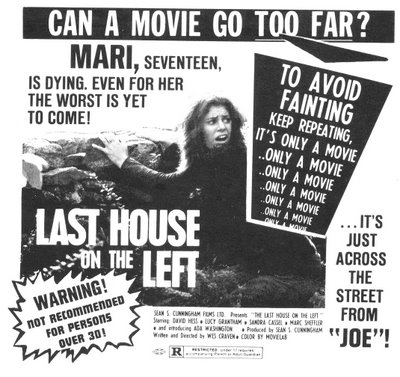
The Last House on the Left (1972)

LAST HOUSE ON THE LEFT

THE LAST HOUSE ON THE LEFT (1972) Three stars
Former academic Wes Craven (1939-2015), who also did some work on pornographic films under different aliases, made a big bang with his feature debut THE LAST HOUSE ON THE LEFT, one of the great shockers of the seventies.

It’s an exploitative American modern take on Ingmar Bergman’s THE VIRGIN SPRING (1960), a film itself based on a 13th Century Swedish folk ballad. THE VIRGIN SPRING won the Academy Award for Best Foreign Language Film at the 1961 Academy Awards.

The film’s classic tagline, “To avoid fainting, keep repeating: It’s only a movie, only a movie, only a movie. …” Viewers had a variety of extreme reactions, of course which only helped to hype the film en route to $3.1 million in returns on a $87,000 budget.

Theaters and drive-ins showed LAST HOUSE in many different prints, because individual machinists took it upon themselves to make their own cuts. Normally, the most shocking bits would end up missing. Good luck finding an uncut version of the film.

It received some of the nastiest reviews imaginable, which made seeing the film again seem like more of an event, a happening. Writing for the New York Times, Howard Thompson said, “When I walked out, after 50 minutes (with 35 to go), one girl had just been dismembered with a machete. They had started in on the other with a slow switch blade. The party who wrote this sickening tripe and also directed the inept actors is Wes Craven. It’s at the Penthouse Theater, for anyone interested in paying to see repulsive people and human agony.” Roger Ebert wrote just about the only positive review at the time of the film.

I first watched it about 10 years back and I thought it was a powerful work. I wrote a very positive review somewhere and I gave it three-and-a-half stars. I found it less powerful after subsequent viewings.

Craven and crew made some appalling choices that create a split personality movie.

Watching LAST HOUSE for the first time, you might notice the buffoonish antics of the Sheriff (Marshall Anker) and the Deputy (Martin Kove). Their comedic relief never works and in fact they play like failed slapstick comedy dropped in from another movie. I noticed this element upon first viewing and it was the reason I graded THE LAST HOUSE ON THE LEFT three-and-a-half rather than four stars.

PSYCHO. Herrmann. SUSPIRIA. Goblin. HALLOWEEN. Carpenter.

Well, you’ll never find THE LAST HOUSE ON THE LEFT soundtrack filed alongside those indelible horror movie scores and their composers. That’s why I started a new paragraph.

David Hess, who plays the main villain Krug, wrote and performed four songs for the movie: “The Road Leads to Nowhere” (the best song of the bunch), “Wait for the Rain,” “Sadie and Krug (Baddies’ Theme),” and “Now You’re All Alone.”

Upon more viewings, this music stuck out like a sore thumb, one that poked me right straight in the eye. I’m not sure why I overlooked the music the first time around.

Krug the character, played by Hess the actor, would have killed Hess the singer and songwriter, just slit his throat for singing one of those ridiculous songs. Believe it or not, Hess wrote “Speedy Gonzales,” which became a big hit for Pat Boone in the year 1962.

I still deduct one-half star from LAST HOUSE for the rumbling bumbling stumbling cops and a good quarter star for them Hess songs.

Hess (1936-2011) is so good as the bad guy in LAST HOUSE that we can understand precisely why he became typecast as villain. He played one of the henchmen in Craven’s SWAMP THING.

Sandra Peabody and Lucy Grantham play Mari and Phyllis, who are kidnapped, tortured, raped, and murdered by Krug and company. They have the most difficult roles.

Filming LAST HOUSE proved to be a horrifying ordeal for Peabody, especially since Hess believed in method acting and even threatened assaulting her for real during a rape scene. Peabody dropped out from acting in 1974, after being cast in movies like VOICES OF DESIRE and MASSAGE PARLOR MURDERS! She went into screenwriting, producing children-orientated entertainment, and being an acting coach.

Fred Lincoln (1936-2013) played Weasel, one of Krug’s nasty associates, and LAST HOUSE marked Lincoln’s only non-pornographic role. Lincoln directed more than 300 films; the Internet Movie Database lists 340 directorial credits for the New York native.

Jeramie Rain, who played the vicious Sadie, was married to Richard Dreyfuss from 1983 to 1995 and their union produced three children. She once hitched a ride with real-life serial killers Charles Manson and Tex Watson. That’s fitting because LAST HOUSE seems to have been heavily influenced by the Manson Family and their murders.

Richard Towers and Eleanor Shaw, under different names, play Mari’s parents Dr. John and Estelle Collingwood, highly respectable upper middle class folk. Krug and his gang disguise themselves as traveling salesmen and they call upon the Collingwoods. Both parties eventually discover the others’ identities: The Collingwoods find out their guests killed their daughter and Krug and company discover that Dr. John and Estelle are Mari’s parents.

Dr. John and Estelle devise some elaborate booby traps and Craven displays his fondness for booby traps for the first time. Booby traps also played a role in both THE HILLS HAVE EYES and A NIGHTMARE ON ELM STREET. I believe that Craven should have directed at least the first HOME ALONE, given his predilection for booby traps.

This juxtaposition of seeing a socially respectable upper middle class couple getting down-and-dirty to exact revenge has been one of the most fascinating elements at work in LAST HOUSE. You just might find yourself asking, “What would I do if I found myself in a similar situation?”

Though it’s not a classic on the same level as both NIGHT OF THE LIVING DEAD and THE TEXAS CHAINSAW MASSACRE, LAST HOUSE is essential viewing for horror fans.