
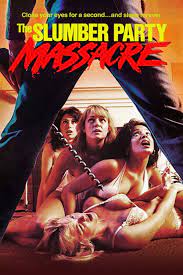
The Slumber Party Massacre (1982)

THE SLUMBER PARTY MASSACRE (1982) ***
Coming across the beloved cult film that was once not so beloved just might be the biggest hazard of movie spectatorship these days.

You better not ride on the general train of thought from the film’s original release or you just might get bludgeoned in the comments section by devotees of the cinematic item under discussion.

You have no taste! You’re an idiot! You just don’t get it! You’re too stupid to understand the undeniable genius! Blah blah blah!

I am thinking first and foremost about films like Halloween III, Howard the Duck, Sleepaway Camp, and Silent Night, Deadly Night.

Maybe you are reading my confession why I had not watched The Slumber Party Massacre until very recently.

I finally caught up with it on Halloween night 2022, I liked it well enough, and I can definitely understand why it’s held in such high esteem in some quarters though I certainly don’t like it as much as others so enthusiastically do.

The Slumber Party Massacre took a while to get started, packed with so many false alarms and jump scares that I began losing patience early on and it was not until the 45- or 50-minute mark that I became enveloped in suspense. The final 25-30 minutes are especially well-made and filled with plenty of impacting moments, so much so that I almost bumped The Slumber Party Massacre up to three-and-a-half stars even after the mixed reaction to the first two-thirds of the film.

All slasher films, whether it be the good, the bad or the ugly, have their gimmicks, be it their setting or their killer in everything from the favorite weapon of choice down to style.

The Slumber Party Massacre sold a good amount on the fact that it has a female director (Amy Holden Jones) and a feminist screenwriter (Rita Mae Brown), something not common for the horror genre overall and specifically the subgenre of the slasher.

Jones shows definite talent in her directorial debut, and it’s no surprise she later directed Love Letters, Maid to Order, and The Rich Man’s Wife and received screenwriting credits on Love Letters, Maid to Order, Mystic Pizza, Beethoven, Indecent Proposal, The Getaway (1994), and The Relic. She also married acclaimed cinematographer Michael Chapman (Taxi Driver, Raging Bull, The Fugitive) in 1980 and stayed his wife until his death in September 2020.

Brown intended The Slumber Party Massacre to be a satire of the slasher genre, but Jones filmed it as straight horror.

However, satirical traces remain throughout The Slumber Party Massacre.Virtually all the male characters are super horny creeps and more than one female character survives all the murder and mayhem, for example.

Never mind that escaped serial killer Russ Thorn (Michael Villella) walks around in plain sight without a mask from the first scene on. He’s also one of a select few slasher film killers with quotes on the Internet Movie Database. Eat your heart out, Jason and Michael!

Also, never mind Thorn’s weapon of choice that could possibly be some kind of metaphor. Yes, it’s a power drill and I’m not sure of the symbology there! I also don’t believe there’s any greater meaning in the ways he meets his inevitable demise at the end of the movie.

The local radio station announces Thorn’s escape more than once, yet nobody seems to notice let alone care until it’s (almost) too late. I seem to remember one of the characters shutting off her car radio in the middle of one of the announcements.

Nearly all the characters are too preoccupied with their pursuits of pleasure at this very moment in time, just like the characters in any Friday the 13th film, to be concerned about some homicidal maniac on a rampage.

These satirical traces make The Slumber Party Massacre a good deal more interesting than, let’s say, Madman and The Prowler.

It works as both a satire and a straight horror film nearly 15 years before Scream came out.

In fact, not that I want to shout about it or anything, The Slumber Party Massacre works better than Scream.
Happy Birthday to Me (1981)

HAPPY BIRTHDAY TO ME (1981) ***
Happy Birthday to Me stands out from the early ’80s slasher film craze pack because a) it has superior production values with a name director (J. Lee Thompson, who directed The Guns of Navarone and Cape Fear) and a good cast including an unhappy Glenn Ford, b) it has a longer running time than the average 85- and 90-minute slasher film, and c) it has one of the most bizarre twist endings this side of Sleepaway Camp.

Just like fellow 1981 Canadian slasher My Bloody Valentine, also produced by John Dunning and André Link with distinctive elements for a slasher, Happy Birthday to Me calls to mind a prestigious Academy Award for Best Picture winner, 1980’s Ordinary People. (My Bloody Valentine recalled The Deer Hunter from the coal mine setting and overall working-class milieu, the prodigious beer drinking, and the more adult-like plot and romantic triangle.)

Let’s see, Happy Birthday to Me and Ordinary People both have the same elite upper middle class suburban prep school environment, traumatic events in the past, troubled teenagers, and a therapist who works with our troubled teen protagonist.

Happy Birthday to Me plays more like a glossy, lurid soap opera at times punctuated with some creative, gruesome murder set pieces.

Melissa Sue Anderson makes her motion picture feature debut in Happy Birthday to Me as protagonist Virginia Wainwright. She had nearly a decade of experience on TV by that point, though, most notably as Mary Ingalls / Mary Ingalls Kendall on the hit show Little House on the Prairie. You can bet playing a blind Mary for a number of seasons prepared an 18-year-old Anderson for her flashbacks, brain operation, therapy sessions, memory loss, and traumatic blackouts throughout Happy Birthday to Me.

Slasher films often pursued at least one name actor for their cast: Betsy Palmer (Friday the 13th), Ben Johnson (Terror Train), Leslie Nielsen (Prom Night), Lauren Bacall, James Garner, and Maureen Stapleton (The Fan), and Farley Granger (The Prowler).

Glenn Ford accumulated 110 acting credits from 1937 through 1991, highlighted by Gilda, The Big Heat, Blackboard Jungle, 3:10 to Yuma, Midway, and Superman. Ford (1916-2006) wouldn’t have wanted to be remembered for Happy Birthday to Me and he was reportedly a very unhappy camper making the film, heavily drinking throughout and hitting the assistant director after he called for a lunch break during the middle of one of Ford’s scenes.

He’s not all that big a role in Happy Birthday to Me.

Ginny Wainwright attends the snobby Crawford Academy and she’s a member of the school’s Top 10 clique, only the best and brightest. They are systematically eliminated apparently by Ginny, and we find out that none of the Top Ten attended Ginny’s birthday party four years before the start of the movie. They attended instead another party for a Top 10 member and Ginny and her mother are then involved with an auto accident that kills Ginny’s mother and leaves the surviving Ginny needing her experimental brain tissue restoration.

Ginny was originally planned to be revealed as the killer possessed by the spirit of her dead mother, but the film instead chose a shocking twist ending that remains the main reason why fans of the film remember it so fondly 40 years later.

Thompson (1914-2002) reportedly got so much into the spirit of the enterprise that he was throwing around buckets of blood on set. The final 40 minutes pile up the corpses.

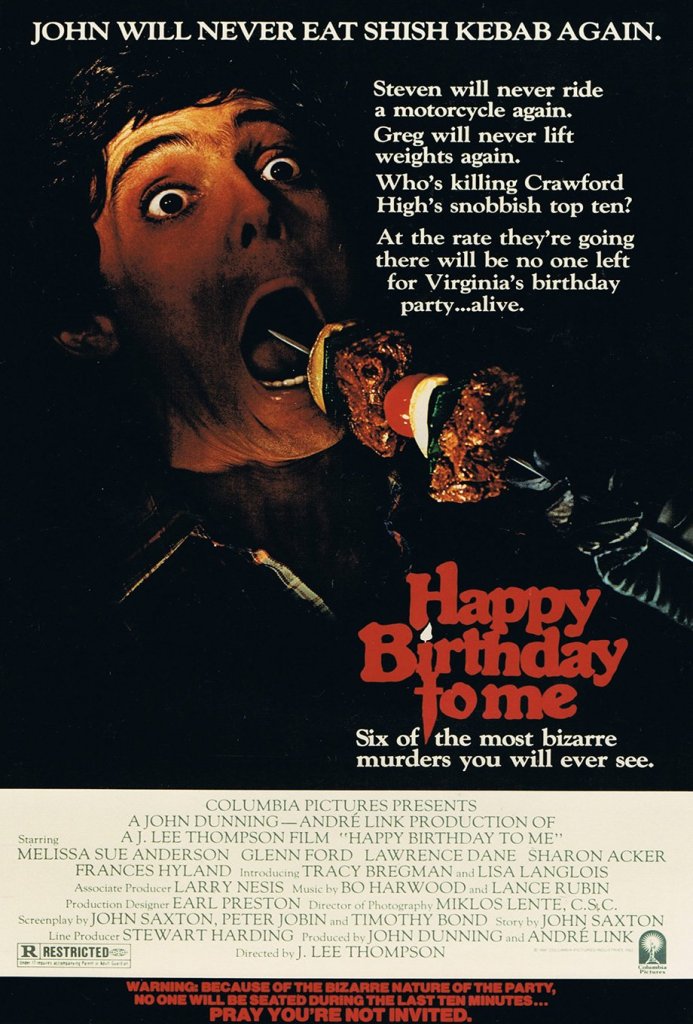
Columbia Pictures went for both the bloody and bizarre in promoting Happy Birthday to Me, a minor hit in the summer of 1981.

The poster has an image of the most famous murder set piece of the movie.

JOHN WILL NEVER EAT SHISH KEBAB AGAIN.

Steven will never ride a motorcycle again.

Greg will never lift weights again.

Who’s killing Crawford High’s snobbish top ten?

At the rate they’re going there will be no one left for Virginia’s birthday party … alive.

Happy Birthday to Me … Six of the most bizarre murders you will ever see.

WARNING: BECAUSE OF THE BIZARRE NATURE OF THE PARTY, NO ONE WILL BE SEATED DURING THE LAST TEN MINUTES … PRAY YOU’RE NOT INVITED.

Factual accuracy is not this poster’s strong suit, since there’s nine deaths in the movie, there’s no John character in the movie, Steven’s the one killed by kebab, and Etienne’s the one done in by a motorcycle.

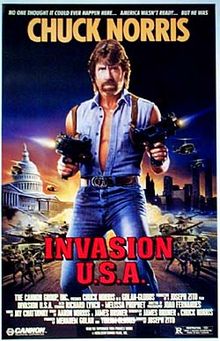
Invasion U.S.A. (1985)

INVASION U.S.A. (1985) *
Joseph Zito made a logical progression from directing mad slasher films The Prowler and The Final Chapter (Jason Voorhees’ third screen entry) to Chuck Norris action spectaculars Missing in Action and Invasion U.S.A for the Cannon Films Group, one of the ultimate purveyors of schlock all through the ’80s.

Their schlock includes Ninja III: The Domination and Breakin’ 2: Electric Boogaloo, both from 1984 and directed by Sam Firstenberg.

Anyway, I digress, which is something that I will invariably do whenever discussing Invasion U.S.A. Yes, I admit upfront this review will be filled with digressions.

The plot: Multinationals with guns (sometimes with subtitles, sometimes without) invade the United States, actually Florida but Invasion Florida doesn’t quite ring the same liberty bell, and one-man army Chuck Norris stops them with bloody ballyhoo. Named Matt Hunter in a fit of poetic fancy, perhaps by one of the writers of this garbage, Norris could have killed ’em all with denim.

Basically, Invasion U.S.A is Red Dawn dumbed down even more and it substitutes teeny bopper Commie scum killers Patrick Swayze, Charlie Sheen, C. Thomas Howell, Jennifer Grey, and Lea Thompson for Norris, who laughably tells us that he works alone. No joke, we know this after ’bout 50 Norris films where his character informs us that he kills scumbags all on his lonesome. I mean, wasn’t one of Norris’ better movies even called Lone Wolf McQuade for crying out loud?

The best Norris pictures have strong supporting characters and casts, who make up for the sometimes personality deficient Norris. Alas, Invasion U.S.A gives us one of the worst characters in not only a Norris movie but all movies in general — an apparent photojournalist named McGuire (Melissa Prophet) who probably should have been named Molly Magsnarl instead. She’s not the least bit grateful for Hunter saving her, and I would have let her meet her ultimate demise after the first time she snarls at me Cowboy. She blows out the tires on Invasion U.S.A every time she’s on screen.

Seeing her camera made me laugh, though, because I thought about how it was John Rambo’s assignment to only take photos of the POWs — not to rescue them — in Rambo: First Blood Part 2.

Speaking of First Blood Part 2, released a few months before Invasion U.S.A, it and Arnold Schwarzenegger’s Commando (released just after Invasion U.S.A) both blow away Invasion U.S.A in the great 1985 One-Man Army Movie Sweepstakes.

I also found a worse movie than Star Trek V: The Final Frontier that includes characters singing Row, Row, Row Your Boat.

The Prowler (1981)

THE PROWLER (1981) *
Describe The Prowler in one word.

Excess.

Yes, indeed, director Joseph Zito goes for an excess of false alarms and jump scares. It seems like there’s a scene like that every couple minutes. I mean, for crying out loud, somebody (usually her policeman significant other) sneaks up on our main female protagonist alone at least five times. Keep in mind The Prowler (hopefully not confused with the 1951 Joseph Losey thriller) earned Zito the opportunity to direct Friday the 13th: The Final Chapter.

Tom Savini’s gore effects ran into considerably less interference than earlier 1981 slasher films My Bloody Valentine and Friday the 13th Part 2, both released in the immediate aftermath of John Lennon’s murder and the subsequent MPAA tougher stance against graphic violence. Savini’s effects are quite frankly almost too good for their own good, as the blood gushes like a geyser at regular intervals. I found them a little much, just as I did in Maniac, and I usually love Savini’s work, especially Dawn of the Dead and Day of the Dead.

In addition to all the false alarms and jump scares, The Prowler relies too much on cat-and-mouse or a ‘contrived action involving constant pursuit, near captures, and repeated escapes.’ The main female protagonist and her dashing cop significant other recall Nancy Drew and one of the Hardy Boys. At one point late in the picture, she even attempts the old hiding underneath the bed with a deranged, psychopathic killer nearby trick.

The Prowler begins with a 1945 newsreel and a ‘Dear John’ letter, before getting down to brass tacks with a double homicide in the distant past that will trigger a present-day murder spree. After the success of Halloween, this flashback style of storytelling to start the whole shebang in style became the vogue for slasher films. Let’s see, Friday the 13th, Prom Night, Terror Train, and The Burning all started up this way and Happy Birthday to Me and My Bloody Valentine were both not too far behind with tours of the past. The plots of The Prowler and My Bloody Valentine have striking parallels, especially the overall look of the killer.

The Prowler conceals the identity of the killer until nearly the end of the movie and that’s probably best … but, who are we kidding, since I found some or even most of the Prowler’s behavior laughable even before the unveiling that calls into question every murder in the past hour. Fortunately, though, we have only a brief unmasking and then our heroine unceremoniously shotgun blasts the Prowler’s head to smithereens. We are spared any big speech or further character motivation and the frenzied scenery chewing of, let’s say, Betsy Palmer late in Friday the 13th. Unfortunately, we are not spared yet another jump scare in the film’s last scene, as if Zito received a bonus for overloading the picture with jump scares. Jump scares are cheap, though, and eventually some audience members turn against any picture that abuses jump scares, false alarms, cat-and-mouse, flashbacks, and dream sequences or whatever combination of them.

Casting Farley Granger as Sheriff George Fraser proved to be a strike against The Prowler, because I flashed back on two of the greatest thrillers ever made, Rope and Strangers on a Train, directed by none other than the Master of Suspense, Alfred Hitchcock. All the marvels of modern cinematic technology like nudity, gore, and profanity galore cannot make up for the difference between Zito and Hitchcock or the difference between a hack and a master.