
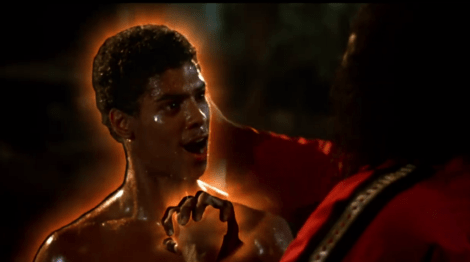
The Last Dragon (1985)

THE LAST DRAGON

THE LAST DRAGON (1985) Three stars

Gene Siskel included THE LAST DRAGON among his “Guilty Pleasures” in a 1987 “Siskel & Ebert” show and he gave it one of his funniest reviews, highlighted by “I’m a sucker for glowing fingers. Roger, I see glowing fingers in a movie, I tend to like the movie. … Just one finger (in E.T.), that’s how much I like it. In this one, you get 20. Two men, Roger, 20. Can you imagine the ads? ‘20 times the entertainment value of E.T.’” Siskel gave it three-and-a-half stars in his 1985 print review.

Roger Ebert gave it a mixed negative review and two-and-a-half stars, “THE LAST DRAGON turns into a funny, high-energy combination of karate, romance, rock music and sensational special effects. It’s so entertaining that I could almost recommend it … if it weren’t for an idiotic subplot about a gangster and his girlfriend, a diversion that brings the movie to a dead halt every eight or nine minutes. … They’ve been borrowed from a hundred other movies, they say things that have been said a hundred other times, and they walk around draining the movie of its vitality. They’re tired old cliches getting in the way of the natural energy of Taimak, Vanity and the Shogun character.”

I find myself occupying the middle ground between Siskel and Ebert. They both agreed on the strengths and the weaknesses of THE LAST DRAGON, but Siskel found the strengths to be stronger and Ebert the weaknesses to be weaker. LAST DRAGON co-stars Taimak, Vanity, and Julius J. Carry III are the strengths and Chris Murney as comic gangster Eddie Arkadian and Faith Prince as his aspiring singer girlfriend Angela Viracco are the weaknesses.

Taimak (full name Taimak Guarriello) stars as Leroy Green, who’s inspired by the works of Bruce Lee to such a degree that he’s called “Bruce Leroy.” He’s in pursuit of “The Glow,” referenced memorably by Siskel — see, only a true martial arts master can exhibit “The Glow” over his entire body and that’s Leroy’s No. 1 goal. Scenes like “Don’t think, feel! It’s like a finger pointing away to the moon. Do not concentrate on the finger or you will miss all of the heavenly glory” from ENTER THE DRAGON undoubtedly warmed the heart of Mr. Leroy … and possibly Motown mogul Berry Gordy, whose Motown Productions sponsored THE LAST DRAGON.

He’s opposed by Sho’nuff (Carry III), a.k.a. “The Shogun of Harlem,” who sees Leroy in his way for ultimate martial arts mastery. Sho’nuff interrupts a showing of the sacred text ENTER THE DRAGON in an urban theater and he throws down the gauntlet, “Well well, well. If it ain’t the serious, elusive Leroy Green. I’ve been waiting a long time for this, Leroy. I am sick of hearing these bullshit Superman stories about the — Wassah! — legendary Bruce Leroy catching bullets with his teeth. Catches bullets with his teeth? Nigga please.” Leroy counters with two platitudes that he might have gleaned from the “Kung Fu” TV show, then Sho’nuff throws it down again, “See, now it is mumbo jumbo like that, and skinny little lizards like you thinkin’ they the last dragon that gives kung fu a bad name. Get up, Leroy, I got somethin’ real fo’ yo’ ass in these hands.” Carry III (1952-2008) undoubtedly prepared for his role as Sho’nuff by playing in both DISCO GODFATHER, his debut feature, and THE FISH THAT SAVED PITTSBURGH.

All roads lead to a final showdown between Leroy and Sho’nuff when, sure enough, they both have “The Glow.” Leroy, though, finally exhibits true martial arts mastery.

Bruce Leroy also becomes the protector of television personality Laura Charles (Vanity) against them comic gangsters. She tells Leroy, “I thought that maybe it would be a great idea if I got myself a bodyguard. You know, like someone to guard my body? What girl could do worse than to have her own real life kung fu master?”

THE LAST DRAGON is a lot of fun, especially for viewers who are fans of martial arts spectaculars, particularly Bruce Lee. During the 1985 episode they reviewed THE LAST DRAGON, Siskel and Ebert lamented the lack of quality martial arts entertainment in a special “X-ray segment.” They singled out three “better” martial arts films that predated THE LAST DRAGON: ENTER THE DRAGON, THE OCTAGON starring Chuck Norris, and THE KARATE KID, the surprise blockbuster from 1984. I felt bad for Siskel and Ebert, because it seemed like they missed a great many great martial arts films like DRUNKEN MASTER and THE 36TH CHAMBER OF SHAOLIN, for example, and instead they made several “Dogs of the Week” (their picks for worst movie each episode until September ‘82) from seeing obviously inferior martial arts imports with lousy prints and horrific dubbing. It would be difficult for anybody not to form a negative opinion about martial arts films from seeing only the mass-produced bargain-basement rip-offs that almost immediately came in the wake of Bruce Lee’s death in 1973.

Thankfully, through ventures like the Dragon Dynasty, we can see classics like THE 36TH CHAMBER, KING BOXER (a.k.a. FIVE FINGERS OF DEATH), THE ONE-ARMED SWORDSMAN, FIST OF LEGEND, MAD MONKEY KUNG FU, FIVE DEADLY VENOMS, and EIGHT DIAGRAM POLE FIGHTER in quality prints and not dubbed in dodgy English. Films like these have provided me a ridiculous amount of enjoyment over the years.
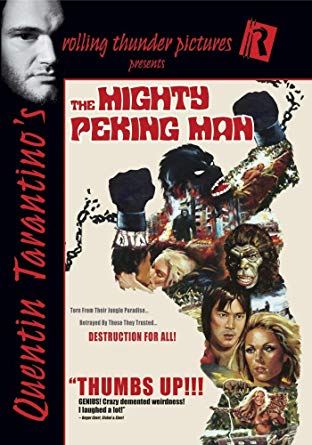
The Mighty Peking Man (1977)

THE MIGHTY PEKING MAN

THE MIGHTY PEKING MAN (1977) ***

The Shaw Brothers (Runme 1901-85 and Run Run 1907-2014) have rarely ever let me down and they provided some of the greatest entertainments of all-time, like THE ONE-ARMED SWORDSMAN, FIVE FINGERS OF DEATH, INFRA-MAN, THE 36TH CHAMBER OF SHAOLIN, and CLAN OF THE WHITE LOTUS.

The Shaw Brothers did not (and still do not, in death) cheat us.

For example, in THE MIGHTY PEKING MAN, their 1977 spin on King Kong, Mighty Joe Young, and Tarzan (not to mention Godzilla) that’s not quite peak but still good Shaw Brothers, we don’t have to wait very long whatsoever to see the title character. No, life is short, time is precious, so director Ho Meng-hua gives us our first monster encounter in the first minute of screen time. Okay, to be exact, it’s 1:45 into the movie, but that still beats most every other entry in this distinguished genre.

That establishes a tone for a very generous entertainment package. Find a copy and buy it for somebody, and it’s the gift that keeps on giving.

THE MIGHTY PEKING MAN not only provides a sympathetic monster in the grand tradition, but also (in no particular order) a plucky explorer hero (Danny Lee) who’s been betrayed by his lover with his playboy brother so he’s drowning his sorrows in booze when he’s recruited for a jungle mission, a scantily-clad leading lady (Evelyne Kraft, a regular Swedish Fay Wray) who’s grown up with the animals in the jungle after her parents died in a plane crash (she’s been raised by the Mighty Peking Man, in fact), an earthquake, elephants, tigers and leopards (oh my!), a fight between a leopard and a snake, quicksand, vine swinging, flashbacks to key moments in both the hero’s and the leading lady’s life, callous and shady businessmen, heartless authority figures, mucho destruction of miniatures galore, and a grand finale that boggles the mind even after everything that came before.

My favorite scene, however, begins around the 33-minute mark.

It involves the Semi-Obligatory Lyrical Interlude, a term made famous by the late Roger Ebert. Here’s the definition from Ebert: “Scene in which soft focus and slow motion are used while a would-be hit song is performed on the sound track and the lovers run through a pastoral setting. Common from the mid-1960s to the mid-1970s; replaced in 1980s with the Semi-Obligatory Music Video.”

The Simon and Garfunkel songs in THE GRADUATE epitomize the Semi-OLI.

The one in THE MIGHTY PEKING MAN rates below Louis Armstrong singing “We Have All the Time in the World” over George Lazenby and Diane Rigg in ON HER MAJESTY’S SECRET SERVICE and the foreboding use of Roberta Flack’s “The First Time Ever I Saw Your Face” in Clint Eastwood’s PLAY MISTY FOR ME. Ebert himself said Eastwood filmed the first Semi-OLI that works.

In THE MIGHTY PEKING MAN, our hero and leading lady embrace and lock lips for the first time (watch her eyes after this first kiss) and they unleash the awesomely banal love song “Could It Be I’m in Love, Maybe.”

This is one helluva old-fashioned love song and one helluva Semi-OLI.

I mean, I believe it’s the only Semi-OLI in the history of motion pictures to incorporate a leopard.

Not only that, but the leading lady seems more interested in the leopard than our poor, poor hero. You really sympathize for this guy even more after this scene.

Let’s get back to those lyrics for a second here.

“The love you gave me then showed me a thing or two / I guess I saw it in your eyes / And the look of love upon your face is too hard to disguise / Maybe just a smile will say [cannot make out, even after watching this scene 500 times] / Could it be I’m in love (Maybe? Baby?)” (To hell with it, I already chose “Maybe.” Why does life have to be so difficult?)

“I can’t begin to say what makes me feel like this / I never knew what love could do / But if this is love, it’s here to stay / [Don’t want to make this part out] / So all I have to hear is I’ll give it all to you.”

There’s more lyrics, but we all catch the drift and there’s not any need to drown in banality.

It all totals about 3:30 of pure junk food cinema bliss.

I definitely love it because it’s so utterly ridiculous.

Then again, utterly ridiculous describes THE MIGHTY PEKING MAN.

I should end this review with a consideration of the ending of THE MIGHTY PEKING MAN. Just imagine the ending of KING KONG times 10 times 10.

The One-Armed Swordsman (1967)

day 37, the one-armed swordsman

THE ONE-ARMED SWORDSMAN (1967) Three-and-a-half stars
Last month, our glossary of cinematic terms included “giallo,” the Italian thriller genre that definitely had an impact on the American slasher film.

Just a few days into November, now we have “wuxia,” a genre of Chinese fiction incorporating martial arts, sorcery, and chivalry.

The genre enjoyed its 15 minutes of fame in America during the successful run of CROUCHING TIGER, HIDDEN DRAGON (2000). (I’ll never forget the tittering of some in the audience throughout its two hours at the Pittsburg 8 Cinema. I loved the movie.)

There’s just something about handicapped swordsman movies from the 1960s, but, then again, maybe only I have this problem.

Back in the days of a free Hulu account, I enjoyed the heck out of the Japanese ZATOICHI THE FUGITIVE, ZATOICHI ON THE ROAD, and ZATOICHI AND THE CHEST OF GOLD, starring Shintaro Katsu as the blind swordsman Zatoichi.

Just a couple years ago, I caught up with THE ONE-ARMED SWORDSMAN and its sequel released two years later, RETURN OF THE ONE-ARMED SWORDSMAN, both part of the Dragon Dynasty DVD series of releases that will give viewers a greater sense of where Quentin Tarantino found his inspiration. (One should also seek out 1976’s THE ONE-ARMED BOXER VS. THE FLYING GUILLOTINE, another highly entertaining concoction in the same league with INFRA-MAN and DRUNKEN MASTER.)

Jimmy Wang Yu stars as the titular protagonist, Fang Kang, whose servant father sacrifices his life to save his teacher and the Chi school of Golden Sword Kung Fu in the opening scene. The servant father’s dying wish is to have his son be taught at his master’s school. Fang Kang’s fellow students, especially the teacher’s daughter, grow to resent him and they do their best to make him leave. On a snowy night, Pei-er, the teacher’s daughter, challenges Fang Kang to a fight and in anger over his refusal to fight her, she chops off his arm. Dang, girl! Fang Kang flees through the woods.

A young woman named Xiao Man inadvertently finds Fang Kang (he falls into her boat) and nurses him back to good health. He decides that he will give up swordsmanship (we know how that’ll work, especially with the movie’s title) and become a farmer with Xiao Man.

Meanwhile, the bad, bad men led by The Long-Armed Devil and The Smiling Tiger have it out for Fang Kang’s teacher, Qi Ru Feng, and have developed a “sword-lock” device that will be the demise of Qi Ru Feng and all his disciples.

(Wouldn’t you love to be called “The Long-Armed Devil”? Well, that’s not a question for “the short-armed.”)

Fang Kang becomes depressed over not being able to practice his martial arts and the ever-reluctant Xiao Man gives him a half-burned out kung fu manual that she inherited from her dead parents. Fang Kang, of course, becomes a new master, yeah, you guessed it, “The One-Armed Swordsman.”

The One-Armed Swordsman learns of the plot to kill Qi Ru and saves the day.

We could have written this script with one arm tied behind our backs. Just please make it the weak arm.

I should now mention THE ONE-ARMED SWORDSMAN includes much bloodletting, a year’s worth of production at the blood bank in 117 minutes. This bloodletting will likely interest contemporary audiences more than anything else.

Not sure how they made the fake blood in THE ONE-ARMED SWORDSMAN, but there’s recipes for it throughout the Interwebs.

Bet we’ll have to start with corn syrup.

THE ONE-ARMED SWORDSMAN (influenced by American Westerns and Japanese Samurais) ushered in a new era of Hong Kong movies built around male anti-heroes, swordplay, and bloodletting.

This pioneering Shaw Brothers production became the first Hong Kong film to gross HK $1M in returns and made Jimmy Wang Yu an early martial arts star.