
Frankenstein Meets the Wolf Man (1943)

FRANKENSTEIN MEETS THE WOLF MAN (1943) ***1/2
Frankenstein Meets the Wolf Man starts with an absolute big bang and we have possibly the greatest five minutes in any classic Universal monster movie.

That includes such immortal movies as Frankenstein, The Bride of Frankenstein, Son of Frankenstein, Dracula, The Mummy, The Invisible Man, and The Creature from the Black Lagoon, all stone cold classics essential to every horror movie lover.

The opening gets everything absolutely right: two grave robbers, a cemetery in the middle of the night, Larry The Wolf Man Talbot’s crypt, a full moon, a whole bunch of wolfbane, the revived Wolf Man’s hand, and enough overall spooky atmosphere for approximately 50 scary movie scenes. Yeah, it’s such a phenomenal sequence that director Tom McLoughlin revived it for his opening in Jason Lives, the one film during that long-running series most influenced by classic monster movies.

The rest of Frankenstein Meets the Wolf Man does not quite measure up, especially once Frankenstein’s Monster enters the picture, but it’s still a great deal of fun.

Of course, it doesn’t hurt any that Lon Chaney Jr. (1906-73) returns as Larry Talbot, one of the greatest horror movie characters. Chaney Jr. played Talbot five times from 1941 through 1948 — the original Wolf Man, Frankenstein Meets the Wolf Man, House of Frankenstein, House of Dracula, and Abbott and Costello Meet Frankenstein.

Talbot’s a tortured soul — in fact, mondoshop.com hypes its Wolf Man poster, The most tortured soul in the Universal Monsters universe is unquestionably that suffering bastard Larry Talbot, a.k.a. The Wolf Man — and we feel great empathy for this character because he essentially doesn’t want any damn part of being the Wolf Man. Your own son Bela was a werewolf. He attacked me. He changed me into a werewolf. He’s the one that put this curse on me. You watched over him until he was permitted to die. Well, now I want to die to. Won’t you show me the way?

In that way, he’s different from Dracula, Frankenstein’s Monster, the Mummy, and the Invisible Man. Lon Chaney’s Phantom in the 1925 classic The Phantom of the Opera inspires similar feelings as Talbot and the Wolf Man. To his enduring credit, Boris Karloff (1887-1969) worked some pathos into Frankenstein’s Monster, especially in Frankenstein and The Bride of Frankenstein. Still, Talbot stands apart from most cinematic monsters and maybe it’s because he’s the most explicitly human.

Bela Lugosi (1882-1956) passed on Frankenstein’s Monster in Frankenstein, much to his eternal regret, and so he signed on for the Monster in Frankenstein Meets the Wolf Man after playing Ygor in Son of Frankenstein and The Ghost of Frankenstein. During the latter film, one might remember that Dr. Ludwig Frankenstein accidentally put Ygor’s brain into the Monster’s head — he speaks poetically at one point in the film, I am Ygor. In a series that paid minuscule attention to continuity from one film to the next, the Monster originally spoke and explained his plight in Frankenstein Meets the Wolf Man, but Universal studio heads apparently laughed their heads off at Lugosi’s dialogue and demanded it be excised from the final cut, rendering the monster absolutely ridiculous and his scenes basically a washout. I am not sure why Lugosi’s voice suddenly became laughable. Lugosi’s stunt double stands in for the 61-year-old man in many scenes. Ironically, though, whenever people imitate Frankenstein’s Monster, it’s the Lugosi version from Frankenstein Meets the Wolf Man. (Lugosi played Bela in The Wolf Man and Chaney Jr. was Frankenstein’s Monster in The Ghost of Frankenstein after Karloff bowed out.)

We’re not sure exactly why the Monster’s encased in ice or why there’s a production number that must have moseyed on over from MGM. The second half of Frankenstein Meets the Wolf Man often leaves us feeling awful perplexed.

Frankenstein Meets the Wolf Man finishes strong, thankfully, and we do see our titular monsters slug it out, though it presents an internal struggle because while we’d love more battle royale between the monsters we do love the 90 seconds they give us. This movie paved the highway for King Kong vs. Godzilla and Freddy vs. Jason.

In most every way possible, Frankenstein Meets the Wolf Man proves to be a red hot mess, but a lovable and thoroughly entertaining one nonetheless.
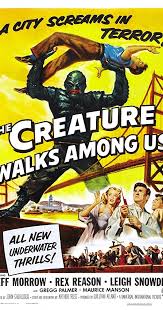
The Creature Walks Among Us (1956)

THE CREATURE WALKS AMONG US (1956) **1/2
I should have already learned my lesson.

I bitch about the yucky suck face between scientists John Agar and the lovely Lori Nelson through most of the second half of Revenge of the Creature, so it only serves me right that I got immediately served with the miserably married couple played by Jeff Morrow and Leigh Snowden in The Creature Walks Among Us, the third and final entry in the Creature series released by Universal Studios. Morrow and Snowden are truly a downer and their scenes drag The Creature Walks Among Us down a notch or two from being a perfectly enjoyable creature feature.

All three Creature features benefit heavily from their underwater photography and Walks Among Us works best when the action takes place underwater. Above water, especially when Morrow and Snowden provide us another unpleasant scene together, it’s not so hot. Watching Revenge and Walks Among Us in close proximity, it’s obvious just how much influence these earlier films had upon the later Jaws series also produced by Universal. Jaws 3 borrowed major plot developments from Revenge, for crying out loud.

In a fundamental way, though, Walks Among Us cheats us. It doesn’t really live up to any part of that title until the very end of the picture, when the title character escapes from captivity. I certainly don’t remember a city screaming in terror and the poster incorporates the Golden Gate Bridge into its promotional campaign. Good job, marketing department. Sure, we see the Golden Gate, kinda sorta obligatory for any film shot for any length in San Francisco, but I don’t recall any character being held up above the Golden Gate by our title character, sure to be thrown to his death. Now, that would be an impressive scene.

I feel like I must make amends in this review for cheating Ricou Browning (born 1930) in the Revenge review. He’s the man in the creature suit in the underwater scenes. In Walks Among Us, Don Megowan plays the Gill Man on land. In Revenge, it was Tom Hennesy. In Creature, it was Ben Chapman. I believe it’s a testament to the quality of Browning’s work in the underwater scenes that he filled the creature suit in all three movies.

Strangely enough, I felt a certain sadness during Walks Among Us, alternating with a sense of overall wonderment toward the Universal Classic Monsters series. Walks Among Us ended a stretch where I watched 16 classic horror films, from 1935’s Werewolf of London to 1956’s The Creature Walks Among Us, for the first time, having already watched Universal’s true classics like The Bride of Frankenstein and The Wolf Man several times before. Because I even sometimes enjoy watching a bad movie, like The Invisible Woman, this stretch greatly satisfied both the historian and the horror movie fan living inside me.

Top 12 Universal Classic Monster Movies
1. The Bride of Frankenstein (1935)
2. Frankenstein (1931)
3. The Wolf Man (1941)
4. Son of Frankenstein (1939)
5. Creature from the Black Lagoon (1954)
6. The Invisible Man (1933)
7. The Phantom of the Opera (1925)
8. The Mummy (1932)
9. Dracula’s Daughter (1936)
10. Dracula (Spanish version) (1931)
11. Dracula (English version) (1931)
12. Abbott and Costello Meet Frankenstein (1948)

Abbott and Costello Meet the Mummy (1955)

ABBOTT AND COSTELLO MEET THE MUMMY (1955) Two stars
Bud Abbott (1897-1974) and Lou Costello (1906-59) enjoyed a phenomenal run for Universal Studios from 1941’s Buck Privates through 1955’s Abbott and Costello Meet the Mummy.

They made lots of pictures that made lots and lots of money and they met lots and lots of interesting people (and monsters) in their pictures.

Their career meeting people for Universal took off with the 1948 hit Abbott and Costello Meet Frankenstein, a title which sells Larry Talbot / The Wolf Man (Lon Chaney Jr.), Dracula (Bela Lugosi), and even for one gag the Invisible Man (Vincent Price) short. After that, let’s see, Abbott and Costello meet the Killer, Boris Karloff (not the killer), the Invisible Man (not Vincent Price), Captain Kidd, Dr. Jekyll and Mr. Hyde, the Keystone Kops, and the Mummy. We should pause right here and mention Abbott and Costello visited Jack and his beanstalk, Africa, Mexico, and Mars.

I wanted to like Abbott and Costello Meet the Mummy.


I wanted to laugh at Abbott and Costello Meet the Mummy.

I had a mixed reaction instead.

I liked it without laughing at it once.

Since it’s a comedy and I didn’t laugh even once, I guess I don’t really like it.

I call it a forced smile picture more than anything else, where I see the joke, understand the joke, and finally smile with a sense of resignation.

Maybe I have seen too many Abbott and Costello films in close proximity during quarantine, not to mention imitation Abbott and Costello Don Knotts and Tim Conway in The Private Eyes, but I failed to laugh at humor frequently predicated on Costello fumbling bumbling stumbling into or through someone or something, being terrified beyond the capacity for rational thought or a coherent sentence, and then most often failing to make the skeptical Abbott believe him. I swear, Abbott and Costello must play their favorite routine about 100 times during Meet the Mummy.

Abbott and Costello only call each other by name throughout Meet the Mummy. During the final credits, they’re listed playing Pete Patterson and Freddie Franklin, respectively. That’s about the high point of the humor in Meet the Mummy.

Of all the Universal classic monsters, I must admit that I like the Mummy series the least, namely the four pictures Universal rattled off like machine gun fire in the 1940s — The Mummy’s Hand, The Mummy’s Tomb, The Mummy’s Ghost, and The Mummy’s Curse. I like Hand alright, find Tomb elevated by Lon Chaney Jr.’s debut as Kharis, and Ghost and Curse have already blended into monotonous goo in my brain after seeing them back-to-back recently. Don’t even get me started on the Indiana Jones wannabe Brendan Fraser CGI monstrosities and I blissfully missed Tom Cruise’s so-called abomination completely.

Chaney Jr. proved to be the most menacing Mummy on screen, and he’s not in Meet the Mummy. It could be any other guy wrapped in gauze and affecting a lumbering pace. Yeah, it’s a guy named Eddie Parker. Oh, sure, probably a nice guy, but still no Chaney Jr. They call the Mummy ‘Claris’ — not Kharis — anyway in Meet the Mummy.

Meet Frankenstein and Meet the Invisible Man worked because the actors portraying the monsters played it straight rather than knowing they were in a comedy. It’s similar to the acting in Airplane, Top Secret, and The Naked Gun, in that it never received the credit it deserved.

As for Abbott and Costello, there’s always Hold That Ghost, Meet Frankenstein, Meet the Invisible Man, and “Who’s on First.”

Fade to Black (1980)

FADE TO BLACK

FADE TO BLACK (1980) ***

Vernon Zimmerman wrote and directed FADE TO BLACK, a horror film that shows the darkest side of an obsession with movies. Its main character, Eric Binford (Dennis Christopher), takes cinemania literally, as he kills his victims in the guise of his favorite movie characters. They include Dracula, the Mummy, and Hopalong Cassidy.

FADE TO BLACK reached theaters on October 14, 1980. Nearly two months later, disillusioned Beatles fan Mark David Chapman killed former Beatle member John Lennon outside his residence at the Dakota Apartments in New York City. Chapman shot Lennon four times in the back with a .38 special. Chapman stayed at the scene and read from J.D. Salinger’s “The Catcher in the Rye” until the police arrived to arrest him. Chapman became fixated on “Catcher” protagonist Holden Caulfield, who loved to rail against “the phonies,” and Chapman surely considered Lennon a phony.

Eric is barely hanging on at the beginning of FADE TO BLACK. His wheelchair bound Aunt Stella (Eve Brent Ashe), who we later find out is actually his mother, nags at him; for example, her first lines are “Eric! Get up! Well, lookie here. Mister Smart Mouth fell asleep with his nose buried in the screen again! Your one-eyed monster is gonna soften your eyes, much less rot your brain! You spend all your time daydreaming and watching those silly movies on the TV and your projector.” Aunt Stella even blames Eric for her accident and her subsequent paralysis many years ago.

Had she ever seen KISS OF DEATH, she might not have been so hateful to the kid. Eric, though, seems to have a special affinity for Richard Widmark’s Tommy Udo, a precursor to Heath Ledger’s Joker in THE DARK KNIGHT. Udo’s the type of guy who thinks nothing of pushing an old lady in a wheelchair down a flight of stairs to her eventual demise.

Eric is a perpetual fuck up at his job at a film distributor’s warehouse and his boss Mr. Berger (Norman Burton), well, you know, he does what a good boss does in a horror movie built around revenge. Eric discovers Mr. Berger’s weakness, a weak heart that could stop ticking any time if Mr. Berger proved unable to reach his precious medication.

Co-workers Richie (Mickey Rourke) and Bart (Hennen Chambers), especially Richie, give Eric grief every chance they get.

One day, Eric spots Australian model and Marilyn Monroe lookalike Marilyn O’Connor (Linda Kerridge, in a sensational movie debut) eating in a cafe with her friend. Eric works up the courage to strike up a conversation with Marilyn and he asks her what movie Marilyn Monroe and Tom Ewell watched in THE SEVEN YEAR INCH. (I know this one. May I please answer? THE CREATURE FROM THE BLACK LAGOON.) Eric asks Marilyn out to a movie that night and she says yes. He’s all excited, for a change, about something in the “real world.” …

Marilyn unintentionally stands up Eric, a prostitute treats him like shit, Stella smashes his film projector, and, yes, Eric loses his shit and for the rest of the picture, he seeks vengeance against those who he feels have wronged him.

Even a shady filmmaker named Gary Bially (Morgan Paull) crosses Eric by stealing his idea for a nifty low-budget film named ALABAMA AND THE FORTY THIEVES, which Eric says would be made in the early 1950s style of Samuel Fuller.

I’ve read in several places that FADE TO BLACK fails because Christopher gives a bad performance and/or Eric Binford proves to be such a detestable protagonist. Reviews mentioned that Christopher plays a character totally unlike his Dave Stoller in BREAKING AWAY, Christopher’s last big film before FADE TO BLACK.

An unhinged character like Eric Binford — especially since he loves imitating his favorite movie characters in both appearance and speech — allows the actor latitude to push a performance over-the-top and Christopher definitely pushes those limits for even somebody (like me, for example) who admires his performance in FADE TO BLACK.

I give Christopher a tremendous amount of slack after his breakout performance in BREAKING AWAY; he created one of the more lovable characters in cinematic history and I’ll always be grateful to Christopher for that.

Reviewers, though, apparently forgot Dave Stoller’s obsession with bicycling and everything Italian. Did they not remember “cutter” Dave pretending to be Italian exchange student Enrico Gimondi to impress and then date a cute Indiana University co-ed? Dave even renamed poor Jake the Cat “Fellini.”

Eric and Dave are not as different as reviewers have suggested. Eric just lived a tougher life right from the start and he was definitely not blessed with great friends and family like Dave Stoller. We could get into the whole “Nature vs. Nurture” discussion and when’s the last time a horror movie spurred on that.

What I especially liked about FADE TO BLACK is that it follows Eric’s descent into madness all the way to its inevitable conclusion — especially inevitable since Eric becomes Cody Jarrett from WHITE HEAT — and then it finishes in such a flourish atop legendary movie palace Grauman’s Chinese Theatre to make WHITE HEAT director Raoul Walsh and star Jimmy Cagney proud. “Made it Ma! Top of the world!”