
She-Wolf of London (1946)

SHE-WOLF OF LONDON (1946) *
I have an alternate title for the 1946 Universal Studios anti-horror classic She-Wolf of London: She-Wolf of Tedium.

Since there’s no actual she-wolf, our new alternate title downsizes to Tedium.

Over a 31-year period, Universal made 31 films that are grouped together as the Classic Monsters series, featuring Dracula, Frankenstein’s Monster, the Wolf Man, the Invisible Man, the Phantom, the Mummy, and/or the Werewolf of London, not to mention Abbott and Costello.

She-Wolf of London falls outside the Classic Monsters jurisdiction and it’s worse than any of them. Yes, it’s even worse than The Invisible Woman, the nadir of the Classic Monsters series.

Since I watched The Wolf Man and Werewolf of London, I expected a she-wolf in London, transformation scenes, and scenes of mayhem.

No, director Jean Yarbrough (The Devil Bat), screenwriter George Bricker, and producer Ben Pivar give us a standard issue murder mystery.

June Lockhart, then a 21-year-old ingenue years before her mother roles on Lassie and Lost in Space, stars as poor, poor Phyllis Allenby, whose deep, deep belief in the so-called ‘Curse of the Allenbys’ leads her to believe that she’s the werewolf responsible for all the deaths in the local park. Good old Aunt Martha (Sara Haden), that good old Aunt Martha, anyway, she owns dogs that bark all night and they take a real shining to poor, poor Phyllis. Between all the murders that point toward her and dogs barking and curse talk, Phyllis gets worse over the course of She-Wolf of London. That’s all part of Aunt Martha’s master plan, since she wants to drive Phyllis insane and inside an asylum so Aunt Martha and her daughter remain living inside the mansion rather than Phyllis and her doting barrister, boyfriend, and potential husband Barry Lanfield (Don Porter). Barry sees through it all, believes in Phyllis, and it’s all so touching when he proves her innocence. Instead, Aunt Martha becomes one of those less than convincing movie murderers, you know, in a revelation that renders the rest of the movie, what’s the word, ridiculous … and not the good ridiculous either.

Yeah, that’s a whole lot of plot synopsis and She-Wolf of London surrenders itself to many exposition scenes during a 61-minute motion picture spread. All that exposition becomes the source of all that pesky tedium, which is not exactly what I was expecting from a movie titled (incorrectly) She-Wolf of London. There I go again, my own worst enemy.

The Invisible Man (2020)

THE INVISIBLE MAN (2020) *
I should have called the cops on The Invisible Man.

The latest remake of an old Universal Studios warhorse, The Invisible Man gives viewers two hours of domestic violence. That makes it a relentlessly unpleasant and positively joyless viewing experience, and definitely not what I expected from an Invisible Man movie. Obviously, it’s my problem that I entered The Invisible Man expecting a grand old entertainment and received something else that produced the barest minimum of entertainment value.

I know, I know, shame on me.

Recently, I watched The Invisible Woman, Invisible Agent, and The Invisible Man’s Revenge to complete the series of six Invisible Man pictures that began in 1933 with James Whale’s classic and ended in 1951 with Abbott and Costello Meet The Invisible Man. I give five of the six films positive reviews and they’re all entertaining in their own ways — yes, even The Invisible Woman has its moments, few and far between but nonetheless they’re visible.

Invisible Agent wisely took the series in a new direction — a different one from the wrong hard left turn made by The Invisible Woman — incorporating Nazis, Nazi spies, spying against Nazis, and Peter Lorre into the formula. It’s hard not to watch Invisible Agent and think Steven Spielberg loved the movie growing up and it later informed Raiders of the Lost Ark, especially Ronald Lacey’s Peter Lorre-like character.

The Invisible Man’s Revenge returns to the roots of the series and the title describes the plot.

Here’s the length of the first six Invisible Man pictures: 71 minutes, 81, 72, 81, 78, and 82, all well below the 124 minutes offered by the 2020 version.

However, the new Invisible Man contributes maybe five minutes of entertainment value and it’s one of those films I liked less and less as it traveled down a long and predictable road. The earlier Invisible Man films move along briskly, while this marvel of modern technology belabors everything to such a degree that a three-toed sloth dipped in molasses moves faster.

Aside from the invisibility hook and the Griffin surname for the title character and his slimy brother, the new Invisible Man has a lot more in common with the 1991 Julia Roberts battered woman hit Sleeping with the Enemy. By calling it The Invisible Man brand name, though, expectations are high for entertainment, but that’s not what it offers in the slightest so it set itself up for its own failure.

I generally distrust remakes, reboots, sequels, etc., and I am sure that many of us do in varying degrees. I love it when viewers of all demographics bitch and complain about old movies, how they’re crusty and slow-moving and not in color, but they’re plundered from on a regular basis most often with inferior storytelling craft by the new guard.

The Invisible Man director and writer Leigh Whannell previously brought us the first three Saw movies, and so the fact that his Invisible Man wallows in and lingers over domestic violence should be of little or no surprise. Whannell wrote the story or screenplay or both for all three, and starred as Adam Faulkner-Stanheight in Saw. I managed to mostly avoid the once seemingly interminable Saw series, catching only one of the seven films churned out by the foremost torture porn assembly line in seven years. For some unknown reason even to me, I watched Saw IV and hated just about every single millisecond of it. All these years later, I only remember thinking they should have called it Fuck with an exclamation point because that’s about the only dialogue used with any regularity.

Never fear, fans of Whannell and rehashes and Whannell rehashes, because Wolfman and Escape from New York are in pre-production.

Fuck!

The Invisible Woman (1940)

THE INVISIBLE WOMAN (1940) *1/2
Normally, it’s great for a movie to be considered 20 years ahead of its time.

Unfortunately for Universal Studios’ third entry in the Invisible Man series, The Invisible Woman, it’s not so great that it predated the Disney live-action comedies of the ’60s and ’70s, unless you’re into that kind of thing.

One always should account for personal taste in delicate matters like these, so I will note that I prefer both The Invisible Man and The Invisible Man Returns (released earlier in 1940) over The Invisible Woman because they have a darker sense of humor at play than a predominantly lighthearted comedy that revolves heavily around the good old slapstick.

Ah, yes, good old slapstick. That’s where The Invisible Woman paved the way for all them Disney Solid Gold hits of the ’60s and ’70s.

Slapstick, in this case, does not mean the virtuoso physical feats of silent greats Buster Keaton and Harold Lloyd or the brutality of the Three Stooges and Home Alone.

No, rather, it’s mostly supporting characters falling down and fainting and gasping, like, for example, man servant George (played by Charlie Ruggles). Take a drink for every time George falls down or faints or flusters and you’ll be feeling at least a buzz in no time. Depending on the drink, you might miss out on most of The Invisible Woman and I call that a happy ending.

The Invisible Woman throws in comic gangsters, characters that have very rarely worked throughout cinematic history, not then, not before then, not after then, not ever. Given the presence of Shemp Howard in a henchman role, one might be tempted to believe The Incredible Woman would give up on the genial slapstick and really go for the gusto like maybe a Three Stooges short. No, no, no.

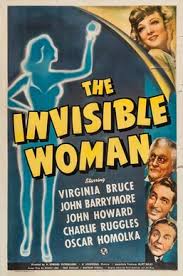
I don’t really need to discuss the plot, because it’s one of them movies where the title says it all more or less and we can quickly move on to who plays who, like John Barrymore as nutty Professor Gibbs, Virginia Bruce the spunky title character and John Howard her eventual leading man, Margaret Hamilton and Ruggles the servants, and Oscar Homolka the main heavy. What a waste of a talented cast, though, and undoubtedly one of the worst films made during Universal’s run of horror films.