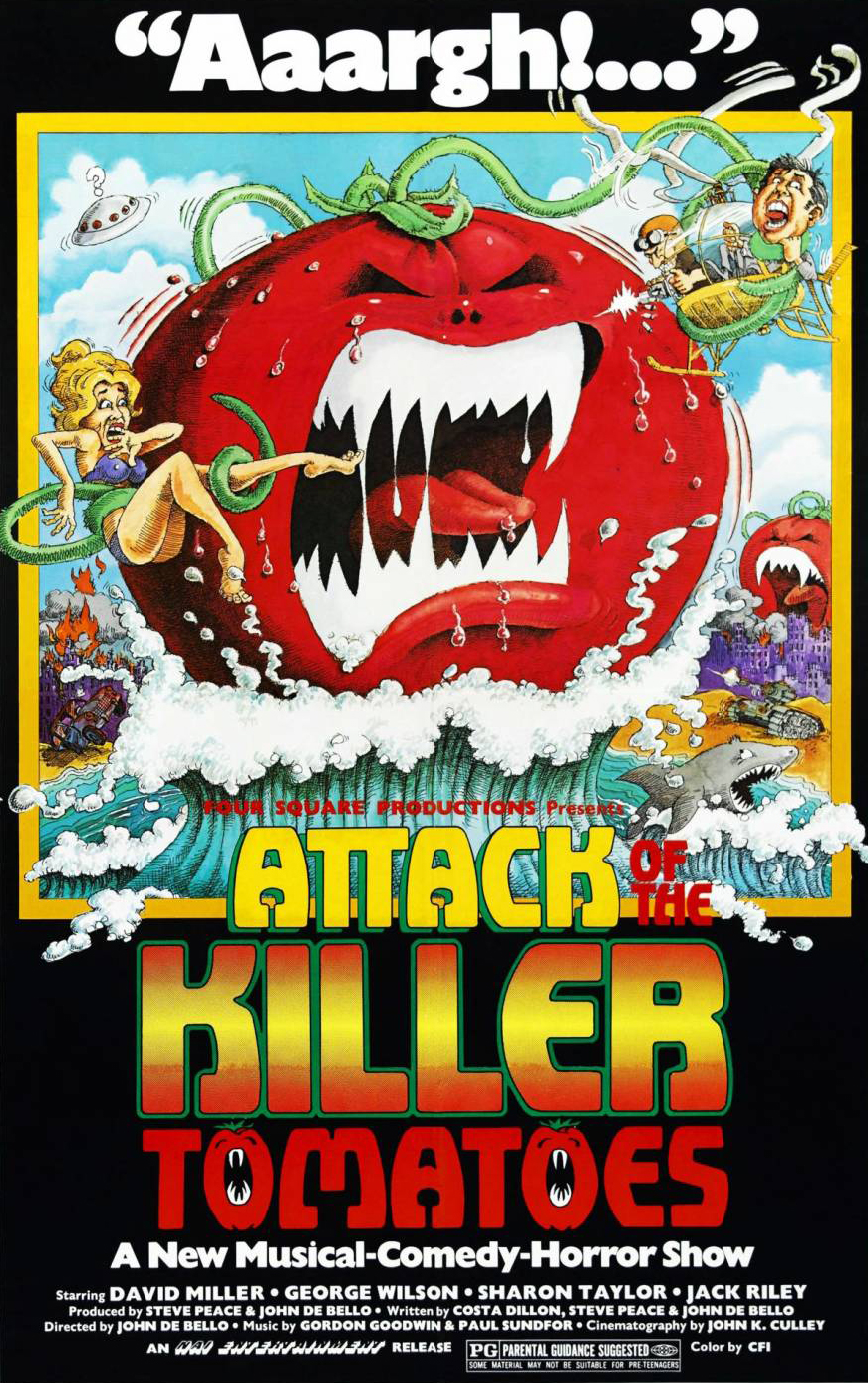
Attack of the Killer Tomatoes (1978)

ATTACK OF THE KILLER TOMATOES

ATTACK OF THE KILLER TOMATOES (1978) Three stars

“In 1963, Alfred Hitchcock made a motion picture entitled THE BIRDS, a film which depicted a savage attack upon human beings by flocks of the winged creatures.

“People laughed.

“In the fall of 1975, 7 million black birds invaded the town of Hopkinsville, Kentucky, resisting the best efforts of mankind to dislodge them.

“No one is laughing now.”

— Introduction to ATTACK OF THE KILLER TOMATOES


Watching ATTACK OF THE KILLER TOMATOES in full for the first time in possibly 30 years, it brought to mind KING KUNG FU.

Both are extremely low-budget labor-of-love parodies and tributes to both older and contemporaneous movies. Both have their dead spots and their high points. Both try many, many, many jokes. Both are filed under cult movies and “so bad they’re good.” Both love their filming locations, Wichita in KING KUNG FU and San Diego in KILLER TOMATOES. Both show people having a darn good time making a silly little movie. Both are so endearingly goofy that I end up forgiving all their various sins and transgressions and enjoying them.

Unlike KING KUNG FU, though, KILLER TOMATOES inspired three sequels — RETURN OF THE KILLER TOMATOES! (1988), KILLER TOMATOES STRIKE BACK! (1990), and KILLER TOMATOES EAT FRANCE! (1991) — plus an animated series and two video games.

Let me highlight what I liked (or loved) about KILLER TOMATOES.

— The songs are great. We have “Theme from Attack of the Killer Tomatoes,” “Puberty Love,” “The Mindmaker Song,” “Tomato Stomp,” and “Love Theme from Attack of the Killer Tomatoes.” I am sure that millions and millions proclaim GREASE the best musical from the film year 1978. No way! I say it’s KILLER TOMATOES all the way. I mean, both the opening and closing musical numbers are fantastic. “Theme” should have been a hit a la “The Blob” by The Five Blobs in 1958. “Love Theme” gives us better opera than YES, GIORGIO, Pavarotti’s feature film debut and farewell. I should have selected it to play at my wedding. “Puberty Love” kills the tomatoes. It’s that bad. Even badder. Just the sheet music for “Puberty Love” alone kills tomatoes smack dead in their tracks. Future Soundgarden and Pearl Jam drummer Matt Cameron sang “Puberty Love” around the tender age of 15. Maybe one day Pearl Jam will cover “Puberty Love.” It couldn’t be any worse than “Last Kiss.” By the way, you can’t throw tomatoes at the performers during “Puberty Love,” because all the tomatoes will be dead.

— KING KUNG FU combined King Kong and kung fu, according to a report from man on the spot Captain Obvious. KILLER TOMATOES affectionately kids monster movies, for example. Notice how the Japanese military always struggles against Godzilla. Well, in KILLER TOMATOES, the American military cannot lick our title characters. Rather, it takes playing a horrible little song named “Puberty Love” throughout San Diego Stadium. Tim Burton must have been taking notes before he made MARS ATTACKS!

— Fans of imported monster movies should have a great time with the character Dr. Nokitofa (credited to Paul Oya). KILLER TOMATOES purposely gave Dr. Nokitofa a bad dub, you know, one of those wildly inappropriate voices that just does not fit the character. I love it and I wish they gave his character more scenes with more lines. I busted a gut at his scene. When Dr. Nokitofa corrects somebody for calling tomatoes “vegetables,” he says “Technically sir, tomatoes are fags” … then his colleague Dr. Morrison says, “He means fruits.” Yes, there’s some bad taste humor in KILLER TOMATOES. Some of it works and some of it does not. Nature of the humor, so they say.

— There’s something absolutely brilliant about a character being chased by a “killer” tomato, relentlessly down the street, up the stairs, and through the hallway.

— I must admit to feeling grateful none of my newspaper bosses ever said that I have a great ass, like the editor (Ron Shapiro) tells Lois Fairchild (Sharon Taylor) in their first scene together.

— With a reporter named Lois, of course that affords KILLER TOMATOES an opportunity to kid SUPERMAN. KILLER TOMATOES came out a good two months before SUPERMAN, one of the most wildly anticipated releases in 1978.

— KILLER TOMATOES kids JAWS much more affectionately and successfully than GIANT SPIDER INVASION, A*P*E, THE HILLS HAVE EYES, and ORCA: THE KILLER WHALE, all of which took pot shots at Steven Spielberg’s game-changing summer blockbuster.

— I cannot have much of any ill will toward a film that works in a cameo for the San Diego Chicken (Ted Giannoulas) and thanks “Every Screwball in San Diego County,” that’s including Mr. Chicken, for the great crowd scene near the end of the picture.

— In conclusion, I thank director and co-writer John DeBello and fellow writers Costa Dillon and J. Stephen Peace (all three each took on even more roles) for their efforts in making a fun little movie.

A*P*E (1976)

A*P*E (1976) One-half star

Finally, now I can mark this one off the bucket list.

I have wanted to watch A*P*E ever since I bought an used copy of John Wilson’s “The Official Razzie Movie Guide” more than 12 years ago. The infamous shot of the man-in-a-suit ape flying the middle finger graces the front cover of the book and of course, I surrendered the hardly-earned on that beautiful book. Wilson wrote of the ape suit, “(It) looks more like your grandmother’s lamb’s wool coat collar than an actual simian.”

On December 2, 2019, a date that will live in Internet infamy, I watched A*P*E and it was even worse than I thought possible, believe it or not. Not sure why it even received a half-star.

This joint South Korean and American production cost an incredible $23,000, including a reported $1,200 for miniatures, and they filmed this 87-minute craptacular in a mere 14 days. Please keep in mind that Robert Rodriguez made EL MARIACHI for $7,000, so I am not knocking A*P*E because of its budget.

It was a quickie exploitation picture designed to cash in on the much hyped KING KONG released in late 1976. A*P*E originally announced itself as THE NEW KING KONG, but RKO filed a $1.5 million suit against Kukje Movies, the Lee Ming Film Co., and Worldwide Entertainment, the producers of A*P*E. They changed the title to APE (we are no longer stylizing a title of a movie with very, very, very little style) and added the tag “Not to be confused with KING KONG.”

APE (a.k.a. “Attacking Primate monstEr”) is so bad that it makes KING KONG ‘76 look much, much, much better.

Let’s start taking down APE flaw by flaw.

Prerequisite screen ingenue Marilyn Baker (Joanna Kerns) and reporter Tom Rose (Rod Arrants) suck face through a lot of APE. I mean, get a room, for crying out loud. When they’re not sucking face, their mouths are utilized for uttering mushy-mouthed dialogue so bad that we prefer them sucking face.

There’s a scene where Miss Baker screams for what feels like an eternity. She probably screams more during this scene than Fay Wray, Jessica Lange, and Naomi Watts did in all their scenes combined in their respective KONG movies.

Between Miss Baker’s screams and two Korean children laughing for another eternity, I was blessed to not have a pencil nearby, because it’s quite possible that I would have grabbed it and jabbed both my eardrums until I could no longer hear.

I love how when they’re evacuating South Korean cities, the voice over the loud speakers speaks English. Guess that’s how imperialism works and this cheap KING KONG rip-off was the cinematic wing.

I shall regroup here and move away from imperialism. They filmed APE in 3-D and even if we did not know that coming in, we could figure it out for ourselves very quickly considering all the objects coming at us, including arrows, boulders, and that infamous middle finger.

The title character not only looks like a shoddy rug, but it is very distracting when he changes in size from scene-to-scene. He’s supposed to be 36 feet tall, but we don’t believe it for a single fleeting second.

In an early scene, the ape kills a shark, just another jab at JAWS. APE joins a club that includes GIANT SPIDER INVASION, THE HILLS HAVE EYES, and ORCA THE KILLER WHALE.

APE arrived in theaters in October ‘76, beating KING KONG by two months. That’s the only thing APE had on KING KONG.

The Last House on the Left (1972)

LAST HOUSE ON THE LEFT

THE LAST HOUSE ON THE LEFT (1972) Three stars
Former academic Wes Craven (1939-2015), who also did some work on pornographic films under different aliases, made a big bang with his feature debut THE LAST HOUSE ON THE LEFT, one of the great shockers of the seventies.

It’s an exploitative American modern take on Ingmar Bergman’s THE VIRGIN SPRING (1960), a film itself based on a 13th Century Swedish folk ballad. THE VIRGIN SPRING won the Academy Award for Best Foreign Language Film at the 1961 Academy Awards.

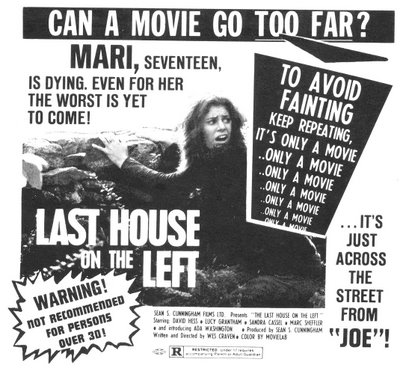
The film’s classic tagline, “To avoid fainting, keep repeating: It’s only a movie, only a movie, only a movie. …” Viewers had a variety of extreme reactions, of course which only helped to hype the film en route to $3.1 million in returns on a $87,000 budget.

Theaters and drive-ins showed LAST HOUSE in many different prints, because individual machinists took it upon themselves to make their own cuts. Normally, the most shocking bits would end up missing. Good luck finding an uncut version of the film.

It received some of the nastiest reviews imaginable, which made seeing the film again seem like more of an event, a happening. Writing for the New York Times, Howard Thompson said, “When I walked out, after 50 minutes (with 35 to go), one girl had just been dismembered with a machete. They had started in on the other with a slow switch blade. The party who wrote this sickening tripe and also directed the inept actors is Wes Craven. It’s at the Penthouse Theater, for anyone interested in paying to see repulsive people and human agony.” Roger Ebert wrote just about the only positive review at the time of the film.

I first watched it about 10 years back and I thought it was a powerful work. I wrote a very positive review somewhere and I gave it three-and-a-half stars. I found it less powerful after subsequent viewings.

Craven and crew made some appalling choices that create a split personality movie.

Watching LAST HOUSE for the first time, you might notice the buffoonish antics of the Sheriff (Marshall Anker) and the Deputy (Martin Kove). Their comedic relief never works and in fact they play like failed slapstick comedy dropped in from another movie. I noticed this element upon first viewing and it was the reason I graded THE LAST HOUSE ON THE LEFT three-and-a-half rather than four stars.

PSYCHO. Herrmann. SUSPIRIA. Goblin. HALLOWEEN. Carpenter.

Well, you’ll never find THE LAST HOUSE ON THE LEFT soundtrack filed alongside those indelible horror movie scores and their composers. That’s why I started a new paragraph.

David Hess, who plays the main villain Krug, wrote and performed four songs for the movie: “The Road Leads to Nowhere” (the best song of the bunch), “Wait for the Rain,” “Sadie and Krug (Baddies’ Theme),” and “Now You’re All Alone.”

Upon more viewings, this music stuck out like a sore thumb, one that poked me right straight in the eye. I’m not sure why I overlooked the music the first time around.

Krug the character, played by Hess the actor, would have killed Hess the singer and songwriter, just slit his throat for singing one of those ridiculous songs. Believe it or not, Hess wrote “Speedy Gonzales,” which became a big hit for Pat Boone in the year 1962.

I still deduct one-half star from LAST HOUSE for the rumbling bumbling stumbling cops and a good quarter star for them Hess songs.

Hess (1936-2011) is so good as the bad guy in LAST HOUSE that we can understand precisely why he became typecast as villain. He played one of the henchmen in Craven’s SWAMP THING.

Sandra Peabody and Lucy Grantham play Mari and Phyllis, who are kidnapped, tortured, raped, and murdered by Krug and company. They have the most difficult roles.

Filming LAST HOUSE proved to be a horrifying ordeal for Peabody, especially since Hess believed in method acting and even threatened assaulting her for real during a rape scene. Peabody dropped out from acting in 1974, after being cast in movies like VOICES OF DESIRE and MASSAGE PARLOR MURDERS! She went into screenwriting, producing children-orientated entertainment, and being an acting coach.

Fred Lincoln (1936-2013) played Weasel, one of Krug’s nasty associates, and LAST HOUSE marked Lincoln’s only non-pornographic role. Lincoln directed more than 300 films; the Internet Movie Database lists 340 directorial credits for the New York native.

Jeramie Rain, who played the vicious Sadie, was married to Richard Dreyfuss from 1983 to 1995 and their union produced three children. She once hitched a ride with real-life serial killers Charles Manson and Tex Watson. That’s fitting because LAST HOUSE seems to have been heavily influenced by the Manson Family and their murders.

Richard Towers and Eleanor Shaw, under different names, play Mari’s parents Dr. John and Estelle Collingwood, highly respectable upper middle class folk. Krug and his gang disguise themselves as traveling salesmen and they call upon the Collingwoods. Both parties eventually discover the others’ identities: The Collingwoods find out their guests killed their daughter and Krug and company discover that Dr. John and Estelle are Mari’s parents.

Dr. John and Estelle devise some elaborate booby traps and Craven displays his fondness for booby traps for the first time. Booby traps also played a role in both THE HILLS HAVE EYES and A NIGHTMARE ON ELM STREET. I believe that Craven should have directed at least the first HOME ALONE, given his predilection for booby traps.

This juxtaposition of seeing a socially respectable upper middle class couple getting down-and-dirty to exact revenge has been one of the most fascinating elements at work in LAST HOUSE. You just might find yourself asking, “What would I do if I found myself in a similar situation?”

Though it’s not a classic on the same level as both NIGHT OF THE LIVING DEAD and THE TEXAS CHAINSAW MASSACRE, LAST HOUSE is essential viewing for horror fans.

Laserblast (1978)

LASERBLAST

LASERBLAST (1978) Two-and-a-half stars

LASERBLAST is a clunky piece of low-budget junk, but it is not without its charms.

For example, LASERBLAST takes a pot shot at STAR WARS, literally when our teenage protagonist Billy Duncan (Kim Milford) blows up a STAR WARS billboard on the side of the road with his laser cannon. It blows up real good. For that matter, just about everything blows up real good in LASERBLAST.

We’ll get back to that later.

For now, however, I’d like to touch on a couple of the contemporaneous pot shots taken at JAWS.

THE GIANT SPIDER INVASION, which came out a few months after JAWS in 1975, has Sheriff Jeff Jones (Alan Hale Jr.) say over the CB radio of the spider, “You ever see the movie JAWS? It makes that shark look like a goldfish!”

THE HILLS HAVE EYES includes a ripped poster of JAWS.

ORCA: THE KILLER WHALE has a killer whale kill a great white shark early on in the proceedings.

Coincidentally, both THE HILLS HAVE EYES and ORCA were released on the same day (July 22) in 1977.

Anyway, back to LASERBLAST, a quickie exploitation picture made to cash in on the teenybopper science fiction craze between STAR WARS movies. It later became known for being one of the worst movies ever made, especially after Mystery Science Theater 3000 lampooned LASERBLAST in a 1996 episode.

I feel almost bad for giving a mixed review to LASERBLAST, especially after writing positive reviews for THE KILLING OF SATAN, TROLL 2, THE TERROR OF TINY TOWN, and PLAN 9 FROM OUTER SPACE. Almost. Believe it or not, all four of those other films have a higher IMDb rating than LASERBLAST.

LASERBLAST surrenders itself to filler scenes that just scream out TACKY SEVENTIES. It feels like a bloated production even at 80-85 minutes.

David W. Allen (1944-99) worked on 48 films in visual effects or puppetry or stop motion animation over nearly a 30-year career. His notable credits include FLESH GORDON, THE HOWLING, CAVEMAN, Q: THE WINGED SERPENT, THE STUFF, WILLOW, and GHOSTBUSTERS II.

Allen’s alien stop motion work in LASERBLAST received better reviews than any other aspect of the film.

Unfortunately, the stop motion aliens do not have more screen time in LASERBLAST.

Milford is not exactly playing the greatest hero in the history of cinema. For example, he’s the first and only hero ever to be picked on by screen nerd extraordinaire Eddie Deezen; both Milford and Deezen made their screen debuts in LASERBLAST. Milford (1951-88) became known for his work in the musicals “Jesus Christ Superstar” and “The Rocky Horror Picture Show.” He plays most of the movie without a shirt.

Let’s face it, Billy Duncan has a bad, bad, bad life: His mother always seems to be going to Acapulco, his girlfriend’s grandpa freaks out on him and runs poor, poor Billy off, two dope-smoking cops love writing up Billy for speeding tickets, and Chuck (Mike Bobenko) and Froggy (Deezen) bully him. Froggy, by the way, has seen STAR WARS five times, according to one of the dope-smoking deputies (played by veteran character actor Dennis Burkley in the early stages of his career).

Billy’s life changes for the better when he finds that darn laser cannon in the desert. As it says on the poster, Billy was a kid who got pushed around then he found the power.

Billy, of course, uses the laser cannon to blow up a bunch of stuff real good before the stop-motion aliens come for him.

One car blows up about five times in LASERBLAST. They give us just about every conceivable angle.

Yes, it’s that kind of a movie.

Keenan Wynn and Roddy McDowall (his last name spelled “McDowell” in the credits) make glorified cameo appearances.

LASERBLAST is bad enough that McDowall’s Peter Vincent could have played it on the TV series “Fright Night” featured in FRIGHT NIGHT.

On the bright side, LASERBLAST is considerably better than “The Star Wars Holiday Special,” which has gone down in history as the biggest STAR WARS rip-off of them all.