
Grand Theft Auto (1977)

GRAND THEFT AUTO

GRAND THEFT AUTO (1977) Three stars

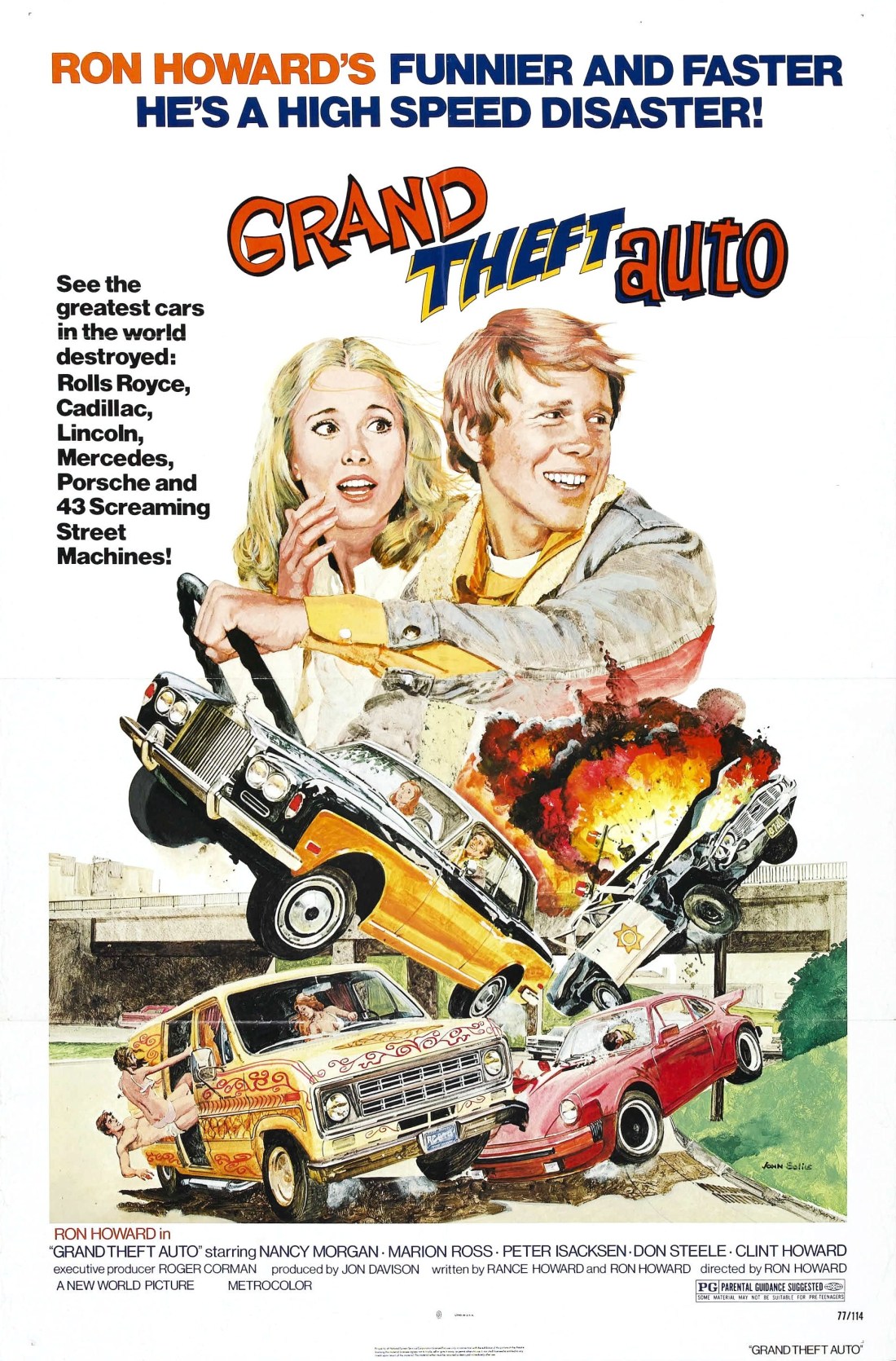
I just love the poster for GRAND THEFT AUTO, Ron Howard’s feature debut as director.

It advertises “See the greatest cars in the world destroyed: Rolls Royce, Cadillac, Lincoln, Mercedes, Porsche and 43 Screaming Street Machines.”

Sounds like my kind of picture.

RON HOWARD’S FUNNIER AND FASTER

HE’S A HIGH SPEED DISASTER!

A drawing of Nancy Morgan aghast and Howard with that All-American smile on his face and his left hand on the steering wheel. Below the young lovebirds are flames and crashes. Sure does resemble a drive-in movie from 1977.

Howard directed, starred in, and co-wrote this picture for New World, produced by Jon Davison and executive produced by Roger Corman. Howard kept some of GRAND THEFT AUTO in the family with father Rance a co-star and co-writer and brother Clint a co-star. It’s no small wonder that Howard earned a reputation for being one of the nicest guys in Hollywood.

Howard did not sell his soul to the Devil to get the picture made. No, instead, he made a deal with Mr. Corman. Howard agreed to star in EAT MY DUST! from 1976 if he could have a crack at directing. The rest is history and Howard’s directorial credits number 32, including Academy Award for Best Picture winner A BEAUTIFUL MIND. His other credits include NIGHT SHIFT, SPLASH, PARENTHOOD, FAR AND AWAY, THE PAPER, APOLLO 13, and FROST/NIXON.

Made for a reported $600,000 on down time for Howard from “Happy Days” (No. 1 show on TV in 1976-77 and No. 2 in 1977-78), GRAND THEFT AUTO tells a simple story.

Paula Powers (Morgan) loves her boyfriend Sam Freeman (Howard) and they want to get married, but her wealthy parents, especially her gubernatorial candidate father, oppose this pairing, taking Mr. Freeman for a gold digger. Paula’s parents want her to marry the wealthy Collins Hedgeworth (Paul Linke), who’s such a blasted tool he spends the movie in his jockey outfit. Paula steals her father’s Rolls Royce and Sam, and they plan to get married in Vegas. There ends up being a $25,000 reward for Paula and then a $25,000 price tag for Collins.

Seemingly all of California (and Nevada) pursues Paula and Sam, as well as Collins.

Collins alone goes through at least three cars in his first few minutes of screen time. What a schmuck! His overprotective mother, played by America’s Sweetheart and Howard’s TV mother Marion Ross, is the one responsible for the reward for Collins and it is one of the undeniable highlights of the movie to hear Marion Ross say “Piss off!” Even a preacher (Hoke Howell) goes after the money. Sleazy DJ Curly Q. Brown (Don Steele) eventually takes to the air in a whirlybird and he tells Mr. Freeman on the air, “Well, if you have it, I’m going to report it. Because every time you turn around and fart, it’s news.” The film especially picks up once Curly Q. Brown starts his play-by-play of the chase across California and Nevada.

The plot also includes a Helicopter vs. Rolls Royce showdown, a bridge blown up real good, and a Demolition Derby. The 1970s were the glory days for the car chase and GRAND THEFT AUTO belongs alongside DUEL, MAD MAX, CONVOY (both movie and song), SMOKEY AND THE BANDIT, THE FRENCH CONNECTION (chase scene), and several other pics.

Do Paula and Sam get married (and live happily ever after)? Well, I would never dream of revealing such an ending, although I told my wife after she asked me if they got married. I will compromise, though, and duly note GRAND THEFT AUTO saves its best demolition for last.

Shaft (1971)

SHAFT

SHAFT (1971) Three-and-a-half stars

A whole new generation of fans discovered Isaac Hayes (1942-2008) through his work for Trey Parker and Matt Stone on “South Park.”

I’m talking about Chef, Hayes’ animated alter ego, his songs like “Chocolate Salty Balls” and “Love Gravy,” his lines “Hello there, children” and “Damn, woman, I just gave you sweet loving five minutes ago” (oh, for just one game of South Park pinball right about now), and his overall cool until everything went all screwy there at the end between Mr. Hayes and the boys.

I went back in time and delved through Hayes’ previous work.

At some point in the late 20th or early 21st century, I watched Gordon Parks’ SHAFT for the first time, roughly the same time as I watched the John Singleton remake, er, sequel starring Samuel Jackson and featuring Christian Bale, Toni Collette, and Jeffrey Wright. It would have been nice if the suburban multiplex paired the ‘71 and ‘00 pictures together, but, no, of course not, and my ears still feel like they’re ringing from the 110-minute action spectacular. Nigel Tufner must have been the projectionist that day, because it was cranked up to 11 x 11.

(For crying out loud, why do we need three movies simply titled SHAFT? This is just as bad as HALLOWEEN.)

I vastly prefer the ‘71 SHAFT over any of the later SHAFT films (I, of course, have not seen the 2019 one) and there’s not one scene in either ‘70s sequel, BIG SCORE and GOES TO AFRICA, or the 2000 sequel or the rest of the first picture itself that even approaches the opening five minutes. Talk about iconic.

It all starts with the multifaceted sounds of the modern day big city rumble, then it moves on to the sights. Burt Lancaster and Telly Savalas in THE SCALPHUNTERS and George Peppard and Dean Martin in ROUGH NIGHT IN JERICHO. Robert Redford, Michael Pollard, and Lauren Hutton in LITTLE FAUSS … never mind, the first 42nd Street showing of HE AND SHE and second big hit THE ANIMAL. There’s more hype, then the first notes of Hayes’ “Theme from Shaft” hit us.

Nearly 45 seconds into the movie, we’re given our introduction to the title character with a close-up of the man coming out from the subway and we’re already interested. He walks across six lanes of traffic and flashes an obscene gesture and shouts “Up yours!” at somebody who had the audacity to honk their horn. We’re interested some more, as we observe what must be just another day in the life of this angry black man.

We see more commercialization and Shaft walks through a crowd of picketers. One sign: “I GOT MY JOB THROUGH THE New York Times.” Another: “WANT YOUR SEX LIFE PUBLISHED?” One more: “I LOST MY JOB THRU Fidelifacts.” Just before making his way through picketers, Shaft flashes his badge at a street peddler, who promptly skedaddles to somewhere else. “Theme from Shaft” has been playing this whole time and picking up momentum as the opening credits scroll and our title character strolls.

It’s been about 150 seconds into the number before Hayes matter-of-factly asks “Who’s the black private dick that’s a sex machine to all the chicks?” Backing vocalists Pat Lewis, Rose Williams, Mitchell Butler, and Telma Hopkins answer “Shaft” and Hayes replies “Damn right.” We are hooked, that’s damn right for sure.

“Theme from Shaft” won the 1972 Academy Award for Best Original Song, and it’s a stone cold classic especially in its single form. We can file the opening scene in SHAFT under “Great Opening Scenes.”

Hayes wrote the lyrics, handled lead vocals, made the arrangements, and played the keyboards. Lester Snell (electric piano), David Becker (viola), Charles Pitts (guitar), Michael Toles (guitar), Marc “Dr. Love” Davis (guitar solo), James Alexander (bass guitar), Richard “Johnny” Davis (trumpet), John Fonville (flute), Gary Jones (congas), and Willie Hall (drums) all played their parts masterfully.

Despite the fact that none of the remaining 90 or so minutes can measure up against the opening five, SHAFT affords one additional pleasures. That should be of little surprise, since this material puts a black spin on James Bond and Mike Hammer.

White author Ernest Tidyman (1928-84) adapted his own 1970 novel for the screen and Tidyman became a household name in Hollywood with SHAFT and THE FRENCH CONNECTION both major hits in 1971. Tidyman won the Academy Award for Best Adapted Screenplay for THE FRENCH CONNECTION, a Best Picture winner.

Tidyman, who FRENCH CONNECTION producer Philip D’Antoni thought would be black, did not like the SHAFT rewrite by John D.F. Black, a writer hired by Parks. Despite his displeasure, Tidyman returned to write the sequel also directed by Parks (1912-2006). The former newspaperman wrote more Shaft novels, “Shaft Among the Jews” (1972), “Shaft’s Big Score” (1972), “Shaft Has a Ball” (1973), “Goodbye, Mr. Shaft” (1973), “Shaft’s Carnival of Killers” (1974), and “The Last Shaft” (1975). Tidyman also wrote HIGH PLAINS DRIFTER and the early Chuck Norris pic A FORCE OF ONE.

Former model turned actor Richard Roundtree makes such a strong impression as Shaft that he’s been called the first black action hero. Not a bad screen debut. Hayes’ opening number greatly assists Roundtree, his character, and us audience members because it paints a portrait of Shaft’s basic personality and makes him a bit larger-than-life. We like this character a great deal already within the film’s first five minutes. We applaud him, especially when he sticks it to the man. Every now and then, all of us wish that we could stick it to the man, just like John Shaft.