
Gappa (1967)

GAPPA: THE TRIPHIBIAN MONSTER (1967) ***
Sixty-two albums when he was alive and 54 more since his 1994 death, wanker guitar solos, frequently obscure and sophomoric lyrics, jazz and orchestral or hippie and doo-wop and other stylistic detours on the regular, and political and social satire that probably applies to all us members of the general audience somewhere down the line of a long and storied musical and recording career.

No, sorry, we’re not here to discuss the outstanding 2020 documentary Zappa directed by Alex Winter or Bill S. Preston, Esq., from the Bill & Ted films.

Nor are we here to discuss Gamera the giant flying turtle monster loved by children everywhere or Godzilla the ‘King of the Monsters’ or Gorgo and his sea monster mother Ogra (neither should necessarily be confused with Gorgo, Queen of Sparta) or Gordo the monster Spanish insult.

Nope, we’re here for Gappa: The Triphibian Monster from 1967, which if you like Gamera, Godzilla, Gorgo, etc., you might also find Gappa to your liking if you give it the good old college try. Why are there so many monsters that start with ‘G’? It’s a great big alphabet, for crying out loud.

The film’s also called Gappa the Triphibian Monsters and American-International dubbed the American version Monster from a Prehistoric Planet. It can be found in multiple places on the ‘Net.

Statement of fact: I’m a big fan of the old school monster movie aesthetic — rubber monsters, men-in-suits, miniatures, hapless government and military men, pro forma human interest though I usually wish monster films to go lighter on the human interest, etc. I like a lot of the Showa Era Godzilla moving pictures, like most of the Gamera films, and like Gorgo a good deal. Yeah, call them goofy or silly or ridiculous or preposterous or whatever denigrating pejorative haters desire but they’re mostly a good deal of fun.

By the way, what the hell is a Gappa? A triphibian monster, of course. What the heck’s a triphibian? A monster who’s adept at war on land, at sea, and in the air. A triple-threat, for a sports analogy. That also sounds like the potential for tons of mass destruction and busloads of extras running for their lives. Damn straight, Skippy.

The plot of Gappa has been called a virtual duplication of Gorgo — stupid fucking humans find a tropical island, take a monster back with them against the warnings of the islanders, and the monster’s parents come smashing Tokyo looking for their pride and monster joy — and one might be tempted to group them together with Son of Godzilla and All Monsters Attack as family values kaiju. The Family Values Kaiju Tour literally could have taken the world by storm, in spite of the fact that Son of Godzilla and All Monsters Attack both suck and rank among the worst Godzilla films.

Anyway, we’re not here for Godzilla and I’ll go on the permanent record right now to say that I bawl like a big ole blubbering baby at the end of Gappa. In the words of Weird Al, I was just overwhelmed by its sheer immensity, I had to pop myself a beer.
Sleepaway Camp (1983)

SLEEPAWAY CAMP

SLEEPAWAY CAMP (1983) Two stars

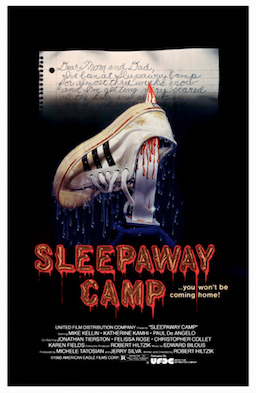
This is one of those instances where I can remember seeing the poster long before the attached movie.

Undoubtedly like most of the jaded youth of my generation, I first saw the poster for SLEEPAWAY CAMP back in the late 1980s. It’s the one that stayed with me the most over the decades.

It has the dominant image of a dripping wet shoe being stabbed all the way through by a bloodied knife. Above, there’s a letter from a camper, “Dear Mom and Dad, I’ve been at Sleepaway Camp for almost three weeks now and I’m getting very scared. …” Right below the hand holding the knife are the title dripping blood from its bold type and the tag “You won’t be coming home!”

Now, hours after watching SLEEPAWAY CAMP for the first time, it’s just as unforgettable as the poster.

To a great degree, SLEEPAWAY CAMP chucks our traditional notions of what constitutes a “good” or a “bad” movie right out the fucking window. It’s more of an experience, an event, a rite of passage, something where you can ask friends and family if they have ever seen it. If they have or haven’t, dynamite conversation will follow either way. For sure, though, it would make a great watch party — of course, following proper social distancing protocol at this point in history.

Here’s a few notes on the experience:

— Melodrama is defined as such, “A sensational dramatic piece with exaggerated characters and exciting events intended to appeal to the emotions.” Addendum: See SLEEPAWAY CAMP. Early on, after the obligatory flashback to traumatic events of the past, Desiree Gould’s Aunt Martha establishes the basic tone for the rest of the movie: Campy with overacting possible. Yes, SLEEPAWAY CAMP goes over-the-top, gleefully, merrily, in every scene, including the end credits.

— Being bat shit crazy for 84 minutes has been SLEEPAWAY CAMP’s meal ticket to cult movie immortality. Because, let’s face it, it’s not as well-made technically as similar low-budget precursors BLACK CHRISTMAS, ALICE SWEET ALICE, and HALLOWEEN. Not even remotely close.

— SLEEPAWAY CAMP uses a musical score that also functions as bludgeoning device and melodrama amplifier. I just checked for any injuries after being whacked upside the head at regular intervals by Edward Bilous’ sledgehammer score. I survived without a single bump — amazing, I know. Anyway, I looked up this Bilous fellow. IMDb linked me to edwardbilous.com and a Bilous quote from the Wall Street Journal, “Artists today need a new set of skills to be able to tell the unique story of their generation.” He’s the founding director for the Center for Innovation in the Arts and the artistic director for Beyond the Machine, A Festival of Electro-Acoustic and Interdisciplinary Art at Juilliard. He joined the Juilliard faculty in 1984.

— “Weird Al” Yankovic’s “Nature Trail to Hell” sounds like a spin on FRIDAY THE 13TH PART III and SLEEPAWAY CAMP. “Coming this Christmas to a theater near you / The most horrifying film to hit the screen / There’s a homicidal maniac who finds a cub scout troop / And he hacks up two or three in every scene / Please don’t reveal the secret ending to your friends / Don’t spoil the big surprise / You won’t believe your eyes when you see. …” and “See severed heads that almost fall right in your lap / See that bloody hatchet coming right at you / No, you’ll never see hideous effects like these again / ‘Till we bring you ‘Nature Trail to Hell Part 2.’” File “Nature Trail to Hell” alongside such “Weird Al” epics as “The Biggest Ball of Twine in Minnesota,” “Albuquerque,” “Trapped in the Drive-Thru,” and “Jackson Park Express.”

— In his final performance, veteran actor Mike Kellin (1922-83) surpasses Gould in scenery chewing. He chews scenery to such a degree that he could chew through every picture’s scenery within an entire multiplex. Kellin plays Camp Arawak owner Mel Kostic, who keeps downplaying everything until about the 50th dead body. At least it feels that way anyway. He’s one of those characters who becomes creepier and more detestable over the course of the movie, especially when he lines up dinner with a camp counselor in her late teens and assaults one of the main characters who he mistakenly believes to be the killer. Mel loses his shit late in the picture, and it’s not pretty.

— By this point in the review, I should have already discussed the plot. Eight years after a tragic boating accident near Camp Arawak, Aunt Martha sends her niece Angela (Felissa Rose) to camp with Ricky (Jonathan Tiersten), Angela’s cousin and Martha’s son who’s a veteran camper. Mean girls Judy (Karen Fields) and Meg (Katherine Kamhi), as well as a group of their male counterparts both teenage and prepubescent, are relentlessly cruel and nasty toward Angela and Ricky, especially the initially painfully shy and quiet Angela. Ricky’s friend Paul (Christopher Collet) takes a shining to Angela and he’s able to break her silence. Over time, however, the picture develops a dread pattern: Every character who’s cruel and nasty to Angela or Ricky bites the dust in spectacular fashion. Yes, just like everything else in the picture, including the crop-tops and short-shorts, the murder set pieces are over-the-top.

— At this relative late point in the slasher film craze, a mere five years since HALLOWEEN, films in the genre needed a major selling point and SLEEPAWAY CAMP includes one of those (awesome but infuriating) endings that redefines the reality of every scene that came before, just like FRIDAY THE 13TH and HAPPY BIRTHDAY TO ME. This beyond bizarre ending is the first and foremost reason we still talk about SLEEPAWAY CAMP all these years later.