Porky’s (1981)

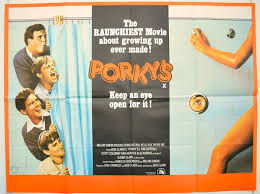
PORKY'S

PORKY’S (1981) Three stars

“Nobody ever went broke underestimating the intelligence of the American public,” H.L. Mencken famously said.

Mencken said that long before the success of PORKY’S, PORKY’S II: THE NEXT DAY, and PORKY’S REVENGE!, comedies which combined for over $200 million in box office and rental returns. Mencken died in 1956.

PORKY’S earned the vast majority of that $200 million and it came from out of seemingly nowhere to place fifth at the American box office in 1982, behind only breakaway winner E.T., ROCKY III, ON GOLDEN POND, and AN OFFICER AND A GENTLEMAN. PORKY’S sat on top of the American box office from late March through early May and it was dethroned by Arnold Schwarzenegger and CONAN THE BARBARIAN.

Unlike those other films, however, critics absolutely detested PORKY’S and aligned it with FRIDAY THE 13TH and THE CANNONBALL RUN in an unholy trinity of films that would no doubt lead to the downfall of Western Civilization. PORKY’S exhibits more than most how a film can be hated by critics and loved by the masses.

The success of the first PORKY’S spawned a whole slew of teenage sex comedies, often nostalgic and especially set in either the 1950s or 1960s.

I claimed a copy of PORKY’S as one of my first VHS purchases in my late teenage years and it quickly became a favorite movie of my rowdy group of friends. We loved it, as well as NATIONAL LAMPOON’S ANIMAL HOUSE, CADDYSHACK, KINGPIN, and THE BIG LEBOWSKI.

Every time I watch PORKY’S, I find a few big laughs and that’s why I am giving the film a passing grade. As far as the sequels are concerned, they are dreadful and deserve their horrible reputation. I remember seeing all of them in heavily edited form on “USA Up All Night,” before catching up with them all on video or pay TV.

Of course, our seven high school horn balls in PORKY’S are all played by older actors: Dan Monahan turned 26 in 1981, Mark Herrier 27, Wyatt Knight 26, Roger Wilson 25, Cyril O’Reilly 23, Tony Ganios 22, and Scott Colomby 29. That’s not anything new for a Hollywood film. For example, in GREASE, another highly successful nostalgia piece, John Travolta was 23 when he made it and Olivia Newton-John was 28 almost 29, Stockard Channing 33, Jeff Conaway 27, Barry Pearl 27, and Michael Tucci 31 when they were playing high school students.

Speaking of GREASE, one could describe PORKY’S as GREASE with T&A and rednecks instead of PG and greasers and without musical numbers.

PORKY’S includes sex jokes, condom jokes, sex jokes, size jokes, sex jokes, nude jokes, sex jokes, penis jokes, sex jokes, virgin jokes, sex jokes, and fat jokes, especially at the expense of villains Porky (Chuck Mitchell, a 6-foot-3, nearly 400-pound man) and Ms. Beulah Balbricker (Nancy Parsons).

Porky is a real vile piece of work, a saloon and brothel owner who is the most powerful man in his county. Every public official seems to be related to Mr. Wallace, namely his brother Sheriff Wallace (former NFL great Alex Karras). Mitchell wraps his best redneck goon around such dialogue as “I was givin’ the old place an enema and this pile of shit come floatin’ up to the surface” and “Where are these five little virgins who think they reached manhood? You wanna tangle ass with me? Come up here, you sawed-off punk! I’ll educate ya! I’ll wrap this right around your damn neck!” It is to Mitchell’s credit that he creates such a nasty character that we do root for his comeuppance in the final reel.

Balbricker embodies the worst killjoy or she’s basically portrayed as the Carrie Nation of the teenage sex comedy. Less successful, though, much less successful. After all, Carrie Nation (1846-1911) said things like “I felt invincible. My strength was that of a giant. God was certainly standing by me. I smashed five saloons with rocks before I ever took a hatchet” and “I want all hellions to quit puffing that hell fume in God’s clean air.” Balbricker (also called “Ball-breaker” and “King Kong” by other characters) develops an obsession with one character’s penis. Please can we call it a tallywhacker? Penis is so personal. Parsons, like Mitchell, gives a very good performance, one that rates with John Vernon in ANIMAL HOUSE.

Kim Cattrall must have used her work here as Miss Honeywell (“Lassie”) during her audition for “Sex and the City.” It definitely beats MANNEQUIN.

Writer and director Bob Clark (1939-2007) has a very interesting story and filmography, since his credits include the 1974 proto-slasher BLACK CHRISTMAS, the beloved A CHRISTMAS STORY, and the first two PORKY’S films, as well as even more diverse entries like MURDER BY DECREE, TRIBUTE, RHINESTONE, TURK 182!, LOOSE CANNONS, and BABY GENIUSES.

His entry in “Take One’s Essential Guide to Canadian Film” from 2001 : “Clark turned down bids to play pro football to complete a drama major at the University of Miami. With the success of his low-budget horror classic CHILDREN SHOULDN’T PLAY WITH DEAD THINGS, Clark moved to Montreal in 1973 and came to dominate Canadian commercial filmmaking for a decade. He followed CHILDREN with BLACK CHRISTMAS, a box-office hit starring Margot Kidder, and then, from 1978 to 1981, he directed MURDER BY DECREE, TRIBUTE, and PORKY’S – three of the most successful films produced in the tax-shelter era. Sad to say, the sophomoric PORKY’S remains the Canadian box-office champ. Clark returned to the United States in 1984; his career, like his locale, has gone south since.”

I read that Clark gathered the material for PORKY’S over a 15-year period, combining stories from other males of his generation with his own experiences. Every Hollywood studio passed on PORKY’S and it was produced by the Canadian company Astral Bellevue Pathe and Melvin Simon Productions (Mr. Simon, who died in 2009 at the age of 82, developed Mall of America, co-owned the Indiana Pacers along with his brother Herbert, and produced films including PORKY’S, THE STUNT MAN, and ZORRO, THE GAY BLADE), but 20th Century Fox picked up the U.S. distribution and a slick marketing campaign, combined with strong word-of-mouth, produced a monster hit on a $4 million budget.

Clark passionately defended the film amid the constant cries of misogyny and racism.

Those critics are missing that Wendy, played by Kaki Hunter, is often the sunniest presence and that Clark set his film in the Deep South in 1954. One character does overcome his initial anti-Semitism and becomes friends with a Jewish classmate.

THE NEXT DAY seems to address both criticisms, though, with one thoughtful dialogue scene between Wendy and main horn ball Pee-Wee (Monahan) and then adds a fanatical reverend, hypocritical politicians, a Native American, and the Ku Klux Klan to the mix. All the latter material simply does not mesh with the juvenile sex comedy.

Clark did not return to direct REVENGE and director James Komack and screenwriter Ziggy Steinberg wanted the third installment to return to the pure sex farce of the first movie. All the actors simply look too long in the tooth to be partaking in such adolescent shenanigans. I mean, for crying out loud, Colomby was nearly in his mid-30s by the point they made this third PORKY’S film; he graduated from Beverly Hills High School in 1970. Bottom line: I laughed not a single time at PORKY’S REVENGE, maybe once at NEXT DAY.


PORKY’S II: THE NEXT DAY (1983) One star; PORKY’S REVENGE! (1985) No stars

Kingpin (1996)

KINGPIN (1996) Four stars

Over a period of a couple years in the late 1990s, there were two great bowling comedies released: The Farrelly Brothers’ KINGPIN and the Coen Brothers’ THE BIG LEBOWSKI. Granted, there’s far more to both movies than bowling.

A few of my friends and I watched these movies time and time again. They both played a central role in nearly a decade of regular Friday or Saturday or Sunday night bowling adventures at the Holiday Lanes in Pittsburg, Kansas. Alcohol helped too, although when the bowling alley banned outside cups, college student attendance dramatically took a dip. Eventually, though, our group sucked it up and put the money down on the watered down bowling alley beer.

A couple times during my writing career, I have mentioned KINGPIN. I reviewed ZOMBIELAND for the college newspaper and reunited Woody Harrelson and Bill Murray gave me an opportunity to reference their dueling comb-overs in KINGPIN. I just laughed thinking about it. I named KINGPIN one of my 10 favorite sports movies for The Morning Sun.

Harrelson plays Roy Munson from Ocelot, Iowa, the 1979 Iowa state bowling champion who embarks on a professional bowling career early on during KINGPIN. He’s a promising young bowler, but, unfortunately, he runs afoul veteran bowler Ernie McCracken (Murray), who cons rather than mentors the younger bowler. McCracken hated the fact that Munson beat him in bowling and in a con gone tragically bad, a gang of amateur bowlers take it out on Munson after they find out both he and McCracken are pros. McCracken gets away, of course, and leaves Munson to reap the consequences. Munson loses his right hand in a scene that’s very, very, very rough for a PG-13 comedy. It plays like a scene from a Scorsese gangster pic.

Seventeen years later, Roy Munson’s a real born loser in Scranton, Pennsylvania. Man, talk about down on his luck. He’s got a prosthetic hand and a major drinking problem. He sales bowling supplies, rather unsuccessfully, since nobody wants novelty gags in the men’s room any more. Munson is perpetually behind on his rent and that means his creepy landlady harasses the former pro bowler. They work out a debt solution I do not recommend and work in a Mrs. Robinson parody for tremendous sport Lin Shaye.

Speaking of sports, KINGPIN parodies the genre. Munson takes on a managerial role for Amish bowler Ishmael (Randy Quaid) and they decide to work their way to Reno for a $1 million winner-takes-all tournament to save Ishmael’s farm. Along the way, they gain Claudia (Vanessa Angel) and Roy and Claudia assume the roles with Ishmael that Jack Nicholson and Otis Young did with Quaid in the 1973 film THE LAST DETAIL. Needless to say, Ishmael gets hurt on the eve of the tournament in Reno, Munson makes his bowling comeback, and Munson and McCracken eventually battle for $1 million and comb-over superiority.

I find myself laughing throughout most of KINGPIN. Like the comedies of the Z-A-Z boys and Mel Brooks, or for that matter the Marx Brothers and the Three Stooges, I laugh twice at some of these jokes, a second laugh at the fact that I laughed in the first place. For example, I am laughing right now just thinking about Roger Clemens’ cameo playing a redneck named “Skidmark” and I have already mentioned Harrelson’s and Murray’s comb-overs.

Harrelson, Quaid, and Murray all have no problem looking absolutely ridiculous on screen, something they demonstrate time and time again for nearly two hours in KINGPIN. The Farrelly Brothers and the actors will stoop just that low for a laugh.

Murray has made a parallel career for himself with supporting roles and cameos, ever since CADDYSHACK. He’s done it with TOOTSIE, ED WOOD, SPACE JAM, WILD THINGS, COFFEE AND CIGARETTES, and, of course, KINGPIN, where he appears near the beginning and near the end of the picture. He just about walks away with the movie. Ernie McCracken is a real piece of work, crass, vile, womanizing, on down the line, but he seems to be a beloved figure within the movie. Of course. We love Murray and McCracken, and it’s the way he reads lines like “It’s a small world when you’ve got unbelievable tits, Roy.”

Of course, McCracken’s talking about Claudia, played by the lovely Angel. She is the discovery in KINGPIN, because we have seen Harrelson, Quaid, and Murray be funny before in several movies. At the same time, Angel could be seen on TV during her run on “Weird Science,” playing the character first essayed by Kelly LeBrock. She plays some of the same notes in both roles, with her delightful English accent and her sarcastic wit. It’s a joy watching her sock it to Munson and McCracken. It remains a mystery why Angel has never become a bigger star.

I recently talked about enjoying few comedies as much as NATIONAL LAMPOON’S ANIMAL HOUSE. Well, I just spent over 800 words on one of those few.


The Big Lebowski (1998)

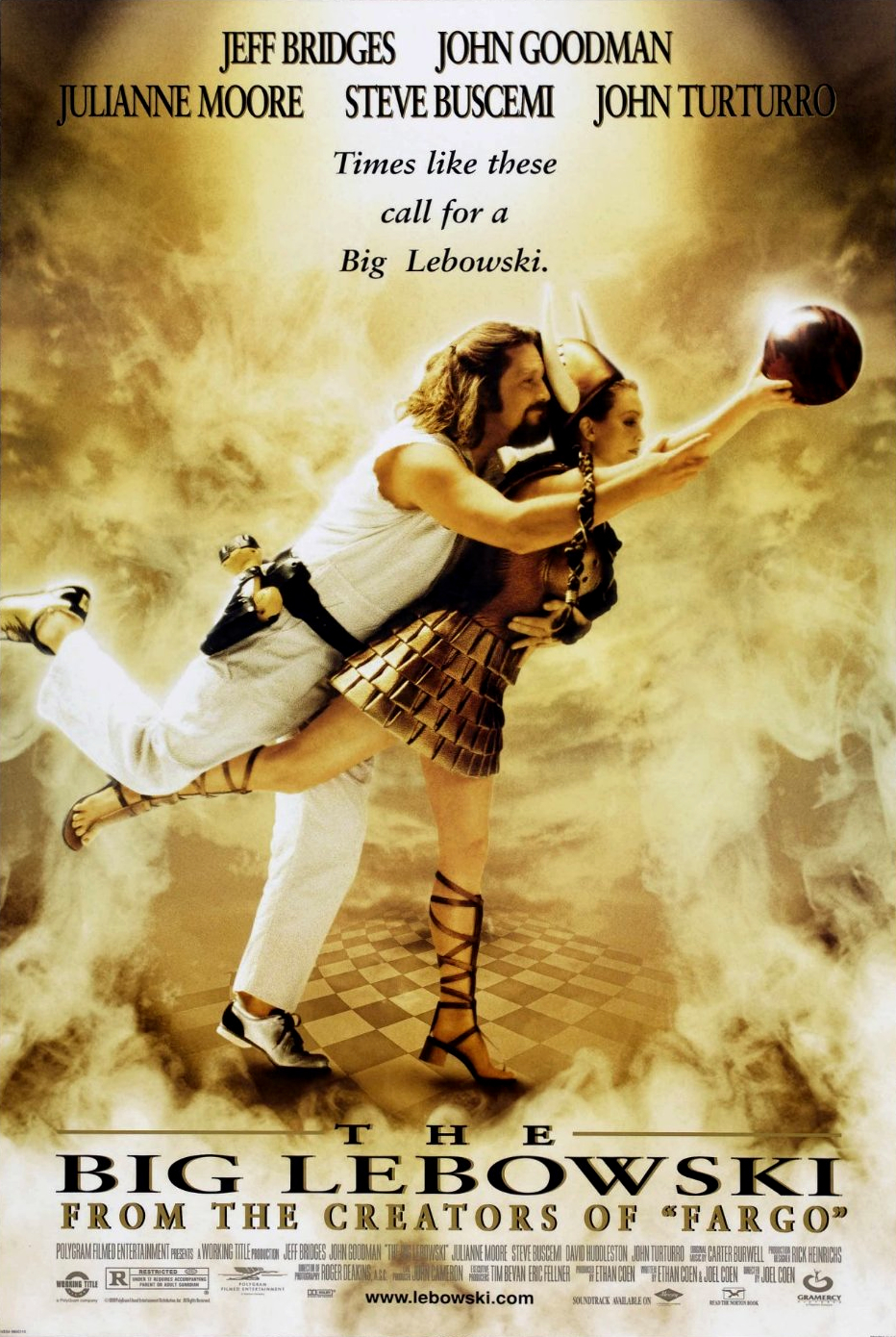
THE BIG LEBOWSKI

THE BIG LEBOWSKI (1998) Four stars
The Coen Brothers’ THE BIG LEBOWSKI starts with a brilliant idea: Why not take a blissed out former 1960s radical who loves his White Russians and his bowling with his two best mates and place him right smack dab in the heart of a labyrinthine plot straight from THE BIG SLEEP.

You might remember Howard Hawks’ 1946 classic, starring Humphrey Bogart and Lauren Bacall. That’s the one where writer Raymond Chandler famously said of the identity of the murderer of the Sternwoods’ chauffeur, “I don’t know.” Apparently, neither did Hawks or any of the various writers — William Faulkner, Leigh Brackett, Jules Furthman, and Phiip Epstein — involved with the screen adaptation of Chandler’s 1939 novel.

How does Jeffrey “The Dude” Lebowski react to such a convoluted plot?

I believe he explains it as such, “This is a very complicated case. You know, a lotta ins, lotta outs, lotta what-have-you’s. And, uh, lotta strands to keep in my head, man. Lotta strands in old Duder’s head. Luckily I’m adhering to a pretty strict, uh, drug regimen to keep my mind, you know, limber.”

Main characters “The Dude” and Walter Sobchack are known to be inspired by a couple Hollywood eccentrics: Jeff Dowd and John Milius.

Dowd was a member of the Seattle Liberation Front, a radical anti-Vietnam War protest group that became known as the Seattle Seven. Lebowski mentions this fact in THE BIG LEBOWSKI.

Dowd then became a producer’s representative, a consulting producer, creative consultant, post-production consultant, producer, and executive producer. Those are some of his credits.

Ethan and Joel Coen first met Dowd around the time of their feature debut BLOOD SIMPLE.

I remember coming across him in the writings of Roger Ebert, for example a story from the 1999 Toronto Film Festival called “Dude Keeps Building a Rep.”

It starts out with Dowd telling Ebert that he’s got to see a movie called GOAT ON FIRE & SMILING FISH. Ebert’s in the press office at the Toronto Film Festival, only out of his hotel room four minutes before Dowd could find the critic. Dowd hands Ebert two Xeroxed sheets stapled together promoting GOAT ON FIRE & SMILING FISH.

Ebert wrote, “The Dude’s name is Jeff Dowd. He is tall and large and has a lot of unruly curly hair and a big mustache. If you saw the Coen Brothers movie THE BIG LEBOWSKI, Jeff Bridges was playing a character based on him, although the Dude is a great deal more abstentious than the Bridges character. If he were not, the movie would have been called THE LATE LEBOWSKI. The Coens and Dowd go back a long way, to 1984, when he was telling me, ‘You gotta see this one. It’s called BLOOD SIMPLE. These are the Coen Brothers.’”

Dowd “repped” THE BLACK STALLION, CHARIOTS OF FIRE, HOOSIERS, THE STUNT MAN, and THE BLAIR WITCH PROJECT, just like he did GOAT ON FIRE & SMILING FISH.

Dowd to Ebert, “Just so people see them. I’d walk up and down the lines for hit movies, handing out brochures for what we were showing. The way I figure it is, who goes to movies? People who go to movies, that’s who. They may or may not read Premiere magazine. They may or may not watch TV. But they go to movies. So if Warner Bros. spends $40 million to promote a movie and they’re standing in line to see it, why not tell them about my movie?

“A lot of the movies, they’re not what they seem to be. You take THE BLACK STALLION. The studio said it would never appeal to children because the first 18 minutes were without dialogue. I hold a test screening. A little girl, 5 years old, is in front of me. She tells her mommy she has to pee. She gets up and stands on the aisle, still watching the screen, and she stands there for the next 10 minutes. Her knees are knocking together, she has to pee so bad, but she can’t stop watching. The whole history of THE BLACK STALLION was changed, right then and there.”

The St. Louis-born Milius’ writing credits include JEREMIAH JOHNSON, MAGNUM FORCE, APOCALYPSE NOW, 1941, and CLEAR AND PRESENT DANGER. He both wrote and directed THE WIND AND THE LION, BIG WEDNESDAY, CONAN THE BARBARIAN, and RED DAWN. He’s not directed anything since 1997.

Milius says that Hollywood blacklisted him for his conservative beliefs.

He’s the disreputable one of the Film Brat Generation, whose friends and colleagues include Steven Spielberg, George Lucas, Francis Ford Coppola, and Brian DePalma.

A 2017 Indie Film Hustle story comes with the tagline “John Milius: The Craziest Director in Hollywood?”

“He’s a really funny guy, a really good storyteller,” Ethan Coen said of Milius in a book on THE BIG LEBOWSKI. “He was never actually in the military, although he wears a lot of military paraphernalia. He’s a gun enthusiast and survivalist type. Whenever we saw him, he’d invite us out to his house to look at his guns — although we never took him up on it.”

You can hear Milius’ storytelling abilities on commentaries for APOCALYPSE NOW, 1941, and CONAN THE BARBARIAN, for example.

Milius contributed Robert Shaw’s famous U.S.S. Indianapolis speech in JAWS (uncredited), some of Dirty Harry’s best lines, and all that stuff about surfing in APOCALYPSE NOW.

It helps that John Goodman, like Milius, is a native of the St. Louis area.

Bridges and Goodman have been two of the best actors working in the movies.

They’re probably as close to a guarantee of quality as anybody you can name.

“The Dude” and Walter are likely the characters they will be most associated with all their lives.

There’s lots of inspired madness throughout THE BIG LEBOWSKI.

Like the trippy production number called “Gutterballs,” combining bowling and Busby Berkeley, all scored by Kenny Rogers and the New Edition’s “Just Dropped In (To See What Condition My Condition Was In),” Rogers’ first Top 10 hit.

Like the German nihilists who have a band and album that are parodies of / homages to Kraftwerk, with the band name Autobahn and the album cover that’s similar to THE MAN-MACHINE.

Like utilizing gems like Bob Dylan’s “The Man in Me” and Captain Beefheart’s “Her Eyes Are A Blue Million Miles.”

Like Mr. Lebowski’s rant about the Eagles. Reportedly, Allen Klein (1931-2009) wanted $150,000 for usage of the Rolling Stones’ “Dead Flowers,” but he waived that licensing fee because he so loved the scene where “The Dude” hates on the Eagles. You’re not the only one, Mr. Klein.

THE BIG LEBOWSKI joins TWILIGHT ZONE: THE MOVIE and AN AMERICAN WEREWOLF IN LONDON for some of the best utilization of Creedence Clearwater Revival in a moving picture.

Coupled with BOOGIE NIGHTS (1997), THE BIG LEBOWSKI helped start my love affair with Julianne Moore, which continued over many, many years in everything from THE END OF THE AFFAIR to CHLOE.

Character actors Steve Buscemi, John Turturro, Ben Gazzara, David Huddleston, and Philip Seymour Hoffman all lend their abilities to the menagerie.

Never mind Sam Elliott’s voiceover narration.

I vividly remember coming across THE BIG LEBOWSKI when it came on Showtime in the late 1990s. I played the VHS dub I had for several friends and it became one of our favorite movies.

I’ve seen it many, many, many times over the years. It’s my favorite Coen Brothers movie, certainly far ahead of the overrated FARGO and NO COUNTRY FOR OLD MEN.

An old friend would seemingly only want to play THE BIG LEBOWSKI, FEAR AND LOATHING IN LAS VEGAS, and THE CROW, although he would also play the hell out of CITY LIGHTS, BLADE RUNNER, and SOME LIKE IT HOT as well, for that matter.

It’s been a while since I’ve watched it and I just might have to change that very, very soon.