
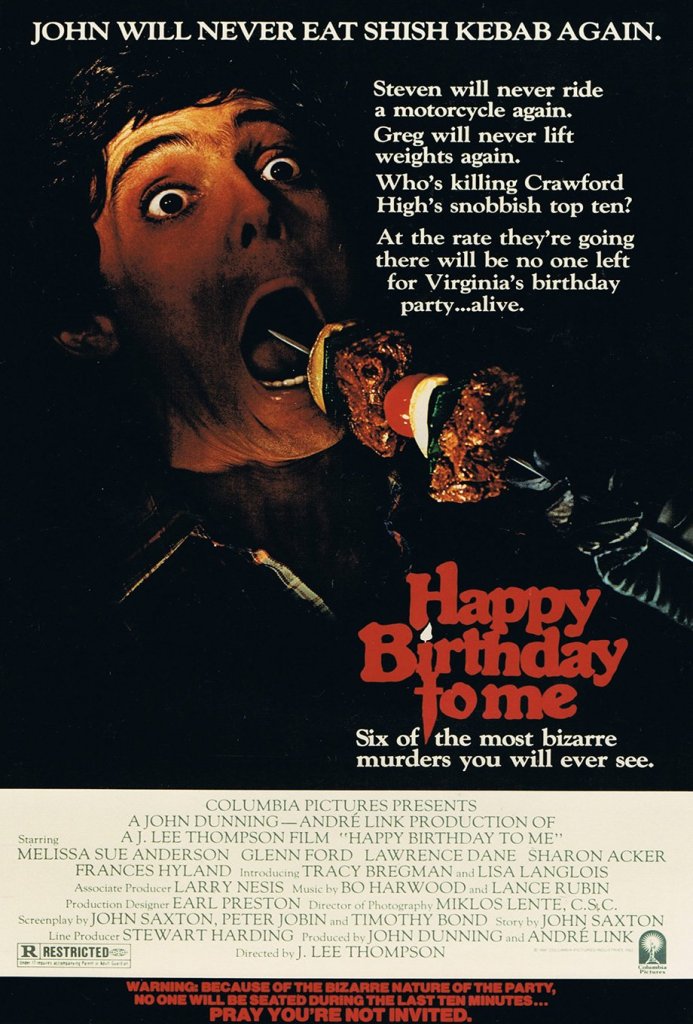
Happy Birthday to Me (1981)

HAPPY BIRTHDAY TO ME (1981) ***
Happy Birthday to Me stands out from the early ’80s slasher film craze pack because a) it has superior production values with a name director (J. Lee Thompson, who directed The Guns of Navarone and Cape Fear) and a good cast including an unhappy Glenn Ford, b) it has a longer running time than the average 85- and 90-minute slasher film, and c) it has one of the most bizarre twist endings this side of Sleepaway Camp.

Just like fellow 1981 Canadian slasher My Bloody Valentine, also produced by John Dunning and André Link with distinctive elements for a slasher, Happy Birthday to Me calls to mind a prestigious Academy Award for Best Picture winner, 1980’s Ordinary People. (My Bloody Valentine recalled The Deer Hunter from the coal mine setting and overall working-class milieu, the prodigious beer drinking, and the more adult-like plot and romantic triangle.)

Let’s see, Happy Birthday to Me and Ordinary People both have the same elite upper middle class suburban prep school environment, traumatic events in the past, troubled teenagers, and a therapist who works with our troubled teen protagonist.

Happy Birthday to Me plays more like a glossy, lurid soap opera at times punctuated with some creative, gruesome murder set pieces.

Melissa Sue Anderson makes her motion picture feature debut in Happy Birthday to Me as protagonist Virginia Wainwright. She had nearly a decade of experience on TV by that point, though, most notably as Mary Ingalls / Mary Ingalls Kendall on the hit show Little House on the Prairie. You can bet playing a blind Mary for a number of seasons prepared an 18-year-old Anderson for her flashbacks, brain operation, therapy sessions, memory loss, and traumatic blackouts throughout Happy Birthday to Me.

Slasher films often pursued at least one name actor for their cast: Betsy Palmer (Friday the 13th), Ben Johnson (Terror Train), Leslie Nielsen (Prom Night), Lauren Bacall, James Garner, and Maureen Stapleton (The Fan), and Farley Granger (The Prowler).

Glenn Ford accumulated 110 acting credits from 1937 through 1991, highlighted by Gilda, The Big Heat, Blackboard Jungle, 3:10 to Yuma, Midway, and Superman. Ford (1916-2006) wouldn’t have wanted to be remembered for Happy Birthday to Me and he was reportedly a very unhappy camper making the film, heavily drinking throughout and hitting the assistant director after he called for a lunch break during the middle of one of Ford’s scenes.

He’s not all that big a role in Happy Birthday to Me.

Ginny Wainwright attends the snobby Crawford Academy and she’s a member of the school’s Top 10 clique, only the best and brightest. They are systematically eliminated apparently by Ginny, and we find out that none of the Top Ten attended Ginny’s birthday party four years before the start of the movie. They attended instead another party for a Top 10 member and Ginny and her mother are then involved with an auto accident that kills Ginny’s mother and leaves the surviving Ginny needing her experimental brain tissue restoration.

Ginny was originally planned to be revealed as the killer possessed by the spirit of her dead mother, but the film instead chose a shocking twist ending that remains the main reason why fans of the film remember it so fondly 40 years later.

Thompson (1914-2002) reportedly got so much into the spirit of the enterprise that he was throwing around buckets of blood on set. The final 40 minutes pile up the corpses.

Columbia Pictures went for both the bloody and bizarre in promoting Happy Birthday to Me, a minor hit in the summer of 1981.

The poster has an image of the most famous murder set piece of the movie.

JOHN WILL NEVER EAT SHISH KEBAB AGAIN.

Steven will never ride a motorcycle again.

Greg will never lift weights again.

Who’s killing Crawford High’s snobbish top ten?

At the rate they’re going there will be no one left for Virginia’s birthday party … alive.

Happy Birthday to Me … Six of the most bizarre murders you will ever see.

WARNING: BECAUSE OF THE BIZARRE NATURE OF THE PARTY, NO ONE WILL BE SEATED DURING THE LAST TEN MINUTES … PRAY YOU’RE NOT INVITED.

Factual accuracy is not this poster’s strong suit, since there’s nine deaths in the movie, there’s no John character in the movie, Steven’s the one killed by kebab, and Etienne’s the one done in by a motorcycle.

The Texas Chainsaw Massacre 2

THE TEXAS CHAINSAW MASSACRE 2 (1986) ***
I wanted to like The Texas Chainsaw Massacre 2 considerably more than I did, because of the way director Tobe Hooper (1943-2017) and screenwriter Kit Carson (1941-2014) mixed in satire and dark comedy with all the material that seems like a prerequisite for a sequel to only one of the most infamous movies ever made, 1974’s The Texas Chain Saw Massacre.

Unfortunately, though, leading lady Caroline Williams’ harried disc jockey Stretch — yes, even women from Texas have names that play right alongside Slim and Tex — spends a good 75 percent of her screen time screaming. Williams screams more than Fay Wray in The Most Dangerous Game and King Kong and Mystery of the Wax Museum combined, more than Jamie Lee Curtis in Halloween and The Fog and Prom Night and Terror Train and Halloween II combined, and more than all the heroines combined who have faced Jason and Freddy and Michael over the last couple decades. Williams probably wishes they paid her by the scream.

All that infernal screaming begins to bog Massacre 2 down in the middle stretches of a film that both starts and finishes rather strongly.

Massacre 2 also features a Dennis Hopper performance that rates a distant fourth behind River’s Edge, Blue Velvet, and Hoosiers in the unofficial Hopper-portrays-an-epic-burnout-not-totally-unlike-himself (though, to be fair to Hopper, his Blue Velvet character goes beyond, way beyond, the pale of the normal cinematic psychopath) in 1986 competition.

Since Hopper (1936-2010) portrays former Texas Ranger and Sally and Franklin Hardesty-Enright’s uncle Lt. Boude ‘Lefty’ Enright and Cannon Films released Massacre 2, wouldn’t it have been absolutely fantastic if Cannon action hero Chuck Norris played the ranger pursuing vigilante justice against the ripped, twisted, absolutely positively deranged (not to mention cannibalistic) Sawyer family.

Both Chainsaw movies start with narration and an opening crawl.

The original: The film which you are about to see is an account of the tragedy which befell a group of five youths, in particular Sally Hardesty and her invalid brother, Franklin. It is all the more tragic in that they were young. But, had they lived very, very long lives, they could not have expected nor would they have wished to see as much of the mad and macabre as they were to see that day. For them an idyllic summer afternoon drive became a nightmare. The events of that day were to lead to the discovery of one of the most bizarre crimes in the annals of American history, The Texas Chain Saw Massacre.

The sequel: On the afternoon of August 18, 1973, five young people in a Volkswagen van ran out of gas on a farm road in South Texas. Four of them were never seen again. The next morning the one survivor, Sally Hardesty-Enright, was picked up on a roadside, blood-caked and screaming murder. Sally said she had broken out of a window in Hell. The girl babbled a mad tale: a cannibal family in an isolated farmhouse … chainsawed fingers and bones … her brother, her friends hacked up for barbecue … chairs made of human skeletons … Then she sank into catatonia. Texas lawmen mounted a month-long manhunt, but could not locate the macabre farmhouse. They could find no killers and no victims. No facts; no crime. Officially, on the records, The Texas Chainsaw Massacre never happened. But during the last 13 years, over and over again reports of bizarre, grisly chainsaw mass-murders have persisted all across the state of Texas. The Texas Chainsaw Massacre has not stopped. It haunts Texas. It seems to have no end.

Made on an estimated $80-140,000 production budget, the original deserves such descriptive phrases as grainy and gritty. Gory, no. Disturbing, yes definitely, terrifying, for sure, with a more than macabre sense of humor, especially during the best dinner table scene this side of Tod Browning’s Freaks. I about lose it every time the family wants the 124-year-old Grandpa Sawyer to end Sally’s life with one crushing blow of a hammer and this cannibalistic codger just can’t find the strength to do it, ultimately giving Sally the opportunity for escape.

More than a decade later, Hooper wanted Massacre 2 to be a dark comedy, accentuating those elements from the original. Meanwhile, naturally, Cannon desired a finished product more along the lines of The Texas Chainsaw Massacre or at least its shocking reputation.

The finished product plays more like a compromise.

Both films are reflective of the times they were made. The original, released on the first day of October 1974, came out in the midst of Richard Nixon’s resignation speech, the Watergate scandal that brought Nixon down, the final year of the Vietnam War, the Oil Embargo 1973-74, and general discord in the land. The sequel, released on Aug. 22, 1986, gives us cannibals with ‘family values’ a few months before former Hollywood actor turned politician Ronald Reagan’s speech centered around the family unit and giddy excess in every single frame to produce a bigger but not better Texas Chainsaw Massacre.

The original has this insidious way of getting underneath our skin and dominating our thought patterns, and none of the slicker sequels, remakes or imitations even come remotely close to its power to provoke.

NOTE: The parody of The Breakfast Club earns the film’s poster four stars.

Terror Train (1980)

TERROR TRAIN.jpg

TERROR TRAIN (1980) Two stars
An above-average cast and cinematographer John Alcott’s work aboard a novel setting for a horror film distinguish TERROR TRAIN but otherwise, it’s a bumpy ride for 90-plus minutes.

TERROR TRAIN succeeds in making the sales pitch “HALLOWEEN on a train” come true.

Scream queen Jamie Lee Curtis headlined the cast and this was her fourth horror movie of a career that began with a big bang in HALLOWEEN. She appeared in three horror movies alone in the calendar year 1980: THE FOG in February followed by Canadian productions PROM NIGHT (July) and TERROR TRAIN (October). HALLOWEEN II rounded out the Curtis horror movie quintology in October 1981 and she had successfully become typecast. Curtis broke free by the end of the decade, proving herself especially adept at comedy.

HALLOWEEN was a great scary movie and Curtis’ next four ranged from the average (THE FOG, HALLOWEEN II, TERROR TRAIN) to the abysmal (PROM NIGHT). They made her Laurie Strode character in HALLOWEEN II a shell of herself from the first movie: Curtis never quite perfected her limp and it was depressing to see her in that hobbled state after being such a refreshing, resourceful character in the original. She never lost her scream, though.

Like seemingly every other slasher of the era, TERROR TRAIN starts in the past. In the original HALLOWEEN, 6-year-old Michael Myers murdered his teenage sister Judith. In FRIDAY THE 13TH, two camp counselors are murdered. In PROM NIGHT, there’s a prank gone horribly wrong. TERROR TRAIN belongs in the prank gone horribly wrong category.

Curtis plays Alana Maxwell, who reluctantly takes a central role in the sexual initiation prank against fraternity pledge Kenny (Derek MacKinnon). Kenny, of course, goes schizo almost immediately after this prank and he’s sent to a psychiatric hospital. Three years later, these same fraternity and sorority creeps host a New Year’s Eve costume party on a moving train … and they have an uninvited guest. This costume party angle affords the filmmakers another novelty: Kenny can assume the identity of every person he kills, so he can be the guy in the Groucho Marx mask or the great lizard costume and catch his next victim by complete surprise.

These fraternity and sorority characters are by and large noxious pieces of work, especially Doc (Hart Bochner) and Mo (Timothy Webber). Their inevitable deaths feel like they take forever, mainly because we have to endure more and more of their odious behavior. Then, when we get there, their deaths are letdowns compared to similar moments in other slasher films. I mean, for crying out loud, even PROM NIGHT, an otherwise awful movie, gives us a great decapitation replete with a head roll.

And now for something completely different: Slashers often found room for at least one veteran cast member. They picked Ben Johnson (1918-96) as the veteran cast member in TERROR TRAIN and he thankfully gets a more substantial role than, let’s say, Glenn Ford in HAPPY BIRTHDAY TO ME. As the conductor Carne, Johnson shows the cool of a world champion rodeo cowboy and Academy Award winning supporting actor (LAST PICTURE SHOW). In fact, he’s almost too cool in the midst of all the murder and mayhem. Overall, he’s a welcome presence.

David Copperfield (the magician, not the Charles Dickens character) makes his motion picture debut, apparently because producer Sandy Howard liked magicians. Copperfield stretches his chops by playing “The Magician,” does a routine that slows down the movie even more in the middle, and bows out none too gracefully after being an obligatory red herring.

Harry Houdini (1874-1926) made only silent movies: feature-length THE GRIM GAME, THE MAN FROM BEYOND, and HAIDANE OF THE SECRET SERVICE. Silence could have served TERROR TRAIN well.

John Alcott (1931-86) received a mention in the opening paragraph for his cinematography. His credits include the Stanley Kubrick films 2001, A CLOCKWORK ORANGE, BARRY LYNDON, and THE SHINING (released about five months before TERROR TRAIN), and I mentioned him in the review of the 1975 World War II film OVERLORD. OVERLORD seamlessly combined archival footage director Stuart Cooper found from the Imperial War Museum with contemporary footage shot by Alcott. Alcott’s challenge in TERROR TRAIN naturally centered on space and lighting, and he proved up to the challenge. You can file TERROR TRAIN in the great-looking slasher films after HALLOWEEN and MY BLOODY VALENTINE.

Ultimately, though, TERROR TRAIN succeeds at train and fails at terror.