Phantom of the Paradise (1974)

PHANTOM OF THE PARADISE

PHANTOM OF THE PARADISE (1974) **

Brian De Palma’s PHANTOM OF THE PARADISE, a great big flop during its original release, is another cult film where I have to say, “I am glad you love this movie, but I don’t.” Big deal, it happens both ways on a regular basis.

It’s also one of those movies where I liked it less and less the more it was on, until I simply just wanted it to be over.

PHANTOM OF THE PARADISE gets called a “rock opera” and compared with THE ROCKY HORROR PICTURE SHOW, which came out about one year later.

Now, we’re getting to the heart of the problem. Both PHANTOM OF THE PARADISE and ROCKY HORROR are limp-wristed rock if they are in fact rock at all. Paul Williams, the songwriter and star of PHANTOM, he’s best known for writing Three Dog Night’s “An Old Fashioned Love Song,” the Carpenters’ “Rainy Days and Mondays,” Barbra Streisand’s “Evergreen” from A STAR IS BORN, and Kermit the Frog’s “Rainbow Connection” from THE MUPPET MOVIE. Not exactly the most rocking credentials.

Singer-songwriter and show tunes, with a little Sha Na Na and Meatloaf thrown in for extra measure, are not my idea of rock and that’s what PHANTOM and ROCKY HORROR offer listeners and viewers.

I already wrote a review comparing ROCKY HORROR against ROCK ‘N’ ROLL HIGH SCHOOL, a 1979 film that centers around the music of the Ramones.

This whole rock opera angle initiated my brilliantly engineered mind to recall Ken Russell’s TOMMY from 1975, another musical contemporaneous with both PHANTOM and ROCKY HORROR that’s far more deserving of being called a “rock opera.” That’s definitely true, because at one time The Who — the band responsible for the music for both the 1969 album and 1975 movie — owned the rights on “loudest rock band in the world.” They lived rock, long before they wrote a song like “Long Live Rock,” “Be it dead or alive.”

Russell, who’s every bit as good as De Palma at capturing wretched excess on celluloid, gives us non-singers Oliver Reed and Jack Nicholson, natural born entertainers Ann-Margret and Tina Turner, a Marilyn Monroe-themed cult led by “The Preacher” (Eric Clapton), and Elton John’s centerpiece “Pinball Wizard” number, taking advantage of a $5 million budget. Hell to the yes, I love me some pinball and Sir Elton’s melodramatic demise. Never mind what Ann-Margret does with champagne, beans, chocolates, and bubbles. What’s that Beach Boys line about excitation?

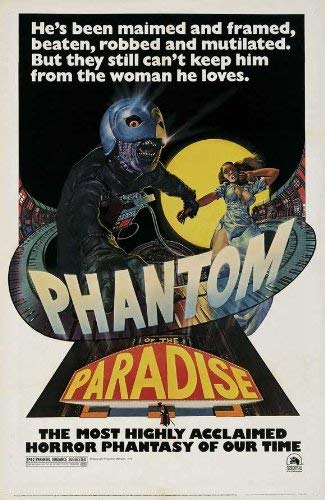
PHANTOM OF THE PARADISE (reportedly made for $1.3 million) takes on classic novels “Phantom of the Opera,” “The Picture of Dorian Gray,” and “Faust.” It also predates the Black Sabbath compilation album “We Sold Our Soul for Rock ‘N’ Roll.”

I prefer the 1925 silent PHANTOM OF THE OPERA because of Lon Chaney’s brilliant performance (his 1974 counterpart William Finley gives the best performance in the movie), the fact that melodrama works better in silent rather than sound films, and the fact that we do not hear the opera music. Yeah, that’s right, I do not particularly care for opera, rock or not. PHANTOM OF THE PARADISE does not rock enough.

I would have greatly preferred Robert Johnson’s music over Paul Williams’ tunes. Here I am and I can’t remember any of Williams’ songs from the film. Not a good sign.

I would not be surprised, though, to find out that Dario Argento cast Jessica Harper in SUSPIRIA (1977) because of her performance in PHANTOM OF THE PARADISE.

I’ll take SUSPIRIA.

TOMMY (1975) ***

TOMMY

House (1977)

HOUSE

HOUSE (1977) Four stars

The year 1977 produced four of the definitive WTF movies in the history of cinema: ERASERHEAD, SUSPIRIA, EXORCIST II, and HOUSE, an item from the Japanese studio (Toho) responsible for Akira Kurosawa, Godzilla, Mothra, Rodan, and the H-Man.

Toho really outdid itself with HOUSE, which even surpasses GODZILLA VS. THE SMOG MONSTER in nonstop funky weirdness. Janus Films describes HOUSE as an episode of “Scooby Doo” directed by Dario Argento.

Bottom line: HOUSE just might be even weirder than ERASERHEAD, more colorful than SUSPIRIA, and more whacked out bat shit crazy than EXORCIST II. You have been warned.

First-time director Nobuhiko Obayashi pulls out all the stops in realizing a rather simple tale on the surface: teenage girl Gorgeous (Kimiko Ikegami) and her six friends Prof (Ai Matsubara), Melody (Eriko Tanaka), Mac (Mieko Sato), Kung Fu (Miki Jinbo), Sweet (Masayo Miyako), and Fantasy (Kumiko Oba) pay Gorgeous’ aunt (Yoko Minamida) in the country a visit. It just so happens that the aunt died in this house many years ago waiting on her fiancee to return from World War II and her spirit remains and feasts on unmarried girls. This is a haunted house movie where the house is hungry, very hungry indeed.

Obayashi’s at-the-time pre-teen daughter Chigumi Obayashi contributed ideas to her father. She came up with several childhood fears, her father relayed the fears to screenwriter Chiho Katsura, and they incorporated her ideas into the finished product. You’ll be able to recognize her contributions almost instantly and they contribute to the uniqueness.

Just as a fun exercise, I looked up the plot keywords for HOUSE on IMDb: “refrigerator,” “banana,” “watermelon,” “bloody spray,” “dismemberment,” “decapitation,” “full frontal nudity,” and “severed head” are some of the more interesting 75 keywords and they only scratch at the surface of the overall bizarre nature of the entire enterprise.

More than 30 years after its original release, HOUSE seemingly came from out of nowhere to develop a cult following in the United States, playing first as a midnight movie in Nashville and then at a film festival in Austin in 2009 before heading to DVD.

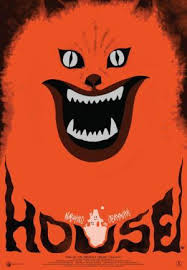
I first encountered HOUSE through its cover image for the Criterion Collection release on October 26, 2010. Maybe you remember seeing that artwork, as well. Nashville graphic designer and Ben Folds drummer Sam Smith came up with the distinctive image: “I used the first idea that came to me after watching a screener of the film — Blanche the cat’s psycho-screaming mug — and adapted it to stand alone as a symbol of the uncanny and over-the-top assault that our midnight-movie audience was in for,” Smith said. The poster first appeared for the film at the Belcourt Theatre in Smith’s hometown.

Then, I read the reviews for HOUSE and they’re nearly as over-the-top as the film itself.

Online reviewer Dennis Schwartz wrapped up his mixed review, “The director uses freeze-frames, jump-cuts, video effects to change dimensions, spiral effects, color tints, and assorted other techie tricks to play the scary pic card more for laughs than to be gruesome. It’s an experimental visual pic that becomes overwhelmed with low-brow slapstick comedy, a ridiculous killer house and garish visuals. But it’s a one-of-a-kind film that has its admirers, who just can’t resist such weird childish nonsense.”

Michael Atkinson opined in the Village Voice, “But though it plays like a retarded hybrid of ROCKY HORROR and WHISPERING CORRIDORS, it is, moment to moment, its own kind of movie hijinks. It even won a directorial-debut critics’ prize back in the day. Gigglers and cultists, pony up.”

I watched James Rolfe’s review for Monster Madness X from 2016. Rolfe started his review with a pause and a WOW! Of course, Rolfe picked HOUSE for one of the “WTF Wednesday” reviews.

I finally caught up with HOUSE in late summer 2019 and it lived up to expectations. It calls to mind a few pictures: EVIL DEAD II, THE SPIRIT OF THE BEEHIVE, THE 5,000 FINGERS OF DR. T, DAISIES, SUSPIRIA, and MY NEIGHBOR TOTORO. Like those films, though, HOUSE ultimately stands alone as an unique work because it creates its own world. I find that I respond more forcefully to fictional works that do that, rather than just rehash more of the same old already damaged goods. I want to be challenged, inspired, etc. I’ve never seen a haunted house movie quite like HOUSE.

HOUSE haunts one’s thoughts and gains in strength upon deeper reflection. At this moment of typing, I am thinking about Gorgeous’ aunt and how much time she spent waiting alone in that house for the love of her life to return from World War II. He never did, and they both died, she in that darn house and she’s cursed to haunt it for eternity because of her bitterness about the war. Then, I start thinking about the sheer enormity of the loss endured by the human race from Sept. 1, 1939 through Sept. 2, 1945: An estimated 70-85 million people died or three percent of the world’s population in 1940; 50-55 million civilians and 21-25 million soldiers no longer lived on this planet from a variety of causes, death on a mass scale that doubled World War I; the atomic bomb and the Holocaust two of humanity’s depressing advancements in death.

Obayashi was born in Hiroshima in 1938 and he lost all his childhood friends when the United States dropped an atomic bomb on Hiroshima on Aug. 6, 1945. Hiroshima and Nagasaki, as well as post-WWII nuclear testing, inform many Japanese films of the last almost 75 years.

Suspiria (1977)

DAY 24, SUSPIRIA

SUSPIRIA (1977) Four stars
This is one of those rare films where what would normally be weaknesses actually turn out to be strengths and help the film become a seminal work.

For example, older actors playing high school students (Jessica Harper and Stefania Casini were both in their late 20s) and dubbing only add to the weirdness and disorienting nature of SUSPIRIA, director and writer Dario Argento’s first installment in the “Three Mothers” trilogy.

SUSPIRIA is first and foremost a visceral experience, a treat for the eyes and the ears with first-rate production and sound design. It was one of the last films to use imbition Technicolor (used previously for THE WIZARD OF OZ and GONE WITH THE WIND) and it looks absolutely marvelous with its vivid colors.

You won’t be able to keep your eyes off the screen, even if you want to cover them during some of the more squeamish moments. Just remember the film’s tagline: “The only thing more terrifying than the last 12 minutes of this film are the first 92.”

Italian progressive rock band Goblin, who previously scored Argento’s 1975 classic giallo DEEP RED and later scored TENEBRE (1982), adds tremendously to the disorientating effect; Goblin’s scores for DEEP RED and SUSPIRIA rank with John Carpenter’s main HALLOWEEN theme and Bernard Herrmann’s work for Alfred Hitchcock’s thrillers.

Disorientation is what SUSPIRIA achieves thematically above anything else. We’re never quite sure what’s going to happen next, despite the fact that we think we know what to expect, even in an Argento movie, from all our experience watching scary movies. We know that everything will be heightened in an Argento movie, just like other Italian horror movies by such maestros as Mario Bava and Lucio Fulci.

However, like a lot of those other films, all the elements in SUSPIRIA work together even if logically nothing makes any sense in the moment.

Urban Dictionary lists SUSPIRIA as “One of the greatest movies ever made — Dario Argento’s 1977 horror film, about a young girl at a German dancing academy, who discovers that the faculty are witches, plotting against her life in a series of ritual voodoo killings, involving sacrifices and vestal virgins on a pagan altar. … I first saw SUSPIRIA at the age of 10, and was terrified.”

Guess that’s one way to use “Suspiria” in a sentence.

NOTE: The 2018 remake directed by Luca Guadagnino was released October 26. The movie stars Dakota Johnson and Tilda Swinton, as well as Jessica Harper and Chloe Grace Moretz, and Thom Yorke (Radiohead) provided the soundtrack.