Venom (1981)

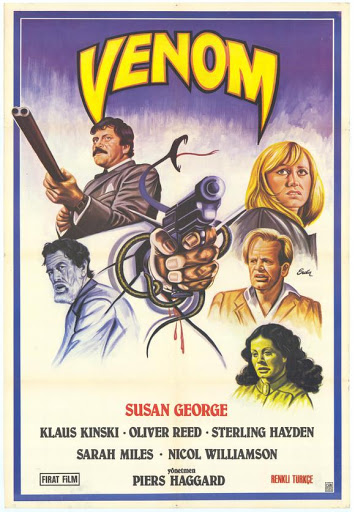
VENOM (1981) ***
I just finished considering Silent Rage, a film that runs Chuck Norris, a Western, Animal House, mad scientists, and a madman killer made indestructible through a cinematic blender.

Thus, I feel safe in saying that Silent Rage prepared me for Venom, a British horror film that has a distinguished multinational cast, kidnapping and hostage negotiation, and only the world’s deadliest snake, the dreaded Black mamba from sub-Saharan Africa. The mamba gets a few closeups, more than Norma Desmond in Sunset Boulevard and Daffy Duck in Duck Amuck, and its own POV. Yeah, we’ll call it the Black Mamba Cam.

That distinguished cast includes kidnappers Klaus Kinski and Oliver Reed, Scotland Yard commander and lead negotiator Nicol Williamson, snake expert Sarah Miles, slinky (won’t call her slutty or a snake expert in her own right) nurse Susan George, and lovable crusty old grandfather Sterling Hayden.

Basically, Venom contains three movies within one — the kidnapping inside the house, the hostage negotiation and the behind-the-scenes police maneuvering on the outside, and the deadly snake on the loose. We’ve all seen kidnapping and hostage negotiation plenty before, on TV cop shows and in the movies, but very rarely do the kidnappers have to deal with the world’s deadliest snake. And Lord knows we’ve all seen a bad snake movie or two, like for example the 1972 disaster Stanley, which populated its killer snake scenario with thoroughly unpleasant and despicable characters, a somewhat heavy-handed environmental message, and some of the dopiest music ever heard by man this side of Jonathan Livingston Seagull.

Venom turned out to be a far more enjoyable motion picture experience than Stanley. For example, the scene in Venom where the boy picks up the mamba by mistake and unknowingly transports the world’s deadliest snake from one side of London to another brought to mind the classic sequence in Sabotage that ends in the death of a young boy named Stevie. The inevitable scenes late in the picture when the mamba strikes Reed and Kinski are both well worth their wait, and the mamba’s strike at George about 30 minutes into the picture lets us know that we’re in for a treat when Reed and Kinski do meet their demise.

Later that day, much later in the day to be precise, though, I watched Murders in the Zoo from 1933 and imagine my delightful little surprise when a mamba figured prominently in that older film’s plot. The gruesome hits in Murders in the Zoo just keep on coming down the home stretch, especially when a boa constrictor consumes the dastardly big-game hunter, bastardly zoologist, and insanely jealous husband played by Lionel Atwill.

Venom and Murders in the Zoo both find perfect ways to deal with snakes in the grass.

Ninja Rap: Enter the Ninja, Revenge of the Ninja

NINJA RAP: ENTER THE NINJA, REVENGE OF THE NINJA

An instant word search on ninja returns this definition, “A ninja or shinobi was a covert agent or mercenary in feudal Japan. The functions of a ninja included espionage, deception, and surprise attacks. Their covert methods of waging irregular warfare were deemed dishonorable and beneath the honor of the samurai.” Buh.

It goes without saying but we’ll say it anyway that ninja survived a gratuitous Vanilla Ice rap number and mass flatulence, er, mass gas in a kiddie picture.

There’s also “A person who excels in a particular skill or activity. ‘The courses vary — you don’t have to be a computer ninja to apply.’”

I contribute: “An iconic action movie bad ass character archetype epitomized by the legendary ‘Ninja Trilogy’ from Cannon Films, ENTER THE NINJA (1981), REVENGE OF THE NINJA (1983), and NINJA III: THE DOMINATION (1984).”

I’ve already discussed NINJA III at some length — any movie that combines ENTER THE NINJA, THE EXORCIST, and FLASHDANCE must have something brilliant up her sleeve — and only very recently caught up with ENTER THE NINJA and REVENGE OF THE NINJA on the same night.

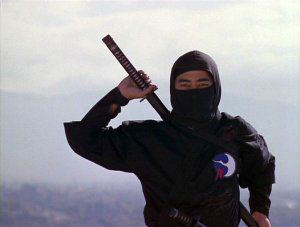
Of course, any definition of “ninja” would be greatly served by a picture of Japanese martial artist Sho Kosugi. In fact, this review would be vastly improved just by the mere insertion of a picture of The Man, The Myth, The Legend. A picture speaks louder than a thousand words … regardless, it’s not like any action movie hero worth their celluloid ever spoke a thousand words.

SHO KOSUGI

I’ve made it through most of the collected film works of Eastwood, Bruce Lee, Jackie Chan, Norris, Stallone, Schwarzenegger, et cetera, and now I am grateful for the opportunity to delve into Kosugi’s filmography. It’s a safe bet that I will eventually seek out PRAY FOR DEATH, DEATHS OF THE NINJA, and RAGE OF HONOR because they’re great titles and have great cover art in addition to starring Mr. Kosugi.

I’ll start with REVENGE OF THE NINJA, the second and best overall installment of the so-called ‘Ninja Trilogy.’ Kosugi takes on a starring role after playing second (or third or fourth) fiddle in ENTER THE NINJA, behind at least Franco Nero, Susan George, and Christopher George. The Kosugi parts are arguably the best parts of ENTER, so REVENGE serves up a full course of Kosugi with hors d’oeuvres, wine (or beer or liquor), and dessert included.

The nominal plot: “After his family is killed in Japan by ninjas, Cho and his son Kane come to America to start a new life. He opens a doll shop but is unwittingly importing heroin in the dolls. When he finds out that his friend has betrayed him, Cho must prepare for the ultimate battle he has ever been involved in.”

The actual plot: ACTION! PLENTY OF ACTION! We’re talking serious hardcore ninja action here. I’m no expert on ninja weaponry, but I do believe that REVENGE (as did ENTER before and THE DOMINATION after it) employs the ninjato, the katana, nunchaku, blowgun, shuriken, crossbow, and many, many more weapons of mass dismemberment. Gore hounds have a lot of howling to do over the ‘Ninja Trilogy.’

REVENGE prevails over ENTER because it spends more time focused on the actual plot than the nominal plot.

We have not only two fierce ninja warriors, Kosugi’s hero Cho Osaki opposed by the dastardly bastard Braden (Arthur Roberts), but we also have two, er, 1 1/2 Kosugis in this picture, since Sho’s real-life son Kane Kosugi plays Cho’s son Kane. We say 1/2 because Kane was around 9 years old when he made his memorable motion picture debut in REVENGE. He’s not one of those insufferable movie brats who mugs so heavily that I check my wallet after their every scene. He’s not David Mendenhall in OVER THE TOP, for example. Yes, he’s basically a miniaturized Sho Kosugi.

Both REVENGE and THE DOMINATION ultimately win over ENTER because they’re more entertaining and off-the-wall in that classic crazy Cannon way.

Nero, of course, makes for an effective action hero in a more traditional sense and I find his filmography very fascinating, from playing the title character in the 1966 Spaghetti Western DJANGO and Lancelot in the lavish 3-hour 1967 American musical CAMELOT (singing voice by Gene Merlino) to roles in Quentin Tarantino’s DJANGO UNCHAINED (naturally) and JOHN WICK: CHAPTER 2. Nero plays a character named “Cole” in ENTER and that has seemed to be one of the more common given names for both action movies and soap operas; Roger Ebert’s Little Movie Glossary includes The Cole Rule: “No movie made since 1977 containing a character with the first name ‘Cole’ has been any good.”

I commented during ENTER that it marked the first time I had seen English actress Susan George (STRAW DOGS) in a movie without her getting naked.

Christopher George almost walks away with the picture as the nefarious businessman Charles Venarius. He’s so bad that he’s good because George savors every single line. It is indelible fun hearing George deliver “This is 20th Century Manila, not feudal Japan.”

Kosugi appeared in all three NINJA films, as three different characters, and ultimately it is his screen presence that makes all three such enjoyable and memorable experiences.