
Couple Bombs from ’81: The Legend of the Lone Ranger, First Monday in October

COUPLE BOMBS FROM ‘81: THE LEGEND OF THE LONE RANGER, FIRST MONDAY IN OCTOBER

THE LEGEND OF THE LONE RANGER fails miserably at capturing any of the magic of the 1978 blockbuster SUPERMAN, its obvious cinematic inspiration.

Not even one speck.

Like SUPERMAN, LONE RANGER gives us a mythic origin story for an old cultural hero and then unfurls a new grand adventure featuring our updated hero and other updated characters. Sounds like a great time at the movies, but where did LONE RANGER go so absolutely incredibly stupendously wrong?

First stumbling block first, we have screen neophyte Klinton Spilsbury, who more or less remains a screen neophyte after LONE RANGER. That’s because Spilsbury botched his opportunity so badly that producers dubbed him with James Keach in post-production. Spilsbury quickly became a punchline upon the release of the film. For example, Gene Siskel remarked in his review that Spilsbury playing the Lone Ranger would make for a fine trivia question in the 1990s. I am straining to remember if Spilsbury appeared in “Trivial Pursuit” or perhaps on “Jeopardy” as the answer to who played the Lone Ranger in THE LEGEND OF THE LONE RANGER. If producers dub in another actor’s voice, how much of a performance did the dubbed out actor really give? Nevertheless, Spilsbury joined the ranks of infinitely superior actor Harvey Keitel, whose trademark Brooklyn accent did not make the final cut of SATURN 3. Sorry, Mr. Keitel.

Spilsbury definitely proved to be no Christopher Reeve, whose performance as both mild-mannered reporter for a great metropolitan newspaper Clark Kent and Kal-El, a.k.a. Superman, a.k.a. The Man of Steel, contributed a great deal to what made SUPERMAN and SUPERMAN II successful super-budget entertainments that connected with a mass audience on a personal level. Reeve said that he found inspiration from Cary Grant’s performance in BRINGING UP BABY and SUPERMAN and SUPERMAN II indeed at times resemble screwball romantic comedies. (Gene Hackman, Ned Beatty, and gang unfortunately suggest the campy villains from the 1960s Batman TV show, almost upsetting that precarious balance ‘tween humor and seriousness. Terence Stamp, Jack O’Halloran, and Sarah Douglas make better villains in SUPERMAN II.)

LONE RANGER lacks a lighter, humorous touch to counterbalance its mythology attempts. It is so somber that it becomes ponderous and then dreary before it finally springs into action, despite the efforts of Merle Haggard in the Waylon Jennings “Dukes of Hazzard” balladeer role. Obituarists skipped this chapter in Haggard’s career out of respect for the man when he died in 2016.

Finally springs into action is an understatement in the case of LONE RANGER.

LONE RANGER takes approximately 70 minutes to get the title character into costume and to play the William Tell Overture on the soundtrack, and we’re talking about a movie clocked at 98 minutes. William A. Fraker (director), Walter Coblenz (producer), Martin Starger (executive producer), and the writing team of Ivan Goff, Ben Roberts, William Roberts, Michael Kane, and Gerald B. Derloshon discovered a new level of stupidity.

Complete epic failure amounts to the only legend created by THE LEGEND OF THE LONE RANGER.

FIRST MONDAY IN OCTOBER also has its roots in old movies, though it may not be as obvious as LONE RANGER.

FIRST MONDAY wanted to be like one of those movies pairing Spencer Tracy and Katharine Hepburn — WOMAN OF THE YEAR, KEEPER OF THE FLAME, WITHOUT LOVE, SEA OF GRASS, STATE OF THE UNION, ADAM’S RIB, PAT AND MIKE, DESK SET, and GUESS WHO’S COMING TO DINNER.

Those movies succeeded in part because of the chemistry between Tracy and Hepburn and our enjoyment from watching them interact.

FIRST MONDAY fails in large part because Walter Matthau and Jill Clayburgh do not spark that Tracy-Hepburn chemistry and they are both miscast in their roles. FIRST MONDAY should be renamed “The Bickersons Go to the Supreme Court.”

Matthau stars as veteran Associate Justice Dan Snow and Clayburgh draws freshly appointed Associate Justice Ruth Loomis. All we need to know about them boils down to cranky old white ultra-liberal male (Snow) and feisty liberated white ultra-conservative female (Loomis) babble and battle but nonetheless develop affection toward each other.

Matthau gives the standard Matthau performance and it simply does not suit his character. Melvyn Douglas and Henry Fonda played this character on stage and they were both much better fits than Matthau.

Clayburgh made her fame as the quintessential liberated woman in AN UNMARRIED WOMAN and so it is jarring to see her play a rigid conservative. Also, she’s too young for her character. Jean Arthur, Jane Alexander (a few years older than Clayburgh), and Eva Marie Saint played the role on stage.

Paramount originally planned to release FIRST MONDAY in early 1982, but after President Ronald Reagan nominated Sandra Day O’Connor to the Supreme Court on July 7, 1981, Paramount rushed FIRST MONDAY forward to release in late August, one month before the Senate confirmed O’Connor’s appointment.

It is possible that FIRST MONDAY benefited commercially from publicity attendant with O’Connor’s historic appointment. FIRST MONDAY earned nearly $13 million in returns. In the long run, though, so what?

Upon first perusal of British director Ronald Neame’s film credits, one sees two disaster films, THE POSEIDON ADVENTURE and METEOR. After watching FIRST MONDAY, I count three disaster films directed by Neame.

I reviewed two bombs from ‘81 because Hollywood still recycles, rehashes, regurgitates, recapitulates, and remakes old movies, old plays, old TV shows relentlessly.

Black Christmas (1974)

BLACK CHRISTMAS

BLACK CHRISTMAS (1974) Three stars

Watching BLACK CHRISTMAS for the first time, one might be surprised just how many standards of the slasher film can be seen during this 1974 Canadian chestnut from director Bob Clark.

Let’s see, we have an opening shot later repeated by John Carpenter’s HALLOWEEN, a killer who racks up a rather impressive body count, POV shots from the killer’s perspective, obscene phone calls from the killer following every killing, plot twists (including the location of the caller), “The Final Girl,” and a shock ending, as well a holiday theme. BLACK CHRISTMAS basically synthesized elements that were already present during previous films like PSYCHO, PEEPING TOM, and Mario Bava movies BLOOD AND BLACK LACE and TWITCH OF THE DEATH NERVE into a single horror film narrative.

The plot also echoes “The Babysitter & The Man Upstairs” urban legend, so we already know the location of the caller. Still, the characters do not, so it’s a jolt hearing “The call is coming from inside the house.” Several movies, notably BLACK CHRISTMAS and WHEN A STRANGER CALLS, have relied on this angle for their chills and thrills.

A real-life case has been credited for inspiring the urban legend.

On Mar. 18, 1950, 13-year-old babysitter Janett Christman was raped and strangled to death in Columbia, Missouri, three days before her 14th birthday. Mr. and Mrs. Ed Romack found the body when they returned home, but, fortunately, their 3-year-old son Gregory was still alive, sleeping in his room. From the AP story, “Prosecuting Attorney Carl Sapp said blood was smeared through the house, indicating the girl put up a terrific struggle. … Footprints were found in a sleet-covered area near a broken window in the house. Police believe the intruder crawled through the window. The state highway patrol also is processing fingerprints found at the scene.”

More from the report, “An electric iron cord was twisted around the girl’s throat. Her scalp had been pierced several times by an instrument, apparently similar to a small lead pipe.”

Christman may have attempted to call the police around 11 p.m. the night of her death. Columbia policeman Roy McCowan took a call from a frightened girl who told him to “come quick.” “I urged her to calm down and just tell me where she was,” he said. “Then there was silence — not the sound of a receiver being hung up — just silence.” The Romacks’ phone was discovered “improperly placed on the instrument.”

Christman’s murder remains unsolved.

Just a few years earlier in Columbia, Stephens College student Marylou Jenkins, a white woman, was raped and murdered with an electric cord (reportedly from a lamp) twisted around her throat. An all-white jury convicted black man Floyd Cochran of the crime and he was executed Sept. 26, 1947 in the Missouri State Penitentiary Gas Chamber in Jefferson City. Cochran was originally arrested for murdering his wife with a shotgun and then he confessed to raping and murdering Jenkins.

For his last meal, Cochran ordered but did not partake in consuming a T-bone steak, french fries, scalloped corn, cream gravy, bread, butter, cake, and coffee. He died at the age of 36.

From 1938 through 1989, Missouri put to death 40 inmates in the gas chamber at Jefferson City, with John Brown the first on Mar. 3, 1938 and George “Tiny” Mercer the last on Jan. 6, 1989. Mercer was the first person from Missouri executed since 1965.

Just about seemingly every horror movie in existence shoots for a slambang ending, so we leave it discussing just what happened inside our heads or with all our friends and loved ones who have also seen this movie. BLACK CHRISTMAS gives us a rather unconventional ending, in that we are left unsure of the fate of protagonist Jess (Olivia Hussey) as she’s alone in the sorority house with the killer. Also, we never find out the real identity of the killer other than he’s named “Billy” and very rare indeed is the horror movie (especially a slasher) without a great big reveal in the grand finale. You just might have to be a fan or at least more forgiving of an ambiguous ending to appreciate BLACK CHRISTMAS. Either way, though, it will be discussed.

Like the later HALLOWEEN, BLACK CHRISTMAS thrives on atmosphere. That’s what they both do best and why fans appreciate them all these decades later.

Both films have rather distinguished casts for low-budget horror movies. Hussey came to fame during her teenage years for her performance as Juliet in Franco Zeffirelli’s 1968 ROMEO AND JULIET. Keir Dullea played astronaut Dave Bowman in both 2001: A SPACE ODYSSEY (1968) and later 2010 (1984); Dave uttered the famous words, “Open the pod bay doors please, HAL.” Margot Kidder (1948-2018) appeared previously in Brian De Palma’s 1973 shocker SISTERS and subsequently made her fame as Lois Lane in four Superman movies. Character actor John Saxon’s six-decade career includes ENTER THE DRAGON, TENEBRAE, A NIGHTMARE ON ELM STREET, and FROM DUSK TILL DAWN.

Director, screenwriter, and producer Clark (1939-2007) is best known for his two radically different nostalgia pieces, PORKY’S and A CHRISTMAS STORY. Yes, please wrap that magnificently designed brain around the fact that Clark directed both BLACK CHRISTMAS and A CHRISTMAS STORY. Louisiana born Clark found his greatest success up north in Canada. PORKY’S supporting actors Doug McGrath and Art Hindle both appear in BLACK CHRISTMAS.

Kidder almost steals the show in BLACK CHRISTMAS as the drunken, profane sorority girl Barb. She rips into her dialogue with extra relish. Hussey makes for a good entry point and rooting interest. Saxon knows how to maximize his screen time.

For horror movie fans who have not yet seen BLACK CHRISTMAS, I fully recommend amending it immediately.

Hanover Street (1979)

HANOVER STREET

HANOVER STREET (1979) One star

In a review of the Michael Bay cinematic bomb PEARL HARBOR, “one of the most insulting, most cloying excuses for mass entertainment ever made” I called that one, I mentioned HANOVER STREET and called it both possibly Harrison Ford’s worst movie and a weeper from Hell.

HANOVER STREET establishes a basic plot scenario that worked much better in films contemporaneous with World War II, films like WATERLOO BRIDGE, CASABLANCA, THE CLOCK, and BRIEF ENCOUNTER. Outside that immediate context, though, a film had better be very good because otherwise it will not get away with a period romance. In fact, played badly, we just might laugh it right off the screen. That’s what I did, for example, to survive PEARL HARBOR.

We have all seen HANOVER STREET many times before, even before seeing the film for the first time. Peter Hyams both directed and wrote HANOVER STREET, so he definitely has nobody but himself to blame for such ridiculous tripe.

David (Ford), American pilot.

Margaret (Lesley-Anne Down), English nurse.

She’s married.

He’s not.

Instant love / lust.

They start a love affair in the midst of a London blown up real good.

She keeps her husband a secret from her new lover.

He’s assigned to escort a British secret agent into France.

They’re shot down behind enemy lines.

David discovers that secret agent, you guessed it, is Margaret’s husband, Paul (Christopher Plummer).

David and Paul must work together to survive.

Enough is enough, because I think anybody with an IQ of at least 100 can finish the rest of the synopsis of HANOVER STREET.

With the staggering success of both ROCKY and STAR WARS in back-to-back years (1976 and 1977), both good old-fashioned popular entertainments, Hollywood began churning out light, feel good, escapist pictures by the dozens. It especially became even more pronounced in 1979 (and beyond), since 1978 releases GREASE, HEAVEN CAN WAIT, and SUPERMAN proved to be major hits in the ROCKY and STAR WARS mold.

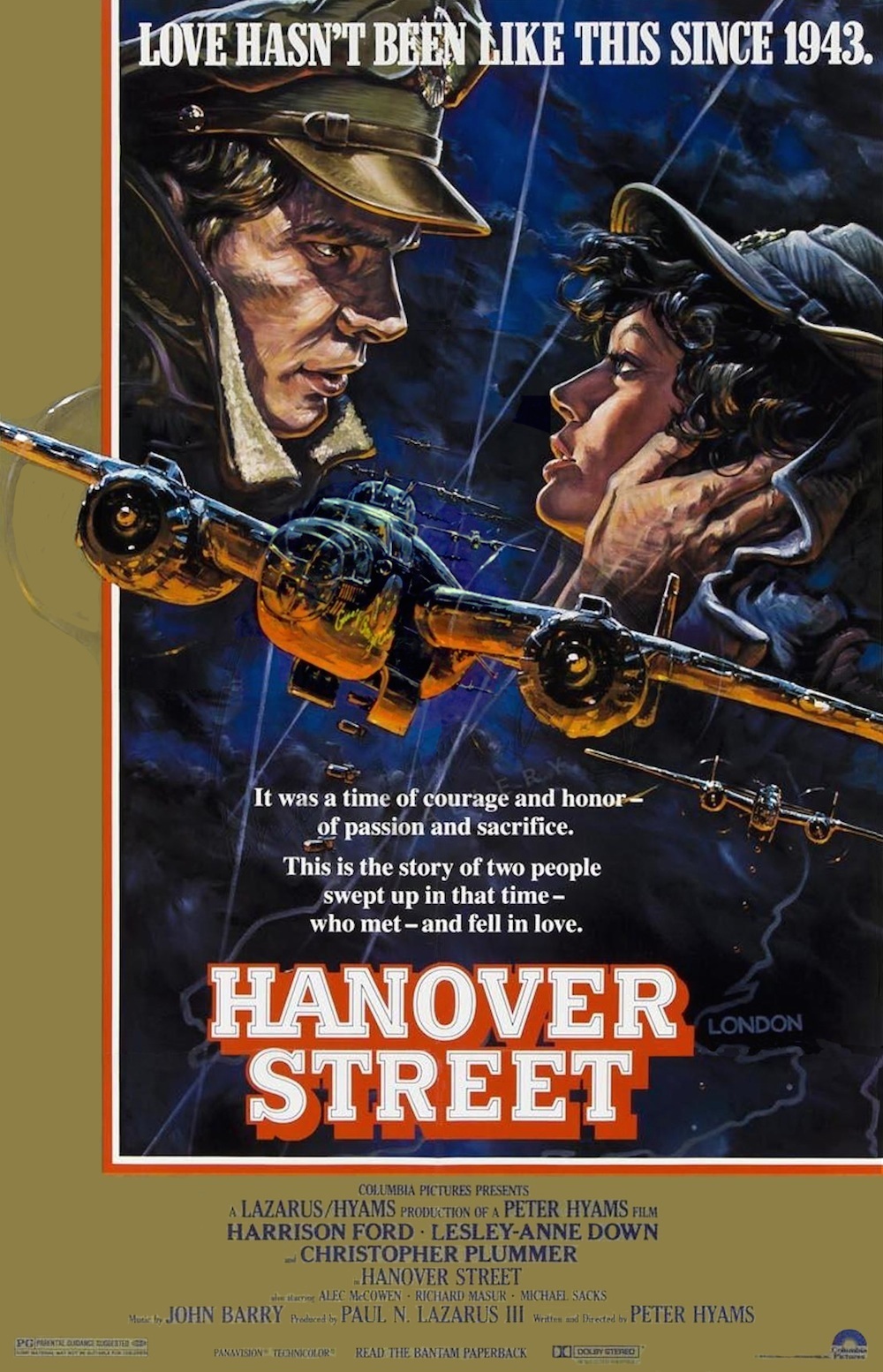
Just take a look at the poster for HANOVER STREET.

The words at the top: LOVE HASN’T BEEN LIKE THIS SINCE 1943.

Below that an illustration of Harrison Ford and Lesley-Anne Down looking each other passionately in the eyes, foreshadowing or merely shadowing a key scene in the movie.

More text (hype): “It was a time of courage and honor – of passion and sacrifice. This is the story of two people swept up in that time – who met – and fell in love.”

There’s also a map and two planes on the poster.

Ford worked so effectively as both Han Solo and Indiana Jones in eight films partly because he found a way to work in humor that counterbalanced all the cornball surrounding him. There’s also that priceless scene in THE EMPIRE STRIKES BACK when Princess Leia (Carrie Fisher) tells Han that she loves him and he merely says, “I know.”

In HANOVER STREET, Ford stumbles his way though dialogue like “Think of me when you drink tea,” “I love you enough to let you go, which is more than I’ve ever felt about anyone in my life,” and “You’ve got to go to him, and I’ve got to turn and walk away.” To be fair, everybody stumbles in HANOVER STREET and there’s no counterbalance to cornball.

Christopher Plummer legendarily disliked working on THE SOUND OF MUSIC (he called it “The Sound of Mucus”) and he said this about his co-star, “Working with Julie Andrews is like getting hit over the head with a valentine.” (Plummer and Andrews have remained friends.)

I just wonder what Plummer has to say about HANOVER STREET.