

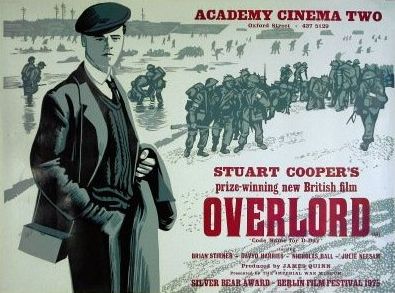
OVERLORD (1975) Four stars
American director Stuart Cooper did something very interesting for his fourth film, 1975’s OVERLORD.
Cooper integrated archival footage of British training missions and the D-Day Invasion (a.k.a. Operation Overlord) into a fictional film about a young man’s journey from call up to the grave. Cooper and his very talented cinematographer John Alcott (he won the Academy Award for Best Cinematography for his work on Stanley Kubrick’s BARRY LYNDON, another 1975 film) did their best to make a consistent look so one could not tell any difference between the archival footage and the fictional story.
The Imperial War Museum granted Cooper access to its vaults and that’s where he found all that historical footage. Cooper had originally planned to make a documentary on the Overlord Embroidery, which commemorates scenes from wartime photos housed by the Imperial War Museum. Sandra Lawrence designed it and the Royal School of Needlework provided the handiwork.
Cooper told The Guardian in 2008, “I spent approximately 3,000 hours in that dark cell between 1971 and 1975, briefly interrupted by a couple of other projects. It was during the archival research that I developed the idea of a dramatised feature film about an English soldier who sees his first action on D-Day, interweaving the archive footage to expand and tell the story. …
“A major concern for my cinematographer, John Alcott, was how to match the texture of the archive footage. In an unprecented move, the museum granted us access to the original nitrate negatives. The quality of the original nitrate negatives was pristine. After Alcott examined them, we decided to film OVERLORD on period lenses. Alcott scoured England and found two sets of 1936 and 1938 German Goetz and Schneider lenses. Alcott then applied a lighting style in keeping with the war photography, seamlessly blending the archive and dramatised story. Seventy percent of the film is live action, which was completed in 10 days of filming.”
OVERLORD, though it won the Silver Bear at the 25th Berlin International Film Festival, seemed to have fallen through the cracks of history for many, many years.
Cooper again in The Guardian, “In spite of OVERLORD’s festival success, it never gained distribution in the U.S., which I suspect hurt its chances of being properly remembered. It may also have been because it was made during the tail end of the Vietnam War, as well as being a black-and-white film with a very British story. The only airing the film received in the U.S. was on Jerry Harvey’s Z Channel in 1982, a forerunner to U.S. cable stations. Twenty-two years later, Xan Cassavetes, John Cassavetes’ daughter, included several clips of OVERLORD in her 2004 documentary, Z CHANNEL: A MAGNIFICENT OBSESSION. As a result, OVERLORD was invited to the Telluride Film Festival, where it was a surprise success. Shortly afterwards, it was belatedly picked up for U.S. distribution.”
Better late than never, for sure.
I found out about the film from Roger Ebert’s 4-star review in 2006.
Ebert first wrote about the film at Telluride in 2004, “The most remarkable discovery at this year’s Telluride is OVERLORD, an elegiac 1975 film that follows the journey of one young British soldier to the beaches of Normandy. … Unlike SAVING PRIVATE RYAN and other dramatizations based on D-Day, OVERLORD is an intimate film, one that focuses closely on Tom Beddoes (Brian Stirner), who enters the British army, goes through basic training and is one of the first ashore on D-Day. Beddoes is not a macho hero but a quiet, nice boy, who worries about his cocker spaniel and takes along ‘David Copperfield’ when he goes off to war.”
Christopher Hudson’s screenplay built scenes based on diaries and letters from real servicemen, again providing something unique from the average war film.
Unique is definitely one word for OVERLORD.
You sometimes feel like you’re watching a real young man’s life, as if Tom Beddoes had been a real person and had been followed around by a documentary film crew who managed to conceal themselves from the real people being filmed.
That’s a different feeling than just about every other fictional war movie.
Of course, OVERLORD includes all the standard issue scenes: Tom’s call up, his basic training, his meeting a young woman whom he falls in love with (she’s called “The Girl” in the credits), his journey overseas, and finally his death on D-Day.
OVERLORD reminds us that clichés have their roots in things commonly happening to people.
Who knows how many Tom Beddoes there have been and will be throughout the pages of history.
I drift back to the following lyrics from the Clash’s “The Call Up,” “There is a rose that I want to live for / Although, God knows, I may not have met her / There is a dance an’ I should be with her / There is a town unlike any other.”
 Attack of the Killer Librarian