Schlock (1973)

SCHLOCK

SCHLOCK (1973) ***

Schlock (/SHläk/): cheap or inferior goods or material; trash.

For quite some time as I watched it, I could not make heads or tails out of John Landis’ 1973 extremely low-budget feature film debut SCHLOCK.

I mean, I understood that it’s a good old-fashioned spoof of good old-fashioned monster movies, sure, from the moment I read a plot synopsis and that its title speaks louder than a thousand words, you bet, but it kept veering between tones. Our title character (played by none other than Landis himself) seemed menacing and imposing one moment and then funny the very next. He’s the missing link and “The Banana Monster” and the poster promises “A love stronger than KING KONG.”

There was one sequence though in particular that changed my tune about SCHLOCK.

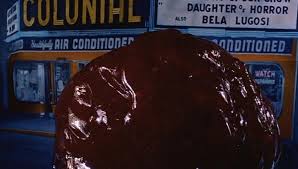
Schlock (blanking on his full name right now) watches DINOSAURUS! from 1960 and THE BLOB from 1958 in a movie theater, both classics directed by Irvin S. Yeaworth and produced by SCHLOCK producer Jack H. Harris. We see choice scenes from both films, like a dinosaur fight and that classic moment in THE BLOB when its title character attacks first the projectionist and then the patrons to rudely interrupt the showing of DAUGHTER OF HORROR (renamed from DEMENTIA). Showing THE BLOB also provided Landis an opportunity to work Steven, er, Steve McQueen into his little $60,000 movie.

Not only that, but Schlock learns about vending machines and cleans out a candy counter. Bet he loved them jujubes with his sharp teeth. I love what Schlock does when this incredibly tall man sits in the seat one row in front of him. If only life could be that way. Then again, proper authorities cannot handle Schlock.

At the point Schlock went movie watching, I learned to stop worrying and like (not love) SCHLOCK.

Landis’ love for SEE YOU NEXT WEDNESDAY starts out early in his directorial career, by promoting it with “First, BIRTH OF A NATION! Then, GONE WITH THE WIND! 2001: A SPACE ODYSSEY! LOVE STORY! SEE YOU NEXT WEDNESDAY! And now … SCHLOCK!” A line spoken in 2001 turned into a running gag throughout most Landis films and even the music video for Michael Jackson’s “Thriller.”

So many low-budget movies have a great back story.

Landis and crew, including makeup artist Rick Baker early in his career, made SCHLOCK during 12 days in the summer of 1971, but it was not released until 1973. Johnny Carson found out about the film and he booked Landis on “The Tonight Show.” With this spotlight opportunity, Landis showed clips from SCHLOCK, which helped the first-time director find a distributor in Jack H. Harris Enterprises. Harris put up $10,000 if Landis put 10 minutes of running time on SCHLOCK.

I enjoyed SCHLOCK every bit as much as the Joan Crawford classic TROG (1970) and the similarly low-budget KING KUNG FU (1976).

Of course, I did not forget, but I will see you next Wednesday.
Code of Silence (1985)

CODE OF SILENCE

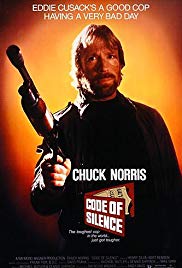
CODE OF SILENCE (1985) Three-and-a-half stars

CODE OF SILENCE and LONE WOLF McQUADE are the best Chuck Norris movies.

They are the ones for people who otherwise grunt and groan at the possibility of watching a Chuck Norris movie. You know, individuals who go, “Ugh, I don’t like Chuck Norris, his movies are so dumb and stupid. They’re ridiculous and redneck.” Then, there’s other people who only want to watch Norris on “Walker, Texas Ranger” re-runs 24 hours a day 365 days a year because they have little tolerance for movie violence and vulgarity.

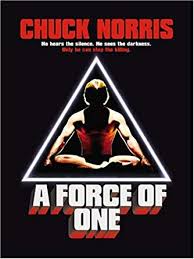
Let’s get a few things straight: I don’t especially care for Norris’ ultra-conservative politics (he predicted 1,000 years of darkness if Obama won a second term). I hate those darn infomercials that he did with Christie Brinkley plugging exercise machines. I cannot stand “Walker, Texas Ranger,” except for when clips were used for the “Walker, Texas Ranger Lever” on Conan O’Brien. I hate that he sued “Chuck Norris Facts” author Ian Specter because “Mr. Norris is known as an upright citizen to whom God, country, and values are of paramount importance” and “Mr. Norris also is concerned that the book may conflict with his personal values and thereby tarnish his image and cause him significant personal embarrassment.” I often dislike the use of slow motion in many Norris pictures, like, for example, at the end of A FORCE OF ONE and I cannot decide if that ridiculous echoed voice-over in THE OCTAGON is the worst or the funniest thing I have ever heard. Finding all his voice-overs compiled into a 4-minute, 20-second YouTube video, I vote for the latter. I will one day write a review of THE OCTAGON in the style of that voice-over; I remember Richard Meltzer’s review of the Creedence album PENDULUM with a built-in echo. For whatever reason, Norris’ inner monologues in THE OCTAGON call to mind Ted Striker’s cockpit moment when he hears echo and Manny Mota pinch-hitting for Pedro Borbon. THE OCTAGON voice-over is even funnier than the one in AIRPLANE! I understand that I like watching old Norris movies for their camp and nostalgic value. I’d rather watch one than listen to a Ted Nugent album (or song). I apologize for (possibly) coming on so defensive about Carlos.

In the pantheon of action stars, Norris rates below Clint Eastwood, Steve McQueen, Jackie Chan, Bruce Lee, Arnold Schwarzenegger, and Sylvester Stallone. He’s never made a movie quite at the level of THE GOOD, THE BAD AND THE UGLY, THE GREAT ESCAPE, DRUNKEN MASTER, ENTER THE DRAGON, the first two TERMINATOR movies, and ROCKY. Norris belongs in the second tier of action stars.

Back to CODE OF SILENCE (and LONE WOLF McQUADE).

Both movies have good supporting casts — for example, CODE OF SILENCE surrounds Norris with quality character actors like Henry Silva, Bert Remsen, Dennis Farina (before he became a full-time actor), Ralph Foody, Ron Dean, and Joseph F. Kosala.

Andrew Davis directed CODE OF SILENCE, his first action picture, and his later credits include ABOVE THE LAW, THE PACKAGE, UNDER SIEGE, THE FUGITIVE, CHAIN REACTION, and COLLATERAL DAMAGE. THE FUGITIVE, one of the best films of 1993, was nominated for seven Academy Awards, including Best Picture, and good old grizzled Tommy Lee Jones won an Oscar for Best Supporting Actor. He’s a good director, certainly the best of any Norris movie.

At this point in his career, Norris wanted to distance himself somewhat from his karate and become a more polished, all-purpose action star. If all his subsequent movies were more like CODE OF SILENCE, he would have been onto something, but, alas, Norris returned to third- and fourth-rate product like FIREWALKER and MISSING IN ACTION III before finding his greatest commercial success on TV.

In CODE OF SILENCE, Norris plays Chicago policeman Eddie Cusack, who finds himself in the middle of a gang war all while he’s alienated himself from his fellow officers (barring one, his former partner) for breaking the “code of silence” by standing and testifying lone wolf like against a veteran officer (Foody) accused of killing an unarmed teenager.

Norris enlists Prowler on his side for the final confrontation, Prowler a police robot with a tremendous arsenal that kills bad guys good.

We do see one particularly rare scene in any Norris movie: He gets knocked around real good by a group of thugs. That’s not happened often to Norris since he took on Bruce Lee late in WAY OF THE DRAGON.

Between his work in CODE OF SILENCE, ABOVE THE LAW, and THE FUGITIVE, Davis showed himself to be a master of scenes involving the ‘L,’ Chicago’s elevated train rapid transit system that we have seen on many films and shows. There’s a chase and fight scene on top of the ‘L’ in CODE OF SILENCE that belongs with Norris’ flying kick through a windshield in GOOD GUYS WEAR BLACK and driving his super-charged Dodge Ramcharger out of the grave in LONE WOLF McQUADE as the best Norris moments.

Good Guys Wear Black (1978)

GOOD GUYS WEAR BLACK

GOOD GUYS WEAR BLACK (1978) Two-and-a-half stars
The late Steve McQueen gave his friend Chuck Norris some advice for his motion picture career. McQueen said that Norris talked too much in GOOD GUYS WEAR BLACK and that, in the future, he should let his supporting actors do more talking, since it would have the effect of making what Norris says more important.

I quoted McQueen in a review of A FORCE OF ONE, Norris’ third feature. McQueen’s right about GOOD GUYS WEAR BLACK: Norris does talk too much and he should have allowed his talented supporting cast more of an opportunity to carry the speaking.

Norris stars in GOOD GUYS as John T. Booker and there’s Anne Archer as Booker’s romantic interest and smaller roles for James Franciscus, Dana Andrews, and Jim Backus. It is especially nice to see Andrews on the screen, because we remember him from classics like LAURA and especially THE BEST YEARS OF OUR LIVES. Backus deserved better, especially since, all things considered, he probably enjoyed C.H.O.M.P.S. more than what he did GOOD GUYS.

Because I saw the later film before the earlier one, GOOD GUYS’ plot reminded me of the 1985 Arnold Schwarzenegger vehicle COMMANDO. Booker’s surviving Vietnam War comrades are being systemically eliminated five years after the first scene in the movie when they survive a death trap set for them. We have a shady diplomat on the verge of becoming Secretary of State, who is blackmailed into pursuing the elimination of the Black Tigers, the elite group of CIA assassins headed by Norris’ Booker. This plot was written on the back of a much larger napkin than COMMANDO.

GOOD GUYS, like A FORCE OF ONE, exists as middle-of-the-road Norris, not quite as inspired as his best films CODE OF SILENCE and LONE WOLF McQUADE, but still better than his starring debut BREAKER! BREAKER! and THE OCTAGON, his fourth picture.

CODE OF SILENCE and LONE WOLF are his best pictures mainly because they have the best supporting casts. They also have their fair share of exciting moments.

I mean, who could ever forget that classic scene in LONE WOLF when David Carradine’s treacherous villain buries Norris alive in his super-charged Dodge Ramcharger. After coming to and pouring beer on himself, Norris and his Dodge rise up out of the ground and he gets out and guns down several of Carradine’s anonymous henchmen. Capping it all off, Norris tells his young partner to get him a beer. Epic.

There’s just one scene in GOOD GUYS that even approaches that great LONE WOLF scene.

Booker faces down an assassin, who just blew up the plane carrying Archer’s reporter character and Booker’s romantic interest Margaret, and eventually Booker takes out this formidable foe with a flying kick through the bad guy’s windshield as he attempts to run over Booker. This moment alone is worth the price of a rental or a more long-term purchase, and it could play as the front end of a highlight reel with LONE WOLF.

Unfortunately, the rest of GOOD GUYS does not live up to that incredible flying kick, reportedly performed by Norris’ brother Aaron, but it still has a certain value, especially in seeing Norris portray a college professor and a race car driver in addition to being a cold-blooded assassin. Boy, that Norris sure could do anything.

NOTES: In 2017, a 22-year-old John T. Booker, from Topeka (Kansas), was sentenced to 30 years in prison for his vehicle bomb detonation attempt at Fort Riley. Booker wanted to kill American soldiers and assist the Islamic State of Iraq and al-Sham (ISIS) in their fight against the United States.

There’s also a Dr. John T. Booker who’s an Associate Professor of French at the University of Kansas. His teaching and research focus on the French novel of the 19th and 20th centuries.

Kansas seems to have the market cornered on the John T. Booker name.

The Blob (1958)

THE BLOB 2

THE BLOB (1958) Four stars

Watching the original BLOB just the other day, once again it hit me how much THE BLOB seems to be influenced by the 1955 classic REBEL WITHOUT A CAUSE.

THE BLOB leads Steven McQueen and Aneta Corseaut respectively call to mind James Dean and Natalie Wood (McQueen even a few years older than Dean playing a high schooler), there’s a more friendly policeman in both films (Ray in REBEL WITHOUT A CAUSE, Dave in THE BLOB), and they both are iconographic time capsule films that appeal to all generations.

Plain and simple, THE BLOB is a goofy, ridiculously fun time at the movies.

It sets the tone with that glorious theme song over the opening credits — “Theme from the Blob” by the Five Blobs and it’s a real catchy little ditty written by Burt Bacharach and Mack David. It sure beats “Raindrops Keep Falling on My Head.”

“Beware of the Blob, it creeps

And leaps and glides and slides

Across the floor

Right through the door

And all around the wall

A splotch, a blotch

Be careful of the Blob.”

What’s the Blob? A modified weather balloon in early shots and colored silicone gel in later shots. From outer space.

It’s also been compared to cherry Jell-O.

THE BLOB was inspired by a real event that happened in  1950 Philadelphia. The Philadelphia Inquirer headline on Sept. 27, 1950: FLYING ‘SAUCER’ JUST DISSOLVES. Joe Keenan and John Collins, a pair of veteran police officers who probably both thought they had seen just about everything before the night in question, spotted a mysterious object falling from the sky, of course, just like in THE BLOB and KILLER KLOWNS FROM OUTER SPACE, for that matter. They pursued this mysterious object and eventually encountered a large mass which they described as “purple jelly.” Collins decided that he would reach out and touch the mysterious object … by that point, backup (two more officers) had arrived, so four policemen were taking on the case. Collins had much better luck than the old man at the beginning of both ’58 BLOB and ’88 BLOB. He survived. Within 30 minutes of the first sighting, this blob-like object disappeared. The police told their story to the local media the next day, and the rest is history.

Made for $240,000 (though numbers vary, as low as $110,000 has been reported), THE BLOB predates later George Romero horror films made in Pennsylvania.

THE BLOB filmed at Valley Forge Studios — destroyed by a fire in 1962 — and the towns of Phoenixville, Downingtown, Chester Springs, and Royersford. These locations give THE BLOB an unique flavor and I do enjoy how eventually young and old alike work together to defeat the monster.

Phoenixville (2018 estimated pop.: 16,957) features the historic Colonial Theatre, one of the town’s claims to fame. Since 2000, Phoenixville and the Colonial commemorate THE BLOB with the annual “Blobfest.” The 21st edition will be held July 10-12, 2020. Every year, of course, they reenact the famous run out from the Colonial when the title character attacks. In addition to THE BLOB, FORBIDDEN PLANET and TEENAGERS FROM OUTER SPACE will be featured in 2020.

(BTW, Phoenixville ranks in the top 10 in the U.S. in breweries per capita. Let’s see, there’s Root Down, Crowded Castle, Stable 12, Rebel Hill, Rec Room, Iron Hill, Sly Fox, Baba’s Brew, A Culture Factory, Stickman Brews, Tuned Up, Steel City, et cetera, on the map.)

It just doesn’t get much better than when the title character attacks The Colonial during DAUGHTER OF HORROR, a real movie that’s the altered version of the 1955 movie DEMENTIA. The Kino Video DVD cover highlights three great reviews for DEMENTIA. Variety: “May be the strangest film ever offered for theatrical release.” Preston Sturges: “A work of art. It stirred my blood and purged my libido.” New York Censor Board: “Overflows with horror, hopelessness, sadism, violent acts of terror and outbursts of panic.”

Anyway, the Blob hates the cold. In that case, though, the Colonial must not have been too “Healthfully Air Conditioned,” because the Blob seems to thrive as it engorges the poor projectionist and heads into the auditorium.

Sometimes, during a bad bad bad movie at the multiplex, I’ve wanted the Blob to strike our screen and send us running.

A Force of One (1979)

A FORCE OF ONE

A FORCE OF ONE (1979) Two-and-a-half stars
We should all thank Steve McQueen (1930-80) for the acting career of Chuck Norris, because it was McQueen who encouraged Norris to get into acting.

After all, without Norris’ acting career would there ever have been “Chuck Norris Facts?” Or the lever on “Conan?”

So, thank you, Steve McQueen.

McQueen also had some important advice for Norris after GOOD GUYS WEAR BLACK (1978).

“They said I was the worst thing in 50 years,” Norris said in a 1983 New York Times article. “Well, I wasn’t good, but my feelings were hurt. I said, ‘I’m not trying to be Dustin Hoffman; I just want to project a strong positive hero image on the screen.’ I went to Steve, and he said, ‘In GOOD GUYS, you talk too much. Too much dialogue. Let the character actors lay out the plot. Then, when there’s something important to say, you say it, and people will listen. Anyway, you’ll get better as an actor. You should have seen me in THE BLOB.’”

McQueen seemed to be onto something regarding the quality of Norris movies, because Norris’ best pictures LONE WOLF McQUADE and CODE OF SILENCE both rely on strong casts around Norris: David Carradine, Barbera Carrera, Leon Isaac Kennedy, Robert Beltran, L.Q. Jones, Dana Kimmell, R.G. Armstrong, Sharon Farrell, and William Sanderson (LONE WOLF); Henry Silva, Bert Remsen, Molly Hagan, Dennis Farina, Mike Genovese, and Ralph Foody (CODE OF SILENCE).

A FORCE OF ONE, alas, features a decent supporting cast around Norris — Jennifer O’Neill (she actually receives top billing), Clu Gulager, Ron O’Neal, and Charles Cyphers — and they handle the awfully generic material rather well. We should be grateful for a good supporting cast because. …

I mean, how many times have we seen this plot filmed on TV or even in the movies? We’ve all been here many, many, many times before, sitting through cops, drugs, cop killers, drug lords, et cetera.

Screenwriter Ernest Tidyman’s credits include SHAFT, THE FRENCH CONNECTION, and HIGH PLAINS DRIFTER, heavy duty action credentials.

Tidyman (1928-84), however, was not impressed by A FORCE OF ONE, called it his least successful effort, and said that he only wrote the script to buy his mother a house.

I understand Tidyman’s disappointment with his script.

That said, I enjoyed most of A FORCE OF ONE because it combines a standard issue cops and criminals plot acted out by a good cast with martial arts and a “very subtle” anti-drug message that plays like one of those infamous 1980s TV commercials, only featuring roundhouse kicks.

Wish they would have showed A FORCE OF ONE in D.A.R.E.

Oops, never mind, since all us kiddos are supposed to resist violence.

A FORCE OF ONE loses points and a positive review because of two negative elements.

Dick Halligan’s music hits the viewer like a roundhouse upside the head. I would love to make a joke here referencing either “blood,” “sweat,” or “tears” because Halligan founded the jazz-rock band Blood, Sweat & Tears and played in that group from 1967 through 1972. I just don’t have it today.

All plot roads lead to a final karate showdown between Norris and the main heavy. This is what we wait for all 80 minutes.

Unfortunately, the final karate showdown quickly devolves into slow motion and distorted / echoed vocal effects, plus Halligan’s music returns with a vengeance.