It (1927)

IT (1927) ***1/2

“Hey, old timer, have you seen IT?”

“Yeah.”

“I bet, though, knowing you, that you liked the crusty old TV version from, like what, 1890 better than the new one.

[Silence for a couple beats]

“Well, which one did you prefer?”

“Neither.”

“What?”

“That’s right, I prefer the 1927 IT starring legendary ‘It’ girl Clara Bow over any Stephen King adaptations called IT. Boom!”

— Theoretical conversation circa ‘18


That quality possessed by some which draws all others with its magnetic force. With ‘It’ you win all men if you are a woman and all women if you are a man. ‘It’ can be a quality of the mind as well as a physical attraction.

— Definition of ‘It’


Clara Bow obviously had ‘It’ and she displays it throughout IT, the film that officially made her a sensation after it was released on February 19, 1927.

Bow’s 1927 can stand against Babe Ruth’s — .356 average with 158 runs scored, 29 doubles, eight triples, 60 home runs, 165 RBI, 137 walks vs. 89 strikeouts, and 110 victories and a 4-0 World Series sweep against Pittsburgh — and Charles Lindbergh’s, for his legendary nonstop flight from New York City to Paris.

Bow (1905-65) made six films in 1927: IT, CHILDREN OF DIVORCE, ROUGH HOUSE ROSIE, WINGS, HULA, and GET YOUR MAN.

She helped pave the way for every female sex symbol to come. For example, her skirt flew up during IT, a good 28 years before Marilyn Monroe’s most famous movie bit in THE SEVEN YEAR ITCH. WINGS also features a brief — I mean brief — Bow boob flash. Blink and you’ll miss it.

She also inspired a millinery fashion craze, for crying out loud.

From the June 10, 1927 edition of the St. Louis Dispatch — advertising Clara Bow Vacation Hats for $1.25 each — “Smart and clever are these Clara Bow Hats that are fashioned of a good quality felt in twelve attractive modes. In black, white, pink and all the Summer shades — trimmed with applique of felt in contrasting colors as well as soid effects. Are soft and crushable, easily packed in handbag or trunk.” Each hat purchased came with a 8 x 10 photograph of Bow wearing that hat. No additional charge.

In the August 16 edition of the Minneapolis Star Tribune, Clara Bow Hats were being sold for 98 cents and each hat came with a copy of Bow’s signature. Apparently, there were 12 styles and colors of hats.

From the June 19 Nebraska State Journal, “In Gold’s smart millinery collections you’ll find ‘it’ — the cutest cleverest group of Clara Bow hats and every one of ‘em has ‘it.’ These perky little felt novelties are only $1.45 but they look like a million dollars worth of Clara Bow’s vivacity.”

Bow also became tabloid fodder, like this report from the Los Angeles Times during the making of WINGS, “Clara Bow, Paramount star, is becoming destructive. The queen of the flappers wrecked one perfectly good Ford while learning to drive one for certain sequences in “Wings,” the road show which tells the story of the American Ace in France. Miss Bow plays the part of an ambulance driver. “Wings” is being directed by William Wellman, himself a flyer during the war.” The reports and the rumors became wilder.

Bow retired from acting in 1933 to move to a ranch in Nevada, where she focused her energies on being a wife and a mother.

IT provides an early example of a concept film and it uses product placement — plugging Cosmopolitan Magazine and giving source material writer Elinor Glyn a cameo where she expounds on ‘It.’

IT features a plot that’s older than the Hollywood hills: A salesgirl, Betty Lou (Bow), sets her sights on wealthy (and handsome) playboy Cyrus T. Walham (Antonio Moreno), who’s her boss. There’s plot complications left and right — not convolutions, though — like so many romantic comedies but this is a movie that moves easily beyond its plot because of the style of director Clarence Badger, the witty dialogue and inter-titles, and both the incredible style, spunk, and star power of Bow.

“I don’t go to church. Kneeling bags my nylons.” — ACE IN THE HOLE

“Alright, I’ll go manicure my gloves.” — BUGSY MALONE

“She gave me a smile I could feel in my hip pocket.” — FAREWELL, MY LOVELY

Supporting character Monty Montgomery (William Austin) gets one of the all-time great lines, “I feel so low, old chap, that I could get on stilts and walk under a dachshund.” File it alongside the three lines quoted right above.

Monty proved to be a pleasant surprise, a supporting character who at least made me smile from his very first to his very last appearance. Monty creates the film’s biggest laughs and in a different way than Bow, he’s nearly as unforgettable. I would argue his eyes are just as memorable. What could otherwise be melodramatic mugging benefits from the parameters of silent cinema and his reactions — especially his astonished double takes — are worth their weight in comic gold. He’s a genuine hoot. That statement works for IT as a whole. In movie terms, IT definitely has “it.”
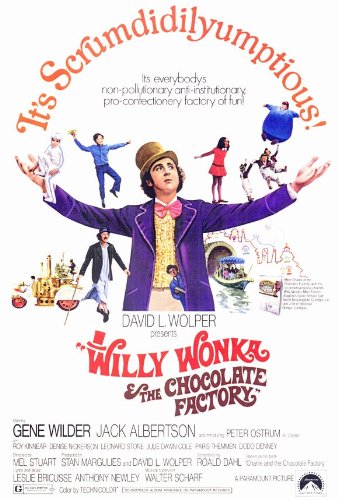
Willy Wonka & the Chocolate Factory (1971)

WILLY WONKA

WILLY WONKA & THE CHOCOLATE FACTORY (1971) Three-and-a-half stars

Over the years, many individual performers have walked away with a movie and made it their own. For example, Gene Wilder in WILLY WONKA & THE CHOCOLATE FACTORY.

Wilder provides one of the great movie entrances at about the 45-minute mark of the picture and it’s about darn time because it’s a bit of a slog before we reach the chocolate factory. Our expectations are very high by this point in the picture and Wilder’s Willy Wonka meets and even surpasses them. It was Wilder himself who insisted that he make such an entrance.

“When I make my first entrance, I’d like to come out of the door carrying a cane and then walk toward the crowd with a limp,” Wilder said. “After the crowd sees Willy Wonka is a cripple, they all whisper to themselves and then become deathly quiet. As I walk toward them, my cane sinks into one of the cobblestones I’m walking on and stands straight up, by itself; but I keep on walking, until I realize that I no longer have my cane. I start to fall forward, and just before I hit the ground, I do a beautiful forward somersault and bounce back up, to great applause.”

This entrance establishes Wonka’s unpredictability right from the start.

Wilder magnificently expresses all the sides of Willy Wonka’s personality. It turns on a dime from joy and wonder to malevolent anger at the selfish children who found their golden ticket in a Wonka bar. Their golden tickets earned the children a pass to Wonka’s factory. The five children are Augustus Gloop, Veruca Salt, Violet Beauregarde, Mike Teavee, and Charlie Bucket and they are each joined by one parent or grandparent in the case of final ticket winner Charlie Bucket. The bad children are punished in unspeakable, horrifying ways for their indiscretions. That’ll show ‘em and serves ‘em right, greedy little bastards.

When the beloved Wilder died in 2016 at the age of 83, I thought immediately of his performance as Willy Wonka and his spotlight song “Pure Imagination,” a number written by the British duo of Leslie Bricusse and Anthony Newley. “If you want to view paradise / Simply look around and view it / Anything you want to do it / Wanna change the world / There’s nothing to it / There is no life I know / To compare with pure imagination / Living there you’ll be free / If you truly wish to be.” At its very, very best, WILLY WONKA approaches THE WIZARD OF OZ and Wilder’s on par with Margaret Hamilton and Frank Morgan and gang. They all share a certain joy of performance that’s wonderful to behold.

Like THE WIZARD OF OZ, WILLY WONKA undoubtedly introduced multitudes of children to scary movies. The Haunted Forest, the Wicked Witch of the West, flying monkeys, et cetera, in the 1939 film and the Oompa-Loompas and the boat ride in WILLY WONKA.

“Charlie and the Chocolate Factory” author Roald Dahl (1916-90) absolutely hated the 1971 screen adaptation. Dahl received credit for writing the screenplay, but it was the uncredited David Seltzer who came in and made script changes that raised Dahl’s ire.

What did Mr. Dahl hate about the picture? The shift in focus from Charlie to Willy Wonka. Check. The musical numbers. Check. Casting Gene Wilder rather than Spike Milligan, Dahl’s stated preference. Check. Guess the question should be changed to what didn’t Mr. Dahl hate about WILLY WONKA. This whole situation reminds one that Stephen King hates Stanley Kubrick’s THE SHINING.

I saw WILLY WONKA for the first time in fifth grade (1990) and read Dahl’s novel the next school year. I loved Dahl’s novel, but I have not read it since completing it during sixth grade, roughly the same age as the precocious golden ticket winners. Meanwhile, I have seen the 1971 version several times since that first encounter nearly three decades ago, on cable TV (Teavee), VHS, and DVD. I do think of the film more often than I do the book, and I believe that it has almost everything to do with the Wilder performance.

I have skipped Tim Burton’s 2005 adaptation CHARLIE & THE CHOCOLATE FACTORY & I just remember being appalled from the start by still photographs of Johnny Depp’s take on Willy Wonka. Remember that scene in ANIMAL HOUSE when the older members of Delta Tau Chi pelt that picture of pledge Flounder with beer cans? That’s about how I feel every time I see a picture of Depp as Wonka. (Generally speaking, I have no problem with Burton and Depp movies. I love ED WOOD and like SLEEPY HOLLOW and SWEENEY TODD a lot.)

In a 2013 interview with Turner Classic Movies host Robert Osborne (1932-2017), Wilder shared his true feelings on the 2005 version.

“I think it’s an insult,” he said. “Johnny Depp, I think, is a good actor, but I don’t care for that director [Tim Burton]. He’s a talented man, but I don’t care for him doing stuff like he did.”

Pet Sematary (2019)

PET SEMATARY

PET SEMATARY (2019) One-and-a-half stars

I best stay away from the reboots, retcons, or remakes of horror movies for quite some time.

In the case of PET SEMATARY, it actually did meet my rather low expectations.

For the record, it’s the second time in my life that I let a loved one pick the free rental — following M. Night Sham-A-Lama-Ding-Dong’s 2006 epic turd LADY IN THE WATER — and I still feel cheated. There’s an obvious moral lesson to be learned here.

PET SEMATARY lays it on thick, awful thick, with just about every cheap carny trick in the book. I wanted to give up about 20 minutes in, during the death of Victor Pascow in the hospital. That’s when the young man’s brain pulsates from his skull and a nurse exclaims, “Oh my God! I can see his brain!” I stuck it out, although I grumbled something or other about “cheap trick” to my wife not long after the scene.

The plot: Dr. Louis Creed (Jason Clarke) and his wife Rachel (Amy Seimetz) move their family — daughter Ellie (Jete Laurence) and son Gage (Hugo, Lucas Lavoie), plus fur baby Church — from metropolis Boston to rural Maine.

Now, in real life, that’s undoubtedly a good move for everybody concerned. Not in the movies, however, especially any movie based on a best-selling Stephen King novel.

You just know they’re fucked, doomed to a nightmarish saga worse than urban violence. In fact, we needed Crazy Ralph peddling past on his bicycle and screaming “You’re doomed” and “It’s got a death curse” at our young couple.

I know what you’re thinking, that Jason killed off Crazy Ralph long ago, but not if Crazy Ralph was buried in a pet cemetery. I’m just getting a little bit ahead of myself, oh by about three paragraphs.

Thanks to the collective works of King and “Murder, She Wrote,” I have no desire to move to Maine.

The Creeds buy one doozy of a property and I bet it’s listed right next to the Amityville Horror House in Toms River, New Jersey. Once again, the true villain of a horror movie should be the realtor.

Real estate perks for the Creeds’ dream house: A highway seemingly just a step away with semi-trucks barreling down the road all hours of the day (exactly what you’d want for two young children and one pet) and a pet cemetery in your backyard.

Never mind a kindly old man neighbor (John Lithgow) who’s going to lead you straight to your doom.

You’d think you’d rather go back to where you came in the first 10 minutes, right?

All this happens with the utmost predictability, because first and foremost it’s a remake that does not stray too far from the original. We’ve already been down this highway before and one big alteration director Kevin Kolsch and Dennis Widmyer and screenwriter Jeff Buhler made was spelled out in the film’s promotion. One of the trailers showed the whole movie in a mere 2 minutes, 26 seconds. PET SEMETARY is yet another movie where I recommend watching the trailer over the actual movie.

Somewhere, in past reviews, I have mentioned how I normally hate jump scares. They’re precisely what I mean by cheap carny trick.

Seasoned movie viewers should be able to detect a jump scare from a country mile away, identifying all the telltale signs.

PET SEMATARY abuses the old standard “It’s Only A Dream” about, just a guess here, 10 times too many.

Abuse is a fitting word for PET SEMETARY.

NOTE: How many times did AutoCorrect change the second half of PET SEMATARY to seminary? Every single time, and I had to change it to the original “incorrect” spelling. However, just think of the possibilities inherent here, for example, “I don’t want to be buried in a pet seminary.”

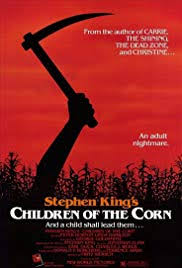
Children of the Corn (1984)

CHILDREN OF THE CORN

CHILDREN OF THE CORN (1984) One star

CHILDREN OF THE CORN is yet another textbook example of a film that cannot be taken seriously although it would love to be considered a serious film. We know that ‘cause we read an opening title like STEPHEN KING’S CHILDREN OF THE CORN, bashing us over the head this film wants to be a major event in our lives rather than a borderline incoherent, rambling supernatural thriller with pseudo-religious hogwash and brutal thriller machinations as its main selling points.

I will be the first to admit my ambivalence toward Stephen King, as well as Tom Clancy, John Grisham, Laurel Hamilton, Dean Koontz, and every other author who seems to have built-in access to a guaranteed mass audience every single time they publish even their napkins. Kmart, Walmart, and your friendly local supermarket determine the ultimate literary value of a select few writers and the rest of us hacks wallow in anonymity and simmering jealousy.

Fortunately, and unfortunately, I am well-versed in Stephen King film adaptations, probably just as much as you are at home. For every successful adaptation, like STAND BY ME and THE SHAWSHANK REDEMPTION, there’s absolute doggerel like CUJO, MAXIMUM OVERDRIVE, and DREAMCATCHER that rate among the most torturous movie experiences. In fact, I’d rate DREAMCATCHER high up among my top five worst movie theater experiences. One day, I’ll have to sit down and concentrate on that list.

CHILDREN OF THE CORN rates as bad King film adaptation. The rabid cult following may disagree but they’re not writing this review.

First and foremost, this is another King adaptation with religious poppycock galore. I traditionally despise religious fanaticism in the movies ‘cause it’s used by filmmakers as a cheap exploitation tactic. I hated, hated, hated this approach in films like AMITYVILLE II: THE POSSESSION, CARRIE, and THE OMEN. Are we supposed to cheaply laugh at somebody’s faith ‘cause they’re overzealous suckers and we’re in on the know and the joke they’re suckers?

How are we supposed to react to the evil corn, the pontification, and the music recycled from THE OMEN every time our filmmakers — led by director Fritz Kiersch — want us to pay attention. I have what’s called “bad laughs” and lots of them over the running time of CHILDREN OF THE CORN.

There’s a gruesome opening scene: The kids of Gatlin, Nebraska (introductory title: “GATLIN, NEBRASKA — THREE YEARS AGO”), kill their fathers and mothers and grandfathers and grandmothers and “The Blue Man.” See, a couple shady little individuals calling themselves Isaac and Malachi are instructed by “He Who Walks Behind the Rows.”

At this point, we should make a crucial distinction that just might save your life or at least guide you toward a better movie rental: In Nebraska, corn fields command kids to kill all the adults and make them sacrificial fodder. Meanwhile, in Iowa, corn fields instruct farmers to build a baseball diamond and they will come, well, except for Ty Cobb.

Anyhoo, Isaac (John Franklin) establishes a tyrannical regime of kids opposed to “sex, drugs, and rock ’n’ roll.” He’s a babbling pseudo-religious visionary with bad make-up. I laughed at Isaac’s pontification more than I have at some comedians over an entire career, because Isaac is a power-hungry miniature twit.

Malachi is the brute enforcer, a red-headed Jason Voorhees minus the hockey mask. He’s played by Courtney Gains, one of the best faces of 1980s movies. Sure we all remember Courtney Gains. George Constanza remembers him as the evil video store clerk in a “Seinfeld” episode. Gains appeared in BACK TO THE FUTURE, THE ‘BURBS, CAN’T BUY ME LOVE, and SECRET ADMIRER. For example, he tried cutting in on George McFly with Lorraine Baines at the Enchantment Under the Sea dance in good ole 1955. I’d rather talk more about Courtney Gains and his career than go back to reviewing CHILDREN OF THE CORN.

Where was I again? Who am I?

Anyway, Peter Horton and Linda Hamilton play our resident clean-cut wholesome All-American couple taking a trip inside a clean-cut wholesome All-American nightmare only found within a bad horror movie. These young lovers violate the Number One rule of interstate travel: ALWAYS STAY ON THE HIGHWAY. It’s almost like they never watched THE HILLS HAVE EYES.

This is yet another one of those “Of course” movies, because we say of course, they find a run down gas station with no telephone. Of course, the gas station owner’s a diabolical, shady old man in cahoots with the evil kiddos. Of course, the husband Burt (Horton) sees and hears something OVER THERE, always OVER THERE, and checks it out while the wife Vicky (Hamilton) wants to leave. Of course, they never do leave (until the end of the movie) and must fight through a living Hell to survive.

Next time, however, I suggest they drive through Iowa and find the Buddy Holly Crash Site near Clear Lake. It’s a long walk to the shrine of Holly, Ritchie Valens, and the Big Bopper, but a must if you love rock ‘n’ roll.

Back to the old man who’s the gas station attendant. He’s played by R.G. Armstrong in not one of his finest screen moments. Armstrong plays the role of a character whose function is that of the corpse in a self-contained murder sequence in a horror film, where it takes untold minutes to reach a destination we already predetermined in our heads after having watched countless self-contained murder sequences in horror films. Armstrong (1917-2012) must have rapidly slipped in his old age, considering that he survived THE BEAST WITHIN just a couple years before.

There’s also a little girl named Sarah, another pint-sized visionary. Her endearing and redeeming character trait is that she draws pictures of everything. Of course, Malachi wants to curb her artistic inclinations and of course, Isaac defends her visionary gifts, conflict among the ranks of the evil kiddos that only escalates during CHILDREN OF THE CORN.

I’d rather have looked at an exhibit of Sarah’s illustrations than watch CHILDREN OF THE CORN.

That’s because CHILDREN OF THE CORN bludgeons us with every cheap shock tactic of the bad horror movie.

There’s a lot of thunder and lightning, fire and brimstone, and loud music. And there are way too many scenes built on tight framing so we’re supposed to be scared on cue by an unexpected object jumping into the frame. The scariest accomplishment, however, of CHILDREN OF THE CORN is that it developed a cult following.

Silver Bullet (1985)

SILVER BULLET

SILVER BULLET (1985) Two stars

“It’s such a fine line between stupid, and clever.”

— Spinal Tap lead singer David St. Hubbins

That’s one way to describe the Stephen King adaptation SILVER BULLET, which has left viewers from day one debating whether or not the film makers were intentionally parodying Stephen King and werewolf movies by making so many individual details ridiculous.

Many reviewers just considered SILVER BULLET to be laughably bad and not in the good way, hot on the entrails of previous laughably bad King adaptations CUJO and CHILDREN OF THE CORN.

Watching SILVER BULLET for the first time in many, many years, I must admit the internal split and acknowledge the fine line between stupid and clever.

Let us consider:

— We have a narrator (Broadway standout Tovah Feldshuh) who sounds like an old woman, although it’s only nine years after the main events depicted in the film when she was 15 years old. Feldshuh’s even listed as playing “Older Jane.”

— Gary Busey plays Uncle Red, a womanizing drunkard who dotes on paralyzed prepubescent protagonist Marty Coslaw (Corey Haim), Jane’s younger brother, and makes the boy customized wheelchairs called “The Silver Bullet.” I remembered the second wheelchair most from previous viewings of the film when I was roughly the same age as Marty.

— That second wheelchair, oh wow, just let me tell you that you’ve not enjoyed a complete moviegoing life until you’ve seen the scene where our priest / werewolf (Everett McGill) stalks Marty and his souped-up “Silver Bullet” in broad daylight. Marty’s second great escape is even greater than his first.

— Uncle Red should have pursued a career in wheelchair manufacturing.

— This review gives away the identity of the werewolf. Big deal. The movie tips off the identity almost immediately, but, of course, in a movie like SILVER BULLET, the townspeople are nincompoops and it takes young ones like Marty and Jane to figure out the truth. Those nincompoops are on an epic scale of nincompoop. I mean, it’s tipped off so obviously that “WEREWOLF” should have flashed on the screen below the character. They all should have died.

— The nincompoops form a “Citizens Action Brigade” in the first 30 minutes … after four killings. They load up on guns, load up into trucks, head out into the woods, step into traps, et cetera. Two nincompoops produce one of the great dialogue exchanges from the Planet X. …

Maggie Andrews: What’s the matter, Bobby? You gonna make lemonade in your pants?

Bobby Robertson: I ain’t scared!

— The werewolf resembles a black bear. After the technological advances made in the werewolf movie just four years earlier by THE HOWLING and AN AMERICAN WEREWOLF IN LONDON, SILVER BULLET set the species back years.

If they remade SILVER BULLET today, would the original be called a “classic”? Undoubtedly yes, of course, because every old movie remade automatically becomes “classic.” We’ve heard that incessantly about the 1989 PET SEMATARY, for example.

SILVER BULLET, like PET SEMATARY, is not a classic by any definition — “Judged over a period of time to be of the highest quality and outstanding of its kind” or “A work of art of recognized and established value.”

For crying out loud, TEEN WOLF — released a couple months before SILVER BULLET — stands up better.

Tourist Trap (1979)

TOURIST TRAP


TOURIST TRAP (1979) Three stars

TOURIST TRAP belongs to a rather fine and distinguished horror movie tradition I’ll call “American Gothic” (forget the famous 1930 painting by Grant Wood).

Other films that fit the bill are several Universal productions, Val Lewton productions beginning with CAT PEOPLE, HOUSE OF WAX, PSYCHO, NIGHT OF THE LIVING DEAD, THE LAST HOUSE ON THE LEFT, TEXAS CHAINSAW MASSACRE, EATEN ALIVE, THE HILLS HAVE EYES, and FUNHOUSE. As you can see, directors Wes Craven (1939-2015) and Tobe Hooper (1943-2017) both liked this mode.

“American Gothic” horror films are heavy on atmosphere, whether they’re filmed in black & white or color. They often delight in exposing the darker underbelly of American society after such happenings as the closing of the local slaughterhouse or the roadside wax museum that once existed on the right side of the road before it was bypassed. They sometimes take on the disintegration of the family unit or any number of issues plaguing our society. “American Gothic” films are rich in metaphorical readings.

Since it belongs to such a fine tradition, you’ll be able to recognize TOURIST TRAP right off the bat and see that it’s a dab of HOUSE OF WAX layered on top THE HILLS HAVE EYES or any of the seemingly hundreds of horror movie plots that begin with car trouble and the wrong gas station and end after several deaths.

Later on, you’ll note that it’s also a pinch of PSYCHO and a dash of TEXAS CHAINSAW MASSACRE — Chuck Connors plays wax museum proprietor Mr. Slausen in the grand old Anthony Perkins as Norman Bates style (a hallmark “American Gothic” element)  and production designer Robert Burns worked on both TEXAS CHAINSAW and THE HILLS HAVE EYES.

Just like the Bates Motel had seen better days before PSYCHO, so had Mr. Slausen’s “Slausen’s Lost Oasis.” Nowadays, Mr. Slausen’s wax museum would have been profiled by Roadside America, the guide to “uniquely odd tourist attractions,” and it could have survived and even thrived off this exposure.

If you find wax figures, mannequins, human replicas, et cetera, repellent or they weird you the fuck out, then you will enjoy TOURIST TRAP.

I especially recommend seeing the film before stopping in at Jesse James Wax Museum right off the highway in Stanton, Missouri.

It’s your patriotic duty.

TOURIST TRAP creates a creepy, claustrophobic atmosphere transcendent of the standard issue plot.

From the brilliant opening scene all the way to the bitter end about 90 minutes later, there’s somebody eyeball stalking the protagonists in every scene in TOURIST TRAP.

That somebody’s usually a wax figure, mannequin, human replica, etc., and that’s just creepy, for lack of a better word.

For many years, TOURIST TRAP itself met the fate of “Slausen’s Lost Oasis,” seemingly forgotten and consigned to being a relic of a bygone era of horror movies. Never mind Stephen King’s recommendation in his 1981 book “Danse Macabre.”

The film has made a comeback in recent years.

Cinemassacre’s “Monster Madness” featured TOURIST TRAP in 2014.

In July 2018, Joe Bob Briggs opened “The Last Drive-In with Joe Bob Briggs” by showcasing TOURIST TRAP.

It just goes to show you that nobody can ever keep an “American Gothic” horror film down for too long.

Christine (1983)

DAY 2, CHRISTINE

CHRISTINE (1983) Three-and-a-half stars
Back in college, during my first assignment for the school paper, I wrote a section about how Americans love their cars, from Route 66 and Jack Kerouac to James Dean and back. The summer editor took out the Americans love their cars section and now, it’s a suitable introduction for John Carpenter’s CHRISTINE, an adaptation of a Stephen King novel that does put a novel spin on some American fiction tropes.

We’ve seen many, many (arguably too many) films where boy meets girl and it’s love at first sight, but this is a film where it’s boy meets car and they meet cute with the car in shambles and up for sale by a codger who’s suspiciously quick to accept any price for the car. The boy’s arguably not in any better shape than the car.

The boy in love is Arnie Cunningham, a nerd supreme, and the car is a 1958 Plymouth Fury named Christine that’s definitely “bad to the bone” or at least bad to the bumper. Arnie, who dwells in 1978 California, might have liked to seen the 1957 Detroit prologue where an assembly line worker’s killed by the devil car, but Arnie and Christine are definitely meant for each other.

True love at first sight for both parties, and it will not be denied.

Yeah, you might say the film’s ridiculous, but most horror films are ridiculous, of course, and CHRISTINE works partly because it’s a love story with a twist in the main premise that we can appreciate. We love our cars, of course, but our love thankfully never reaches Arnie and Christine levels. It’s undeniable, though, to watch it happen to somebody else in a movie.

CHRISTINE also works because of the lead performance by Keith Gordon as the super nerd Arnie, who might be the cousin of Terry the Toad. He’s transformed by his love for his car into somebody foreign to his parents and his best friend Dennis, a football jock who sticks up for Arnie in the face of relentless school bullies and who questions Arnie’s purchase of the car right from the start. With this special car in his life, Arnie becomes a new young man by discarding his old taped-up horn-rimmed glasses, dressing like a latter day James Dean (ideal since Christine only plays ’50s rock ‘n’ roll), and becoming first arrogant and later belligerent, especially whenever any one comes between him and Christine. Fools they are, several individuals mess with the boy and car or just the car alone and they usually face gruesome consequences for their reprehensible actions.

We like this Arnie character and Gordon performance even more when Arnie starts taking a walk (or drive) on the mean side.

Anyway, the new brimming-with-confidence Arnie begins seeing the hot new girl in school, Leigh Cabot, and their relationship needless to say is complicated by Christine. Romantic triangles are frequent in the movies, but CHRISTINE might be the first and only one with a boy, a girl, and a killer car.

The girl and the car are both jealous of each other and that leads to the classic moment at the drive-in when the car attempts to kill the girl. Serves her right.

Needless to say, the girl wants very little to do with the boy after surviving this moment and the boy and the car become even closer, all leading us to a thrilling duel-to-the-death climax between machines in a garage.

John Rockwell and Alexandra Paul are just fine in their roles as best friend Dennis and would-be girlfriend Leigh, respectively, and if Columbia Pictures had its way, casting would have been disastrous with Scott Baio in the Arnie role and Brooke Shields as Leigh. Egads! Thankfully, the filmmakers insisted on lesser known actors. Kevin Bacon auditioned for Arnie, but he went off to do FOOTLOOSE instead and that obviously worked out best for all parties involved.

Gordon, who had previously appeared in JAWS 2 and DRESSED TO KILL, gives the defining performance of his career and his Arnie Cunningham rates with the greats in screen nerddom.

Veteran character actors Robert Prosky, Harry Dean Stanton, and Roberts Blossom (three of the best) are on hand and their old-fashioned grit and grime mesh well with the teeny boppers and the possessed car.

We talked about the subtle twists CHRISTINE puts on formula material. Well, the final line reading gives us Leigh declaring “God, I hate rock ‘n’ roll.” Probably the first teenager to ever say that in a film.