Message from Space (1978)

MESSAGE FROM SPACE

MESSAGE FROM SPACE (1978) *

It took two tries to make it all the way through Kinji Fukasaku’s MESSAGE FROM SPACE, one of the first of many STAR WARS rip-offs that only make you appreciate more what George Lucas and gang did in their movies.

How does MESSAGE FROM SPACE rip off STAR WARS? Let us count the ways. A soap, er, space opera, characters named Meia and Hans, a robot, interplanetary strife and destruction, aerial dogfights in space, laser beams, and a musical score by Kenichiro Morioka that should have been enough for grounds for a lawsuit from 20th Century Fox, John Williams, and the London Symphony Orchestra.

I struggled through MESSAGE FROM SPACE and it was a real cinematic endurance contest to get through its 105 minutes. I only made it through about 30 minutes the first try.

At one point in time, I thought about cutting MESSAGE FROM SPACE a little slack for its often lousy special effects, until I read that MESSAGE FROM SPACE cost $5-6 million. Okay, that’s about half of what 20th Century Fox spent on STAR WARS the previous year, but the budget for MESSAGE FROM SPACE apparently established a record (long since broken, of course) for largest budget for a Japanese movie. There went the slack, she be gone.

Vic Morrow (1929-82) sadly found himself at that stage in his career when he appeared in awful movies like HUMANOIDS FROM THE DEEP, GREAT WHITE, and MESSAGE FROM SPACE. Work is work is work, right? In MESSAGE FROM SPACE, Morrow plays a character named General Garuda and receives top billing in the cast above Sonny Chiba. Garuda Indonesia is the airline of Indonesia. Morrow seems to be drinking in every scene and if you had to act with an imitation R2-D2 named Beba, you’d be a full-blown alcoholic too.

This is one of those films not exactly helped out by a bad dubbing job.

I am normally one equipped with more empathy and enthusiasm than the average cinematic pleasure seeker for movies like MESSAGE FROM SPACE. I mean, for crying out loud, I have given four stars to INFRA-MAN, DRUNKEN MASTER, and PLAN 9 FROM OUTER SPACE, three incredibly ridiculous movies that immediately came to mind.

I just found scant pleasure to be experienced from MESSAGE FROM SPACE.

Hard to believe, right, when MESSAGE FROM SPACE features eight Liabe seeds. They resemble walnuts, glowing, magical walnuts that are the unifying plot device; bet Nuts.com would do killer business with a MESSAGE FROM SPACE remake. Rather than The Force, MESSAGE FROM SPACE only manages doze nuts. Bad joke, I know right, but the bad movie made me do it. I promise, I promise, I would never write anything like that otherwise.

Hanover Street (1979)

HANOVER STREET

HANOVER STREET (1979) One star

In a review of the Michael Bay cinematic bomb PEARL HARBOR, “one of the most insulting, most cloying excuses for mass entertainment ever made” I called that one, I mentioned HANOVER STREET and called it both possibly Harrison Ford’s worst movie and a weeper from Hell.

HANOVER STREET establishes a basic plot scenario that worked much better in films contemporaneous with World War II, films like WATERLOO BRIDGE, CASABLANCA, THE CLOCK, and BRIEF ENCOUNTER. Outside that immediate context, though, a film had better be very good because otherwise it will not get away with a period romance. In fact, played badly, we just might laugh it right off the screen. That’s what I did, for example, to survive PEARL HARBOR.

We have all seen HANOVER STREET many times before, even before seeing the film for the first time. Peter Hyams both directed and wrote HANOVER STREET, so he definitely has nobody but himself to blame for such ridiculous tripe.

David (Ford), American pilot.

Margaret (Lesley-Anne Down), English nurse.

She’s married.

He’s not.

Instant love / lust.

They start a love affair in the midst of a London blown up real good.

She keeps her husband a secret from her new lover.

He’s assigned to escort a British secret agent into France.

They’re shot down behind enemy lines.

David discovers that secret agent, you guessed it, is Margaret’s husband, Paul (Christopher Plummer).

David and Paul must work together to survive.

Enough is enough, because I think anybody with an IQ of at least 100 can finish the rest of the synopsis of HANOVER STREET.

With the staggering success of both ROCKY and STAR WARS in back-to-back years (1976 and 1977), both good old-fashioned popular entertainments, Hollywood began churning out light, feel good, escapist pictures by the dozens. It especially became even more pronounced in 1979 (and beyond), since 1978 releases GREASE, HEAVEN CAN WAIT, and SUPERMAN proved to be major hits in the ROCKY and STAR WARS mold.

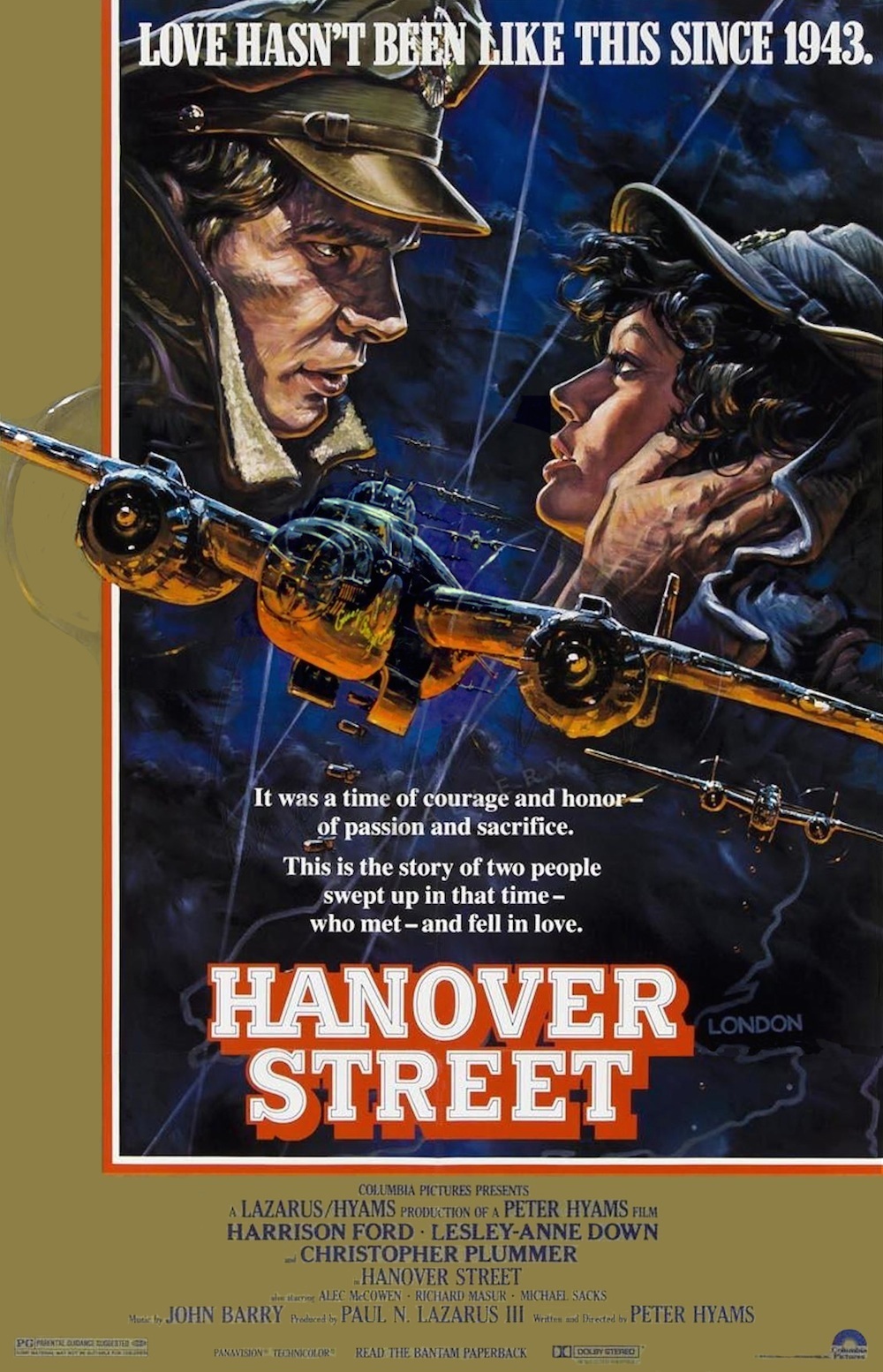
Just take a look at the poster for HANOVER STREET.

The words at the top: LOVE HASN’T BEEN LIKE THIS SINCE 1943.

Below that an illustration of Harrison Ford and Lesley-Anne Down looking each other passionately in the eyes, foreshadowing or merely shadowing a key scene in the movie.

More text (hype): “It was a time of courage and honor – of passion and sacrifice. This is the story of two people swept up in that time – who met – and fell in love.”

There’s also a map and two planes on the poster.

Ford worked so effectively as both Han Solo and Indiana Jones in eight films partly because he found a way to work in humor that counterbalanced all the cornball surrounding him. There’s also that priceless scene in THE EMPIRE STRIKES BACK when Princess Leia (Carrie Fisher) tells Han that she loves him and he merely says, “I know.”

In HANOVER STREET, Ford stumbles his way though dialogue like “Think of me when you drink tea,” “I love you enough to let you go, which is more than I’ve ever felt about anyone in my life,” and “You’ve got to go to him, and I’ve got to turn and walk away.” To be fair, everybody stumbles in HANOVER STREET and there’s no counterbalance to cornball.

Christopher Plummer legendarily disliked working on THE SOUND OF MUSIC (he called it “The Sound of Mucus”) and he said this about his co-star, “Working with Julie Andrews is like getting hit over the head with a valentine.” (Plummer and Andrews have remained friends.)

I just wonder what Plummer has to say about HANOVER STREET.

The Wizard of Oz (1939)

THE WIZARD OF OZ

THE WIZARD OF OZ (1939) Four stars

I watched THE WIZARD OF OZ for the first time since my Grandma died and the experience naturally brought on a lot of precious memories.

After all, I watched THE WIZARD OF OZ for the first (and second and third …) time at my Grandma’s house. She loved the movie and every now and then, she also talked about how many times she went to the movies to watch GONE WITH THE WIND. It was several, and I can remember hearing the delight in her voice just talking about it. She turned 10 years old in 1939, one of Hollywood’s hallowed years with MGM productions THE WIZARD OF OZ and GONE WITH THE WIND headlining. GONE WITH THE WIND was the TITANIC of its day, but a 4-hour historical soap opera did not enter my priority list until college. I watched THE WIZARD OF OZ a good dozen times before I got through GONE WITH THE WIND even once.

It was the CBS broadcast of THE WIZARD OF OZ that we watched together and the first time I can remember it I must have been 8 years old. Like IT’S A WONDERFUL LIFE, THE WIZARD OF OZ became an annual TV event for generations of Americans. I first watched IT’S A WONDERFUL LIFE at my Grandma’s house and it assumed the position of a holiday tradition for many years. I want to say that IT’S A WONDERFUL LIFE played on the local NBC affiliate.

Seeing THE WIZARD OF OZ for the 20th or 30th or 40th or 50th time (I lost track) in my life before this review, I found myself singing the songs, yes, every single line of every single darn song, but the most pleasure I experienced came from imitating the Wicked Witch of the West (Margaret Hamilton). I mean, I doubt that anybody who’s ever watched THE WIZARD OF OZ can resist imitating her voice on the all-time classic line “I’ll get you, my little pretty, and your little dog, too.” Hamilton virtually steals the movie and she’s so much more fun than that darn Glinda the Good Witch (Billie Burke), whose goodness decreases over time.

The Wicked Witch finished in fourth place on the American Film Institute’s top 50 villains list (2003), behind Hannibal Lecter, Norman Bates, and Darth Vader and ahead of Nurse Ratched, Mr. Potter, Alex Forrest, Phyllis Dietrichson, Regan MacNeil (when possessed), and the Evil Queen in the top 10.

Ironically enough, Hamilton served as a school teacher before her acting career. She became known for terrifying children … but she retained a lifelong commitment to education.

I wish I could have met Hamilton (1902-85).

“Almost always they want me to laugh like the Witch,” she said. “And sometimes when I go to schools, if we’re in an auditorium, I’ll do it. And there’s always a funny reaction, like they wish they hadn’t asked. They’re scared. They’re really scared for a second. Even adolescents. I guess for a minute they get the feeling they got when they watched the picture. They like to hear it but they don’t like to hear it. And then they go, ‘Oh…’ The picture made a terrible impression of some kind on them, sometimes a ghastly impression, but most of them got over it, I guess. … Because when I talk like the Witch and when I laugh, there is a hesitation, and then they clap. They’re clapping at hearing the sound again.”

THE WIZARD OF OZ served as many people’s introduction to scary movies. (Throw in classic Disney films SNOW WHITE and PINOCCHIO, as well, both of which I remember first watching during roughly the same period as when I first watched THE WIZARD OF OZ.)

Not only the Wicked Witch, but also somebody wanting to take your pet away, running away from home, a tornado, them flying monkeys, et cetera, they’re all terrifying, especially to a small child watching it for the first time. (Please consider the film left out the most gruesome details from the L. Frank Baum source material.)

THE WIZARD OF OZ shows us how much fun it can be to be scared.

That’s just one way the film reaches us.

Hamilton herself talked about its seemingly everlasting appeal.

“THE WIZARD OF OZ keeps coming back every year,” she said, “because it’s such a beautiful film. I don’t think any of us knew how lovely it was at first. But, after a while, we all began to feel it coming together and knew we had something. I can watch it again and again and remember wonderful Judy, Bert, Ray, Jack, Billie, Frank and how wonderful they all were. The scene that always gets to me, though, and I think it’s one of the most appealing scenes I’ve ever seen, is the one where the Wizard gives the gifts to them at the end. Frank (Morgan) was just like that as a person. And every time I see him do it, the tears come to my eyes. I listen to the words. I think of Frank, and I know how much he meant what he said, and how much the words themselves mean.”

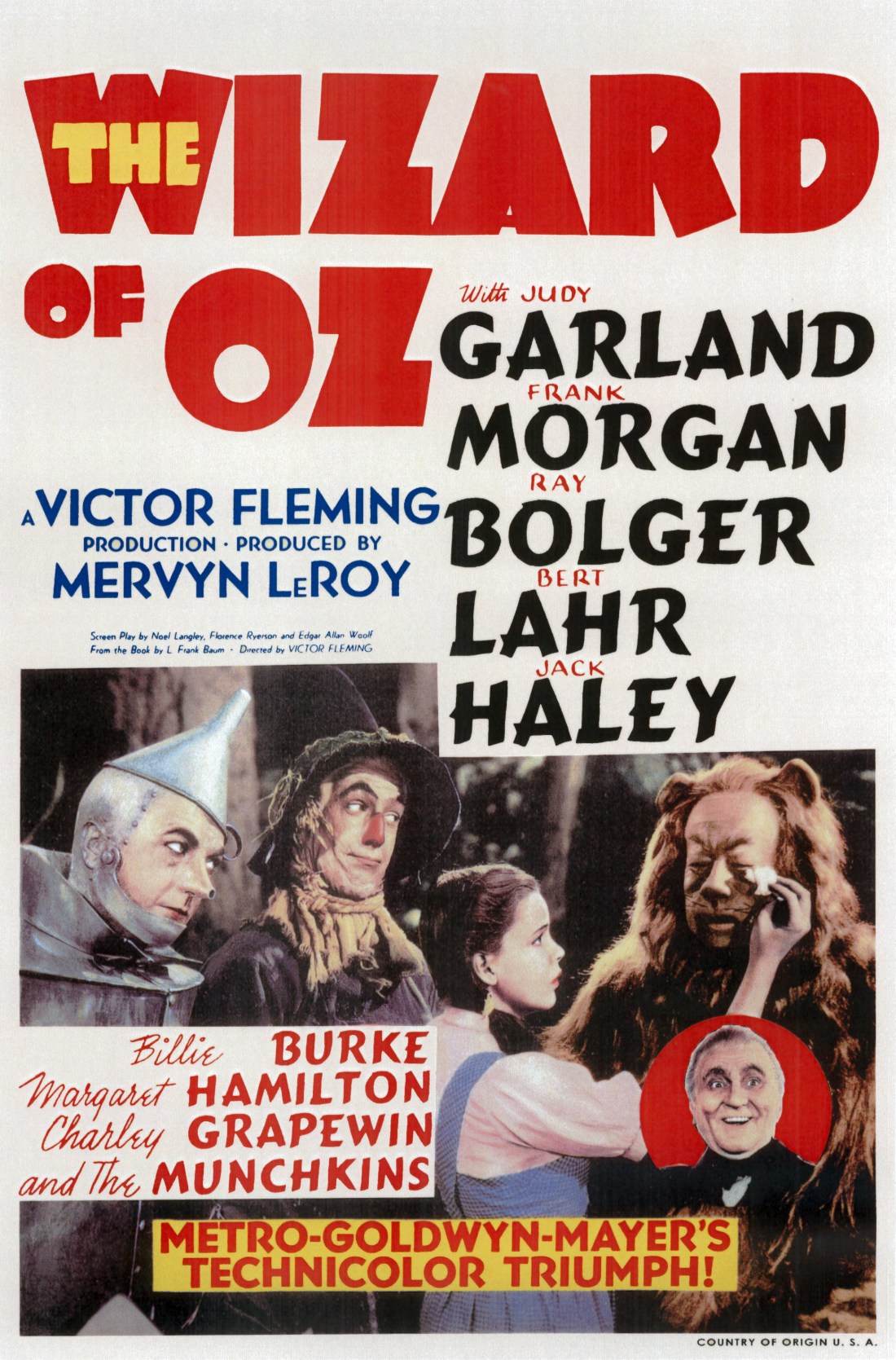
I devoted much space to Hamilton and the Wicked Witch, but there are at least six more beloved characters and performers: Dorothy Gale (Judy Garland, 1922-69), the Scarecrow (Ray Bolger, 1904-87), the Tin Man (Jack Haley, 1898-1979), the Cowardly Lion (Bert Lahr, 1895-1967), Toto (Terry, 1933-45), and the Wizard (Frank Morgan, 1890-1949). They go a long way toward making THE WIZARD OF OZ a classic that will persevere down the ages.

On this latest go-around, I again noticed how much of an influence WIZARD OF OZ had on George Lucas when he made STAR WARS.

THE WIZARD OF OZ grabs us early on, precisely at the moment when Garland begins singing “Over the Rainbow,” and it just builds and builds for the next 90-odd minutes.

Eighty years after it premiered (Aug. 25, 1939), I now have one more reason to watch it moving forward. Grandma, it felt like you were right there with me.

Laserblast (1978)

LASERBLAST

LASERBLAST (1978) Two-and-a-half stars

LASERBLAST is a clunky piece of low-budget junk, but it is not without its charms.

For example, LASERBLAST takes a pot shot at STAR WARS, literally when our teenage protagonist Billy Duncan (Kim Milford) blows up a STAR WARS billboard on the side of the road with his laser cannon. It blows up real good. For that matter, just about everything blows up real good in LASERBLAST.

We’ll get back to that later.

For now, however, I’d like to touch on a couple of the contemporaneous pot shots taken at JAWS.

THE GIANT SPIDER INVASION, which came out a few months after JAWS in 1975, has Sheriff Jeff Jones (Alan Hale Jr.) say over the CB radio of the spider, “You ever see the movie JAWS? It makes that shark look like a goldfish!”

THE HILLS HAVE EYES includes a ripped poster of JAWS.

ORCA: THE KILLER WHALE has a killer whale kill a great white shark early on in the proceedings.

Coincidentally, both THE HILLS HAVE EYES and ORCA were released on the same day (July 22) in 1977.

Anyway, back to LASERBLAST, a quickie exploitation picture made to cash in on the teenybopper science fiction craze between STAR WARS movies. It later became known for being one of the worst movies ever made, especially after Mystery Science Theater 3000 lampooned LASERBLAST in a 1996 episode.

I feel almost bad for giving a mixed review to LASERBLAST, especially after writing positive reviews for THE KILLING OF SATAN, TROLL 2, THE TERROR OF TINY TOWN, and PLAN 9 FROM OUTER SPACE. Almost. Believe it or not, all four of those other films have a higher IMDb rating than LASERBLAST.

LASERBLAST surrenders itself to filler scenes that just scream out TACKY SEVENTIES. It feels like a bloated production even at 80-85 minutes.

David W. Allen (1944-99) worked on 48 films in visual effects or puppetry or stop motion animation over nearly a 30-year career. His notable credits include FLESH GORDON, THE HOWLING, CAVEMAN, Q: THE WINGED SERPENT, THE STUFF, WILLOW, and GHOSTBUSTERS II.

Allen’s alien stop motion work in LASERBLAST received better reviews than any other aspect of the film.

Unfortunately, the stop motion aliens do not have more screen time in LASERBLAST.

Milford is not exactly playing the greatest hero in the history of cinema. For example, he’s the first and only hero ever to be picked on by screen nerd extraordinaire Eddie Deezen; both Milford and Deezen made their screen debuts in LASERBLAST. Milford (1951-88) became known for his work in the musicals “Jesus Christ Superstar” and “The Rocky Horror Picture Show.” He plays most of the movie without a shirt.

Let’s face it, Billy Duncan has a bad, bad, bad life: His mother always seems to be going to Acapulco, his girlfriend’s grandpa freaks out on him and runs poor, poor Billy off, two dope-smoking cops love writing up Billy for speeding tickets, and Chuck (Mike Bobenko) and Froggy (Deezen) bully him. Froggy, by the way, has seen STAR WARS five times, according to one of the dope-smoking deputies (played by veteran character actor Dennis Burkley in the early stages of his career).

Billy’s life changes for the better when he finds that darn laser cannon in the desert. As it says on the poster, Billy was a kid who got pushed around then he found the power.

Billy, of course, uses the laser cannon to blow up a bunch of stuff real good before the stop-motion aliens come for him.

One car blows up about five times in LASERBLAST. They give us just about every conceivable angle.

Yes, it’s that kind of a movie.

Keenan Wynn and Roddy McDowall (his last name spelled “McDowell” in the credits) make glorified cameo appearances.

LASERBLAST is bad enough that McDowall’s Peter Vincent could have played it on the TV series “Fright Night” featured in FRIGHT NIGHT.

On the bright side, LASERBLAST is considerably better than “The Star Wars Holiday Special,” which has gone down in history as the biggest STAR WARS rip-off of them all.