
Kiss Me Deadly (1955)


KISS ME DEADLY (1955) ****

Sometimes, it seems that like no author ever liked any film adaptation of their work. It feels that way every time I read up on a film based on a novel.

For example, British novelist Roald Dahl (1916-90) hated WILLY WONKA & THE CHOCOLATE FACTORY, though he’s credited for writing the screenplay. David Seltzer rewrote Dahl’s original script and the original author hated the changes like a different ending and the addition of musical numbers. The choice of Gene Wilder to play Willy Wonka also did not jibe with Dahl.

Stephen King famously hates Stanley Kubrick’s adaptation of THE SHINING. “I have a real problem with THE SHINING and Stanley Kubrick knew that I had a real problem with THE SHINING. I had a discussion with him beforehand. He said, ‘Stephen, Stanley Kubrick here, don’t you agree that all stories of ghosts are fundamentally optimistic?’ I said, ‘What do you mean?’ and he said ‘Well if there are ghosts it means we survive death and that’s fundamentally an optimistic view, isn’t it?’ I said, ‘Mr. Kubrick, what about Hell?’ and there’s a long pause on the telephone line and then he said in a very stiff and a very different voice, ‘I don’t believe in Hell.’ I said to myself, ‘Well, that’s fine, but some of us do and some of us believe that ghosts may survive and that may be Hell.’” King called THE SHINING “a cold film” with “striking images” and compared it to a “beautiful car that had no engine.”

Now, we get to the classic 1955 apocalyptic film noir KISS ME DEADLY directed by Robert Aldrich (1918-83) and written by screenwriter A.I. Bezzerides (1908-2007) and an uncredited Aldrich from Mickey Spillane’s 1952 novel.

Spillane (1918-2006), of course, did not find the film adaptation of his novel to be “classic.” Apparently, Bezzerides felt the same about the source material.

“I was given the Spillane book and I said, ‘This is lousy. Let me see what I can do.’ So I went to work on it. I wrote it fast because I had contempt for it. … I tell you Spillane didn’t like what I did with his book. I ran into him at a restaurant and, boy, he didn’t like me.”

Why not?

Bezzerides added espionage and the infamous nuclear suitcase (“The great whatsit”), plot details not in Spillane’s novel. On top of that, Bezzerides made detective protagonist Mike Hammer a narcissistic bully of a very high degree of creep. Hammer, played by Ralph Meeker, pushes anti-hero to its most extreme limits. For whatever reason, Nazareth’s “Hair of the Dog” comes to mind, mainly that “Now you’re messin’ with a son of a bitch” chorus.

The appropriately named Hammer makes his living (predominantly) by blackmailing adulterous husbands and wives and he’s appropriately named Hammer because he’s always dropping the hammer on somebody in his way. Assorted thugs and sordid contacts, of course, but also a coroner not wanting to part with a key and a clerk not wanting to cooperate because Hammer’s not a member. Hammer’s friends and associates also pay dearly for their association with the detective.

I love Bezzerides’ dialogue.

One thug waxes poetic, “Dames are worse than flies.”

That’s as great as “I don’t pray. Kneeling bags my nylons” from Billy Wilder’s ACE IN THE HOLE and Harry Lime’s “cuckoo clock” speech from Carol Reed’s THE THIRD MAN.

KISS ME DEADLY prepares us for what lies ahead from its very first scene and then its opening credits, both stating that it will be a film like none other. What’s that old Cole Porter song? Yes, “Anything Goes.”

First scene: A frightened young woman. Dressed only in a trench coat, and she’s also in her bare feet. She’s flagging a ride as the motor cars zip past on a highway. She’s desperate, so desperate that she finally places herself in front of the path of one of the zipping cars. That car just happens to be driven by none other than Hammer. His first line, “You almost wrecked my car! Well? Get in!”

Opening credits: They scroll backwards. All the while, we hear the cries of the frightened young woman (Cloris Leachman).

Christina Bailey, the frightened young woman, tells Hammer, “Get me to that bus stop and forget you ever saw me. If we don’t make it to the bus stop. … If we don’t, remember me.” Needless to say, Miss Bailey does not make it to the bus stop and Hammer (and by extension, we) go down the proverbial rabbit hole. All roads lead to the atomic suitcase and one helluva explosive finale.

Every film noir seems to have at least one femme fatale and KISS ME DEADLY gives us Lily Carver (Gaby Rodgers), who’s compared to Pandora and Lot by one character she guns down late in the picture. She then greets Hammer, “Kiss me, Mike. I want you to kiss me. Kiss me. The liar’s kiss that says I love you, and means something else.” She unloads on Hammer, too.

Yes, she’s arguably the most fatal of any femme.

From her profile on “The Female Villains Wiki,” “Lily often has the manner of a slightly flaky adolescent, which doesn’t seem to be all assumed for the deceptive role she’s playing in the early scenes. When her true identity and character are later revealed, it’s clear she’s one of the most black hearted, deadly female villains ever put on screen. … She kills people easily, with no ethical concerns whatever evident. She smirks after she’s done it. In the last scene in which she appears, we see she’s more than just a greedy, callous killer, very pleased with herself, she’s also a sadist.”

Lily meets her maker in one of the great cinematic deaths. There’s a shot during the apocalyptic ending in RAIDERS OF THE LOST ARK that’s a dead ringer for one in KISS ME DEADLY. Gotta love that Spielberg.

In the alternate ending, the one that was seen for many years, even Hammer goes down in flames. Nihilism and its variants have been used to describe KISS ME DEADLY many times, 639,000 in fact according to Google.

Aldrich later directed WHAT EVER HAPPENED TO BABY JANE?, THE DIRTY DOZEN, and THE LONGEST YARD, but he already outdid himself with KISS ME DEADLY.

All we need to know is that the Kefauver Commission named KISS ME DEADLY as 1955’s No. 1 menace to American youth. That would have included an 8-year-old Steven Spielberg and look how he turned out.
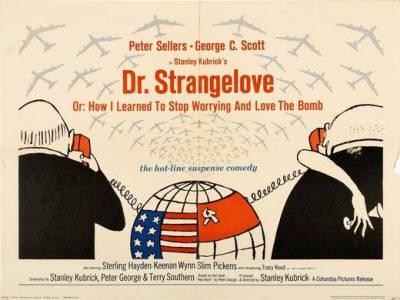
Dr. Strangelove (1964)

day752cdr.strangelove

DR. STRANGELOVE (1964) Four stars
Stanley Kubrick’s DR. STRANGELOVE (abbreviated title) OR: HOW I LEARNED TO STOP WORRYING AND LOVE THE BOMB (long title) contains one of my favorite lines of dialogue in any movie.

President Merkin Muffley, played by Peter Sellers in one of his three roles in the movie, tells the Americans and Commies both, “Gentlemen, you can’t fight in here! This is the War Room!”

I don’t give a damn that it placed No. 64 on the American Film Institute’s 100 Years … 100 Movie Quotes list.

Oh, sorry, “Frankly, my dear, I don’t give a damn” from GONE WITH THE WIND came in at No. 1, followed by quotes from Marlon Brando characters in THE GODFATHER and ON THE WATERFRONT that bums just can’t refuse.

Kansans will be sure thrilled that “Toto, I’ve a feeling we’re not in Kansas anymore” came in at No. 4.

CASABLANCA led that list with six quotes and freaking JERRY MAGUIRE picked up two. Are you kidding?

Anyhoo, DR. STRANGELOVE certainly lives up to such a title: It’s a strange movie about strange people doing and saying the strangest things.

I’ve heard it described as a movie about what could happen if the wrong person pushed the wrong button.

That wrong person would be General Jack D. Ripper (Sterling Hayden), who believes them damn commies have conspired to pollute our “precious bodily fluids.” To say that it’s an obsession for Gen. Ripper would be one of the great understatements.

Gen. Ripper orders a first strike nuclear attack on the Soviet Union.

Then we get a mad gallery of characters that are just slightly less mad than Ripper: Muffley, Group Captain Lionel Mandrake, and Dr. Strangelove played by Sellers; General Buck Turgidson by George C. Scott; Colonel Bat Guano by Keenan Wynn; and Major T.J. “King” Kong by Slim Pickens, for example. Muffley and Turgidson are predominantly inside the War Room, one of the great movie sets.

Sellers originally had been slated to play four roles, including Kong, but it went down to three after he hurt his ankle.

Sellers predominantly improvised most of his dialogue and his ad-libs were retroscripted into the screenplay.

Sellers modeled Muffley after 1952 and 1956 U.S. Presidential candidate Adlai Stevenson and former Nazi scientist Dr. Strangelove after Wernher von Braun. Strangelove’s very reminiscent stylistically of mad scientist Rotwang from Fritz Lang’s METROPOLIS.

Strangelove comes aboard late in the movie as humanity faces nuclear destruction.

Scott, who later won an Oscar for Gen. Patton in the Best Picture-winning PATTON, played Gen. Turgidson a lot differently than he intended and he was apparently tricked by Kubrick into acting ridiculously like in the final film. Scott never worked with Kubrick again. Kubrick and Scott played each other at chess and Kubrick got the edge on Scott, a skilled player, often.

John Wayne and Dan Blocker, of course, turned down Kong because, you know, DR. STRANGELOVE was just way too darn pinko for their persuasions.

The role ended up in the hands of the one-and-only Pickens, whom the makers of DR. STRANGELOVE did not understand was a genuine cowboy.

They did not tell Pickens that it was a black comedy and he played it straight, gloriously straight.

He gets one of the great exit scenes in film history.

There’s a whole lot about DR. STRANGELOVE that I don’t want to talk about in this space, especially for those who have not yet seen the movie.

I believe, however, that you will find it to be one of the great movie experiences.

It’s definitely the satire the Cold War deserved.

It’s an incredibly smart and sneaky movie, truly ahead of its time.

For example, a Cornell University professor Legrace G. Benson wrote Kubrick a fan letter and the professor interpreted DR. STRANGELOVE as being very sexually-layered. (Not sure how people could miss it.)

Kubrick wrote Benson back, “Seriously, you are the first one who seems to have noticed the sexual framework from intromission (the planes going in) to the last spasm (Kong’s ride down and detonation at target).”

And, for sure, after DR. STRANGELOVE you will never hear “We’ll Meet Again” the same way again.

Full Metal Jacket (1987)

day 65, full metal jacket

FULL METAL JACKET (1987) Four stars
I’m a firm believer in the “Full Metal Jacket Fallacy.”

Why, that’s when fools argue the first half of Stanley Kubrick’s FULL METAL JACKET is just brilliant and the second half flat-out sucks donkey testicles.

I’ve heard that argument many, many times in high school, college, and probably will continue to hear it for all my living days. You’re all wrong and I have no problem saying that.

Yes, I would agree the first half’s superior to the second, especially thanks to the powerhouse performances by R. Lee Ermey (1944-2018) and Vincent D’Onofrio, but the second half does not suck.

Granted, I do believe Kubrick’s Vietnam begins with our main protagonist Private Joker (Matthew Modine) and his sidekick Rafterman (Kevyn Major Howard) picking up a Da Nang hooker. In dialogue sampled by infamous rap group 2 Live Crew, she says, “Me so HORNY. Me love you long time.” Anyway, she goes on to guarantee “Me sucky-sucky. Me love you too much” and later on, we hear “Sucky! Sucky! Five dolla!,” rather infamous words. She’s relentless, I’ll give her that.

So, yeah, I can see why people think FULL METAL JACKET sucks during its second half, since hearing “suck” so many times conditioned them into believing the Vietnam portion sucked. I get it now, after many years of being mystified.

FULL METAL JACKET, as many already know, made several great contributions to the English language and it furthered cursing more than just about any other film in cinematic history. Ermey, in particular, used profanity like other artists use clay.

For example, I learned such timid little phrases as “I didn’t know they stacked shit that high,” “Only steers and queers come from Texas” (an Oklahoma variation on this line used in AN OFFICER AND A GENTLEMAN), and “I bet you’re the kind of guy that would fuck a person in the ass and not even have the goddamn common courtesy to give him a reach-around.”

Not that I ever use such phrases, I promise.

That’s good, since I first watched FULL METAL JACKET around the age of 10 on home video. Right around that same moment in time, I first watched films like COMMANDO, THE TERMINATOR, PREDATOR, PLATOON, and STAND BY ME, all films that definitely had an impact on me, though I found their vulgarity funny at the time in a different way than years later. I did not know what most of the words meant upon first viewing, but found them funny in just how they sounded and how they were delivered. I picked up the meanings in later viewings, and I still find them all funny.

STAND BY ME, as well as THE BAD NEWS BEARS, especially proved revelatory, in that kids from different eras cussed.

I mean, STAND BY ME gave us the line “A pile of shit has a thousand eyes” and Tanner Boyle in THE BAD NEWS BEARS, why he’s one of the greatest foul-mouthed hooligans in history.

Ermey and D’Onofrio give two brilliant performances, but since they’re in a film directed by Kubrick (1927-99), they were not nominated for the Academy Awards.

That’s because Kubrick’s often considered the real star in his movies and he’s one of the greatest directors ever whose credits include THE KILLING (watch this one followed by RESERVOIR DOGS), PATHS OF GLORY, SPARTACUS, DR. STRANGELOVE, 2001, A CLOCKWORK ORANGE, BARRY LYNDON, THE SHINING, and EYES WIDE SHUT.

Kubrick made 13 feature films during his career from 1953 through 1999. He was a photographer for Look magazine in the late 1940s and early 1950s, and that background informs all his films. They all have indelible scenes.

Kubrick’s films grow better over time and they’re generally perceived more favorably after cold or hostile receptions during their first theatrical release. They have a timeless quality about them.

How often were the actors’ performances saluted by the industry?

Seemingly not very often.

Peter Ustinov won the 1961 Academy Award for Best Supporting Actor for SPARTACUS, probably the project least satisfactory personally to Kubrick.

Sue Lyon won the Golden Globe for Most Promising Newcomer for her work in LOLITA and James Mason, Shelley Winters, and James Mason were nominated along with Lyon.

Peter Sellers received a 1965 Academy Award Best Actor nomination for DR. STRANGELOVE. Sellers played three roles … and he lost the award to Rex Harrison, Professor Henry Higgins in MY FAIR LADY. (Lee Marvin won the next year for two roles in CAT BALLOU, so it must have been easier to win for two roles rather than three.)

All of the awards and nominations for 2001 were either technical (visual effects, cinematography, production design) or for Kubrick and writer Arthur C. Clarke, though Douglas Rain, as the voice of HAL 9000, gives one of the best performances in any film. How would you like to have been beaten out by a sentient computer? No, instead, the 1969 Academy Award nominees for Best Actor were Cliff Robertson in CHARLY, Alan Arkin in THE HEART IS A LONELY HUNTER, Alan Bates in THE FIXER, Ron Moody in OLIVER!, and Peter O’Toole in THE LION IN WINTER … with the prize to Robertson. Who remembers their performances? Honestly … we all remember HAL 9000, “Look Dave, I can see you’re really upset about this. I honestly think you ought to sit down calmly, take a stress pill, and think things over.”

Nearly all the kudos for A CLOCKWORK ORANGE were technical or for the director, like before, but Malcolm McDowell earned a Golden Globe nomination for his performance as larger-than-life Alex DeLarge.

BARRY LYNDON won 1976 Academy Awards for best production design, best costume design, best cinematography, and best original score.

Jack Nicholson won Academy Awards for Best Actor in 1976 (ONE FLEW OVER THE CUCKOO’S NEST) and 1998 (AS GOOD AS IT GETS) and for Best Supporting Actor in 1984 (TERMS OF ENDEARMENT), but he got no love for THE SHINING though his flamboyant performances before and after Kubrick received nominations. I mean, for example, is Nicholson’s performance in THE SHINING all that different from his one in ONE FLEW OVER THE CUCKOO’S NEST?

EYES WIDE SHUT received no Academy Award nominations, just like THE SHINING before it, although Tom Cruise and Nicole Kidman do some of their best work.

Back to FULL METAL JACKET.

Kubrick, Michael Herr, and Gustav Hasford received the film’s lone Academy Award nomination for Best Adapted Screenplay, while both Ermey and D’Onofrio were both separately nominated for Best Supporting Actor, Ermey by the Golden Globes and D’Onofrio by the Boston Society of Film Critics.

I doubt there were better performances from any films released in 1987.

Erney and D’Onofrio bring their characters Gunnery Sergeant Hartman and Private Leonard “Gomer Pyle” Lawrence to such life that they stay with us for the rest of the movie after their unfortunate, tragic demise at the end of the Parris Island sequence. Their characters stay with us forever, in fact, and I venture to say that’s a definition of a great performance.

If somebody mentions Gomer Pyle, for example, I think first of FULL METAL JACKET and not Jim Nabors of “The Andy Griffith Show” and “Gomer Pyle, U.S.M.C.” Please consider that, for a second.

D’Onofrio gained 70 pounds for the role of the overweight Gomer Pyle, who finds that he’s only got one true skill in basic training. Those 70 pounds surpassed what Robert DeNiro did for RAGING BULL, and that performance earned an Academy Award.

Ermey served as a U.S. Marine drill instructor during the Vietnam War and this real experience informed his performance as Hartman.

Kubrick allowed Ermey to ad lib his dialogue, something that does not jibe with Kubrick’s reputed uncompromising perfectionism. In fact, Google “Kubrick perfectionist” and see results like a Telegraph article titled “The relentless, ridiculous perfectionism of Stanley Kubrick.”

I don’t know, Kubrick earned his reputation for relentless perfectionism, of course, but what about Sellers in DR. STRANGELOVE or, for that matter, George C. Scott’s War Room stumble in that same film? Or McDowell’s “Singin’ in the Rain” number in A CLOCKWORK ORANGE? Or Nicholson’s “Here’s Johnny” in THE SHINING? Ad libs, ad libs, ad libs.

Kubrick and his films are complex, contradictory, and controversial, and that’s part of why they stand the test of time.