Dr. Jekyll and Mr. Hyde (1941)

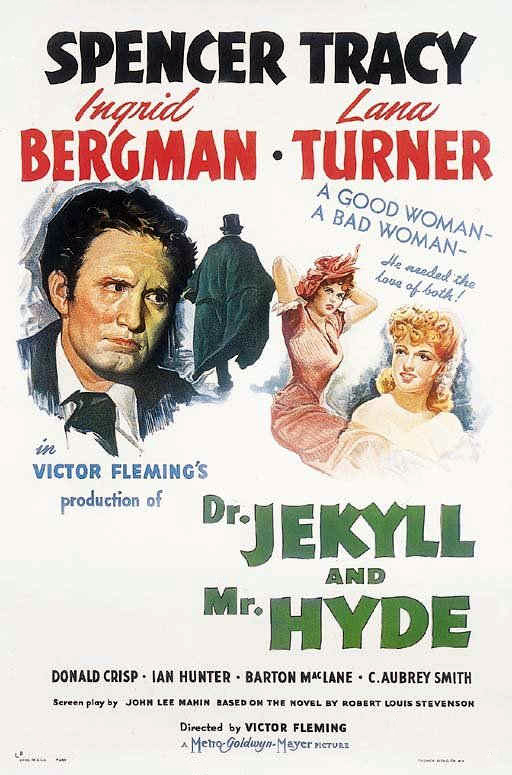
DR. JEKYLL AND MR. HYDE (1941) **
Casting the wrong actor can be fatal to any motion picture.

Take for instance the 1941 horror film Dr. Jekyll and Mr. Hyde directed by Victor Fleming (credited director for Gone with the Wind and The Wizard of Oz) and starring Spencer Tracy, Ingrid Bergman, and Lana Turner, who are wrong for three of the four main roles.

Tracy (1900-67) could play the idealistic Dr. Jekyll in his sleep, but he’s simply not believable as the malevolent Mr. Hyde and that’s a major strike against the film because the duality of man theme flies right out the window without a convincing Mr. Hyde.

Bergman (1915-82) sought out the bad girl role Ivy Pearson and she’s plainly just wrong for a lower class trollop and saloon girl, even before Casablanca, Gaslight, and The Bells of St. Mary’s placed Bergman in the popular imagination as the ideal woman. Ironically, Bergman and Tracy dated during Dr. Jekyll and Mr. Hyde and director Fleming reportedly fell in love with her. Her image as the ideal woman cracked and her career in America ended for the better part of a decade circa 1949 after her affair with married Italian director Roberto Rossellini dominated headlines.

Turner (1921-95) plays against type as the good girl Beatrix Emery and she becomes such a nonentity during Dr. Jekyll and Mr. Hyde that we forget she’s even in the picture. Turner later made her enduring fame playing a femme fatale, a la The Postman Always Rings Twice.

Throughout cinematic history, more than 120 adaptations of Robert Louis Stevenson’s 1886 novella Strange Case of Dr. Jekyll and Mr. Hyde exist, with seemingly a major one every decade.

I vote for the superiority of the 1931 version produced by Paramount, directed by Rouben Mamoulian, and starring Fredric March and Miriam Hopkins. It blows the MGM version made 10 years later right straight out of the water and it’s not even close. Ditto for March and Hopkins, as well as Mamoulian, in comparison against Tracy, Bergman, and Fleming.

The 1931 Dr. Jekyll and Mr. Hyde benefited from being made before the Production Code that came into play around 1934 and being made at Paramount rather than MGM.

Hopkins’ Ivy showing March’s Jekyll her leg still stands up as one of the great erotic moments. March never fails to convince us as both Dr. Jekyll and Mr. Hyde, and he deserved to win the Academy Award for Best Actor for his performance. Mamoulian’s creativity shines throughout.

In the early ’30s, Paramount released such films as Morocco, Unfaithful, Dishonored, Tarnished Lady, Tabu, Million Dollar Legs, Horse Feathers, Island of Lost Souls, She Done Him Wrong, Murders in the Zoo, I’m No Angel, Duck Soup, and Design for Living. Paramount also distributed Fritz Lang’s 1931 all-time classic M in March 1933.

By comparison with the wild-and-crazy Paramount, where the Marx Brothers and Mae West once held court, MGM seemed awful stodgy and strange films like Tod Browning’s Freaks, Mark of the Vampire, and The Devil-Doll feel like aberrations on the studio’s permanent record. The folks around MGM reportedly treated Freaks cast members like, well, freaks.

So, in essence, if you have a chance and you’ve not seen it before, please go find the 1931 Dr. Jekyll and Mr. Hyde and watch it as soon as possible.

Couple Bombs from ’81: The Legend of the Lone Ranger, First Monday in October

COUPLE BOMBS FROM ‘81: THE LEGEND OF THE LONE RANGER, FIRST MONDAY IN OCTOBER

THE LEGEND OF THE LONE RANGER fails miserably at capturing any of the magic of the 1978 blockbuster SUPERMAN, its obvious cinematic inspiration.

Not even one speck.

Like SUPERMAN, LONE RANGER gives us a mythic origin story for an old cultural hero and then unfurls a new grand adventure featuring our updated hero and other updated characters. Sounds like a great time at the movies, but where did LONE RANGER go so absolutely incredibly stupendously wrong?

First stumbling block first, we have screen neophyte Klinton Spilsbury, who more or less remains a screen neophyte after LONE RANGER. That’s because Spilsbury botched his opportunity so badly that producers dubbed him with James Keach in post-production. Spilsbury quickly became a punchline upon the release of the film. For example, Gene Siskel remarked in his review that Spilsbury playing the Lone Ranger would make for a fine trivia question in the 1990s. I am straining to remember if Spilsbury appeared in “Trivial Pursuit” or perhaps on “Jeopardy” as the answer to who played the Lone Ranger in THE LEGEND OF THE LONE RANGER. If producers dub in another actor’s voice, how much of a performance did the dubbed out actor really give? Nevertheless, Spilsbury joined the ranks of infinitely superior actor Harvey Keitel, whose trademark Brooklyn accent did not make the final cut of SATURN 3. Sorry, Mr. Keitel.

Spilsbury definitely proved to be no Christopher Reeve, whose performance as both mild-mannered reporter for a great metropolitan newspaper Clark Kent and Kal-El, a.k.a. Superman, a.k.a. The Man of Steel, contributed a great deal to what made SUPERMAN and SUPERMAN II successful super-budget entertainments that connected with a mass audience on a personal level. Reeve said that he found inspiration from Cary Grant’s performance in BRINGING UP BABY and SUPERMAN and SUPERMAN II indeed at times resemble screwball romantic comedies. (Gene Hackman, Ned Beatty, and gang unfortunately suggest the campy villains from the 1960s Batman TV show, almost upsetting that precarious balance ‘tween humor and seriousness. Terence Stamp, Jack O’Halloran, and Sarah Douglas make better villains in SUPERMAN II.)

LONE RANGER lacks a lighter, humorous touch to counterbalance its mythology attempts. It is so somber that it becomes ponderous and then dreary before it finally springs into action, despite the efforts of Merle Haggard in the Waylon Jennings “Dukes of Hazzard” balladeer role. Obituarists skipped this chapter in Haggard’s career out of respect for the man when he died in 2016.

Finally springs into action is an understatement in the case of LONE RANGER.

LONE RANGER takes approximately 70 minutes to get the title character into costume and to play the William Tell Overture on the soundtrack, and we’re talking about a movie clocked at 98 minutes. William A. Fraker (director), Walter Coblenz (producer), Martin Starger (executive producer), and the writing team of Ivan Goff, Ben Roberts, William Roberts, Michael Kane, and Gerald B. Derloshon discovered a new level of stupidity.

Complete epic failure amounts to the only legend created by THE LEGEND OF THE LONE RANGER.

FIRST MONDAY IN OCTOBER also has its roots in old movies, though it may not be as obvious as LONE RANGER.

FIRST MONDAY wanted to be like one of those movies pairing Spencer Tracy and Katharine Hepburn — WOMAN OF THE YEAR, KEEPER OF THE FLAME, WITHOUT LOVE, SEA OF GRASS, STATE OF THE UNION, ADAM’S RIB, PAT AND MIKE, DESK SET, and GUESS WHO’S COMING TO DINNER.

Those movies succeeded in part because of the chemistry between Tracy and Hepburn and our enjoyment from watching them interact.

FIRST MONDAY fails in large part because Walter Matthau and Jill Clayburgh do not spark that Tracy-Hepburn chemistry and they are both miscast in their roles. FIRST MONDAY should be renamed “The Bickersons Go to the Supreme Court.”

Matthau stars as veteran Associate Justice Dan Snow and Clayburgh draws freshly appointed Associate Justice Ruth Loomis. All we need to know about them boils down to cranky old white ultra-liberal male (Snow) and feisty liberated white ultra-conservative female (Loomis) babble and battle but nonetheless develop affection toward each other.

Matthau gives the standard Matthau performance and it simply does not suit his character. Melvyn Douglas and Henry Fonda played this character on stage and they were both much better fits than Matthau.

Clayburgh made her fame as the quintessential liberated woman in AN UNMARRIED WOMAN and so it is jarring to see her play a rigid conservative. Also, she’s too young for her character. Jean Arthur, Jane Alexander (a few years older than Clayburgh), and Eva Marie Saint played the role on stage.

Paramount originally planned to release FIRST MONDAY in early 1982, but after President Ronald Reagan nominated Sandra Day O’Connor to the Supreme Court on July 7, 1981, Paramount rushed FIRST MONDAY forward to release in late August, one month before the Senate confirmed O’Connor’s appointment.

It is possible that FIRST MONDAY benefited commercially from publicity attendant with O’Connor’s historic appointment. FIRST MONDAY earned nearly $13 million in returns. In the long run, though, so what?

Upon first perusal of British director Ronald Neame’s film credits, one sees two disaster films, THE POSEIDON ADVENTURE and METEOR. After watching FIRST MONDAY, I count three disaster films directed by Neame.

I reviewed two bombs from ‘81 because Hollywood still recycles, rehashes, regurgitates, recapitulates, and remakes old movies, old plays, old TV shows relentlessly.

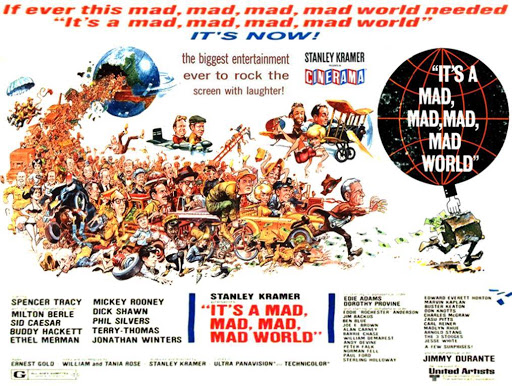
It’s a Mad, Mad, Mad, Mad World (1963)

MAD MAD MAD MAD WORLD

IT’S A MAD, MAD, MAD, MAD WORLD (1963) 1/2*

Let’s start this review with a bold statement and prediction: IT’S A MAD, MAD, MAD, MAD WORLD is the worst comedy I have ever seen and it will remain that way for all my life, even if I would be blessed to reach 100 years old.

Fact: I did not laugh once during the 3-hour, 19-minute duration of IT’S A MAD, MAD, MAD, MAD WORLD.

I consider it a lock on being the worst comedy I will ever see because of that length. Sure, I can go 90 or 95 or even 100 minutes not laughing at some dumb or aggressively stupid comedy, no problem, but 189 minutes proved to be a new personal record for remaining in a state of stone cold silence during a comedy. I only broke that silence to express disbelief with a grunt or a sigh. To be honest these intermittent sighs were deep enough to fill the Grand Canyon.

Yes, I almost forgot LEONARD PART 6 (believe me, how I tried forgetting), which I gave no stars and called “the worst movie ever made.” That’s right, it passes comedy straight into being bad enough to encompass all genres.

Why the half-star for a repetitive, repetitive, repetitive, repetitive comedy? Because I liked looking at the cast members during any fleeting moments when they were quiet. Once they resumed talking, well, shit, IT’S A MAD, MAD, MAD, MAD WORLD turned back into unfunny shit on a stick. Yeah, I felt like IT’S A MAD, MAD, MAD, MAD WORLD beat me over the head with unfunny shit on a stick for roughly a quarter of a quarantine day. I will do my best to utilize past tense during this review because I have no intent to ever watch IT’S A MAD, MAD, MAD, MAD WORLD ever, ever, ever, ever again.

I should rephrase one portion of the paragraph immediately above. Very, very, very, very rarely do any of the characters merely talk during IT’S A MAD, MAD, MAD, MAD WORLD. Just imagine a crowded room populated by people who feel compelled to compete with each other for who can be the loudest (and most obnoxious) person in the world, forget the room. And then being trapped inside that room for over three hours describes this movie in a nutshell. Perhaps it would be too much to add real cars to the room. Nah, instead, we’ll have a movie theater size TV in the room playing a loop of car chases at full volume intensity.

Here’s a main character who speaks in a voice resembling that of a normal person: Emeline-Marcus Finch (Dorothy Provine), whose character seems like the movie loaned her from a library amidst the chaos in this loud, loud, loud, loud movie. They no doubt used the Frances Howard Goldwyn – Hollywood Regional Branch Library, only a three-minute walk from the Walk of Fame.

The film establishes a basic tone early on, when five of the characters stand around and squabble over their potential take of the stolen $350,000 hidden under the ‘Big W’ in the Santa Rosita State Park. Yes, IT’S A MAD, MAD, MAD, MAD WORLD is basically one long argument over money interrupted by chases, overacting, mugging, pitfalls and pratfalls, dancing, overacting, cameo appearances, police chatter, overacting, an intermission, pitfalls and pratfalls, plane crashes, explosions, and (for old times’ sake) overacting.

Just take a look at some of the cast: Spencer Tracy, Milton Berle, Sid Caesar, Buddy Hackett, Ethel Merman, Mickey Rooney, Dick Shawn, Phil Silvers, Terry-Thomas, Jonathan Winters, Jim Backus, William Demarest, Jimmy Durante, Peter Falk, Jack Benny, Joe E. Brown, Norman Fell, Stan Freberg, Leo Gorcey, Edward Everett Horton, Buster Keaton, Don Knotts, Jerry Lewis, ZaSu Pitts, Carl Reiner, Arnold Stang, and the Three Stooges, with more than half of them in minute roles. What a sad, sad, sad, sad waste of talent!

Among the main characters, it’s easy to pick my least favorite: Mrs. Marcus, played by Merman. She’s awful from the start and remains awful for the entire length of the picture. IT’S A MAD, MAD, MAD, MAD WORLD partisans argue that she’s a character that people love to hate. I, however, am not one of those people, because I only hate this character. Thankfully, Merman closed out her career with a hilarious cameo in AIRPLANE!

Gordon Gekko told us “Greed is good” during WALL STREET. Meanwhile, nearly 25 years earlier, IT’S A MAD, MAD, MAD, MAD WORLD told us “Greed is bad, mkay?”

One more zinger before closing time: I laughed more during Stanley Kramer’s INHERIT THE WIND than I did IT’S A MAD, MAD, MAD, MAD WORLD. (If I ever watch Kramer’s JUDGMENT AT NUREMBERG, I’ll be sure to revise this final paragraph and gag.)