
Shaft (1971)

SHAFT

SHAFT (1971) Three-and-a-half stars

A whole new generation of fans discovered Isaac Hayes (1942-2008) through his work for Trey Parker and Matt Stone on “South Park.”

I’m talking about Chef, Hayes’ animated alter ego, his songs like “Chocolate Salty Balls” and “Love Gravy,” his lines “Hello there, children” and “Damn, woman, I just gave you sweet loving five minutes ago” (oh, for just one game of South Park pinball right about now), and his overall cool until everything went all screwy there at the end between Mr. Hayes and the boys.

I went back in time and delved through Hayes’ previous work.

At some point in the late 20th or early 21st century, I watched Gordon Parks’ SHAFT for the first time, roughly the same time as I watched the John Singleton remake, er, sequel starring Samuel Jackson and featuring Christian Bale, Toni Collette, and Jeffrey Wright. It would have been nice if the suburban multiplex paired the ‘71 and ‘00 pictures together, but, no, of course not, and my ears still feel like they’re ringing from the 110-minute action spectacular. Nigel Tufner must have been the projectionist that day, because it was cranked up to 11 x 11.

(For crying out loud, why do we need three movies simply titled SHAFT? This is just as bad as HALLOWEEN.)

I vastly prefer the ‘71 SHAFT over any of the later SHAFT films (I, of course, have not seen the 2019 one) and there’s not one scene in either ‘70s sequel, BIG SCORE and GOES TO AFRICA, or the 2000 sequel or the rest of the first picture itself that even approaches the opening five minutes. Talk about iconic.

It all starts with the multifaceted sounds of the modern day big city rumble, then it moves on to the sights. Burt Lancaster and Telly Savalas in THE SCALPHUNTERS and George Peppard and Dean Martin in ROUGH NIGHT IN JERICHO. Robert Redford, Michael Pollard, and Lauren Hutton in LITTLE FAUSS … never mind, the first 42nd Street showing of HE AND SHE and second big hit THE ANIMAL. There’s more hype, then the first notes of Hayes’ “Theme from Shaft” hit us.

Nearly 45 seconds into the movie, we’re given our introduction to the title character with a close-up of the man coming out from the subway and we’re already interested. He walks across six lanes of traffic and flashes an obscene gesture and shouts “Up yours!” at somebody who had the audacity to honk their horn. We’re interested some more, as we observe what must be just another day in the life of this angry black man.

We see more commercialization and Shaft walks through a crowd of picketers. One sign: “I GOT MY JOB THROUGH THE New York Times.” Another: “WANT YOUR SEX LIFE PUBLISHED?” One more: “I LOST MY JOB THRU Fidelifacts.” Just before making his way through picketers, Shaft flashes his badge at a street peddler, who promptly skedaddles to somewhere else. “Theme from Shaft” has been playing this whole time and picking up momentum as the opening credits scroll and our title character strolls.

It’s been about 150 seconds into the number before Hayes matter-of-factly asks “Who’s the black private dick that’s a sex machine to all the chicks?” Backing vocalists Pat Lewis, Rose Williams, Mitchell Butler, and Telma Hopkins answer “Shaft” and Hayes replies “Damn right.” We are hooked, that’s damn right for sure.

“Theme from Shaft” won the 1972 Academy Award for Best Original Song, and it’s a stone cold classic especially in its single form. We can file the opening scene in SHAFT under “Great Opening Scenes.”

Hayes wrote the lyrics, handled lead vocals, made the arrangements, and played the keyboards. Lester Snell (electric piano), David Becker (viola), Charles Pitts (guitar), Michael Toles (guitar), Marc “Dr. Love” Davis (guitar solo), James Alexander (bass guitar), Richard “Johnny” Davis (trumpet), John Fonville (flute), Gary Jones (congas), and Willie Hall (drums) all played their parts masterfully.

Despite the fact that none of the remaining 90 or so minutes can measure up against the opening five, SHAFT affords one additional pleasures. That should be of little surprise, since this material puts a black spin on James Bond and Mike Hammer.

White author Ernest Tidyman (1928-84) adapted his own 1970 novel for the screen and Tidyman became a household name in Hollywood with SHAFT and THE FRENCH CONNECTION both major hits in 1971. Tidyman won the Academy Award for Best Adapted Screenplay for THE FRENCH CONNECTION, a Best Picture winner.

Tidyman, who FRENCH CONNECTION producer Philip D’Antoni thought would be black, did not like the SHAFT rewrite by John D.F. Black, a writer hired by Parks. Despite his displeasure, Tidyman returned to write the sequel also directed by Parks (1912-2006). The former newspaperman wrote more Shaft novels, “Shaft Among the Jews” (1972), “Shaft’s Big Score” (1972), “Shaft Has a Ball” (1973), “Goodbye, Mr. Shaft” (1973), “Shaft’s Carnival of Killers” (1974), and “The Last Shaft” (1975). Tidyman also wrote HIGH PLAINS DRIFTER and the early Chuck Norris pic A FORCE OF ONE.

Former model turned actor Richard Roundtree makes such a strong impression as Shaft that he’s been called the first black action hero. Not a bad screen debut. Hayes’ opening number greatly assists Roundtree, his character, and us audience members because it paints a portrait of Shaft’s basic personality and makes him a bit larger-than-life. We like this character a great deal already within the film’s first five minutes. We applaud him, especially when he sticks it to the man. Every now and then, all of us wish that we could stick it to the man, just like John Shaft.
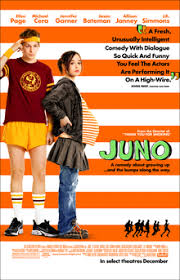
Juno (2007)

JUNO

JUNO (2007) One-and-a-half stars

The second episode of the 10th season of “South Park” gave us a great concept that applies to the 2007 comedy JUNO: “Smug Alert.”

That internal smug alert went off throughout Jason Reitman’s film, especially regarding Diablo Cody’s screenplay and Ellen Page’s precious little title character.

Two quotes from “Smug Alert” pinpoint what’s not right with JUNO.

“Being smug is a good thing,” Gerald Broflovski said.

“You mean — we should drive in hybrids but not act like we’re better than everyone else because of it?” Randy Marsh said.

JUNO (both the movie and the character) acts like being smug is a good thing and that it’s better than everybody else because of it, well, yeah, because that’s what it means to be smug.

Believe it or not, Cody’s original screenplay won for “Best Original Screenplay” in both the American and British editions of the Academy Awards. Yeah, I don’t believe it.

The dialogue scene between Juno and a clerk named Rollo proved enough to set off the “Smug Alert.” I’ll quote it all because I’ll let it form my case against JUNO and Juno.

Rollo: Well, well … if it isn’t MacGuff the crime dog? Back for another test?

Juno: I think the last one was defective. The plus sign looked more like a division sign so I remain unconvinced.

Rollo: Third test today, Mama Bear. Your eggo is preggo, no doubt about it.

Tough Girl: It’s really easy to tell. Is your nipples real brown?

Rollo: Yeah. Maybe your little boyfriend’s got mutant sperms. Knocked ya up twice.

Juno: Silencio old man! Look, I just drank my weight in Sunny-D and I gotta go pronto!

Rollo: Well, you know where the lavatory is.

Rollo [yells]: You pay for that pee stick when you’re done! Don’t think it’s yours just cuz ya marked it with your urine!

[later]

Rollo: Well, what’s the prognosis, fertile Myrtle? Minus or plus?

Juno: [taking a pregnancy test] I don’t know. It’s not seasoned yet. [grabs some candy] I’ll take some of these. Nope … There it is. The little pink plus sign is so unholy.

Rollo: That ain’t no Etch-a-Sketch. This is one doodle that can’t be un-did, homeskillet.

Yeah, exactly, that early dialogue indicts itself and the entire film. Did the voters for “Best Original Screenplay” have that scene erased from their collective memories? Never mind all the critics who listed JUNO as one of 2007’s best films — Roger Ebert named it his No. 1 film.

There are some good things in JUNO but they are ultimately overshadowed by that darn you-know-what that starts with ’s’ and ends with ’ss’ (it’s not success or sadness).

I also dislike the cinematic trend where seemingly every single damn character in a comedy talks like a stand-up comedian with crack timing and perfectly-timed cheap shots, even the characters that are not being played by stand-up comedians.

You had to have been living under a rock to not hear about JUNO in late 2007 and throughout 2008.

JUNO received Academy Award nominations for Best Picture, Best Director, and Best Actress (Page), in addition to its one victory.

Other screenplays nominated against JUNO were LARS AND THE REAL GIRL (Nancy Oliver), MICHAEL CLAYTON (Tony Gilroy), RATATOUILLE (Brad Bird, Jan Pinkava, and Jim Capobianco), and THE SAVAGES (Tamara Jenkins).

I don’t know about you at home, but I’d favor the rat over the brat ‘cause Ratatouille and RATATOUILLE are not smug in the slightest and that makes a huge difference.

Cody (born June 1978) made a name for herself writing an “adult” blog named “The Pussy Ranch” (honest to blog!) and her memoir “Candy Girl: A Year in the Life of an Unlikely Stripper” before she hit the jackpot with her debut screenplay for JUNO. Her life sounds perfectly equipped for becoming an Academy Award winning bio pic. Would her character be played by Miss Sassy Pants Page?

Cody’s other screenplay credits: JENNIFER’S BODY, YOUNG ADULT, PARADISE, RICKI AND THE FLASH, and TULLY. I also regret watching JENNIFER’S BODY, a horror comedy starring Megan Fox and Amanda Seyfried that again set off the “Smug Alert.”

Cody said of JUNO, “You can look at it as a film that celebrates life and celebrates childbirth, or you can look at it as a film about a liberated young girl who makes a choice to continue being liberated. Or you can look at it as some kind of twisted love story, you know, a meditation on maturity.”

I’d rewrite Cody’s quote, “You can look at it as a film that celebrates superficiality and celebrates hipster, or you can look at it as a film about a glib young girl who makes a choice to continue being glib. Or you can look at it as some kind of situation comedy, you know, a meditation on monotony.”

JUNO also frequently misses the mark with the soundtrack, apparently picked by Page herself.

JUNO makes overtures to punk, glam, alternative, et cetera, but picks songs like the Velvet Underground’s “I’m Sticking with You” and Sonic Youth’s “Superstar,” for example, atypical numbers for those bands. Where’s Nirvana and the many bands name-dropped by Kurt Cobain? Like the Vaselines, just one example. Nirvana covered “Here She Comes Now,” the most accessible song from the Velvets’ second LP WHITE LIGHT/WHITE HEAT, 40 minutes and 13 seconds of sound renowned for clearing rooms and making ear drums bleed. What would Juno have made of “Sister Ray”?

Sonic Youth’s Thurston Moore on JUNO in Magnet Magazine, “Every once in a while, you’ll be asked whether your music can be used in a movie. Invariably, we always ask, ‘What’s the movie about?’ Because you don’t want it to be some kind of grotesque film. I didn’t even remember that they’d used the song until I was watching it with my daughter, then I was like, ‘Oh my God!’ [Laughs} When Mark (Jason Bateman) tells Juno, ‘Here’s a Sonic Youth song, I think you’ll really like this,’ and then he plays the song that’s the least indicative of our music — us covering a Carpenters tune — it’s such an odd choice. It’s also funny that she would be into totally hardcore punk — Iggy, Patti Smith, the Runaways — and then quantify Sonic Youth as ‘just a bunch of noise.’ But I think she was just angry at the guy and trying to get back at him.”

Michael Cera plays Paulie Bleeker in what amounted to his second movie featuring “The Michael Cera Role,” following SUPERBAD, and I was already tired of it. No, that’s not Jesse Eisenberg, who you might remember from THE SQUID AND THE WHALE and ZOMBIELAND. Yeah, it’s confusing.

Guess this confusion happened to the guys all the time.

“I bumped into Jesse on the street once and he told me he gets it once a day,” Cera said in the New York Post. “This guy asked me today if I was Napoleon Dynamite [Jon Heder].”

You know you’re in trouble when the best performance in the movie belongs to Jennifer Garner.