
Gappa (1967)

GAPPA: THE TRIPHIBIAN MONSTER (1967) ***
Sixty-two albums when he was alive and 54 more since his 1994 death, wanker guitar solos, frequently obscure and sophomoric lyrics, jazz and orchestral or hippie and doo-wop and other stylistic detours on the regular, and political and social satire that probably applies to all us members of the general audience somewhere down the line of a long and storied musical and recording career.

No, sorry, we’re not here to discuss the outstanding 2020 documentary Zappa directed by Alex Winter or Bill S. Preston, Esq., from the Bill & Ted films.

Nor are we here to discuss Gamera the giant flying turtle monster loved by children everywhere or Godzilla the ‘King of the Monsters’ or Gorgo and his sea monster mother Ogra (neither should necessarily be confused with Gorgo, Queen of Sparta) or Gordo the monster Spanish insult.

Nope, we’re here for Gappa: The Triphibian Monster from 1967, which if you like Gamera, Godzilla, Gorgo, etc., you might also find Gappa to your liking if you give it the good old college try. Why are there so many monsters that start with ‘G’? It’s a great big alphabet, for crying out loud.

The film’s also called Gappa the Triphibian Monsters and American-International dubbed the American version Monster from a Prehistoric Planet. It can be found in multiple places on the ‘Net.

Statement of fact: I’m a big fan of the old school monster movie aesthetic — rubber monsters, men-in-suits, miniatures, hapless government and military men, pro forma human interest though I usually wish monster films to go lighter on the human interest, etc. I like a lot of the Showa Era Godzilla moving pictures, like most of the Gamera films, and like Gorgo a good deal. Yeah, call them goofy or silly or ridiculous or preposterous or whatever denigrating pejorative haters desire but they’re mostly a good deal of fun.

By the way, what the hell is a Gappa? A triphibian monster, of course. What the heck’s a triphibian? A monster who’s adept at war on land, at sea, and in the air. A triple-threat, for a sports analogy. That also sounds like the potential for tons of mass destruction and busloads of extras running for their lives. Damn straight, Skippy.

The plot of Gappa has been called a virtual duplication of Gorgo — stupid fucking humans find a tropical island, take a monster back with them against the warnings of the islanders, and the monster’s parents come smashing Tokyo looking for their pride and monster joy — and one might be tempted to group them together with Son of Godzilla and All Monsters Attack as family values kaiju. The Family Values Kaiju Tour literally could have taken the world by storm, in spite of the fact that Son of Godzilla and All Monsters Attack both suck and rank among the worst Godzilla films.

Anyway, we’re not here for Godzilla and I’ll go on the permanent record right now to say that I bawl like a big ole blubbering baby at the end of Gappa. In the words of Weird Al, I was just overwhelmed by its sheer immensity, I had to pop myself a beer.

Son of Godzilla (1967)

SON OF GODZILLA (1967) **
I made a terrible mistake.

Not in watching Son of Godzilla, the eighth film in the Godzilla series, per se, but watching it through the most available version online.

Characters begin speaking in dubbed English, of course only the best for us American monster movie aficionados, for a few seconds before a foreign language (presumably Russian) overlays the English. We get two bad dub jobs for the price of one, sure yeah whatever never mind.

I was desperate, though, and needed to watch Son of Godzilla to complete the entire 15-film Godzilla series Japan’s hallowed Toho Studios produced from 1954 to 1975. I sucked it up, buttercup, who cares about the bloody dialogue in a Godzilla movie anyway for crying out loud, and mission accomplished. Yes, I always save the worst for last.

Son of Godzilla marks the beginning of a period of several pictures when Toho made Godzilla a kinder, gentler monster. Like Arnold Schwarzenegger, as Godzilla became a bigger star, a monster if you will, the big guy preferred not playing a villain and so Son of Godzilla and 1969’s All Monsters Attack (a.k.a. Godzilla’s Revenge) are the equivalent of later Schwarzenegger pictures like Kindergarten Cop and Jingle All the Way. Not sure that Schwarzenegger ever made his Godzilla vs. Hedorah (a.k.a. Godzilla vs. The Smog Monster) and that’s a bummer.

The suits at Toho have made Godzilla and the men inside the suit do some awkward bull over a nearly 70-year period, but seeing the big guy try and relate to his adopted son Minilla during Son of Godzilla and All Monsters Attack just might take the cake. Godzilla rescues Minilla from a trio of Kamacuras or a mutated mantis species found on Sollgel Island, and is it in poor taste to say that I wish Minilla had been eaten by the mantis. Minilla’s just so darn cute that it took a great deal of restraint to not puke all over my relatively new laptop.

W.C. Fields died eight years before Godzilla’s screen birth, but we can be sure the famously curmudgeonly performer would have found some choice words for Son of Godzilla and All Monsters Attack, easily the worst of the 15 Showa Era films.

I believe Fields said, “I like children, if they’re properly cooked.”

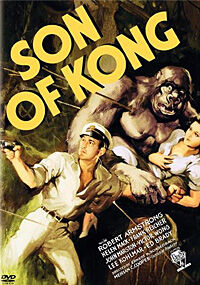
Son of Kong (1933)

SON OF KONG

Son of Kong (1933) Two stars

Released on Mar. 7, 1933, in New York City and a month later nationally, King Kong quickly took the nation by storm and became a cinematic landmark.

Nine months later, incredibly, RKO released the sequel Son of Kong and Hollywood did not make another Kong picture for more than 40 years.

Son of Kong just might be Hollywood’s first rush job and one of its first sequels*. It is a pleasant enough movie to watch, but obviously it’s not a patch on an all-time classic. I’ve watched the original numerous times, but I doubt I’ll want to return to Son of Kong a second time.

That’s because it’s virtually dull as dishwater. It takes approximately 45 minutes to get to our title character. That’s way too long for a movie that lasts only 69 minutes. Despite the return of Carl Denham, the most interesting human character in King Kong, played by the reliably entertaining Robert Armstrong, Son of Kong does not maintain the interest level high enough for a Kong movie. Of course, the original set the bar incredibly high.

They give Denham a potential romantic interest, because lovebirds Ann Darrow (Fay Wray) and John Driscoll (Bruce Cabot) quite naturally did not return for the sequel after their harrowing experiences, and Helen Mack’s Helene Peterson epitomizes the movie as a whole, since she’s pleasant but dull. She’s a singer, not an actress like the lovely Miss Darrow, and gets a production number. Again, pleasant but dull.

Kong co-directors Ernest B. Schoedsack and Merian C.Cooper returned as director and producer. Special effects guru Willis O’Brien and composer Max Steiner also returned, as did some of the supporting cast.

They were on a tight budget, an even tighter schedule, and they obviously knew there was no way they could topple King Kong. Armstrong himself preferred Son of Kong, but that’s because Denham received greater character arc. He’s probably the only person to ever prefer Son over its father. Both the son and the sequel are kinder, gentler — not good for a creature feature.

Sequels very rarely even approach their predecessors, and that was true in 1933 every bit as it is this very day.

For every Bride of Frankenstein and The Empire Strikes Back, we have a million failures and footnotes, like Son of Kong.

*United Artists released Don Q, Son of Zorro in 1925, a sequel to the 1920 classic Mark of Zorro. Swashbuckler supreme Douglas Fairbanks starred in both films. Son of Zorro also predates Son of Kong, Son of Frankenstein, Son of Godzilla, and Son of the Mask. To be fair, though, the sound of a toilet flushing predates Son of the Mask.