
The Swarm (1978)

THE SWARM

THE SWARM (1978) One-half star

Many comedies wish they could make me laugh as hard as I do at the ridiculous disclaimer at the end of the 1978 Irwin Allen film THE SWARM: “The African killer bee portrayed in this film bears absolutely no relationship to the industrious hard-working American honey bee to which we are indebted for pollinating vital crops that feed our nation.”

Were the folks at Warner Bros. seriously afraid of alienating the American honey bee?

I’ve read that the American Bee Association considered suing Allen for defaming the honey bee … and that must be why we ended up with that jive disclaimer right before the end credits. But, honestly, why stop there? The director, writer, and actor guilds should have sued Allen for defaming their respective trades, because this has to be the worst use ever of a $21 million production budget (reports vary on the $), seven Academy Award winning actors (Michael Caine, Olivia de Havilland, Ben Johnson, Jose Ferrer, Patty Duke, Lee Grant, and Henry Fonda, but none of them earned for this movie), and 800,000 bees with their stingers removed.

I’ll never forget THE SWARM because it’s not easy forgetting one of the worst movies ever made. I caught it (not all of it, though) for the first time in either late 1997 or early 1998, home alone late afternoon during my freshman year of college. I returned from class and found this disaster pic flipping channels. It was somewhere in the middle and I watched the rest. The lousy special effects, the cornball everything (premise, plot, dialogue, acting, title), and that darn disclaimer stuck with me. …

I’ve caught up with THE SWARM a couple more times or I’ve watched it at an interval of once every 10 years. It still rates about the exact same as the first time watching it, though, but I guess I have watched it a couple more times after the first as a honest reminder of what a bad movie’s truly like.

Guess we should give a lot of blame for THE SWARM to Allen (1916-91). The Master of Disaster produced THE POSEIDON ADVENTURE, THE TOWERING INFERNO, THE SWARM, BEYOND THE POSEIDON ADVENTURE, and WHEN TIME RAN OUT, the last three of which helped kill off the disaster films that were so popular in the 1970s. THE SWARM earned $7.7 million, BEYOND THE POSEIDON $2.1 million, and WHEN TIME RAN OUT $3.8 million.

Allen also directed THE SWARM and BEYOND THE POSEIDON. In THE SWARM, he kills two genres in one movie, combining disaster with the killer animal genre that became a dominant exploitation staple after the incredible success of Steven Spielberg’s JAWS in 1975.

It was David Hannum, not P.T. Barnum, who came up with the legendary quote, “There’s a sucker born every minute.” Should have been Irwin Allen, though, because his films really take us for suckers one and all. Fortunately, we are better (smarter) than that.

Stirling Silliphant (1918-96) wrote the screenplay for THE SWARM and he wrote both of Allen’s biggest hits, THE POSEIDON and TOWERING INFERNO. He also won an Academy Award for his screenplay for Best Picture winner IN THE HEAT OF THE NIGHT. (Silliphant’s erratic credits include VILLAGE OF THE DAMNED, SHAFT IN AFRICA, and OVER THE TOP.)

Unfortunately, his work on THE SWARM will go down in infamy.

Helicopter pilot: “Oh my God! Bees! Bees! Millions of bees … (later on) Bees! Millions of bees!” Of course, it does not help matters that the bees sometimes look more like painted-on black dots.

There’s some dynamite exchanges in THE SWARM. I’ll highlight just one.

Dr. Crane (Caine): Are you endowing these bees with human motives? Like saving their fellow bees from captivity, or seeking revenge on Mankind?

General Slater (Richard Widmark): I always credit my enemy, no matter what he may be, with equal intelligence.

“No matter what he may bee,” maybe they should have stripped Silliphant of his Academy Award for writing that one.

There’s more howlers in THE SWARM: “Houston on fire. Will history blame me, or the bees?”; “I know people look at me and think that I’m just the man behind the aspirin counter, but inside I love you”; “They’re more virulent than the Australian Brown-Box Jellyfish”; “By tomorrow there will be no more Africans … at least not in the Houston sector.” This dialogue indicts inself.

THE SWARM is one time where calling a film a train wreck is literal.

A train wreck, by the way, that kills Olivia de Havilland, Ben Johnson, and Fred MacMurray, two of the film’s seven Academy Award winning actors. Johnson (1918-96) fared better later as the conductor in the horror film TERROR TRAIN. I really did not want to mention that de Havilland, Johnson, and MacMurray form a romantic triangle in THE SWARM. Let’s just get past that and move on immediately, unlike the movie.

Having such an all-star cast, by the way, backfires miserably for THE SWARM, because I start thinking about movies like ZULU (Caine), THE ADVENTURES OF ROBIN HOOD (de Havilland), THE LAST PICTURE SHOW (Johnson), DOUBLE INDEMNITY (MacMurray), THE MIRACLE WORKER (Duke), and ONCE UPON A TIME IN THE WEST (Fonda), for example, rather than what I am supposed to be watching.

Some of the stars have smaller roles than others. Yeah, and I almost forgot about Richard Widmark, Richard Chamberlain, and Slim Pickens, though I mentioned the always skeptical, always boneheaded General Slater played by Widmark. How could I forget though about Mr. Pickens? According to Cinemorgue Wiki, Pickens died cinematic deaths in THE LAST COMMAND, A THUNDER OF DRUMS, DR. STRANGELOVE, MAJOR DUNDEE, ROUGH NIGHT IN JERICHO, PAT GARRETT & BILLY THE KID, BEYOND THE POSEIDON, THE BLACK HOLE, and THE HOWLING. They missed an opportunity in not killing Pickens in THE SWARM. I mean, his death scenes in DR. STRANGELOVE and PAT GARRETT & BILLY THE KID are legendary.

I am rambling, just like THE SWARM itself.

When you watch THE SWARM, please try and keep in mind that Paul Zastupnevich received a nomination for the Academy Award for Best Costume Design. Unbelievable, just unbelievable, like THE SWARM.
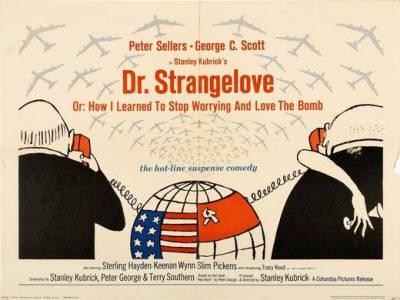
Dr. Strangelove (1964)

day752cdr.strangelove

DR. STRANGELOVE (1964) Four stars
Stanley Kubrick’s DR. STRANGELOVE (abbreviated title) OR: HOW I LEARNED TO STOP WORRYING AND LOVE THE BOMB (long title) contains one of my favorite lines of dialogue in any movie.

President Merkin Muffley, played by Peter Sellers in one of his three roles in the movie, tells the Americans and Commies both, “Gentlemen, you can’t fight in here! This is the War Room!”

I don’t give a damn that it placed No. 64 on the American Film Institute’s 100 Years … 100 Movie Quotes list.

Oh, sorry, “Frankly, my dear, I don’t give a damn” from GONE WITH THE WIND came in at No. 1, followed by quotes from Marlon Brando characters in THE GODFATHER and ON THE WATERFRONT that bums just can’t refuse.

Kansans will be sure thrilled that “Toto, I’ve a feeling we’re not in Kansas anymore” came in at No. 4.

CASABLANCA led that list with six quotes and freaking JERRY MAGUIRE picked up two. Are you kidding?

Anyhoo, DR. STRANGELOVE certainly lives up to such a title: It’s a strange movie about strange people doing and saying the strangest things.

I’ve heard it described as a movie about what could happen if the wrong person pushed the wrong button.

That wrong person would be General Jack D. Ripper (Sterling Hayden), who believes them damn commies have conspired to pollute our “precious bodily fluids.” To say that it’s an obsession for Gen. Ripper would be one of the great understatements.

Gen. Ripper orders a first strike nuclear attack on the Soviet Union.

Then we get a mad gallery of characters that are just slightly less mad than Ripper: Muffley, Group Captain Lionel Mandrake, and Dr. Strangelove played by Sellers; General Buck Turgidson by George C. Scott; Colonel Bat Guano by Keenan Wynn; and Major T.J. “King” Kong by Slim Pickens, for example. Muffley and Turgidson are predominantly inside the War Room, one of the great movie sets.

Sellers originally had been slated to play four roles, including Kong, but it went down to three after he hurt his ankle.

Sellers predominantly improvised most of his dialogue and his ad-libs were retroscripted into the screenplay.

Sellers modeled Muffley after 1952 and 1956 U.S. Presidential candidate Adlai Stevenson and former Nazi scientist Dr. Strangelove after Wernher von Braun. Strangelove’s very reminiscent stylistically of mad scientist Rotwang from Fritz Lang’s METROPOLIS.

Strangelove comes aboard late in the movie as humanity faces nuclear destruction.

Scott, who later won an Oscar for Gen. Patton in the Best Picture-winning PATTON, played Gen. Turgidson a lot differently than he intended and he was apparently tricked by Kubrick into acting ridiculously like in the final film. Scott never worked with Kubrick again. Kubrick and Scott played each other at chess and Kubrick got the edge on Scott, a skilled player, often.

John Wayne and Dan Blocker, of course, turned down Kong because, you know, DR. STRANGELOVE was just way too darn pinko for their persuasions.

The role ended up in the hands of the one-and-only Pickens, whom the makers of DR. STRANGELOVE did not understand was a genuine cowboy.

They did not tell Pickens that it was a black comedy and he played it straight, gloriously straight.

He gets one of the great exit scenes in film history.

There’s a whole lot about DR. STRANGELOVE that I don’t want to talk about in this space, especially for those who have not yet seen the movie.

I believe, however, that you will find it to be one of the great movie experiences.

It’s definitely the satire the Cold War deserved.

It’s an incredibly smart and sneaky movie, truly ahead of its time.

For example, a Cornell University professor Legrace G. Benson wrote Kubrick a fan letter and the professor interpreted DR. STRANGELOVE as being very sexually-layered. (Not sure how people could miss it.)

Kubrick wrote Benson back, “Seriously, you are the first one who seems to have noticed the sexual framework from intromission (the planes going in) to the last spasm (Kong’s ride down and detonation at target).”

And, for sure, after DR. STRANGELOVE you will never hear “We’ll Meet Again” the same way again.

1941 (1979)

day 68, 1941

1941 (1979) Three-and-a-half stars
I have a general rule: Any movie featuring Slim Pickens, Christopher Lee, and Toshiro Mifune in the same scene will automatically be given a positive review, so Steven Spielberg’s 1941 has that going for it right off the bat.

I am sure you remember Pickens, Lee, and Mifune.

Pickens (1919-83) played many, many supporting roles in Westerns, but he also had a great role in Stanley Kubrick’s DR. STRANGELOVE as Major T.J. “King” Kong that incorporated his cowboy flair.

Lee (1922-2015) played Count Dracula seven times, I do believe, in Hammer productions like TASTE THE BLOOD OF COUNT DRACULA and later appeared in one James Bond, five Tim Burton, two STAR WARS, and three LORD OF THE RINGS films. There’s a story that Lee was once pulled over by a Hollywood traffic cop, who asked Lee if he should be driving in daylight.

Mifune (1920-97) appeared in over 150 movies during his career and none are more famous than his 16 collaborations with director Akira Kurosawa (ordered from last to first): RED BEARD, HIGH AND LOW, SANJURO, YOJIMBO, THE BAD SLEEP WELL, THE HIDDEN FORTRESS, THE LOWER DEPTHS, THRONE OF BLOOD, I LIVE IN FEAR, SEVEN SAMURAI, THE IDIOT, RASHOMON, SCANDAL, STRAY DOG, THE QUIET DUEL, and DRUNKEN ANGEL.

All three actors are each speaking different languages.

Awesome.

Pickens, Lee, and Mifune appear together early on in 1941 and we get the first shark victim in JAWS (actress and stuntwoman Susan Backlinie) as bonus opening scene treat.

1941 is the bastard child on Spielberg’s filmography, seemingly the film that even he doesn’t like all that much.

Just how much of a bastard child?

John Wayne and Charlton Heston were both offered the role of General Stilwell and turned it down because they believed 1941 to be unpatriotic.

I believe Wayne even told Spielberg that he should be ashamed … and called the script the most anti-American piece of drivel he ever read.

Robert Stack took on Stilwell and looking at photos of the real Joseph Stilwell, the actor looks just like the real person.

1941 came between CLOSE ENCOUNTERS OF THE THIRD KIND (1977) and RAIDERS OF THE LOST ARK in Spielberg’s filmography, so of course the $94 million worldwide gross of 1941 would be considered a huge bust compared to $300 million for CLOSE ENCOUNTERS and $390 million for RAIDERS.

It’s an oversized, loud comedy that mostly fails on that intended level, but succeeds in other ways. That’s very strange and yes, 1941 is very strange indeed.

Spielberg himself said, “Some people think (1941) was an out-of-control production, but it wasn’t. What happened on the screen was pretty out of control, but the production was pretty much in control. I don’t dislike the movie at all. I’m not embarrassed by it. I just think that it wasn’t funny enough.”

Spielberg has said that Robert Zemeckis, who co-wrote the picture with Bob Gale, should have directed the picture.

Though I don’t laugh at the vast majority of 1941, I am never bored and I end up smiling through a lot of the picture.

I’ve already mentioned Pickens, Lee, Mifune, and Stack, and that just scratches the surface of the star power on board.

We also have Dan Aykroyd, Ned Beatty, John Belushi, Lorraine Gary, Murray Hamilton, Tim Matheson, Warren Oates, and Nancy Allen, and several more familiar faces in Treat Williams, Bobby DiCicco, Eddie Deezen, Wendie Jo Sperber, Perry Lang, Penny Marshall, Michael McKean, Joe Flaherty, Mickey Rourke, and John Candy.

In addition to Pickens, we have a couple more of the great old-time character actors in Dub Taylor and Elisha Cook Jr.

Williams, DiCicco, Dianne Kay, and especially Sperber are particularly delightful and basically steal the movie away from the bigger names. They are fun, fun, fun, that’s for sure, and their work peaks at the USO club sequence, by far the best part of the movie that incorporates a dance contest and a brawl. This sequence found inspiration from both a film and real life: Universal Pictures’ HELLZAPOPPIN’ (1941) and the Zoot Suit Riots of 1943. I rate this sequence with any Spielberg’s ever done throughout his nearly five-decade career; Spielberg thought about making 1941 an old-fashioned musical, but he said he didn’t have the guts to go through with it at the time.

There’s just a lot of enjoyable moments during 1941, plain and simple.

For example, Stilwell watched DUMBO twice in real life during the month of December 1941 when he was a commander in the Los Angeles area. Stilwell, I believe, even cries watching DUMBO in 1941. Sure difficult being a cinephile.