
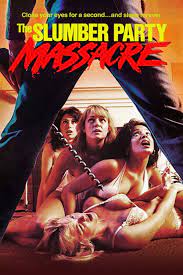
The Slumber Party Massacre (1982)

THE SLUMBER PARTY MASSACRE (1982) ***
Coming across the beloved cult film that was once not so beloved just might be the biggest hazard of movie spectatorship these days.

You better not ride on the general train of thought from the film’s original release or you just might get bludgeoned in the comments section by devotees of the cinematic item under discussion.

You have no taste! You’re an idiot! You just don’t get it! You’re too stupid to understand the undeniable genius! Blah blah blah!

I am thinking first and foremost about films like Halloween III, Howard the Duck, Sleepaway Camp, and Silent Night, Deadly Night.

Maybe you are reading my confession why I had not watched The Slumber Party Massacre until very recently.

I finally caught up with it on Halloween night 2022, I liked it well enough, and I can definitely understand why it’s held in such high esteem in some quarters though I certainly don’t like it as much as others so enthusiastically do.

The Slumber Party Massacre took a while to get started, packed with so many false alarms and jump scares that I began losing patience early on and it was not until the 45- or 50-minute mark that I became enveloped in suspense. The final 25-30 minutes are especially well-made and filled with plenty of impacting moments, so much so that I almost bumped The Slumber Party Massacre up to three-and-a-half stars even after the mixed reaction to the first two-thirds of the film.

All slasher films, whether it be the good, the bad or the ugly, have their gimmicks, be it their setting or their killer in everything from the favorite weapon of choice down to style.

The Slumber Party Massacre sold a good amount on the fact that it has a female director (Amy Holden Jones) and a feminist screenwriter (Rita Mae Brown), something not common for the horror genre overall and specifically the subgenre of the slasher.

Jones shows definite talent in her directorial debut, and it’s no surprise she later directed Love Letters, Maid to Order, and The Rich Man’s Wife and received screenwriting credits on Love Letters, Maid to Order, Mystic Pizza, Beethoven, Indecent Proposal, The Getaway (1994), and The Relic. She also married acclaimed cinematographer Michael Chapman (Taxi Driver, Raging Bull, The Fugitive) in 1980 and stayed his wife until his death in September 2020.

Brown intended The Slumber Party Massacre to be a satire of the slasher genre, but Jones filmed it as straight horror.

However, satirical traces remain throughout The Slumber Party Massacre.Virtually all the male characters are super horny creeps and more than one female character survives all the murder and mayhem, for example.

Never mind that escaped serial killer Russ Thorn (Michael Villella) walks around in plain sight without a mask from the first scene on. He’s also one of a select few slasher film killers with quotes on the Internet Movie Database. Eat your heart out, Jason and Michael!

Also, never mind Thorn’s weapon of choice that could possibly be some kind of metaphor. Yes, it’s a power drill and I’m not sure of the symbology there! I also don’t believe there’s any greater meaning in the ways he meets his inevitable demise at the end of the movie.

The local radio station announces Thorn’s escape more than once, yet nobody seems to notice let alone care until it’s (almost) too late. I seem to remember one of the characters shutting off her car radio in the middle of one of the announcements.

Nearly all the characters are too preoccupied with their pursuits of pleasure at this very moment in time, just like the characters in any Friday the 13th film, to be concerned about some homicidal maniac on a rampage.

These satirical traces make The Slumber Party Massacre a good deal more interesting than, let’s say, Madman and The Prowler.

It works as both a satire and a straight horror film nearly 15 years before Scream came out.

In fact, not that I want to shout about it or anything, The Slumber Party Massacre works better than Scream.
Happy Birthday to Me (1981)

HAPPY BIRTHDAY TO ME (1981) ***
Happy Birthday to Me stands out from the early ’80s slasher film craze pack because a) it has superior production values with a name director (J. Lee Thompson, who directed The Guns of Navarone and Cape Fear) and a good cast including an unhappy Glenn Ford, b) it has a longer running time than the average 85- and 90-minute slasher film, and c) it has one of the most bizarre twist endings this side of Sleepaway Camp.

Just like fellow 1981 Canadian slasher My Bloody Valentine, also produced by John Dunning and André Link with distinctive elements for a slasher, Happy Birthday to Me calls to mind a prestigious Academy Award for Best Picture winner, 1980’s Ordinary People. (My Bloody Valentine recalled The Deer Hunter from the coal mine setting and overall working-class milieu, the prodigious beer drinking, and the more adult-like plot and romantic triangle.)

Let’s see, Happy Birthday to Me and Ordinary People both have the same elite upper middle class suburban prep school environment, traumatic events in the past, troubled teenagers, and a therapist who works with our troubled teen protagonist.

Happy Birthday to Me plays more like a glossy, lurid soap opera at times punctuated with some creative, gruesome murder set pieces.

Melissa Sue Anderson makes her motion picture feature debut in Happy Birthday to Me as protagonist Virginia Wainwright. She had nearly a decade of experience on TV by that point, though, most notably as Mary Ingalls / Mary Ingalls Kendall on the hit show Little House on the Prairie. You can bet playing a blind Mary for a number of seasons prepared an 18-year-old Anderson for her flashbacks, brain operation, therapy sessions, memory loss, and traumatic blackouts throughout Happy Birthday to Me.

Slasher films often pursued at least one name actor for their cast: Betsy Palmer (Friday the 13th), Ben Johnson (Terror Train), Leslie Nielsen (Prom Night), Lauren Bacall, James Garner, and Maureen Stapleton (The Fan), and Farley Granger (The Prowler).

Glenn Ford accumulated 110 acting credits from 1937 through 1991, highlighted by Gilda, The Big Heat, Blackboard Jungle, 3:10 to Yuma, Midway, and Superman. Ford (1916-2006) wouldn’t have wanted to be remembered for Happy Birthday to Me and he was reportedly a very unhappy camper making the film, heavily drinking throughout and hitting the assistant director after he called for a lunch break during the middle of one of Ford’s scenes.

He’s not all that big a role in Happy Birthday to Me.

Ginny Wainwright attends the snobby Crawford Academy and she’s a member of the school’s Top 10 clique, only the best and brightest. They are systematically eliminated apparently by Ginny, and we find out that none of the Top Ten attended Ginny’s birthday party four years before the start of the movie. They attended instead another party for a Top 10 member and Ginny and her mother are then involved with an auto accident that kills Ginny’s mother and leaves the surviving Ginny needing her experimental brain tissue restoration.

Ginny was originally planned to be revealed as the killer possessed by the spirit of her dead mother, but the film instead chose a shocking twist ending that remains the main reason why fans of the film remember it so fondly 40 years later.

Thompson (1914-2002) reportedly got so much into the spirit of the enterprise that he was throwing around buckets of blood on set. The final 40 minutes pile up the corpses.

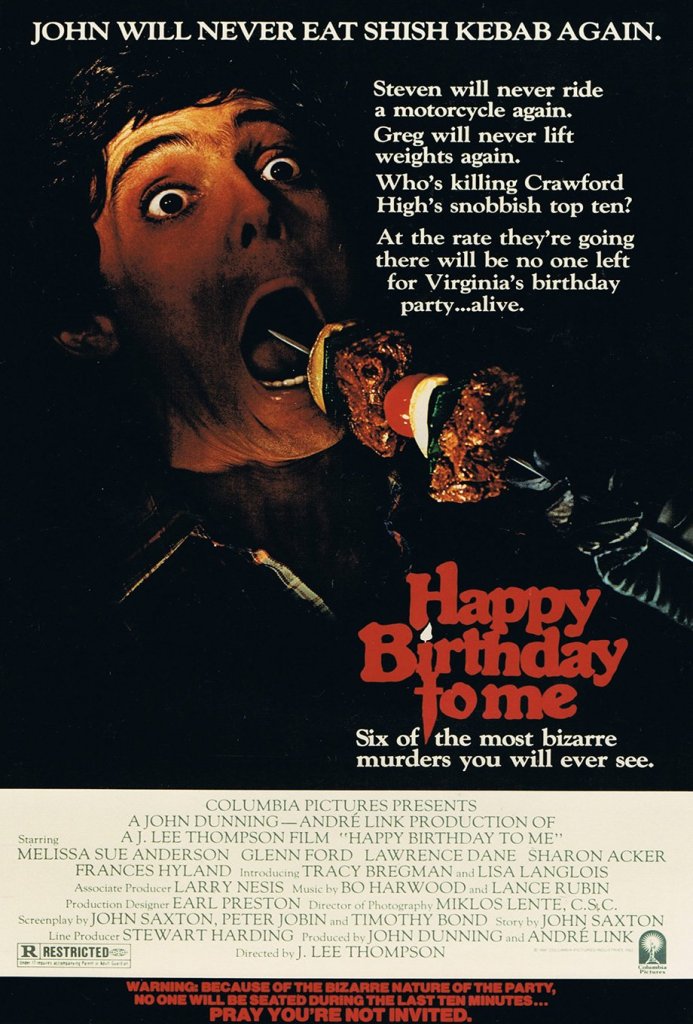
Columbia Pictures went for both the bloody and bizarre in promoting Happy Birthday to Me, a minor hit in the summer of 1981.

The poster has an image of the most famous murder set piece of the movie.

JOHN WILL NEVER EAT SHISH KEBAB AGAIN.

Steven will never ride a motorcycle again.

Greg will never lift weights again.

Who’s killing Crawford High’s snobbish top ten?

At the rate they’re going there will be no one left for Virginia’s birthday party … alive.

Happy Birthday to Me … Six of the most bizarre murders you will ever see.

WARNING: BECAUSE OF THE BIZARRE NATURE OF THE PARTY, NO ONE WILL BE SEATED DURING THE LAST TEN MINUTES … PRAY YOU’RE NOT INVITED.

Factual accuracy is not this poster’s strong suit, since there’s nine deaths in the movie, there’s no John character in the movie, Steven’s the one killed by kebab, and Etienne’s the one done in by a motorcycle.

Sleepaway Camp (1983)

SLEEPAWAY CAMP

SLEEPAWAY CAMP (1983) Two stars

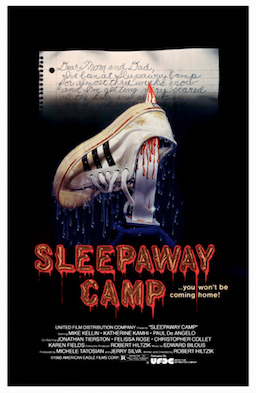
This is one of those instances where I can remember seeing the poster long before the attached movie.

Undoubtedly like most of the jaded youth of my generation, I first saw the poster for SLEEPAWAY CAMP back in the late 1980s. It’s the one that stayed with me the most over the decades.

It has the dominant image of a dripping wet shoe being stabbed all the way through by a bloodied knife. Above, there’s a letter from a camper, “Dear Mom and Dad, I’ve been at Sleepaway Camp for almost three weeks now and I’m getting very scared. …” Right below the hand holding the knife are the title dripping blood from its bold type and the tag “You won’t be coming home!”

Now, hours after watching SLEEPAWAY CAMP for the first time, it’s just as unforgettable as the poster.

To a great degree, SLEEPAWAY CAMP chucks our traditional notions of what constitutes a “good” or a “bad” movie right out the fucking window. It’s more of an experience, an event, a rite of passage, something where you can ask friends and family if they have ever seen it. If they have or haven’t, dynamite conversation will follow either way. For sure, though, it would make a great watch party — of course, following proper social distancing protocol at this point in history.

Here’s a few notes on the experience:

— Melodrama is defined as such, “A sensational dramatic piece with exaggerated characters and exciting events intended to appeal to the emotions.” Addendum: See SLEEPAWAY CAMP. Early on, after the obligatory flashback to traumatic events of the past, Desiree Gould’s Aunt Martha establishes the basic tone for the rest of the movie: Campy with overacting possible. Yes, SLEEPAWAY CAMP goes over-the-top, gleefully, merrily, in every scene, including the end credits.

— Being bat shit crazy for 84 minutes has been SLEEPAWAY CAMP’s meal ticket to cult movie immortality. Because, let’s face it, it’s not as well-made technically as similar low-budget precursors BLACK CHRISTMAS, ALICE SWEET ALICE, and HALLOWEEN. Not even remotely close.

— SLEEPAWAY CAMP uses a musical score that also functions as bludgeoning device and melodrama amplifier. I just checked for any injuries after being whacked upside the head at regular intervals by Edward Bilous’ sledgehammer score. I survived without a single bump — amazing, I know. Anyway, I looked up this Bilous fellow. IMDb linked me to edwardbilous.com and a Bilous quote from the Wall Street Journal, “Artists today need a new set of skills to be able to tell the unique story of their generation.” He’s the founding director for the Center for Innovation in the Arts and the artistic director for Beyond the Machine, A Festival of Electro-Acoustic and Interdisciplinary Art at Juilliard. He joined the Juilliard faculty in 1984.

— “Weird Al” Yankovic’s “Nature Trail to Hell” sounds like a spin on FRIDAY THE 13TH PART III and SLEEPAWAY CAMP. “Coming this Christmas to a theater near you / The most horrifying film to hit the screen / There’s a homicidal maniac who finds a cub scout troop / And he hacks up two or three in every scene / Please don’t reveal the secret ending to your friends / Don’t spoil the big surprise / You won’t believe your eyes when you see. …” and “See severed heads that almost fall right in your lap / See that bloody hatchet coming right at you / No, you’ll never see hideous effects like these again / ‘Till we bring you ‘Nature Trail to Hell Part 2.’” File “Nature Trail to Hell” alongside such “Weird Al” epics as “The Biggest Ball of Twine in Minnesota,” “Albuquerque,” “Trapped in the Drive-Thru,” and “Jackson Park Express.”

— In his final performance, veteran actor Mike Kellin (1922-83) surpasses Gould in scenery chewing. He chews scenery to such a degree that he could chew through every picture’s scenery within an entire multiplex. Kellin plays Camp Arawak owner Mel Kostic, who keeps downplaying everything until about the 50th dead body. At least it feels that way anyway. He’s one of those characters who becomes creepier and more detestable over the course of the movie, especially when he lines up dinner with a camp counselor in her late teens and assaults one of the main characters who he mistakenly believes to be the killer. Mel loses his shit late in the picture, and it’s not pretty.

— By this point in the review, I should have already discussed the plot. Eight years after a tragic boating accident near Camp Arawak, Aunt Martha sends her niece Angela (Felissa Rose) to camp with Ricky (Jonathan Tiersten), Angela’s cousin and Martha’s son who’s a veteran camper. Mean girls Judy (Karen Fields) and Meg (Katherine Kamhi), as well as a group of their male counterparts both teenage and prepubescent, are relentlessly cruel and nasty toward Angela and Ricky, especially the initially painfully shy and quiet Angela. Ricky’s friend Paul (Christopher Collet) takes a shining to Angela and he’s able to break her silence. Over time, however, the picture develops a dread pattern: Every character who’s cruel and nasty to Angela or Ricky bites the dust in spectacular fashion. Yes, just like everything else in the picture, including the crop-tops and short-shorts, the murder set pieces are over-the-top.

— At this relative late point in the slasher film craze, a mere five years since HALLOWEEN, films in the genre needed a major selling point and SLEEPAWAY CAMP includes one of those (awesome but infuriating) endings that redefines the reality of every scene that came before, just like FRIDAY THE 13TH and HAPPY BIRTHDAY TO ME. This beyond bizarre ending is the first and foremost reason we still talk about SLEEPAWAY CAMP all these years later.