The Mad Doctor (1940)

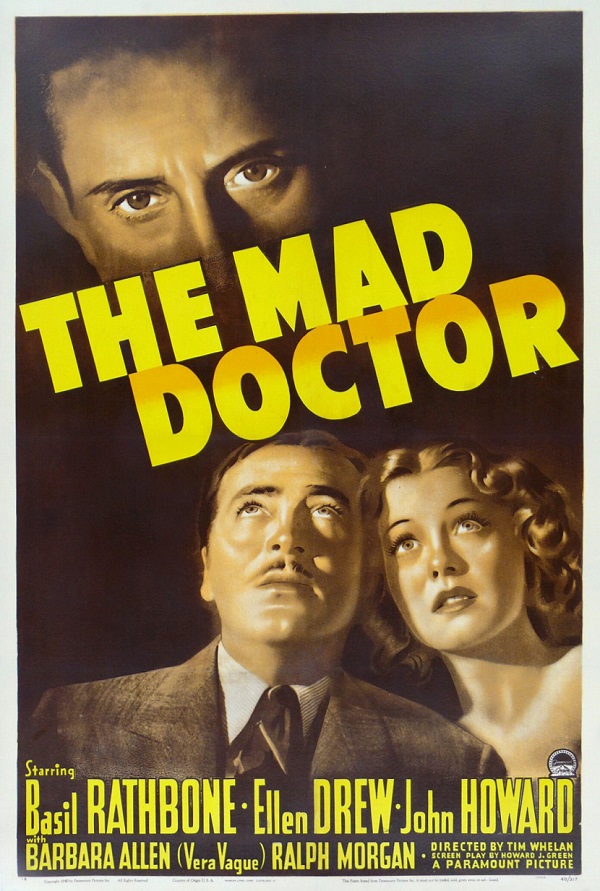
THE MAD DOCTOR (1940) ***1/2
Basil Rathbone, like his fellow English actor Peter Cushing afterwards in the Hammer films, could effectively play both villains and heroes. He’s perfect as both Guy of Gisbourne in The Adventures of Robin Hood and Sherlock Holmes in the 14 movies produced by 20th Century Fox and Universal from 1939 through 1946.

Rathbone (1892-1967) could be suave and sinister, charming and cunning, and it worked for him during a career that lasted from the 1920s through the 1960s.

That great ability to play both suave and sinister, charming and cunning, serves both Rathbone and The Mad Doctor well, a 1940 release directed by Tim Whelan and from Paramount Pictures (now owned by Universal, though) not to be confused with the 1933 Disney animated short The Mad Doctor or the 1942 Universal film The Mad Doctor of Market Street starring Lionel Atwill and directed by Joseph H. Lewis.

You just might recognize the plot of The Mad Doctor from a hundred or a thousand or maybe even a million novels, TV shows, and movies. It seems to have been one of the first plots ever devised.

Our title character targets wealthy women, marries them, and then murders them for their money. We pick it up with his latest target, who also happens to be suicidal in addition to being wealthy. Her ex-fiancé, a newspaper reporter, and an older doctor find out the dark truth about the mad doctor but is it too late for the latest target to be saved from becoming the latest victim. The mad doctor and his male assistant are obviously lovers, something made a lot more obvious than the average movie from 1940.

Yeah, definitely seems familiar, but The Mad Doctor works so effectively and becomes a minor classic because of the performances of not only Rathbone but also Ralph Morgan as bloodhound Dr. Charles Downer and resident villain actor Martin Kosleck as the real nasty piece of work Maurice Gretz.

I heard that Rathbone and Kosleck played up the gay subtext more and more because they found it amusing, and it’s so blatant when Kosleck sinks his teeth into You’re like all the other clever ones, clever until they meet a woman, and then they suddenly become fools.

One can be relatively sure this passed the Hays Code because, let’s face it, Rathbone’s title character and Kosleck’s Maurice Gretz do not meet happy endings.

The Mad Doctor has a classic promotional trailer.

[Text] Women Know The ECSTASY and TERROR Of Loving This Man!

But For Him A KISS … A CARESS Is Not Enough!

He Builds a Bonfire OF WOMEN’S SOULS …

To Satisfy His MONSTROUS CONCEIT!

[Narration] Blood-chilling drama of a man who kills as easily as he loves starring Basil Rathbone, Ellen Drew, and John Howard with Barbara Allen and Ralph Morgan in the amazing drama of a fiend who fascinates women, lures them with love, and then as he tears their souls apart, destroys them.

[Text] SUAVE!

TENDER!

SINISTER!

TERRIBLE!

‘THE MAD Doctor’


Dead of Night (1945)

DEAD OF NIGHT (1945) ****
Back in 2005, I needed three credits to complete a master’s degree in history (lifetime underachievement) and I finished a three-week 120-hour internship that summer at the National Archives in Kansas City, Missouri.

Anyway, they let me loose on their free account on some genealogical site as reward for good behavior and a day-and-a-half later I came back with Sisney family history dating back to 1776.

On February 27, 1776, a few months before the Declaration of Independence, Steven Sisney fought at and was captured and imprisoned during the Battle of Moores Creek Bridge near Wilmington, North Carolina. Sisney was one of about 1600 loyalist-siding Highland Scots who marched from Cross Creek, North Carolina, toward the coast behind British Colonel Donald McLeod. The loyalists lost, the patriots received a morale boost, and North Carolina became the first colony to vote for independence, beating the official declaration by a couple months easy.

Every once in a while, I think about Steven Sisney and his loyalty to the British since I favor the Beatles and the Stones and the Who and the Kinks and Black Sabbath and Led Zeppelin and the Clash and the Sex Pistols and the Buzzcocks and Radiohead and Pink Floyd and Peter Cushing and Christopher Lee and Sherlock Holmes and James Bond and Alec Guinness and Cary Grant and Ben Kingsley and Ian McKellen and Glenda Jackson and Hammer and Hitchcock and Monty Python and Lord of the Rings and Harry Potter and on and so on and on some more again.

If nothing else, the 1945 horror anthology film Dead of Night made me think about Steven Sisney, the epic 1989 David Hackett Fischer history book Albion’s Seed: Four British Folkways in America (never forget the saga of the poor one-eyed servant George Spencer in New Haven, who was hanged for bestiality after a sow birthed a deformed pig with one eye and the two witnesses required for conviction were the deformed piglet and Spencer’s recanted confession), the late Pittsburg State history professor Judith Shaw (1931-2013) who taught many British History courses over the decades, and how much of an impact Dead of Night had on Richard Attenborough’s Magic.

Horror anthologies generally offer a mixed bag of success and failure.

Of course, Ray Davies outlined it in Celluloid Heroes, Success walks hand-in-hand with failure along Hollywood Boulevard. I always think about Twilight Zone: The Movie from 1983 to illustrate the mixed bag qualities of just about every anthology we’ve ever been expected to consume. The segments directed by John Landis and Steven Spielberg suck, the ones from Joe Dante and George Miller are dynamite, and the prologue and epilogue push the overall package into positive review terrain.

In Dead of Night, Alberto Cavalcanti directed Christmas Party and The Ventriloquist’s Dummy, Charles Crichton directed Golfing Story, Robert Hamer directed The Haunted Mirror, and Basil Dearden directed Hearse Driver and Linking Narrative.

It all starts when architect Walter Craig (Mervyn Johns) tells host and potential client Eliot Foley (Roland Culver) and his guests at country estate Pilgrim’s Farm that he’s seen them all in a recurring dream. Craig feels like he’s been at Pilgrim’s Farm before and every guest rings a bell to him despite never having met any of them before. Each person (host and guests alike) rattles off a supernatural tale, inspired by Craig’s revelations. Craig wants to leave because he doesn’t want his dream to come true and the guests do their best to make him stay.

The Haunted Mirror and The Ventriloquist’s Dummy are especially brilliant and Golfing Story reminds one that Ealing Studios later brought us Kind Hearts and Coronets, The Lavender Hill Mob, and The Ladykillers, all of which feature a dark comedy that seems to have started with Hitchcock. Hamer directed Kind Hearts and Coronets and Crichton directed The Lavender Hill Mob (and later on in his career A Fish Called Wanda).

Basil Radford (1897-1952) and Naunton Wayne (1901-70) appear together in Dead of Night, but not as their characters Charters and Caldicott. Charters and Caldicott began in Hitchcock’s 1938 classic The Lady Vanishes and then the acting duo appeared together in a series of films from 1940 through 1949, including three more times playing Charters and Caldicott. They are very funny, both individually and collectively, in Dead of Night. They don’t seem particularly gay in Dead of Night.

During The Haunted Mirror, guest Joan Cortland (Googie Withers) relays to us what happened after she gifted an antique mirror to her future husband Peter (Ralph Michael). Peter sees another room in the mirror’s reflection, does not see Joan in the mirror when she confronts him, and for a spell he sees the room as normal. Joan finds out the history of the mirror and the wealthy man who owned it after she visits the antique shop from which she purchased the mirror. This wealthy man was crippled in a riding accident, then he grew so insanely jealous of his wife that he strangled her and he finally slit his own throat in front of the mirror. When Joan returns home, Peter accuses her of having an affair and then he attempts to strangle her. Joan smashes the mirror in sheer desperation and breaks the spell.

In The Ventriloquist’s Dummy, the absolute most effective segment, resident rational explanation seeker Dr. Van Straaten (Frederick Valk) tells us about the case of ventriloquist Maxwell Frere (Michael Redgrave) and his dummy Hugo Fitch. Maxwell develops a dual personality with Hugo becoming the dominant part. Poor, poor, poor Sylvester Kee (Hartley Power), who happens to catch and be impressed by the act.

In the long run, I was much impressed by Dead of Night and I recommend it to anyone.

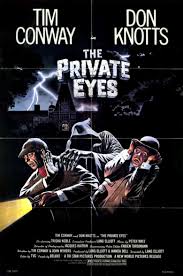
The Private Eyes (1980)

THE PRIVATE EYES (1980) *1/2
Eighty years of nostalgia account for the appeal of the comedy mystery THE PRIVATE EYES.


THE PRIVATE EYES spoofs Sherlock Holmes and Dr. Watson, who first appeared in the 1887 Arthur Conan Doyle novel “A Study in Scarlet” and made a comeback in the ’70s through such films as THE PRIVATE LIFE OF SHERLOCK HOLMES, THE ADVENTURE OF SHERLOCK HOLMES’ SMARTER BROTHER, THE SEVEN-PER-CENT SOLUTION, and MURDER BY DECREE, and it takes on a comedic style made famous by Abbott and Costello in such ’40s films as HOLD THAT GHOST and ABBOTT AND COSTELLO MEET FRANKENSTEIN.

Meanwhile, here we are more than 40 years out from the release of THE PRIVATE EYES, possibly feeling nostalgic for the comedic duo Don Knotts (1924-2006) and Tim Conway (1933-2019), who appeared together in a trifecta of Disney live-action pictures before THE PRIZE FIGHTER and THE PRIVATE EYES, both major successes for Roger Corman’s New World Productions. They last appeared together in a cameo for the bomb turkey CANNONBALL RUN II.

Knotts definitely carries more nostalgic heft than Conway, since I remember him from ‘The Andy Griffith Show,’ ‘Three’s Company,’ PLEASANTVILLE (playing a TV repairman, of course), and even a play in Kansas City when I was in college. Knotts’ Bernard ‘Barney’ Fife worked up my Grandma like no other fictional character and she reveled in his regularly scheduled comeuppance. I fondly remember giving her a hard time about it, saying that Knotts’ Fife made the show and that it went downhill after his departure. Strangely enough, I remember most fondly a TV spot pairing Fife’s antics with Right Said Fred’s ‘I’m Too Sexy.’ Wish that I could find that spot and crack up once again.

So, needless to say, I entered THE PRIVATE EYES with a generosity of good spirit and desire to laugh. I left 90 minutes later defeated by a really, really, really dumb, dumb, dumb mystery comedy and I have no real motivation to seek out the other Knotts and Conway cinematic pairings.

Knotts and Conway portray Inspector Winship and Dr. Tart, two bumbling fumbling stumbling American detectives who have somehow found themselves working for ‘The Yard.’ They bumble fumble stumble from their very first scene together all the way to the end and if you find that bumble fumble stumble worth a funny rumble the first time, you just might find it funny a hundred times. However, I did not find it funny the first or the last time or any darn time in-between.

THE PRIVATE EYES more accurately recalls a Scooby Doo episode. Hey, wouldn’t you know that Knotts appeared in cartoon form in the episodes ‘Guess Who’s Knott Coming to Dinner’ and ‘The Spooky Fog of Juneberry’ and Conway took on the Spirit of Fireball McPhan in ‘The Spirit Spooked Sports Show.’ I vaguely remember watching all three from childhood, but I still have no doubt they are each better than THE PRIVATE EYES.

Ironically, THE PRIVATE EYES has way too much plot for a dumb comedy.

HOLD THAT GHOST works much better than THE PRIVATE EYES because it has flights of fancy that deviate from its mystery plot like Costello’s dance scene with Joan Davis. Since they were all under the imperial offices of Universal Pictures, HOLD THAT GHOST makes room for musical numbers by Ted Lewis and His Orchestra and the Andrews Sisters. THE PRIVATE EYES, meanwhile, offers scenes like a gas station destroyed by Winship and Tart in a way that recalls IT’S A MAD, MAD, MAD, MAD WORLD, a very, very, very, very unfunny comedy. Let’s face it, Hollywood made less dumb comedies in 1941 than both 1963 and 1980.

Knotts and Conway remain likable throughout THE PRIVATE EYES, despite very rarely ever being funny. That said, Australian singer and actress Trisha Noble virtually steals the show out from underneath Knotts and Conway every time she appears as the alluring heiress Phyllis Morley. She’s very, ahem, ‘Oh LàLà,’ like a model for that magazine favored by 1955 Biff Tannen. I can honestly say that she alone boosts the overall rating for THE PRIVATE EYES by at least half a star.