
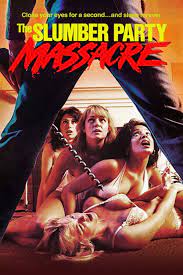
The Slumber Party Massacre (1982)

THE SLUMBER PARTY MASSACRE (1982) ***
Coming across the beloved cult film that was once not so beloved just might be the biggest hazard of movie spectatorship these days.

You better not ride on the general train of thought from the film’s original release or you just might get bludgeoned in the comments section by devotees of the cinematic item under discussion.

You have no taste! You’re an idiot! You just don’t get it! You’re too stupid to understand the undeniable genius! Blah blah blah!

I am thinking first and foremost about films like Halloween III, Howard the Duck, Sleepaway Camp, and Silent Night, Deadly Night.

Maybe you are reading my confession why I had not watched The Slumber Party Massacre until very recently.

I finally caught up with it on Halloween night 2022, I liked it well enough, and I can definitely understand why it’s held in such high esteem in some quarters though I certainly don’t like it as much as others so enthusiastically do.

The Slumber Party Massacre took a while to get started, packed with so many false alarms and jump scares that I began losing patience early on and it was not until the 45- or 50-minute mark that I became enveloped in suspense. The final 25-30 minutes are especially well-made and filled with plenty of impacting moments, so much so that I almost bumped The Slumber Party Massacre up to three-and-a-half stars even after the mixed reaction to the first two-thirds of the film.

All slasher films, whether it be the good, the bad or the ugly, have their gimmicks, be it their setting or their killer in everything from the favorite weapon of choice down to style.

The Slumber Party Massacre sold a good amount on the fact that it has a female director (Amy Holden Jones) and a feminist screenwriter (Rita Mae Brown), something not common for the horror genre overall and specifically the subgenre of the slasher.

Jones shows definite talent in her directorial debut, and it’s no surprise she later directed Love Letters, Maid to Order, and The Rich Man’s Wife and received screenwriting credits on Love Letters, Maid to Order, Mystic Pizza, Beethoven, Indecent Proposal, The Getaway (1994), and The Relic. She also married acclaimed cinematographer Michael Chapman (Taxi Driver, Raging Bull, The Fugitive) in 1980 and stayed his wife until his death in September 2020.

Brown intended The Slumber Party Massacre to be a satire of the slasher genre, but Jones filmed it as straight horror.

However, satirical traces remain throughout The Slumber Party Massacre.Virtually all the male characters are super horny creeps and more than one female character survives all the murder and mayhem, for example.

Never mind that escaped serial killer Russ Thorn (Michael Villella) walks around in plain sight without a mask from the first scene on. He’s also one of a select few slasher film killers with quotes on the Internet Movie Database. Eat your heart out, Jason and Michael!

Also, never mind Thorn’s weapon of choice that could possibly be some kind of metaphor. Yes, it’s a power drill and I’m not sure of the symbology there! I also don’t believe there’s any greater meaning in the ways he meets his inevitable demise at the end of the movie.

The local radio station announces Thorn’s escape more than once, yet nobody seems to notice let alone care until it’s (almost) too late. I seem to remember one of the characters shutting off her car radio in the middle of one of the announcements.

Nearly all the characters are too preoccupied with their pursuits of pleasure at this very moment in time, just like the characters in any Friday the 13th film, to be concerned about some homicidal maniac on a rampage.

These satirical traces make The Slumber Party Massacre a good deal more interesting than, let’s say, Madman and The Prowler.

It works as both a satire and a straight horror film nearly 15 years before Scream came out.

In fact, not that I want to shout about it or anything, The Slumber Party Massacre works better than Scream.
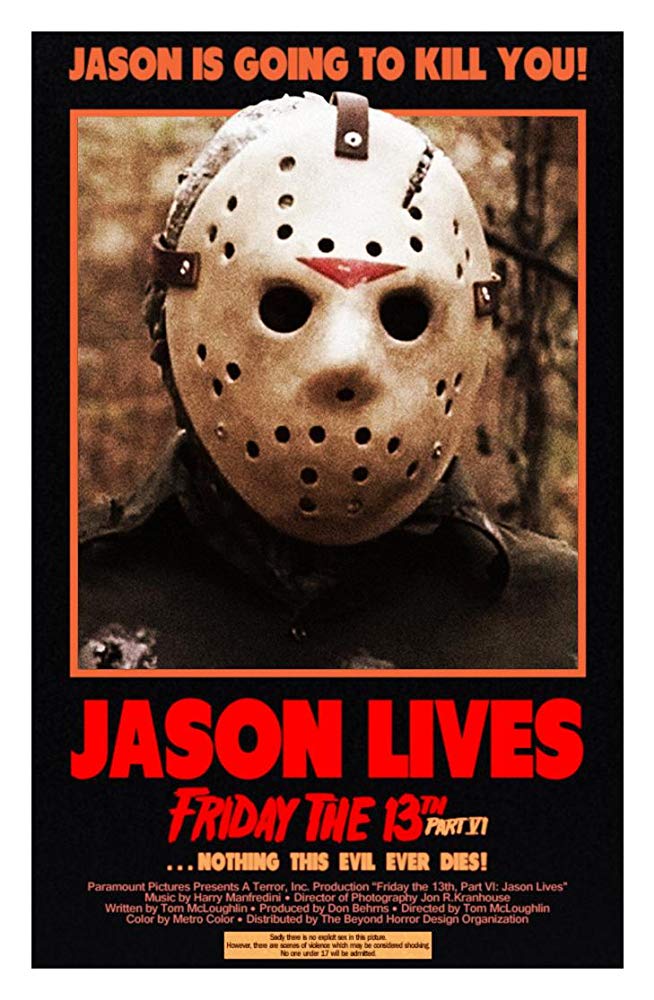
Friday the 13th Part VI: Jason Lives (1986)

JASON LIVES

FRIDAY THE 13TH PART VI: JASON LIVES (1986) Three stars

I find the FRIDAY THE 13TH movies that I like the most are the ones with the best sense of humor.

That’s why I’ll call PART VI: JASON LIVES the best film in the entire series, beating out PART III and THE FINAL CHAPTER. JASON LIVES includes several intentionally funny scenes and that helps its 86 minutes go down smoothly.

Director and writer Tom McLoughlin wanted to satirize a slasher movie all while making one, turn Jason into a supernatural zombie, and not simply churn out a carbon copy of the five previous movies in the series. There are moments intended to recall classic horror movies, like the beginning scene in the cemetery echoes the grave robbers at the beginning of FRANKENSTEIN MEETS THE WOLF MAN. Jason’s revival from the dead courtesy lightning also recalls Frankenstein’s Monster.

“I set up a lot of visual gags,” McLoughlin said in the book “A Strange Idea of Entertainment — Conversations with Tom McLoughlin.” “Like when my wife Nancy is killed by Jason. She tries to bribe him, offering him her wallet to keep him from killing her. She’s got money and a credit card in her wallet, and when Jason kills her in this giant mud puddle, the money sinks and the American Express card floats. I held on that shot for a few extra beats because I knew there would always be some joker in the theater that would yell, ‘Don’t leave home without it!’ And someone always did.”

McLoughlin’s background proved to have a strange influence on Jason Voorhees.

“I was recently interviewed about it, and someone said, ‘Your Jason seemed to be much more communicative,’” McLoughlin said. “I said, ‘That’s because I was dealing with a mime character.’ When he sees the motor home bouncing up and down because a couple are having sex in there, Jason just stands there and stares, with his head tilting back and forth — like a dog trying to figure out what’s going on. It got a big laugh. I wasn’t making fun of Jason … I just figured he would be processing what was going on in that motor home. Whenever I find a way to put my mime training to use in storytelling, I do it.”

Marcel Marceau influenced Jason Voorhees. Makes perfect sense to me.

McLoughlin sang in a rock band before he went to Paris to study mime under Marceau. Back in the States, several years later, McLoughlin had a part as the mutant bear monster in the 1979 horror film PROPHECY directed by John (MANCHURIAN CANDIDATE) Frankenheimer. All these experiences seemingly fed McLoughlin more insight into Jason than any other director.

Alice Cooper provided three songs for JASON LIVES:  “Teenage Frankenstein,” “Hard Rock Summer,” and “He’s Back (The Man Behind the Mask).” Unfortunately, they are not classic Alice Cooper songs, a la the four-album period from “I Love It to Death” through “Billion Dollar Babies” when the band cranked out some of the greatest hard rock ever made, but I still enjoy “He’s Back.” SCREAM later made great use of the Alice classic “School’s Out.”

Speaking of SCREAM, apparently screenwriter Kevin Williamson wanted McLoughlin to direct his hot commodity screenplay, before the project ended up with Wes Craven. Williamson told McLoughlin that JASON LIVES and its humor made a huge impact on Williamson during his youth, so much so that it served as one of the inspirational springboards for SCREAM.

There’s a James Bond gun barrel sequence parody, dialogue that breaks the proverbial fourth wall, a camper reading Jean-Paul Sartre’s existentialist play “No Exit,” a camper praying to God for the first (and only) time in the series, and even Jason surprised at his own astonishing strength. Also, for the first and only time in the series, young campers are in attendance at Camp Forest Green, er, Camp Crystal Lake.

“I’ve seen enough horror movies to know any weirdo wearing a mask is never friendly” and “Some folks sure got a strange idea of entertainment” are lines that display how JASON LIVES influenced SCREAM.

The young children, who Jason does not harm, have their moments, as well, especially when one boy asks his little friend, “So, what were you gonna be when you grew up?”

All these words so far and I have not even mentioned protagonist Tommy Jarvis, who figured in THE FINAL CHAPTER, A NEW BEGINNING, and JASON LIVES. He’s responsible for reviving Jason in the opening sequence and Tommy even makes sure to bring that infamous hockey mask with him. Originally, it had been planned for Tommy to become the antagonist, but it was the extremely negative reaction to A NEW BEGINNING and its non-Jason killer which truly brought Jason back from the dead. Tommy never panned out like he should have and part of the problem is that he’s played by three different actors, Corey Feldman (THE FINAL CHAPTER), John Shepherd (A NEW BEGINNING), and Thom Mathews (JASON LIVES).

Anyway, definitely by this point in the series, Jason became the focus of attention and the antihero extraordinaire of the late ‘80s. Dan Bradley played Jason in the paintball massacre sequence, but former soldier C.J. Graham handled the rest of the duties. He’s a lot more interesting than Tommy Jarvis. That’s why the series moved forward with Jason (Kane Hodder the man behind the mask for four more sequels) and without Tommy Jarvis.