

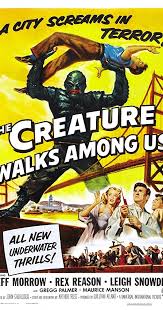
THE CREATURE WALKS AMONG US (1956) **1/2
I should have already learned my lesson.
I bitch about the yucky suck face between scientists John Agar and the lovely Lori Nelson through most of the second half of Revenge of the Creature, so it only serves me right that I got immediately served with the miserably married couple played by Jeff Morrow and Leigh Snowden in The Creature Walks Among Us, the third and final entry in the Creature series released by Universal Studios. Morrow and Snowden are truly a downer and their scenes drag The Creature Walks Among Us down a notch or two from being a perfectly enjoyable creature feature.
All three Creature features benefit heavily from their underwater photography and Walks Among Us works best when the action takes place underwater. Above water, especially when Morrow and Snowden provide us another unpleasant scene together, it’s not so hot. Watching Revenge and Walks Among Us in close proximity, it’s obvious just how much influence these earlier films had upon the later Jaws series also produced by Universal. Jaws 3 borrowed major plot developments from Revenge, for crying out loud.
In a fundamental way, though, Walks Among Us cheats us. It doesn’t really live up to any part of that title until the very end of the picture, when the title character escapes from captivity. I certainly don’t remember a city screaming in terror and the poster incorporates the Golden Gate Bridge into its promotional campaign. Good job, marketing department. Sure, we see the Golden Gate, kinda sorta obligatory for any film shot for any length in San Francisco, but I don’t recall any character being held up above the Golden Gate by our title character, sure to be thrown to his death. Now, that would be an impressive scene.
I feel like I must make amends in this review for cheating Ricou Browning (born 1930) in the Revenge review. He’s the man in the creature suit in the underwater scenes. In Walks Among Us, Don Megowan plays the Gill Man on land. In Revenge, it was Tom Hennesy. In Creature, it was Ben Chapman. I believe it’s a testament to the quality of Browning’s work in the underwater scenes that he filled the creature suit in all three movies.
Strangely enough, I felt a certain sadness during Walks Among Us, alternating with a sense of overall wonderment toward the Universal Classic Monsters series. Walks Among Us ended a stretch where I watched 16 classic horror films, from 1935’s Werewolf of London to 1956’s The Creature Walks Among Us, for the first time, having already watched Universal’s true classics like The Bride of Frankenstein and The Wolf Man several times before. Because I even sometimes enjoy watching a bad movie, like The Invisible Woman, this stretch greatly satisfied both the historian and the horror movie fan living inside me.
Top 12 Universal Classic Monster Movies
1. The Bride of Frankenstein (1935)
2. Frankenstein (1931)
3. The Wolf Man (1941)
4. Son of Frankenstein (1939)
5. Creature from the Black Lagoon (1954)
6. The Invisible Man (1933)
7. The Phantom of the Opera (1925)
8. The Mummy (1932)
9. Dracula’s Daughter (1936)
10. Dracula (Spanish version) (1931)
11. Dracula (English version) (1931)
12. Abbott and Costello Meet Frankenstein (1948)

 Attack of the Killer Librarian