
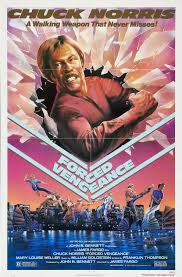
Forced Vengeance (1982)

FORCED VENGEANCE (1982) **1/2
Slow motion’s absolutely vital to understanding the cinematic and TV work of the one and only Carlos Ray Norris.

Slow motion’s everywhere, in action movies, sporting events, movie musicals, etc. To the point that we don’t even realize how everywhere it’s become.

Over the decades, for example, slow motion became a customary tool in violent scenes, from Arthur Penn’s Bonnie and Clyde and Sam Peckinpah’s The Wild Bunch to The Matrix and beyond. Sometimes, I think Gee whiz, that’s awesome and very artfully done, but mostly I just think That’s super lame. I take off points for the obligatory and cheap use of slow motion.

Let’s see, off the top of my head, I deducted from The Lion King and Teen Wolf and Young Guns for their abuse of slow motion late in their motion picture spreads, while Kickboxer 2 flogs viewers with slow motion until it’s like receiving a slow motion roundhouse upside the head. For crying out loud, though, it’s slow motion, super slow even, and that gives us a greater chance to duck out of the way and to see all the cheap audience manipulation at play. I mean, I ducked the Kickboxer 2 roundhouse and found the Siskel & Ebert review playing alongside the movie inside my head esp. Ebert imitating the sounds of slow motion. It was more entertaining that way.

That brings us full roundhouse back to Norris, one of the foremost slow motion abusers.

A former co-worker said that his ears were ringing for a long time after he watched the Who play one of the Day on the Green concerts at Oakland-Alameda County Coliseum. He talked about being whacked upside the head by their incredible Wall of Noise. I soaked up this conversation.

“In 1976, the Who entered the Guinness Book of World Records for performing the loudest concert in history at the time during their concert at England’s Charlton Athletic Grounds with 76,000 watts at 120 decibels. This record would stand for nearly a decade.”

You can bet they used the Rock-o-meter from Rock ‘N’ Roll High School.

Anyway, now I will make the case for something that’s louder than any rock concert or sporting event, any plane taking flight, any hyena’s laugh, and any howler monkey.

For a couple months, I visited my Grandma for her bingo dominance Tuesday and Thursday. After the bingo hour, we’d return to her room and she’d turn her TV back on. Naturally, it would be Walker, Texas Ranger on Hallmark. Of course. At 3 every day, every single TV in the nursing home would simultaneously be turned on full volume and tuned in to Walker, Texas Ranger. That’d be probably close to 100 TVs. Yeah, we’ll go with 100 for the sake of hyperbole.

I’ve never in my life heard anything louder than 100 full blast TVs simultaneously reverberating Walker slow motion roundhouse kicks.

Guinness, book it.

I deducted a half-star from Forced Vengeance because it broke through my pain threshold for slow motion consumption early on during the final act leading toward a grand finale.

You have been forewarned.

Once again, though, a poster for a Norris spectacular earns four stars.

The Warriors (1979)

THE WARRIORS

THE WARRIORS (1979) Three-and-a-half stars

David Patrick Kelly belongs in the Actors Who We Love to Hate Hall of Fame, right alongside such performers as Thomas F. Wilson (for his work as 1955 Biff, 1985 Biff, alternate 1985 Biff, 2015 Biff, Griff, and Buford “Mad Dog” Tannen in the BACK TO THE FUTURE trilogy) and Michael Moriarty (Q: THE WINGED SERPENT).

You might remember Kelly from COMMANDO as Sully, the creep who John Matrix promised to kill last because, you know, Matrix liked Sully … well, Matrix lied and Sully took a great fall. Or maybe DREAMSCAPE starring Dennis Quaid and Kate Capshaw, where the name of Kelly’s would-be presidential assassin, Tommy Ray Glatman, suggests Lee Harvey Oswald, John Wilkes Booth, and James Earl Ray.

Kelly made his motion picture debut as Luther in Walter Hill’s 1979 cult classic THE WARRIORS and Kelly plays a great creep right straight out of the box. Hill later cast Kelly as (a different) Luther in 48 HOURS.

Luther assassinates charismatic, visionary street gang leader Cyrus (Roger Hill) in an early scene and the Warriors from Coney Island are framed as the assassins. The police and every street gang in New York City want them Warriors bad, real bad. The Warriors’ long, harrowing journey back home makes up the vast majority of the movie.

Kelly delivers the goods in every scene that he’s in.

Swan (Michael Beck), the leader of the Warriors, and Luther, the leader of the Rogues, are finally face-to-face late in the picture. Thankfully, because everything’s been leading up toward showdown, Swan asks Luther the burning question we’ve been wanting to ask him ourselves, you know, why’d you do it, why’d you waste Cyrus? In an answer that makes THE WILD ONE proud, Luther says, “No reason. I just … like doing things like that!”

Just a few minutes earlier, Kelly begat the world the famous “Warriors, come out to play,” made famous by the way he said it.

Kelly alone earns THE WARRIORS three stars.

THE WARRIORS is a chase movie, predominantly on foot, and a survival of the fittest movie. It’s one of those great entertainments where you can find deeper messages or merely just sit back and enjoy Hill’s ability to stage larger-than-life action scenes, the colorful characters, and the approximately 90-minute tour of large city street gangs.

In addition to our title characters, we have the Turnbull AC’s, the Orphans, the Baseball Furies (they naturally brandish baseball bats and Kiss-like face paint, combining two of Walter Hill’s two loves), the Lizzies, the Punks, the Rogues, the Riffs (Cyrus’ former gang), the Boppers, the Boyle Avenue Runners, the Electric Eliminators, the Gladiators, the Hi-Hats, the Hurricanes, the Jones Street Boys, the Moonrunners, the Panzers, the Saracens, the Satans Mothers, the Savage Huns, the Van Cortland Rangers, and there’s a whole slew of gangs listed in Hill’s original script.

These gangs have a meeting in the Bronx and that’s when Luther kills Cyrus. All hell breaks loose with our title characters, eight gang members, at the center of the mayhem. The Warriors have more than 20 miles to go from the Bronx to their Coney Island home. It takes about 2 hours via mass transit, so THE WARRIORS feels like it plays out in real time.

Another stylistic flourish in a film overflowing with them involves a female DJ (face of Lynne Thigpen, voice of Pat Floyd) who’s the voice of the street gangs. “All right now, for all you boppers out there in the big city, all you street people with an ear for the action, I’ve been asked to relay a request from the Gramercy Riffs. It’s a special for the Warriors, that real live bunch from Coney, and I do mean the Warriors. Here’s a hit with them in mind.” Her apology to the Warriors at the end comes in the form of Joe Walsh’s “In the City.”

Real-life violence, allegedly inspired by seeing THE WARRIORS itself, unfortunately soured the reaction to the film in early 1979. Tony Bill, who produced his own gang film (BOULEVARD NIGHTS) that was protested in early 1979, said in People Magazine, “It makes sense that a movie that basically glorifies violence would attract violence.” Co-screenwriter David Shaber said THE WARRIORS was Sesame Street compared to a Sam Peckinpah movie (like THE WILD BUNCH). Paramount VP Gordon Weaver said of the violence, “[It’s] the sort of thing that happens at rock concerts, high school basketball games and any place where diverse groups meet. It could have happened anywhere.”

Similar controversies unfortunately later swirled around such films as DO THE RIGHT THING, NEW JACK CITY, and BOYZ N THE HOOD.