
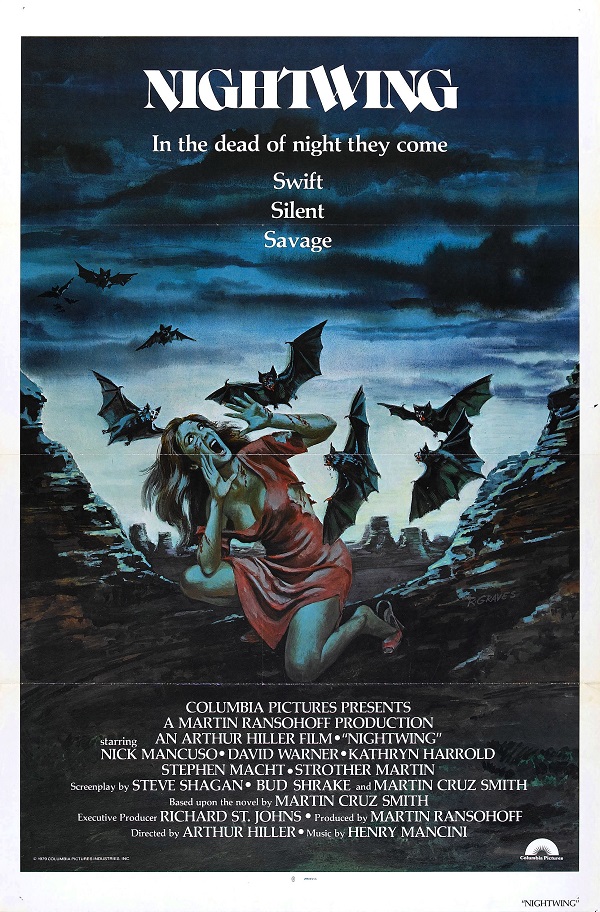
Bats, Bats, Bats & Jaws with Claws: Nightwing, Prophecy, Grizzly

BATS, BATS, BATS & JAWS WITH CLAWS: NIGHTWING, PROPHECY, GRIZZLY
Distinguished character actor David Warner (1941-2022) almost redeems large portions of the 1979 killer vampire bat picture Nightwing, and he’s the reason that it rates out around two stars rather than one or possibly even worse.

Pardon the pun, but Warner truly bites into his dialogue and his monologues are the best moments in Nightwing. Phillip Payne comes across a little batty himself, more often delightfully so than not, and that batty quality would seem to come naturally with the territory of studying and killing plague-infested vampire bats.

The film’s best moments are definitely not the special effects and the vampire bat attack scenes, which almost had me laughing as much as The Bat People or Prophecy or perhaps the ultimate cinematic disaster disaster movie The Swarm.

Generally, I love the prerequisite genre scenes where the scientist explains the phenomenon on the rampage within the movie to a slack-jawed authority figure who usually downplays whatever threat it might be and decides to keep the park / town open.

It rarely ever lets me down, and I enjoyed Nightwing every time Phillip Payne goes all Dr. Sam Loomis on us about vampire bats.

Youngman Duran: It just doesn’t seem natural for a man to spend his life, his entire life, killing bats.

Phillip Payne: Not just bats. Vampire bats. I kill them because they’re evil. There’s a mutual grace and violence in all forms of nature; and each specie of live gives something in return for its own existence. All but one. The freak. The vampire bat alone is that specie. Have you ever seen one of their caves?

YD: No.

PP: I killed over 60,000 of them last year in Mexico. You really understand the presence of evil when you go into their caves. The smell of ammonia alone is enough to kill you. The floor of the cave is a foul syrup of digested blood. And the bats: up high, hanging upside down, rustling, fighting, mating, sending constant messages, waiting for the light to fade, hungry for blood, coaxing the big females to wake up and flex their nightwings to lead the colony out across the land, homing in on any living thing; cattle, sheep, dogs, children, anything with warm blood. And they feast, drinking the blood and pissing ammonia. I kill them because they’re the quintessence of evil. To me, nothing else exists. The destruction of vampire bats is what I live for.

Alrighty then.

Almost none of the small pleasures from Nightwing are to be found in Prophecy, films released only a week apart during June 1979.

Prophecy alternates between a serious, more ambitious movie about ecological concerns and land rights in a dispute between Native Americans and the polluting paper mill, domestic scenes involving a husband (Robert Foxworth) and his wife (Talia Shire), and silly monster attack scenes that belong in something like Food of the Gods or Bigfoot, two bad monster movies from earlier in the ’70s.

Rather, I meant laughably bad monster attack scenes.

None of the elements gel well together in Prophecy.

Prophecy gets awful preachy at times, maybe not too much of a surprise given the film’s title, and Foxworth’s Dr. Robert Verne makes for a rather lackluster and thus unlikable protagonist. Foxworth does not give Prophecy a jolt like Warner does in Nightwing, and his scientific explanatory scenes are pedestrian.

Dr. Verne and his wife Maggie do not have the relationship that, let’s see here, pugilist protagonist Rocky Balboa (Sylvester Stallone) and Adrian (Shire) do in Rocky and Rocky II, ironic considering that Rocky II and Prophecy were both released June 15, 1979.

Their domestic scenes are a drag, and I think less of Foxworth’s Dr. Verne from early on because of the way he treats his wife.

Veteran character actor Richard Dysart (1929-2015) gives the best performance in Prophecy, and it’s not even close. Dysart plays the role of the detestable paper mill company man Isely so effectively that it’s one of the film’s greatest disappointments when it cuts away from his graphic dismemberment by mercury mutant bear Katahdin late in the picture. We’ll have to settle instead for Dysart’s grisly death scene in John Carpenter’s The Thing.

The Katahdin we actually get in the finished product and the one in the promotional material (and dialogue) are not exactly one and the same, which hearkens Prophecy back to low-budget precursors like The Giant Claw and The Wasp Woman more than contemporaries like Alien and Dawn of the Dead, but without the fun of any of those movies.

Leonard Maltin described the monster as a giant salami, Isely said that it’s larger than a dragon with the eyes of a cat, Time reportedly said that it’s Smokey the Bear with an advanced acne condition, and Gene Siskel and Roger Ebert called it a cross between an earthworm and a bear (Siskel) and a grizzly bear and Godzilla (Ebert).

Given that it’s Kevin Peter Hall as the man in the monster suit, one might be tempted to call it a cross between Predator and Harry and the Hendersons.

Manbearpig!

Grizzly, a killer bear picture released three years before Prophecy, works a lot better than Prophecy because it succeeds at a much more modest level of ambition.

It’s required by law that every review mention Grizzly is a Jaws rip-off or we can go right on ahead and call it Jaws with Claws.

We have a law enforcement officer (park ranger), a military veteran (helicopter pilot), and a scientist (naturalist) on the hunt for a giant killer animal (grizzly bear). We also have a park supervisor who refuses to close down the national park despite a series of brutal deaths. The park supervisor allows hunters into the forest to hunt and kill the bear, while media converge on the scene for sensational coverage, but eventually our three main characters must try and do the deed themselves.

I honestly don’t mind too much that Grizzly follows the Jaws formula because Christopher George, Richard Jaeckel, and Andrew Prine are good in their roles and I care about them in their battle against a primal beast.

Honestly, it’s as simple as that, whereas I didn’t particularly care about the overwhelming majority of the human characters in Prophecy and did not care one way or another whether they lived or died just as long as the end credits rolled.

Grizzly, thankfully, is also not preachy, it’s endearing and entertaining on a basic level, and it’s a pleasant way to spend 90 minutes.

Granted, the three main actors and characters are not anywhere near the same level as Roy Scheider’s Sheriff Brody, Richard Dreyfuss’ Matt Hooper, and Robert Shaw’s Captain Quint, just like William Girdler’s no Steven Spielberg, but I still think Grizzly has earned a place right alongside such ’70s killer animal staples as Night of the Lepus, Frogs, Squirm, Kingdom of the Spiders, and Piranha.

Nightwing (1979) **; Prophecy (1979) *; Grizzly (1976) ***
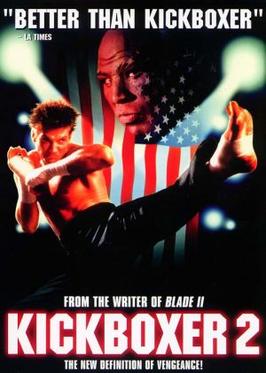
Kickboxer 2 (1991)

KICKBOXER 2

KICKBOXER 2 (1991) *1/2

En route to the cinematic crapper, Albert Pyun’s KICKBOXER 2 abuses two of the worst cinematic devices: slow motion and an offscreen death.

On their review program, Gene Siskel and Roger Ebert pointed out how much Pyun and the picture relied on slow motion during the fight scenes. Ebert claimed they used slow motion for every single moment of every single fight scene in the movie, including for the voices of the announcer and the referee, but that the sound effects guy must not have got the same memo because all the punches and kicks sounded like they were in regular motion. Siskel accused Ebert of eating spiked popcorn. Bottom line: If only KICKBOXER 2 had been half as entertaining as the Siskel & Ebert review.

Let’s take the fight that’s right smack dab in the middle of the picture, between our principled, reluctant-to-fight hero David Sloan’s former protege Brian “The Hammer” Wagner (Vince Murdocco) and the super villainous Tong Po (Michel Qissi) who’s back from KICKBOXER: THE MOTION PICTURE (not its real title). Brian Wagner dies in the ring from a series of brutal slow motion kicks and punches and other blows to the body. Coming that slow, he should have seen it coming and got out of the way. No, no, no, of course not, Brian Wagner wanted to die. Okay, maybe not wanted to die per se, but he was destined to die in that post-Apollo Creed ROCKY IV way. Anyway, we knew he was going to die from early in the picture, when his worried mother told David Sloan (Sasha Mitchell) that she’s afraid for her son and made Mr. Sloan promise to look after him. Brian Wagner further sealed his cinematic doom by walking away from David Sloan and cursing him on the way to greener pastures, by taking the easy fights and that cheap nickname, by allowing himself to be pumped full of steroids, and finally by his defiant overconfidence and his blatant refusal to surrender to his opponent. Yes, yes, he deserved to die.

The final buildup to Wagner’s death hits us over the head with a slow-moving sledge hammer. Not only are Tong Po and Brian Wagner in super duper excruciating slow motion, but Wagner’s poor mother and David Sloan are both moving like that in the crowd … in a cinematic technique derived especially from the later ROCKY pictures, you know when Clubber Lang and Ivan Drago are beating the brain stuffing out of Rocky (or Apollo Creed) and Rocky’s corner men or even his poor, poor wife Adrian are laboriously freaking out but ultimately helpless in the face of slow motion annihilation. I am so, so glad this overdone cinematic technique eventually faded away.

Offscreen deaths are usually cheap and sometimes, they’re even worse. For example, Hicks and Newt at the beginning of ALIEN 3. That one left millions reeling and they’re still talking about it today flabbergasted and frustrated.

In KICKBOXER 2, we are informed that Tong Po killed both David Sloan’s older brothers, including KICKBOXER protagonist Kurt Sloane (Jean-Claude Van Damme), after the events of the first movie and before the events of the second one. And to think Kurt avenged his paralyzed older brother Eric Sloane (played by former world kickboxing champion Dennis Alexio) against Tong Po for the big thrilling conclusion of KICKBOXER.

Yes, that’s right, Sloan and Sloane, that’s what really confused this unfrozen caveman writer. Sloan’s older brothers each have an ‘e’ on the end of their surname. Fascinating. Let’s see here: Van Damme speaks with a thick Franco-Belgian accent, while Sasha Mitchell, why he’s just a poor man’s Keanu Reeves. Bizarre family that must really get around. Ironically enough, though, Mitchell has been called both a poor man’s Keanu and a poor man’s Jean-Claude. Mitchell’s not without a slight charm, however, and he’s definitely not the biggest problem in KICKBOXER 2. The film’s biggest problem is that we’ve seen it all done before … and better numerous times.

KICKBOXER 2 lacks the off-the-wall qualities of a Shaw Brothers spectacular or a truly batty WTF exploitation picture like NINJA III: THE DOMINATION and SAMURAI COP, as well as the genuine pathos of ROCKY and THE KARATE KID. It is neither truly good enough nor bad enough to be any good.

Kill and Kill Again, Firecracker, Circle of Iron

KILL AND KILL AGAIN, FIRECRACKER, CIRCLE OF IRON

In his 1981 TV review of the South African martial arts spectacular KILL AND KILL AGAIN, Roger Ebert predicted action movie stardom for James Ryan and invoked the names Eastwood, Bronson, and Bruce Lee.

Well, in this business and life in general for that matter, you win some, you lose some.

James Ryan, who? Yeah, not exactly a household name.

Describing the plot, I would like to just string together a bunch of random words: martial arts champion for hire undercover government agent top secret rescue mission kidnapped scientist recruit colleagues alternative energy source megalomaniac uniformed cult mind control world domination bar fight mushy romance mushy talk middle-of-nowhere fight storming fortress explosions fisticuffs flips plot revelations not particularly revelatory.

There you go. KILL AND KILL AGAIN, the sequel to KILL OR BE KILLED, in a nutshell.

KILL AND KILL AGAIN works predominantly because it has a good sense of humor and it finds just the right tone to pull off being a successful action comedy.

There’s one especially fun supporting character and supporting performance, the diabolical genius’ assistant and (significant other) Minerva played by Marloe Scott-Wilson. She looks like she drifted over from ROCK ‘N’ ROLL HIGH SCHOOL or THE DECLINE OF WESTERN CIVILIZATION, especially with that ridiculous Day-Glo hairdo. She’s a lot of fun in every scene, especially when she calls residential madman Marduk (Michael Mayer) by these absolutely ridiculous pet names. She comes up with a fresh one every single time. And it rankles Marduk, because good old Minerva says her little terms of endearment right in front of everybody. At one point, Marduk tells her, “I said don’t call me Popsicle.” This running gag even has an explosive payoff in the end.

Guess we should mention that South African beauty queen Anneline Kriel — Miss World 1974 — does her own stunts in the movie. She has to overcome playing a character named “Kandy Kane.” I almost wish they would have named her character “Susan Alexander Kane” or “Emily Kane,” for all us CITIZEN KANE fans in the audience. Now, that would have been an impressive stunt.

Impressive stunts are at the heart of FIRECRACKER, especially during the film’s last 30 minutes.

We’re talking about topless kickboxing and what must surely be one of the weirdest love scenes ever committed to celluloid.

Two sicko creeps pursue our heroine Susanne Carter, played by the luscious Jillian Kesner, and they eventually shed her of her top and bra. She then proceeds to kick their asses viciously. Meanwhile, in the background, we have “Rack Master” boxes. Perfect!

“Rack Master” should have been Carter’s martial arts name and it also should have been a title for FIRECRACKER.

That’s not too much of a stretch, especially since FIRECRACKER traveled as NAKED FIST in Australia.

FIRECRACKER director Cirio H. Santiago plagiarized this topless kickboxing scene from his earlier New World Pictures extravaganza TNT JACKSON.

Now, let us consider that weird love scene. Oh Susanna and her love interest Chuck Donner (Darby Hinton) consummate their relationship, but not before they remove each other’s clothes stitch-by-stitch with a knife. Kinky. Chuck Donner and his incredible mustache, especially his incredible mustache, just scream “Creepy seducer of the ladies who killed Susanna’s sister.” Of course, Susanna does not learn of this fact until after their lovemaking.

Susanna exacts her revenge against Chuck in the ring and we all can be sure that he will never look at another woman ever again.

Kesner passed away in 2007 and she and her late husband Gary Graver (1938-2006) became known for their efforts to preserve the work and legacy of legendary director Orson Welles. I do believe it is time for another reference to CITIZEN KANE.

CIRCLE OF IRON attempts to be something bigger, greater than KILL AND KILL AGAIN and FIRECRACKER. It wants to be a transcendent exploitation film.

We are given the only clue we need as soon as the following title card appears on screen: “Prior to the death of the legendary Bruce Lee he helped to create a movie story that might capture not only the spirit of martial arts but a part of the Zen philosophy he lived by. He was aware that a film with these dynamics would cause controversy, particularly among those unfamiliar with Zen beliefs. But it was this very uniqueness that he believed wound enthrall the moviegoer. Bruce set the story in a land that never was and always is. It is to Bruce Lee that this film is posthumously dedicated.”

I was definitely not enthralled by CIRCLE OF IRON. Not very often.

It certainly did not help that Captain Hairdo, er, Jeff Cooper plays the lead character Cord and this character and performance never quite resonated with me because I kept seeing Roger Daltrey instead and I pretended it was TOMMY.

I kept waiting for Cooper’s cord to break out into song, “Listening to you, I get the music / Gazing at you I get the heat / Following you I climb the mountain / I get excitement at your feet!” and “See me, feel me, touch me, heal me.”

It never happened and I felt extremely disappointed.

David Carradine plays about four roles too many in CIRCLE OF IRON. Okay, I’ll say three roles too many, because we get one of the film’s most entertaining scenes when Carradine assumes the guise of “Monkeyman.” At one point, Carradine’s wig came off and I thought shit like that only happened in SAMURAI COP.

Christopher Lee passed on THE LEGEND OF THE 7 GOLDEN VAMPIRES, a joint venture between Hammer Studios and the Shaw Brothers, because he did not want to play Dracula for the millionth time … but he plays what turns out to be a role that sucks even more in CIRCLE OF IRON, Zoltar, er, Zetan. This is one of those quest movies where you’ll become irritated after hearing a certain name — Zetan, maybe — many, many, many, many, many, many times.

Orson Welles asked me not to reference a certain movie during this review of CIRCLE OF IRON. I must respect his wishes.


KILL AND KILL AGAIN ***; FIRECRACKER ***; CIRCLE OF IRON **

Alice, Sweet Alice (1976)

ALICE, SWEET ALICE (1976) ***

They really tried hard with ALICE, SWEET ALICE, the horror film that’s best known for being Brooke Shields’ film debut.

It appeared in November 1976 at the Chicago International Film Festival, where it competed against such films as ALLEGRO NON TROPPO, GREY GARDENS, SMALL CHANGE, THE DEVIL’S PLAYGROUND, and Best Feature winner KINGS OF THE ROAD.

It received theatrical release (and mostly negative reviews) in 1977, 1978, and 1981. Viewers might have seen it as either ALICE, SWEET ALICE or COMMUNION (the original title) or HOLY TERROR depending on when they watched it.

The promotional forces especially played on the Brooke Shields angle in ‘78 and ‘81.

One of the ‘78 ALICE, SWEET ALICE ads proclaimed at its top, “PRETTY BABY Brooke Shields, America’s New Star,” a reference to Shields being in Louis Malle’s contemporaneous PRETTY BABY.

Three years later, the film returned as HOLY TERROR with a hard sell promotional campaign again built around exploiting Shields’ notoriety from her Calvin Klein advertisements and her film projects like THE BLUE LAGOON. Shields put up a fight, though, because she had more clout and ENDLESS SUMMER coming down the pike; “Brooke was concerned that film goers could only be disappointed if led into the theater with the promise that the film was of recent vintage or that she had a central part in it,” said her attorney. See, the original HOLY TERROR ads used a photo of Shields circa ‘81 rather than one of her from the film that was made during a different administration. Those naughty ad men, they did a bad, bad thing.

Roger Ebert made the advertising campaign for HOLY TERROR his “Dog of the Week.” “The ads promise that it stars Brooke Shields,” Ebert said. “That’s where the trouble begins, because HOLY TERROR was first released five years ago under the title of COMMUNION and then it was released three years ago as ALICE, SWEET ALICE. Now, when this movie was originally shot, Brooke Shields was a little girl, only 10 years old, and as Calvin Klein can tell you, she’s not 10 years old anymore. Shields has a supporting role in the movie as an apparently demented little girl and it’s an effective thriller alright, but how many title changes is it going to go through in an attempt to cash in on Brooke Shields’ recent popularity?” Gene Siskel replied, “Maybe they ought to try GONE WITH THE WIND.”

Truth in advertising: Shields, listed 10th in the cast in the end credits, appears in the picture for about the first 10 minutes. For those of us who think she’s one of the worst mainstream actresses ever committed to celluloid, that’s a major blessing in disguise. She’s not a demented little girl, though, but the first murder victim. Attending her first communion, her character Karen gets killed real good before she can receive it, strangled to death and then incinerated by a masked figure in a costume that should make one think back to the superior thriller DON’T LOOK NOW. Only this raincoat is yellow rather than red like DON’T LOOK NOW.

Deceptive promotional campaigns are not anything new. They’ve happened before and they will happen again. It happens all the time, and not only (but especially) during election years.

For example, John Travolta made his debut (briefly) in the ridiculous 1975 thriller THE DEVIL’S RAIN, which features Ernest Borghine, Eddie Albert, Ida Lupino, Tom Skerritt, William Shatner, and Keenan Wynn in the cast, as well as the special participation of Anton LaVey, high priest of the Church of Satan. Anyway, in the original 1975 ads, not a mention of Travolta. Instead, we have mug shots of “Satan on Earth” (Borghine), “Devil Destroyer” (Albert), “Demon Sacrifice” (Lupino), “Tortured Soul” (Shatner), and “Faceless Follower” (Wynn) right above the claim “Absolutely the most incredible ending of any motion picture ever!”

Preying on Travolta’s success in SATURDAY NIGHT FEVER and GREASE, THE DEVIL’S RAIN made a comeback. Siskel named it a “Dog of the Week” the same week in 1978 his colleague Ebert picked that awful monster movie SLITHIS. “My dog this week is a four-year old film named THE DEVIL’S RAIN that’s suddenly come back to a lot of theaters advertised as starring John Travolta,” Siskel said. “Well, that’s a complete lie. THE DEVIL’S RAIN stars Ernest Borghine as a Devil’s helper trying to hang on to some lost souls. Travolta is on screen for less than a minute, this was his first film. He had only one line of dialogue in it. Most of the time, he has red and green wax melting all over his face. Looks like he fell asleep on a pizza. … Beware of films you’ve never heard of promising big stars. One reason you’ve never heard of them, they’re lousy.”

These promotional campaigns definitely backfired in the case of ALICE, SWEET ALICE, because it’s a good little thriller often compared with the works of Alfred Hitchcock and called a prototype of the slasher film. That should have been more than enough to sell the film.

ALICE, SWEET ALICE involves a series of murders in 1961 in Paterson, New Jersey, around a church and an apartment building. Our title character, a 12-year-old girl played by a 18- or 19-year-old Paula Sheppard, becomes the first suspect and she’s sent to a psychiatric institution for evaluation. She was always mean to her little sister and besides, she’s just plain “weird.” Their parents are divorced and they live with their mother Catherine (Linda Miller) and attend St. Michael’s Parish Girls’ School. We also have the girls’ father Dom (Niles McMaster) and their aunt (Jane Lowry), Father Tom (Rudolph Willrich), his housekeeper Mrs. Tredoni (Mildred Clinton), the creepy obese landlord (Alphonso DeNoble), and assorted policemen and minor characters. Dom leaves behind his new wife to more or less become a detective on behalf of his oldest daughter, and that leads to his demise in a scene that echoes Donald Sutherland’s death at the end of DON’T LOOK NOW.

ALICE, SWEET ALICE reminds one of not only DON’T LOOK NOW, but also any number of giallos or Italian thrillers because of the anti-Catholic themes, dark humor, and familial dysfunction. Lucio Fulci’s DON’T TORTURE A DUCKLING and Dario Argento’s PROFONDO ROSSO quickly come to mind. Of course, all these films have their roots in Hitchcock.

Director, producer, and co-writer Alfred Sole, who shared the screenplay with Rosemary Ritvo, reveals the real killer around the two-thirds mark and that’s a departure from the modus operandi of the thriller.

ALICE, SWEET ALICE stands up long after the promotional campaign has become a faded memory. Anyway, I’ll still call it Brooke Shields’ best movie.

The Last Dragon (1985)

THE LAST DRAGON

THE LAST DRAGON (1985) Three stars

Gene Siskel included THE LAST DRAGON among his “Guilty Pleasures” in a 1987 “Siskel & Ebert” show and he gave it one of his funniest reviews, highlighted by “I’m a sucker for glowing fingers. Roger, I see glowing fingers in a movie, I tend to like the movie. … Just one finger (in E.T.), that’s how much I like it. In this one, you get 20. Two men, Roger, 20. Can you imagine the ads? ‘20 times the entertainment value of E.T.’” Siskel gave it three-and-a-half stars in his 1985 print review.

Roger Ebert gave it a mixed negative review and two-and-a-half stars, “THE LAST DRAGON turns into a funny, high-energy combination of karate, romance, rock music and sensational special effects. It’s so entertaining that I could almost recommend it … if it weren’t for an idiotic subplot about a gangster and his girlfriend, a diversion that brings the movie to a dead halt every eight or nine minutes. … They’ve been borrowed from a hundred other movies, they say things that have been said a hundred other times, and they walk around draining the movie of its vitality. They’re tired old cliches getting in the way of the natural energy of Taimak, Vanity and the Shogun character.”

I find myself occupying the middle ground between Siskel and Ebert. They both agreed on the strengths and the weaknesses of THE LAST DRAGON, but Siskel found the strengths to be stronger and Ebert the weaknesses to be weaker. LAST DRAGON co-stars Taimak, Vanity, and Julius J. Carry III are the strengths and Chris Murney as comic gangster Eddie Arkadian and Faith Prince as his aspiring singer girlfriend Angela Viracco are the weaknesses.

Taimak (full name Taimak Guarriello) stars as Leroy Green, who’s inspired by the works of Bruce Lee to such a degree that he’s called “Bruce Leroy.” He’s in pursuit of “The Glow,” referenced memorably by Siskel — see, only a true martial arts master can exhibit “The Glow” over his entire body and that’s Leroy’s No. 1 goal. Scenes like “Don’t think, feel! It’s like a finger pointing away to the moon. Do not concentrate on the finger or you will miss all of the heavenly glory” from ENTER THE DRAGON undoubtedly warmed the heart of Mr. Leroy … and possibly Motown mogul Berry Gordy, whose Motown Productions sponsored THE LAST DRAGON.

He’s opposed by Sho’nuff (Carry III), a.k.a. “The Shogun of Harlem,” who sees Leroy in his way for ultimate martial arts mastery. Sho’nuff interrupts a showing of the sacred text ENTER THE DRAGON in an urban theater and he throws down the gauntlet, “Well well, well. If it ain’t the serious, elusive Leroy Green. I’ve been waiting a long time for this, Leroy. I am sick of hearing these bullshit Superman stories about the — Wassah! — legendary Bruce Leroy catching bullets with his teeth. Catches bullets with his teeth? Nigga please.” Leroy counters with two platitudes that he might have gleaned from the “Kung Fu” TV show, then Sho’nuff throws it down again, “See, now it is mumbo jumbo like that, and skinny little lizards like you thinkin’ they the last dragon that gives kung fu a bad name. Get up, Leroy, I got somethin’ real fo’ yo’ ass in these hands.” Carry III (1952-2008) undoubtedly prepared for his role as Sho’nuff by playing in both DISCO GODFATHER, his debut feature, and THE FISH THAT SAVED PITTSBURGH.

All roads lead to a final showdown between Leroy and Sho’nuff when, sure enough, they both have “The Glow.” Leroy, though, finally exhibits true martial arts mastery.

Bruce Leroy also becomes the protector of television personality Laura Charles (Vanity) against them comic gangsters. She tells Leroy, “I thought that maybe it would be a great idea if I got myself a bodyguard. You know, like someone to guard my body? What girl could do worse than to have her own real life kung fu master?”

THE LAST DRAGON is a lot of fun, especially for viewers who are fans of martial arts spectaculars, particularly Bruce Lee. During the 1985 episode they reviewed THE LAST DRAGON, Siskel and Ebert lamented the lack of quality martial arts entertainment in a special “X-ray segment.” They singled out three “better” martial arts films that predated THE LAST DRAGON: ENTER THE DRAGON, THE OCTAGON starring Chuck Norris, and THE KARATE KID, the surprise blockbuster from 1984. I felt bad for Siskel and Ebert, because it seemed like they missed a great many great martial arts films like DRUNKEN MASTER and THE 36TH CHAMBER OF SHAOLIN, for example, and instead they made several “Dogs of the Week” (their picks for worst movie each episode until September ‘82) from seeing obviously inferior martial arts imports with lousy prints and horrific dubbing. It would be difficult for anybody not to form a negative opinion about martial arts films from seeing only the mass-produced bargain-basement rip-offs that almost immediately came in the wake of Bruce Lee’s death in 1973.

Thankfully, through ventures like the Dragon Dynasty, we can see classics like THE 36TH CHAMBER, KING BOXER (a.k.a. FIVE FINGERS OF DEATH), THE ONE-ARMED SWORDSMAN, FIST OF LEGEND, MAD MONKEY KUNG FU, FIVE DEADLY VENOMS, and EIGHT DIAGRAM POLE FIGHTER in quality prints and not dubbed in dodgy English. Films like these have provided me a ridiculous amount of enjoyment over the years.

The Mighty Peking Man (1977)

THE MIGHTY PEKING MAN

THE MIGHTY PEKING MAN (1977) ***

The Shaw Brothers (Runme 1901-85 and Run Run 1907-2014) have rarely ever let me down and they provided some of the greatest entertainments of all-time, like THE ONE-ARMED SWORDSMAN, FIVE FINGERS OF DEATH, INFRA-MAN, THE 36TH CHAMBER OF SHAOLIN, and CLAN OF THE WHITE LOTUS.

The Shaw Brothers did not (and still do not, in death) cheat us.

For example, in THE MIGHTY PEKING MAN, their 1977 spin on King Kong, Mighty Joe Young, and Tarzan (not to mention Godzilla) that’s not quite peak but still good Shaw Brothers, we don’t have to wait very long whatsoever to see the title character. No, life is short, time is precious, so director Ho Meng-hua gives us our first monster encounter in the first minute of screen time. Okay, to be exact, it’s 1:45 into the movie, but that still beats most every other entry in this distinguished genre.

That establishes a tone for a very generous entertainment package. Find a copy and buy it for somebody, and it’s the gift that keeps on giving.

THE MIGHTY PEKING MAN not only provides a sympathetic monster in the grand tradition, but also (in no particular order) a plucky explorer hero (Danny Lee) who’s been betrayed by his lover with his playboy brother so he’s drowning his sorrows in booze when he’s recruited for a jungle mission, a scantily-clad leading lady (Evelyne Kraft, a regular Swedish Fay Wray) who’s grown up with the animals in the jungle after her parents died in a plane crash (she’s been raised by the Mighty Peking Man, in fact), an earthquake, elephants, tigers and leopards (oh my!), a fight between a leopard and a snake, quicksand, vine swinging, flashbacks to key moments in both the hero’s and the leading lady’s life, callous and shady businessmen, heartless authority figures, mucho destruction of miniatures galore, and a grand finale that boggles the mind even after everything that came before.

My favorite scene, however, begins around the 33-minute mark.

It involves the Semi-Obligatory Lyrical Interlude, a term made famous by the late Roger Ebert. Here’s the definition from Ebert: “Scene in which soft focus and slow motion are used while a would-be hit song is performed on the sound track and the lovers run through a pastoral setting. Common from the mid-1960s to the mid-1970s; replaced in 1980s with the Semi-Obligatory Music Video.”

The Simon and Garfunkel songs in THE GRADUATE epitomize the Semi-OLI.

The one in THE MIGHTY PEKING MAN rates below Louis Armstrong singing “We Have All the Time in the World” over George Lazenby and Diane Rigg in ON HER MAJESTY’S SECRET SERVICE and the foreboding use of Roberta Flack’s “The First Time Ever I Saw Your Face” in Clint Eastwood’s PLAY MISTY FOR ME. Ebert himself said Eastwood filmed the first Semi-OLI that works.

In THE MIGHTY PEKING MAN, our hero and leading lady embrace and lock lips for the first time (watch her eyes after this first kiss) and they unleash the awesomely banal love song “Could It Be I’m in Love, Maybe.”

This is one helluva old-fashioned love song and one helluva Semi-OLI.

I mean, I believe it’s the only Semi-OLI in the history of motion pictures to incorporate a leopard.

Not only that, but the leading lady seems more interested in the leopard than our poor, poor hero. You really sympathize for this guy even more after this scene.

Let’s get back to those lyrics for a second here.

“The love you gave me then showed me a thing or two / I guess I saw it in your eyes / And the look of love upon your face is too hard to disguise / Maybe just a smile will say [cannot make out, even after watching this scene 500 times] / Could it be I’m in love (Maybe? Baby?)” (To hell with it, I already chose “Maybe.” Why does life have to be so difficult?)

“I can’t begin to say what makes me feel like this / I never knew what love could do / But if this is love, it’s here to stay / [Don’t want to make this part out] / So all I have to hear is I’ll give it all to you.”

There’s more lyrics, but we all catch the drift and there’s not any need to drown in banality.

It all totals about 3:30 of pure junk food cinema bliss.

I definitely love it because it’s so utterly ridiculous.

Then again, utterly ridiculous describes THE MIGHTY PEKING MAN.

I should end this review with a consideration of the ending of THE MIGHTY PEKING MAN. Just imagine the ending of KING KONG times 10 times 10.

A New World Pictures Double Feature: Avalanche & Piranha (1978)

A NEW WORLD PICTURES DOUBLE FEATURE: AVALANCHE & PIRANHA (1978)

Two New World Pictures exploitation films entered the Great American box office sweepstakes in August 1978.

One became a surprise hit and the other dramatically flopped.

Roger Corman, a man of a million film productions, tossed his hat into the disaster movie ring with AVALANCHE, while PIRANHA riffed on the killer fish blockbuster JAWS.

PIRANHA, directed by Joe Dante and populated by experienced character actors like Bradford Dillman and Keenan Wynn and Dick Miller, recouped its budget and then some and spawned one sequel and at least two remakes.

Star actors Rock Hudson (1925-85) and Mia Farrow headline the human cast of AVALANCHE and New World invested a reported $6.5 million on the picture, a great deal more $ than PIRANHA. You know that it did not go very well for AVALANCHE when its greatest claim to fame is that it made “The Official Razzie Movie Guide” honoring the 100 most enjoyably bad movies ever made.

This bad movie enthusiast, however, did not enjoy AVALANCHE. I found it to be a long slog. I mean, I felt like the one climbing the mountain to get through its 90-odd minutes.

First and foremost, it’s a soap opera in the shape of a ski resort hosting a ski tournament and a figure skating competition. Egads! Magazine reporter Caroline (Farrow) divorced control freak and wealthy ski resort owner David (Hudson). You guessed it, David wants her back, wants her to use his last name rather than her maiden name, she keeps him at arm’s length, and she attaches herself to another man, which only infuriates Mr. Control Freak. Man oh man, that scene on the dance floor when David flips on Caroline, I wanted to bury my head in the snow.

That’s not all: We have David’s spirited mother, an elite skier who seems to be even better as lothario, competing figure skaters, competing lovers, a television reporter, and a nosy photographer. Remember, we need a body count.

That nosy photographer (Robert Forster) and David act out a scene near and dear to disaster movie connoisseurs everywhere. Nick Thorne, the nosy photographer’s name, warns David there’s an avalanche coming and that everybody’s in danger. Any of us could write the rest of the scene and, for that matter, the rest of the movie.

Disaster movies often create a dilemma in our hearts and minds: We desperately want the disaster to come and take us away from the phony baloney dialogue and situations. Yes, I’ll say it, the characters deserve to die a dramatic cinematic death sooner rather than later. … Then, when disaster strikes, disaster movies invariably give us scenes just as phony baloney as before. That’s what happens in AVALANCHE.

Director and screenwriter Corey Allen (1934-2010) blamed AVALANCHE’s disaster as a movie on budget cuts and a tight production schedule, whereas Corman said PIRANHA succeeded because it’s funny and very well directed.

I agree.

PIRANHA tips its humorous hand very early on when one of the main characters plays the classic Atari “Shark Jaws” arcade game. Then, we have classic lines like “They’re eating the guests, sir” and “People eat fish. Fish don’t eat people” and “Terror, horror, death. Film at eleven.” Those with a darker sense of humor may find a friend in PIRANHA. We can thank John Sayles for the script.

I’ve said it before and I’ll gladly say it again: Joe Dante is one of the best American directors. His credits include GREMLINS, GREMLINS 2: THE NEW BATCH, THE HOWLING, THE ‘BURBS, MATINEE, and SMALL SOLDIERS. I don’t think he’s ever let me down, and he does not let me down in PIRANHA.

PIRANHA goes cheerfully over-the-top.

For example, JAWS eliminates one kid. PIRANHA takes out virtually an entire summer camp in grisly detail. I’ve known people who hate PIRANHA because of this one sequence.

Roger Ebert began his one-star review, “I walked into PIRANHA wondering why the U.S. government would consider the piranha to be a potential secret weapon. After all, I reasoned, you can lead the enemy to water but you can’t make him wade. I was, it turns out, naive. PIRANHA is filled with people who suffer from the odd compulsion to jump into the water the very moment they discover it is infested by piranhas.”

Of course, the characters in PIRANHA have a compulsion to jump into piranha-infested waters. Honestly, that’s all part of the joke and part of the fun, especially when Kevin McCarthy works up a variant on his INVASION OF THE BODY SNATCHERS performance.

Just like it’s fun seeing Dick Miller doing his take on Murray Hamilton’s mayor in JAWS. Miller, of course, does not want to hear about top secret scientifically-engineered killer piranhas (created through Operation: Razorteeth) and he does not cancel his party for prospective home buyers. You can guess what happens to most of them home buyers. Yes, PIRANHA takes many of the elements from JAWS and pushes them to extremes.

I enjoyed PIRANHA quite a bit, for its tongue-in-cheek humor and film buff references. There’s brilliant little touches strewn throughout the film, like Phil Tippett’s stop-motion animation creation in McCarthy’s lab. He’s the scientific genius behind them super killer fish, who are released into the system by our heroes played by Dillman and Heather Menzies. Anyway, this stop-motion creation, part-fish and part-lizard, epitomizes the generosity of PIRANHA in general. The film gives us a lot to enjoy.

The credits for PIRANHA are first-rate: Dante, Sayles, Tippett, composer Pino Donaggio, editors Dante and Mark Goldblatt, and makeup effects creator Rob Bottin. They all have done some fine work during their careers, inc. PIRANHA.

Steven Spielberg, the director of JAWS, reportedly considered PIRANHA the best of the many JAWS rip-offs and his approval expressed to Universal stopped the studio from pursuing an injunction against New World for PIRANHA. Universal’s first JAWS sequel, JAWS 2, came out two months before PIRANHA.

AVALANCHE (1978) *; PIRANHA (1978) ***