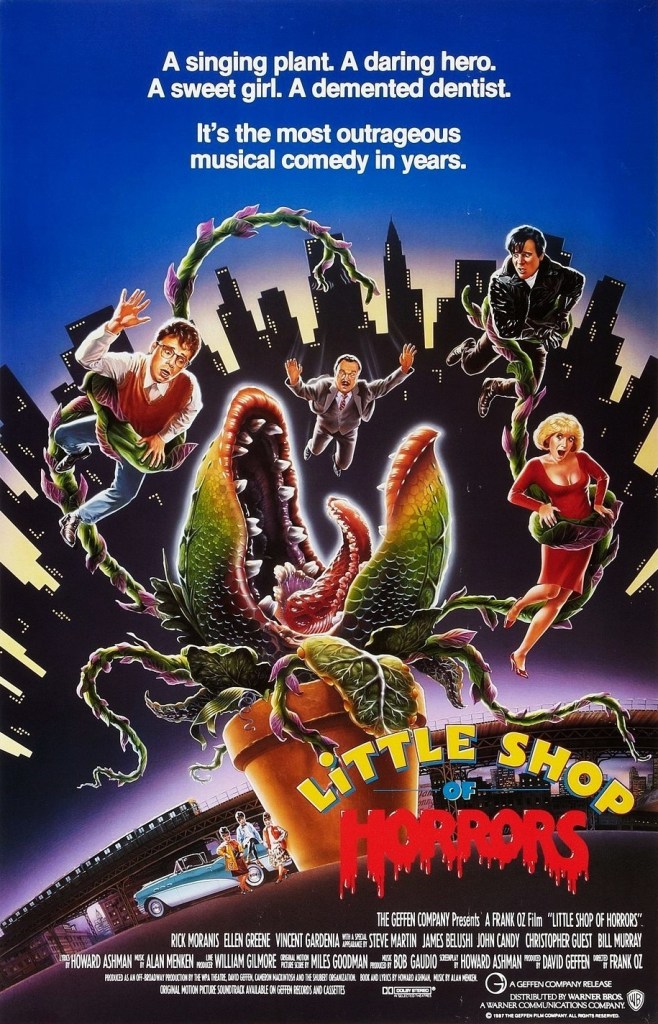
LITTLE SHOP OF HORRORS (1986) **** Little Shop of Horrors, based on the off-Broadway stage musical itself based on the 1960 Roger Corman cult film, is one of those movies that I like a little bit more every time I watch it.
I’ll just come right out and say it early on in this review: I’ll take Little Shop of Horrors over The Rocky Horror Picture Show every day of the week because the performances and characters, the science fiction and horror plot, the script, the direction, the musical production numbers, and the special effects are all far superior. Granted, to be fair, Little Shop of Horrors had more than 25 times the production budget of Rocky Horror.
I watched both films around the same time, in the late ’80s or early ’90s both on late-night local TV Saturday night movie programming. I also remember first coming across Wolfen and The Breakfast Club in this format. Anyway, I’ve always liked Little Shop of Horrors and never particularly cared for Rocky Horror, which I’ve come to like even less with every viewing so it’s Little Shop of Horrors inverted.
Rick Moranis stars as the meek, nerdy florist Seymour Krelborn. He means well but he’s extremely clumsy and pines after his beautiful coworker Audrey (Ellen Greene) who dates the abusive, sadistic, nitrous oxide fiend ’50s style greaser biker dentist Orin Scrivello (Steve Martin). Seymour’s perpetually chewed out by his boss Mr. Mushnik (Vincent Gardenia), the owner of Mushnik’s Flower Shop. Everything changes for Seymour, Audrey, and Mr. Mushnik when Seymour discovers Audrey II (voiced by Levi Stubbs, lead singer of the Four Tops), one mean green mother from outer space with an insatiable appetite and designs on taking over Planet Earth. Feeding Audrey II proves to be a nightmare for Seymour.
Moranis gives his definitive film performance, Greene returns to play Audrey from the stage production, Moranis and Greene make for a great movie couple and they’re very deserving of a happy ending, and Martin and Stubbs are both absolutely incredible in their villainous roles.
In fact, Martin and Stubbs both should have been nominated for Best Supporting Actor, but it’s understandable why they were not in a year with supporting actor winner Michael Caine for Hannah and Her Sisters and nominees Tom Berenger and Willem Dafoe for Platoon, Denholm Elliott for A Room with a View, and Dennis Hopper for Hoosiers.
Comedies, science fiction, and horror films very rarely earn nods from the Academy, a problem for Little Shop of Horrors when it encompasses all three genres.
It also became complicated when considering Stubbs (1936-2008) for a nomination, since he’s the voice of an animatronic puppet with 21 different principal puppeteers including Brian Henson. Stubbs’ authoritative, booming voice benefits the movie infinitely in both the dialogue scenes between Audrey II and poor Seymour and four musical numbers.
Audrey II’s Mean Green Mother from Outer Space, with lyrics by Howard Ashman and music by Alan Menken, received an Academy Award nomination for Best Original Song and lost to Berlin’s Take My Breath Away from Top Gun.
I’ve been known to say to pets both canine and feline Feed me, Seymour.
Crystal (Tichina Arnold), Ronette (Michelle Weeks), and Chiffon (Tisha Campbell), names borrowed from three girl groups contemporaneous with the original Little Shop of Horrors, provide a Greek chorus with sass and style.
Jim Belushi, John Candy, Christopher Guest, and Bill Murray show up in small roles.
Little Shop of Horrors originally retained the ending of the stage musical with Audrey and Seymour killed and giant Audrey II plants on a Godzilla-like rampage, but test audiences positively absolutely hated that Audrey and Seymour were killed and the original 23-minute ending became a rewritten and reshot happy ending that pushed the release date back to December 19, 1986.
I’ve only watched Little Shop of Horrors with the happy ending, and I must say that I’m more than happy with that.
WE HAD OURSELVES A REAL GOOD TIME: BLACULA, DOLEMITE, TNT JACKSON, THE DEVIL AND MAX DEVLIN Max Schreck, Bela Lugosi, Carlos Villarias, Lon Chaney Jr., John Carradine, Christopher Lee, Klaus Kinski, George Hamilton, Frank Langella, Gary Oldman, and Leslie Nielsen.
That’s a lot of bared fangs, deadly stares, and spectacular deaths over the decades.
Fair warning: Best get outta here with that Tom Cruise, Gerard Butler, Robert Pattinson bull.
Blacula star William Marshall deserves his rightful place among the best screen vampires. For example, he’s definitely better than, oh, let’s say, Carradine, who played Dracula in House of Frankenstein, House of Dracula, and Billy the Kid vs. Dracula and often looked like somebody had squeezed some fresh lemon juice in his eyes. A few months after Marshall debuted as Black Dracula, Lee appeared in his sixth Dracula film — cleverly titled Dracula A.D. 1972 — and Lee’s spiraling lack of enthusiasm for the role that made him famous bites you right smack dab in the neck.
With his booming voice, commanding screen presence, and legitimate acting chops, Marshall (1924-2003) owns Blacula and makes it infinitely better than some cruddy hunk of cinematic junk like Blackenstein. He brings an unexpected dignity to what might otherwise have been a throwaway film.
Rating: Three stars.
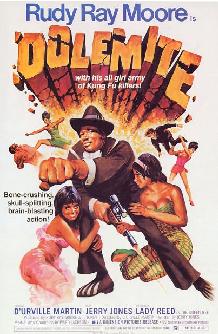
— I enjoyed Dolemite a whole lot more than Disco Godfather, my first Rudy Ray Moore experience, and not only because I’m now calling the former picture Boom Mic Motherfucker.
Disco Godfather lost me by about the millionth or maybe it was by the billionth time Moore (1927-2008) exclaimed Put your weight on it, a slogan that needless to say would not be adopted or adapted by 1980 U.S. Presidential candidates Jimmy Carter, Ronald Reagan, and John B. Anderson. Despite the fact that it tried cultivating a social conscience, Disco Godfather needed some weight put on it, because it was the cinematic equivalent of an anorexic crackhead.
Moore has been called The Godfather of Rap and both Dolemite and the character himself almost instantly serve notice why. Jailbird Dolemite’s first lines are Oh, shit. What the hell does that rat-soup-eatin’ motherfucker want with me? One could play a reasonable drinking game with how many times Dolemite utters motherfucker in the movie, because it’s not every time Cheech & Chong say Man in Up in Smoke (reportedly 285 times) or everybody says Carol Anne in Poltergeist III (121). You won’t get wasted, best shit you ever tasted, from Dolemite. You’ll probably feel pretty good and the alcohol will help laughter.
The plot: Dolemite gets released from prison and fights the criminals and corrupt police officers who sent our favorite cinematic pimp up the river in the first place. Really, though, Dolemite is about the profanity, fight scenes, female (we’ll forget about the male) nudity, and complete utter ridiculousness, all of it done over-the-top. Never mind that it’s a time capsule into Bicentennial-Era America filed right alongside Dog Day Afternoon.
To be honest, though, I was distracted from the plot and everything else by the unpaid co-star Boom Mic Visible, who’s absolutely the funniest motherfucker in Dolemite. According to IMDb, The boom mic is visible in many shots of original Xenon VHS to DVD transfer from the 1980s. The film was originally transferred without the proper ratio ‘gate’ of 1:85.1, revealing more of the top and bottom of the frame than the film makers originally intended. The 2016 Vinegar Syndrome Bluray release was re-transferred from an archive print of the film, at the proper ratio, so the boom mics are hidden in many shots. The Bluray release also includes a ‘boom mic’ version of the new transfer, intentionally revealing the boom mics for comic effect.
Now we know.
The actor John Kerry (not that John Kerry) played Detective Mitchell in Dolemite and it’s a missed opportunity that nobody ever asked 2008 U.S. Presidential Candidate John Kerry about his experiences making Dolemite, what Rudy Ray Moore was really like, etc. That’s a real shame.
Rating: Three stars.
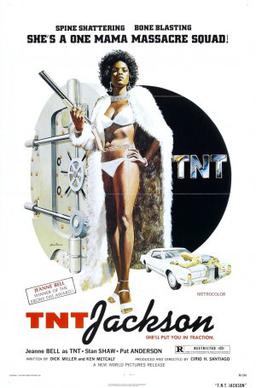
— TNT Jackson is definitely not a good movie, but I am still feeling a certain lingering affection for it that other (better) movies wish they could make me feel for them.
What else could be said about some of the worst martial arts sequences ever committed to celluloid, from the very first fists and feet of fury scene all the way to the grand finale. Would you believe punches and kicks that do not connect but still inflict damage? Would you believe the heroine could punch right through the villain? Well, prepare yourself for TNT Jackson.
TNT Jackson falls short of the standard established by similar pictures Coffy and Cleopatra Jones, because, let’s face it, TNT Jackson star Jeannie Bell falls below Pam Grier and Tamara Dobson, respectively. Sure, former playmate and bunny Bell looks absolutely stunning with her great hair, great face, and great body, but she can’t act her way out of a paper bag and we don’t really believe that she could fight her way out of one if she wasn’t the star of the movie. Miss Jackson and her inevitable white chick nemesis (Pat Anderson) wage what’s possibly the worst cat fight ever in the history of the movies. It’s a doozy, and that describes the vast majority of the 72-minute TNT Jackson. Yes, that’s right, 72 minutes, a genuine throwback.
The late, great character actor Dick Miller (1928-2019) earned a screenwriting credit on TNT Jackson, but apparently producer Roger Corman had it rewritten by Ken Metcalfe, who plays the sleazy sub-villain Sid in TNT. Miller does not appear in TNT Jackson.
It’s amazing TNT Jackson romantic lead and main villain Stan Shaw did not get The Sensational, Smooth, Suave, Sophisticated, Stunning Stan Shaw for his screen credit, but maybe just maybe that’s because he overplays his smooth, suave, sophisticated ways so much that we’re tired of his jive real quick. Heck, even Shaw’s afro overplays it throughout TNT Jackson. I’ve not seen this much overacting by hair since, oh, let’s see, Chu Chu and the Philly Flash or maybe I’m mixing up Carol Burnett’s decorative head cover (wait, that’s just part of her costume) with her maracas.
Basically, I can’t hate too much on TNT Jackson like I do Chu Chu (more like Poo Poo and the Poopy Gas), since director Cirio H. Santiago remade TNT a few years later as Firecracker and substituted (white) Jillian Kesner for Bell in the title role. Both movies have similar plot elements, namely infamous topless fights, and Metcalfe in a similar role, but Firecracker does it better.
After watching TNT Jackson, I could not help but gravitate toward AC/DC’s song and the chorus ‘Cause I’m T.N.T., I’m dynamite / T.N.T., and I’ll win the fight / T.N.T., I’m a power load / T.N.T., watch me explode. Bonus points for TNT Jackson, ones that keep it from a two-star rating.
The best version of TNT Jackson is the two-minute promotional trailer put together by Joe Dante and Allan Arkush for New World Pictures circa 1974 or 1975. The voice-over narration takes it to greatness: TNT Jackson, Black Bombshell with a Short Fuse! This Hit Lady’s Charm Will Break Both Your Arms! She’s a One-Mama Massacre Squad! TNT’s Mad and That’s Real Bad! With That Dynamite Bod She’s a Jet Black Hit Squad! A Super Soul Sister and a Bad News Brother Under Cover and Out to Blast a Killer Army That’s Poisoning the People with Deadly China White! You Best Pay the Fine or She’ll Shatter Your Spine! Black Chinatown, Where Flesh is Cheap and Life is Cheaper! TNT Jackson, She’ll Put You in Traction!
Rating: Two-and-a-half stars. Trailer: Four stars.
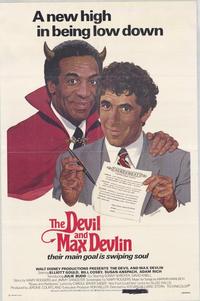
— Before The Devil and Max Devlin, it had no doubt been a long time since Walt Disney Studios depicted Hell in one of their films.
For example, Hell’s Bells from 1929 and Pluto’s Judgement Day from 1935 leap first to mind, two animated shorts that might blow people’s minds who normally associate animation with cute-and-cuddly innocuous fare at this late point in history.
To be fair to the older films, which are both far superior to the main film currently under consideration, feature length The Devil and Max Devlin doesn’t spend a lot of time in Hell.
Well, actually, according to some former President, right, aren’t California and Hell the same?
I wonder, given the subject matter and the presence of Bill Cosby in one of the starring roles, if The Devil and Max Devlin will go or has already gone the way of the controversial, divisive Song of the South — suppressed for seeming eternity by the folks at Disney. I found them both in the dark, dank recesses of the Internet and I hope that I won’t go to jail or Hell for either cultural sin.
Anyway, I like the locations (especially Hell) and I like the high concepts behind The Devil and Max Devlin like a slumlord trying to save his soul by giving the bad guys three unsullied souls and it turned out to be perfect casting to have Cosby in the role of the Devil’s helper, but the movie gets so bogged down in plot details that it evolves into a real slog and we just want more than anything else in the world at the moment for the movie to finally be over. At least, if nothing else, that’s how The Devil and Max Devlin made me feel watching it.
CREATURE FROM THE HAUNTED SEA (1961) * Lemme tell you about Jack from Creature from the Haunted Sea.
His real name is Happy Jack Monahan and he’s a crew member of crook Renzo Capetto, who has this real genius plan backfire on him miserably. Renzo wants to systematically eliminate his hapless crew and blame their deaths on a certain legendary sea monster, and that monster turns out to be real. Who could have guessed such a phenomenon? Anyway, Happy Jack’s played by Robert Bean and not by Jim Beam, which might improve Creature from the Haunted Sea.
This Happy Jack character, who probably once lived in the sand at the Isle of Man, imitates all form of animal life and it’s not a good sign for any sort of a good movie when Happy Jack lets out his inner yak. Happy Jack undoubtedly could have had a great future in “Farmer Says” toys, had he not been cast in Creature from the Haunted Sea.
That’s a roundabout way to get to the main point: Creature from the Haunted Sea ranks with the absolute dregs of the monster movie, down there buried at the bottom of the sea alongside Robot Monster and Slithis and APE, three other infamous monster movie titles featuring infamous movie monsters. You might feel sorry for this poor creature from the haunted sea and for all those associated with him, but mostly you’ll just laugh at him in that same way many people often do when they come across old movies and their antiquated special effects.
I am thankful, however, for Creature from the Haunted Sea, because its tedium afforded me the opportunity for an afternoon nap. I woke up and I felt like I didn’t miss a thing, not a beat; even if I did miss a thing, I would be grateful for it. That afternoon nap earned Creature from the Haunted Sea one-half star more than Slithis and APE, for example, I do believe.
I have not watched every Roger Corman monster movie, but Creature from the Haunted Sea is definitely the worst so far, leagues below Attack of the Crab Monsters from 1957 that’s for certain. Hell, Creature from the Haunted Sea is so bad that it makes The Wasp Woman look almost like Citizen Kane by comparison.
Charles B. Griffith (1930-2007), credited or not but more often credited, wrote screenplays for Corman spectaculars It Conquered the World, Attack of the Crab Monsters, A Bucket of Blood, and The Little Shop of Horrors, as well as later Corman productions Death Race 2000 and Eat My Dust. In other words, the man definitely had his better moments like Bucket of Blood and Little Shop of Horrors. Alas, Creature from the Haunted Sea is not one of them.
Rather, it’s a compendium of crap.
For example, Creature from the Haunted Sea gives us more voiceover narration than what’s necessary for any creature feature. I mean, for crying out loud, I bet there’s more voiceover in Creature from the Haunted Sea than in all the other films combined from 1961. Sure that’s why I fell asleep for a while. Airplane spoofed voiceover fantastically, although thankfully I did not meet the same fate as the characters on that infamous cinematic flight.
It doesn’t even matter that future Academy Award-winning screenwriter Robert Towne delivers this narration or that he’s credited for ‘Sparks Moran / Agent XK150 / Narrator.’
I have not talked much about the actual creature in Creature from the Haunted Sea and there’s a good reason for that. Yes, that’s right, the creature from the haunted sea just might be the worst movie monster I have ever seen, and please keep in mind I’ve seen Robot Monster.
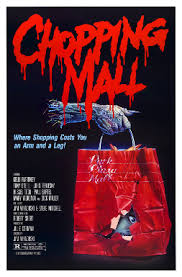
Jim Wynorski’s CHOPPING MALL has just about everything anybody would ever want from a mid-80s horror film.
— An iconic shopping mall shooting location.
— Three killer robots who shoot real frickin’ laser beams. By the way, these kill-bots could eat Paul Blart for breakfast, lunch, dinner, and three desserts, plus in-between snacks.
— Big hair and big boobs.
— A Barbara Crampton topless scene that rates below RE-ANIMATOR and FROM BEYOND. Still, though, it’s topless Barbara Crampton.
— Other familiar teeny bopper horror movie bods and faces.
— The great character actor Dick Miller playing a character named Walter Paisley (his character’s name from BUCKET OF BLOOD).
— A Corman Factory production with posters from previous cult classics (including one directed by Wynorski, his debut film LOST EMPIRE) and clips from Roger Corman’s 1957 epic ATTACK OF THE CRAB MONSTERS.
— Cameos from Corman favorites Paul Bartel and Mary Woronov playing their characters from EATING RAOUL.
— Outdated special effects that were outdated even before the movie’s release. However, that’s all part of their charm.
— Gore galore highlighted by a gnarly head explosion.
— A plot that plays like a fast and loose combination of FAST TIMES AT RIDGEMONT HIGH, FRIDAY THE 13TH, and THE TERMINATOR.
CHOPPING MALL does not muck around, giving us our first killer robot scene right from the start and hey, let’s face it, it breezes past in 76 minutes. For crying out loud, that’s a running time straight from an earlier time in cinematic history. That not mucking around quality is one of the most admirable traits of CHOPPING MALL, that and its desire to give the people what they want in terms of meeting and exceeding the demands of an exploitation film.
It has a basic plot: Three security robots go haywire after a lightning storm, turn rogue and run amok in Park Plaza Mall, actually the Sherman Oaks Galleria in the Sherman Oaks neighborhood in Los Angeles. The galleria, on the corner of Ventura and Sepulveda Boulevards, has been given credit for inspiring the Frank and Moon Unit Zappa satirical hit single “Valley Girl” and FAST TIMES and COMMANDO famously utilized the location.
Of course, with this genre and location, we have four teenage couples who stay after hours to frolic and fool around inside a furniture store, naturally and predominantly hot and horny couples who make up the majority of our body count. That contributes the FRIDAY THE 13TH element, and the presence of Russell Todd aids and abets that mental connection. Todd played Scott in FRIDAY THE 13TH PART 2, a real smug horny bastard adept with a slingshot. Not that did him any bit of damn good against burlap sack Jason Voorhees.
CHOPPING MALL has a good cast and Kelli Maroney and Alan O’Dell make for appealing, likeable female and male leads, especially Maroney. With her big hair, her struggles working in a restaurant, her spunky attitude, and her way around weaponry, Maroney’s Alison Parks feels very reminiscent of Sarah Conner (Linda Hamilton) from the first TERMINATOR.
What I especially like about the teenagers in CHOPPING MALL is that they load up on guns (echoes of DAWN OF THE DEAD) almost immediately after discovering the killer robots. They are far more proactive than the average horror movie teenager, and that helps separate CHOPPING MALL from the pack of run-of-the-mill exploitation films.
File CHOPPING MALL right alongside cult classics from that moment in time like RE-ANIMATOR, FROM BEYOND, and NIGHT OF THE CREEPS.
I had wondered long and hard for many years where Al Jourgensen found a certain sample for a cover version of Black Sabbath’s “Supernaut” that appeared on the Ministry greatest hits compilation “Greatest Fits.”
This incredible sample about halfway through “Supernaut” goes something like, “I’ve come to tell you what I see. There are great darknesses. Farther than time itself. And beyond the darkness … a light that glows, changes … and in the center of the universe, the eye … the eye … the eye … the eye … the eye.”
There I was minding my own fucking business on a hot Saturday night in early June 2020, watching the thrilling conclusion of a pretty damn good little science fiction horror movie called X: THE MAN WITH THE X-RAY EYES, directed by Roger Corman and starring the reliably good Ray Milland. Then, hot dog, what do I hear but “I’ve come to tell you what I see. There are great darknesses. Farther than time itself. And beyond the darkness … a light that glows, changes … and in the center of the universe, the eye that sees us all.” I said to myself, “You magnificent bastard! That’s that sample from ‘Supernaut!’”
Before that discovery, I already thought X was one groovy movie. After that discovery, though, I am convinced it’s a great movie.
I must admit upfront to having a bias in favor of Ray Milland (as well as Roger Corman, for that matter). Milland (1907-86) has never let me down so far and that includes his Academy Award-winning performance as a struggling alcoholic writer in Billy Wilder’s THE LONG WEEKEND, his battle of minds with John Williams’ Chief Inspector Hubbard in DIAL M FOR MURDER, his ultimate cantankerous old coot Jason Crockett in FROGS, his ultimate hateful old bigot Maxwell Kirshner in THE THING WITH TWO HEADS, and his better-than-average Disney live-action villain Aristotle Bolt in the better-than-average Disney live-action film ESCAPE TO WITCH MOUNTAIN. To be honest, I enjoy FROGS every bit as much as DIAL M FOR MURDER and Milland proves responsible for much of the enjoyment of both films.
He’s very good in X as Dr. James Xavier, whose name immediately puts the X-Man character Charles Xavier to mind. Are they related?
In X, Xavier develops special eye drops that give himself X-ray vision and with this great power comes terrible repercussions, of course. Xavier just cannot stop himself from pushing the limits farther and farther. He must see what no man has ever seen before. His friend and colleague Dr. Brant (Harold J. Stone) tries stopping Xavier and Xavier accidentally kills Brant. Xavier goes on the run, first to a carnival, then to a Las Vegas casino, and finally to a religious tent revival that leads to one helluva conclusion.
One of the great scenes begins when Xavier’s lovely colleague Dr. Diane Fairfax (Diana Van der Vlis) takes the X-Man to a groovy little party where everybody just loves to do the Twist. Xavier’s X-ray vision kicks in at some point and we ponder what this scene would have been like had the movie came out in 1969. Even greater.
Before closing soon, I should mention Don Rickles’ strong performance and Dick Miller’s enjoyable one as carny heckler.
X: THE MAN WITH THE X-RAY EYES should be a treat for Corman, Milland, science fiction, horror, American International, sample, Black Sabbath, Ministry, Rickles, and/or Miller connoisseurs. Speaking only from personal experience, it was for me.
A tale of two movies, both from 1962 and both dealing with racism.
Other than their year of release, some of their subject matter, and their being filmed in black-and-white, the films are worlds apart in virtually every other way, including how they have been received by the establishment and the general public.
Roger Corman directed and co-produced (alongside his younger brother Gene) THE INTRUDER for $80,000 and it was filmed on location for three-and-a-half weeks in Southeast Missouri towns East Prairie, Charleston, and Sikeston. William Shatner stars as race hate inciter and outside agitator Adam Cramer and the young Canadian actor was still years away from becoming a household name for “Star Trek.” THE INTRUDER takes place contemporaneously with the civil rights movement and school integration; Charles Beaumont adapted his screenplay from his own 1959 novel of the same name and he even plays school principal Mr. Paton in the film.
Robert Mulligan directed TO KILL A MOCKINGBIRD behind a $2 million budget and major studio backing with a screenplay by future Pulitzer Prize winner Horton Foote adapted from Harper Lee’s 1960 Pulitzer Prize-winning novel of the same name that had already become an institution even before a prestigious film adaptation. Gregory Peck, nominated for an Academy Award for Best Actor four times before his most famous role (THE KEYS OF THE KINGDOM, THE YEARLING, GENTLEMAN’S AGREEMENT, TWELVE O’CLOCK HIGH), stars as noble lawyer Atticus Finch. TO KILL A MOCKINGBIRD filmed on Hollywood back lots and sets designed to recreate the Monroeville, Alabama of Lee’s Great Depression youth.
THE INTRUDER premiered May 14, 1962 in New York City and it would be reissued as I HATE YOUR GUTS and SHAME. In other words, it flopped and Corman has never quite made another picture like THE INTRUDER again. His later exploitation productions hid and obscured their social commentary behind and beneath protective layers of nudity, sex, and violence.
TO KILL A MOCKINGBIRD debuted Dec. 25, 1962 and just like the Lee source material, it became an almost instantaneous social institution and beloved classic. It received eight Academy Award nominations, including Best Picture, and won three, including Best Actor for Peck. It has been a longtime staple of the American Film Institute: No. 34 on the 1997 “100 Years … 100 Movies” list and No. 25 on the 10th Anniversary list and the AFI voted it the No. 1 courtroom drama and Atticus Finch the No. 1 hero on its list of the 100 greatest heroes and villains.
I watched both films in close proximity of each other (both for the first time) and THE INTRUDER absolutely shames TO KILL A MOCKINGBIRD.
Sorry, folks, Adam Cramer presents a far more interesting character than Atticus Finch and Shatner’s incendiary performance blows away Peck and its relentless note of nobility.
Cramer, a non-Southerner decked in a bright white suit, rides into the fictional small Southern town of Caxton and quickly comes on strong as a gentleman. This clever conman and charlatan then goes to work and preys on the racist, anti-integration sympathies of many of the residents to meet his goal of inciting a race war town-by-town. Cramer’s a master manipulator and rabble-rouser who also sets his sights on a high school girl and a frustrated housewife. His manipulative powers lead to one of the black students, Joey Greene (Charles Barnes), being falsely accused of rape by a white girl. That, of course, ties in with the absolute worst nightmare of a racist, one infinitely worse than integration. In a chilling final scene, the inflamed mob interrogates Mr. Greene about this rape. The mob believes it has become judge, jury, and executioner.
Fact and fiction must have blurred for novice actor Charles Barnes, a 19-year-old young man from Charleston (one of the three towns used in filming) whom Corman instructed to draw from real-life experiences attending an integrated high school in his hometown his senior year. The Pittsburgh Courier ran a story on Barnes in May 1962, headlined “Negro Actor’s Reel Role Too Real for Whites … And He Has to Leave Hometown.”
THE INTRUDER plays real, and that sealed its commercial doom and consignment to the dustbin (at least the margins) of cinematic history.
On the other hand, TO KILL A MOCKINGBIRD plays like a series of pat moral lessons for two hours, interrupted by youthful shenanigans and occasional voice-over narration to put us in a proper nostalgic mood.
Enter “To Kill a Mockingbird moral lessons” into a search engine and it returns 1,340,000 hits.
Is that why so many people love TO KILL A MOCKINGBIRD?
Are fans of the film made to feel virtuous watching it?
Just asking for a friend.
Atticus Finch comes across so darn noble maybe because an older Scout Finch, his daughter, narrates the story.
She begins, “Maycomb was a tired old town, even in 1932 when I first knew it. Somehow, it was hotter then. Men’s stiff collars wilted by nine in the morning; ladies bathed before noon, after their 3 o’clock naps, and by nightfall were like soft teacakes with frosting from sweating and sweet talcum. The day was twenty-four hours long, but it seemed longer. There was no hurry, for there was nowhere to go and nothing to buy … and no money to buy it with. Although Maycomb County had recently been told that it had nothing to fear but fear itself … That summer, I was six years old.”
The narration put me off right from the start and it all translated as “Grandma, tell me about the good ole days.”
Between the narration and the sets and the characters, TO KILL A MOCKINGBIRD feels like experiencing a show called “The South 1932” at Universal Studios Hollywood. LOOK! It’s a one-dimensional racist white trash caricature! LOOK! It’s busybody neighbors! LOOK! It’s a crotchety old bag! LOOK! It’s a sheriff named “Heck Tate”! FEEL GOOD ENTERTAINMENT! I don’t know why I need to pay money to see that when I could experience all that for real somewhere in Small Town U.S.A. Never mind, I’ll pass on both.
TO KILL A MOCKINGBIRD stitches together multiple narrative threads, some more successfully than others.
— Scout (Mary Badham), her older brother Jem (Phillip Alford), and her best friend Dill (John Megna), and their larger-than-life misadventures.
— Scout and Jem and their relationship with Atticus, as well as their black maid Calpurnia (Estelle Evans).
— Atticus defends Tom Robinson (Brock Peters), a black man falsely accused of rape by Mayella Ewell (Collin Wilcox) and her father Robert E. Lee “Bob” Ewell (James Anderson), during a trial when the odds are stacked dramatically against both men. Before the trial, townspeople — including Scout’s school mates — call Atticus a “nigger lover” and some of the most concerned citizens form a lynch mob.
— The children’s obsession with Boo Radley (Robert Duvall).
Badham and Alford both give very good performances and their rapport with each other and Peck forms the strongest part of the movie. Badham’s debut performance received a well-deserved nomination for Academy Award for Best Supporting Actress. I understand why multiple generations of young women have responded so favorably toward TO KILL A MOCKINGBIRD. (Mulligan later directed Reese Witherspoon in a similarly affecting performance in the 1991 film THE MAN IN THE MOON.)
On the race level, though, that’s where TO KILL A MOCKINGBIRD fails and it fails miserably.
The black characters remain predominantly in the background, Tom Robinson dies offscreen, and Bob Ewell belongs to a movie racist tradition called “Ku Klux Klown.”
We also have quite possibly the only mob in history ever talked down by a 6- or 7-year-old girl.
By comparison, in THE INTRUDER, a mob burns a cross in a black neighborhood, blows up the local black church and kills the preacher in the blast, and severely beats up the white character who takes a stand alongside the blacks and encourages them to return to school after the bombing. This conscientious white character gets so beaten that he receives broken ribs and loses one eye.
Nobody lays a hand on Atticus.
Meanwhile, only Peters and Evans received screen credit among the black actors in TO KILL A MOCKINGBIRD.
All the others were not credited.
That includes William “Bill” Walker in the small but pivotal role of Reverend Sykes, who delivers the famous line “Miss Jean Louise? Miss Jean Louise, stand up. Your father’s passin’.” Peck himself said this scene — where all the black people in the balcony stand up for Atticus Finch after he defended Tom Robinson — wrapped up his Academy Award for Best Actor.
To be fair, some of the white actors, including Kim Stanley as the narrator, also were not credited.
By the point late in the movie when Bob Ewell attacks Jem and Scout and Boo Radley comes to their rescue, it was basically too little too late for this viewer. I was just ready for TO KILL A MOCKINGBIRD to be over.
RAY HARRYHAUSEN SPECIAL EFFECTS TITAN, CORMAN’S WORLD AND THAT GUY DICK MILLER
It’s often been said that Ray Harryhausen’s stop motion animation creatures are the best features of their respective films, everything from “Mighty Joe Young” and “Earth vs. The Flying Saucers” to “Jason and the Argonauts” and “Clash of the Titans.” He became the auteur.
It’s not often that a visual effects artist overshadows both directors and performers, no offense to Nathan R. Juran (“The 7th Voyage of Sinbad”), Don Chaffey (“Jason and the Argonauts”), and the all-star cast in “Clash of the Titans,” Harryhausen’s grand finale.
In fact, in reviewing “Clash of the Titans” a while back, I wrote that it amounts to Harryhausen vs. nominal star Harry Hamlin. Harryhausen wins. Every. Single. Time.
Then again, maybe not. Not when People Magazine featured Hamlin as the “Sexiest Man Alive” in 1987 and it felt like taking a potshot or two at “Clash of the Titans.”
“And there’s always the possibility of doing a remake of ‘Clash of the Titans.’ ‘I brought my toga home,’ says Harry, raising hopes of another glimpse of those knees. He’s kidding, of course. Frivolous flicks are a thing of the past for The Sexiest Man Alive. Besides, says Harry, laughing, ‘I used the toga to wash my car.'”
While pretty boys are a frivolous matter of the past, even in the present, Harryhausen’s creatures will live on forever.
“Special Effects Titan” allows us the opportunity to hear who and what inspired Harryhausen, his thought and work process on his creations, what challenges he faced, and to see the actual models used. Harryhausen (1920-2013) kept the most minute details in his garage.
— Roger Corman, who turned 94 a month to the day before I watched this documentary, has accumulated 415 producer and 56 director credits over a 65-year period. American International and New World produced some of the best exploitation films ever made along with a ton of schlock (some enjoyable, some not so much).
Peter Bogdanovich, Francis Ford Coppola, Monte Hellman, Martin Scorsese, Ron Howard, Jonathan Demme, Jonathan Kaplan, Joe Dante, Allan Arkush, Jack Nicholson, Peter Fonda, and Pam Grier all had their start or their break working for Corman and most of them appear in “Corman’s World: Exploits of a Hollywood Rebel.” Several more big names also appear in “Corman’s World,” but I would like to move on to the next paragraph.
We see Corman working on location as producer on the 2010 TV movie “Dinoshark,” which instantly calls to mind previous Corman productions like “Piranha” and “Humanoids from the Deep.” Near the end of “Corman’s World,” we also see the Hollywood outsider receive an honorary Oscar for “his unparalleled ability to nurture aspiring filmmakers by providing an environment that no film school could match.” It’s only fitting, though, that “Corman’s World” goes out with a set of clips scored by the Ramones’ explosive title song from “Rock ‘N’ Roll High School.” That’s more in the Corman spirit than any award, as Riff Randell blows up Vince Lombardi High School.
“Corman’s World” reminds me that I should watch “The Intruder” (Corman’s most atypical directorial entry, called “one of the most brutal, honest, and unflinching examinations of American racism in cinema history” by Wheeler Winston Dixon in “Senses of Cinema”), thankfully touches on New World’s distribution of films by Bergman, Truffaut, Kurosawa and Herzog, and shows us Jack Nicholson crying over Corman.
Nicholson made his film debut in Corman’s 1958 production “The Cry Baby Killer” and most of his credits before 1969’s smash hit “Easy Rider” are Corman productions, including most famously “The Little Shop of Horrors” and “The Terror.” Corman productions “The Wild Angels” and “The Trip” paved the highway for “Easy Rider.”
Matter of fact, Corman laid a lot of pavement for the road ahead.
— I generally prefer character actors over stars and that group of character actors includes Sydney Greenstreet, Margaret Hamilton, John Cazale, M. Emmet Walsh, Harry Dean Stanton, Brad Dourif, and, of course, perhaps my all-time favorite Dick Miller, who the Academy Awards left out of their “In Memoriam.” Miller died Jan. 30, 2019, at the age of 90.
Miller began his career in Roger Corman productions in the 1950s and he became director Joe Dante’s favorite actor. No matter the size of the role, whether it’s starring like “Bucket of Blood” (the immortal Walter Paisley) or just one scene like “The Terminator” and “Rock ‘N’ Roll High School,” I fondly remember Miller. Sure many of us movie lovers of a certain persuasion do.
— Miller played Murray Futterman in both “Gremlins” films. In “Gremlins,” World War II veteran Futterman keeps going on and on ’bout foreign cars, foreign this, that and everything, and especially “gremlins” before they even attack the fictional upstate New York town of Kingston Falls. Futterman drunkenly rambles, “They put em in cars, they put em in yer TV. They put em in stereos and those little radios you stick in your ears. They even put em in your watches, they have teeny gremlins for our watches!”
— Miller ad-libbed his “They’re ugly. Ugly, ugly people” line about the Ramones in “Rock ‘N’ Roll High School.” Apparently, that’s what he actually thought when he looked at Joey, Johnny, Dee Dee, and Marky.
— Miller originally had aspirations to be a screenwriter and his writing credits are “Four Rode Out,” “Which Way to the Front?,” and the immortal “TNT Jackson.” Miller predominantly stuck to acting, thankfully, with 184 credits listed at IMDb. He played a character named “Walter Paisley” several times. He left behind a tremendous body of work.
RAY HARRYHAUSEN SPECIAL EFFECTS TITAN (2011) Four stars; CORMAN’S WORLD (2011) Four stars; THAT GUY DICK MILLER (2014) Four stars
Seems like only yesterday — time’s such an elusive concept during quarantine — that I highlighted the deceptive print ads and posters for THE GIANT CLAW.
Today, we return to that beat with Roger Corman’s 1959 wasploitation “non-classic” THE WASP WOMAN — do not fear, it’s not another movie about yet another “White Anglo-Saxon Protestant” woman. Instead, in this one, our protagonist takes, no, abuses an experimental potion made from the royal jelly of wasps that can apparently reverse the aging progress. Unfortunate side effect that even more unfortunately only kicks in during the film’s last 20 minutes: It turns her into the title character or “A BEAUTIFUL WOMAN BY DAY — A LUSTING QUEEN WASP BY NIGHT.”
Anyway, the poster for THE WASP WOMAN, it lies. Oh, how it lies. The poster “Wasp Woman” has a woman’s head and a wasp’s body. In the film, it’s flipped and she resembles a distant cousin of the title character in the much, much better THE FLY from 1958.
THE WASP WOMAN itself could make one feel appreciably older, rather than younger, because it’s extremely dull for the first hour.
We have a crusty old scientist named Zinthrop (Michael Mark). He’s not fun in any traditional mad scientist way … and, then, he’s ran over by a car and subsequently bed ridden for most of the rest of the picture … of course, his accident happened before he could warn our protagonist Janice Starlin (Susan Cabot) of some of the unfortunate side effects found in the other non-human test subjects. He redeems himself in the final act. Actually, no, he does not.
Believe it or not, most of this movie takes place in an office building, the location for the monster movie of your dreams. On top of a dull scientist, we have multiple cosmetic company staff meetings, just exactly what the viewers want during a movie called THE WASP WOMAN. Less wasp woman, more staff meetings, bingo! This movie should have been titled CLUELESS in roughly all 6,500 languages of the world.
By the way, I do believe the film shows bees rather than wasps, most notably in both the opening and closing title screens. I might be wrong, but I don’t want to be stung for being wrong. Please, have mercy on me, I’ve been stung bad enough watching THE WASP WOMAN, which definitely pales against ATTACK OF THE CRAB MONSTERS in the Roger Corman monster movie filmography.
In 1993, TNT’s MonsterVision featured THE WASP WOMAN alongside THE GIANT CLAW, THE CYCLOPS, CREATURE WITH THE ATOM BRAIN, FROM HELL IT CAME, VALLEY OF THE DRAGONS, and THE WEREWOLF during a bad movie marathon called “A Christmas Nightmare.” THE WASP WOMAN played between THE CYCLOPS and CREATURE WITH THE ATOM BRAIN.
At that point in my life, I did not watch “MonsterVision”; I started watching it only during the Joe Bob years. I would love to go back in time to the early ‘90s and talk my teenage self into watching (and taping) “MonsterVision,” so I could have all them old tapes to watch at this critical junction in time. Also, I am sure that I would have already converted them from VHS to DVD. Preservation of the species of bad movies is an imperative.
A NEW WORLD PICTURES DOUBLE FEATURE: AVALANCHE & PIRANHA (1978)
Two New World Pictures exploitation films entered the Great American box office sweepstakes in August 1978.
One became a surprise hit and the other dramatically flopped.
Roger Corman, a man of a million film productions, tossed his hat into the disaster movie ring with AVALANCHE, while PIRANHA riffed on the killer fish blockbuster JAWS.
PIRANHA, directed by Joe Dante and populated by experienced character actors like Bradford Dillman and Keenan Wynn and Dick Miller, recouped its budget and then some and spawned one sequel and at least two remakes.
Star actors Rock Hudson (1925-85) and Mia Farrow headline the human cast of AVALANCHE and New World invested a reported $6.5 million on the picture, a great deal more $ than PIRANHA. You know that it did not go very well for AVALANCHE when its greatest claim to fame is that it made “The Official Razzie Movie Guide” honoring the 100 most enjoyably bad movies ever made.
This bad movie enthusiast, however, did not enjoy AVALANCHE. I found it to be a long slog. I mean, I felt like the one climbing the mountain to get through its 90-odd minutes.
First and foremost, it’s a soap opera in the shape of a ski resort hosting a ski tournament and a figure skating competition. Egads! Magazine reporter Caroline (Farrow) divorced control freak and wealthy ski resort owner David (Hudson). You guessed it, David wants her back, wants her to use his last name rather than her maiden name, she keeps him at arm’s length, and she attaches herself to another man, which only infuriates Mr. Control Freak. Man oh man, that scene on the dance floor when David flips on Caroline, I wanted to bury my head in the snow.
That’s not all: We have David’s spirited mother, an elite skier who seems to be even better as lothario, competing figure skaters, competing lovers, a television reporter, and a nosy photographer. Remember, we need a body count.
That nosy photographer (Robert Forster) and David act out a scene near and dear to disaster movie connoisseurs everywhere. Nick Thorne, the nosy photographer’s name, warns David there’s an avalanche coming and that everybody’s in danger. Any of us could write the rest of the scene and, for that matter, the rest of the movie.
Disaster movies often create a dilemma in our hearts and minds: We desperately want the disaster to come and take us away from the phony baloney dialogue and situations. Yes, I’ll say it, the characters deserve to die a dramatic cinematic death sooner rather than later. … Then, when disaster strikes, disaster movies invariably give us scenes just as phony baloney as before. That’s what happens in AVALANCHE.
Director and screenwriter Corey Allen (1934-2010) blamed AVALANCHE’s disaster as a movie on budget cuts and a tight production schedule, whereas Corman said PIRANHA succeeded because it’s funny and very well directed.
I agree.
PIRANHA tips its humorous hand very early on when one of the main characters plays the classic Atari “Shark Jaws” arcade game. Then, we have classic lines like “They’re eating the guests, sir” and “People eat fish. Fish don’t eat people” and “Terror, horror, death. Film at eleven.” Those with a darker sense of humor may find a friend in PIRANHA. We can thank John Sayles for the script.
I’ve said it before and I’ll gladly say it again: Joe Dante is one of the best American directors. His credits include GREMLINS, GREMLINS 2: THE NEW BATCH, THE HOWLING, THE ‘BURBS, MATINEE, and SMALL SOLDIERS. I don’t think he’s ever let me down, and he does not let me down in PIRANHA.
PIRANHA goes cheerfully over-the-top.
For example, JAWS eliminates one kid. PIRANHA takes out virtually an entire summer camp in grisly detail. I’ve known people who hate PIRANHA because of this one sequence.
Roger Ebert began his one-star review, “I walked into PIRANHA wondering why the U.S. government would consider the piranha to be a potential secret weapon. After all, I reasoned, you can lead the enemy to water but you can’t make him wade. I was, it turns out, naive. PIRANHA is filled with people who suffer from the odd compulsion to jump into the water the very moment they discover it is infested by piranhas.”
Of course, the characters in PIRANHA have a compulsion to jump into piranha-infested waters. Honestly, that’s all part of the joke and part of the fun, especially when Kevin McCarthy works up a variant on his INVASION OF THE BODY SNATCHERS performance.
Just like it’s fun seeing Dick Miller doing his take on Murray Hamilton’s mayor in JAWS. Miller, of course, does not want to hear about top secret scientifically-engineered killer piranhas (created through Operation: Razorteeth) and he does not cancel his party for prospective home buyers. You can guess what happens to most of them home buyers. Yes, PIRANHA takes many of the elements from JAWS and pushes them to extremes.
I enjoyed PIRANHA quite a bit, for its tongue-in-cheek humor and film buff references. There’s brilliant little touches strewn throughout the film, like Phil Tippett’s stop-motion animation creation in McCarthy’s lab. He’s the scientific genius behind them super killer fish, who are released into the system by our heroes played by Dillman and Heather Menzies. Anyway, this stop-motion creation, part-fish and part-lizard, epitomizes the generosity of PIRANHA in general. The film gives us a lot to enjoy.
The credits for PIRANHA are first-rate: Dante, Sayles, Tippett, composer Pino Donaggio, editors Dante and Mark Goldblatt, and makeup effects creator Rob Bottin. They all have done some fine work during their careers, inc. PIRANHA.
Steven Spielberg, the director of JAWS, reportedly considered PIRANHA the best of the many JAWS rip-offs and his approval expressed to Universal stopped the studio from pursuing an injunction against New World for PIRANHA. Universal’s first JAWS sequel, JAWS 2, came out two months before PIRANHA.
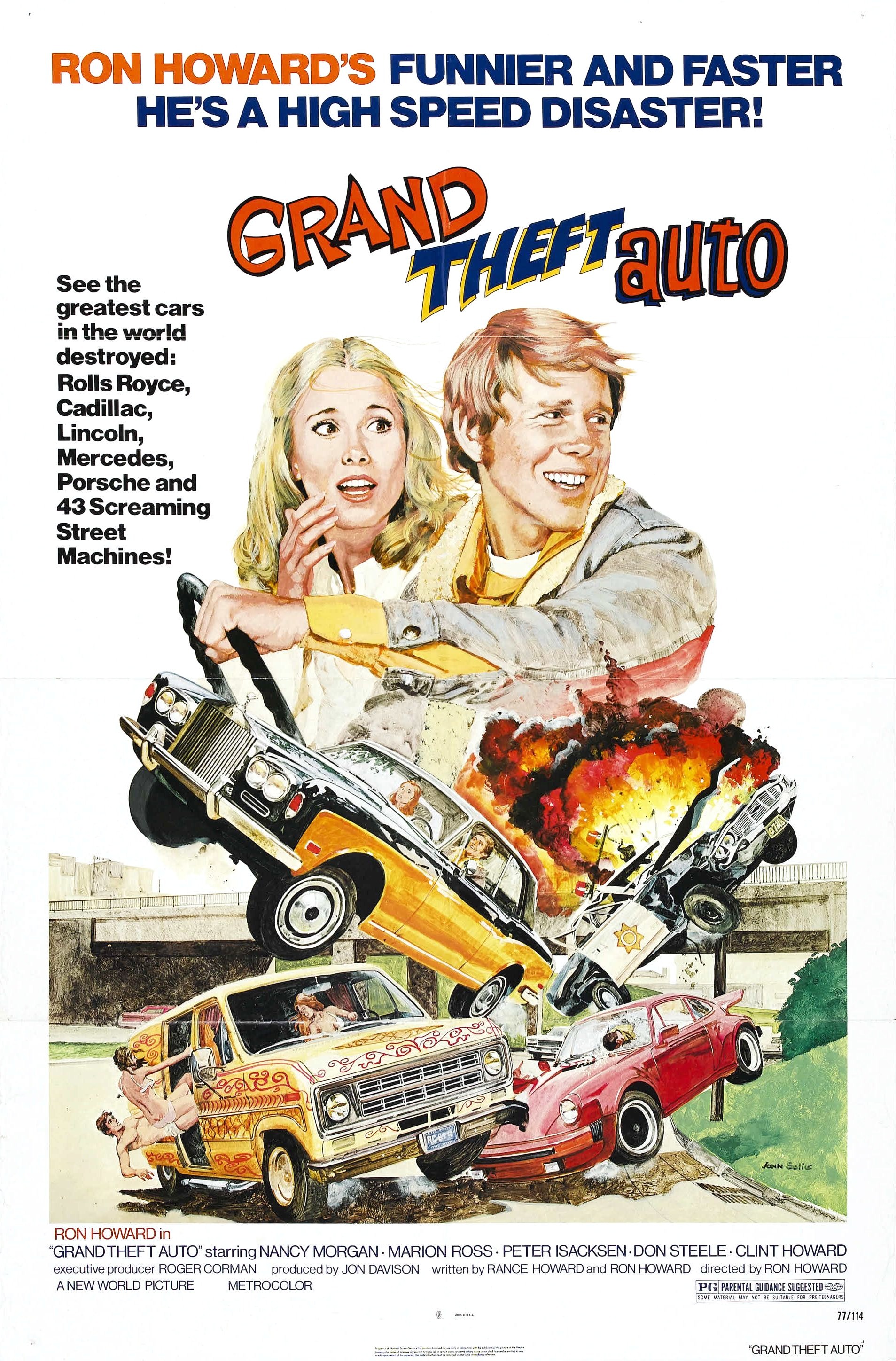
I just love the poster for GRAND THEFT AUTO, Ron Howard’s feature debut as director.
It advertises “See the greatest cars in the world destroyed: Rolls Royce, Cadillac, Lincoln, Mercedes, Porsche and 43 Screaming Street Machines.”
Sounds like my kind of picture.
RON HOWARD’S FUNNIER AND FASTER
HE’S A HIGH SPEED DISASTER!
A drawing of Nancy Morgan aghast and Howard with that All-American smile on his face and his left hand on the steering wheel. Below the young lovebirds are flames and crashes. Sure does resemble a drive-in movie from 1977.
Howard directed, starred in, and co-wrote this picture for New World, produced by Jon Davison and executive produced by Roger Corman. Howard kept some of GRAND THEFT AUTO in the family with father Rance a co-star and co-writer and brother Clint a co-star. It’s no small wonder that Howard earned a reputation for being one of the nicest guys in Hollywood.
Howard did not sell his soul to the Devil to get the picture made. No, instead, he made a deal with Mr. Corman. Howard agreed to star in EAT MY DUST! from 1976 if he could have a crack at directing. The rest is history and Howard’s directorial credits number 32, including Academy Award for Best Picture winner A BEAUTIFUL MIND. His other credits include NIGHT SHIFT, SPLASH, PARENTHOOD, FAR AND AWAY, THE PAPER, APOLLO 13, and FROST/NIXON.
Made for a reported $600,000 on down time for Howard from “Happy Days” (No. 1 show on TV in 1976-77 and No. 2 in 1977-78), GRAND THEFT AUTO tells a simple story.
Paula Powers (Morgan) loves her boyfriend Sam Freeman (Howard) and they want to get married, but her wealthy parents, especially her gubernatorial candidate father, oppose this pairing, taking Mr. Freeman for a gold digger. Paula’s parents want her to marry the wealthy Collins Hedgeworth (Paul Linke), who’s such a blasted tool he spends the movie in his jockey outfit. Paula steals her father’s Rolls Royce and Sam, and they plan to get married in Vegas. There ends up being a $25,000 reward for Paula and then a $25,000 price tag for Collins.
Seemingly all of California (and Nevada) pursues Paula and Sam, as well as Collins.
Collins alone goes through at least three cars in his first few minutes of screen time. What a schmuck! His overprotective mother, played by America’s Sweetheart and Howard’s TV mother Marion Ross, is the one responsible for the reward for Collins and it is one of the undeniable highlights of the movie to hear Marion Ross say “Piss off!” Even a preacher (Hoke Howell) goes after the money. Sleazy DJ Curly Q. Brown (Don Steele) eventually takes to the air in a whirlybird and he tells Mr. Freeman on the air, “Well, if you have it, I’m going to report it. Because every time you turn around and fart, it’s news.” The film especially picks up once Curly Q. Brown starts his play-by-play of the chase across California and Nevada.
The plot also includes a Helicopter vs. Rolls Royce showdown, a bridge blown up real good, and a Demolition Derby. The 1970s were the glory days for the car chase and GRAND THEFT AUTO belongs alongside DUEL, MAD MAX, CONVOY (both movie and song), SMOKEY AND THE BANDIT, THE FRENCH CONNECTION (chase scene), and several other pics.
Do Paula and Sam get married (and live happily ever after)? Well, I would never dream of revealing such an ending, although I told my wife after she asked me if they got married. I will compromise, though, and duly note GRAND THEFT AUTO saves its best demolition for last.






 Attack of the Killer Librarian