Jaws in 3D (1975 / 2022)

JAWS IN 3D (1975 / 2022) ****
When I first read the announcement Jaws 3D would be released to theaters in early September 2022, I mistook it for the Jaws 3-D from 1983 and I thought why in the bloody hell anybody would unleash that bloody awful movie once again … Just when you thought it was safe to go back in a movie theater … because there couldn’t be that much interest really in a third-rate Jaws movie.

I watched Jaws for the first time on the big screen in June 2020, sitting between my wife Lynn on the left and my mom on the right. We ate lunch beforehand at a place called Sharky’s Pub and Grub, and they might even have a Jaws poster. Just when you thought it was safe to go into a restaurant. My stepdaughter Emily and her friend watched E.T.

Jaws is another one of those movies that I would stop and watch every time I would come across it on cable TV, whether it played on TBS or TNT or part of a Jaws marathon 4th of July weekend on one of the premium channels.

Anyway, I decided to watch Jaws in 3D on Saturday, Sept. 3, which just happened to be National Cinema Day. $3 tickets for every showing, every showtime, every format. I had never seen the multiplex so busy; the theater had all hands on deck, and apparently 8.1 million people attended theaters across the nation on that day. Despite not being the biggest 3D fan, I thought why not bloody Jaws, of course a movie not originally in 3D, at that relatively budget price. There was a decent-sized crowd for this 47-year-old blockbuster pioneer, and they remained mostly quiet except for a couple of the most famous shock moments.

I thought it was a great experience, not only because I got to keep the glasses.

I long considered Jaws a very good movie, an ideal one to watch on cable TV when you just want to laze around and watch a movie, but after the last two times I’ve seen it in a movie theater, Jaws has dramatically increased in stature. It’s a great movie.

First and foremost, I appreciate Roy Scheider as Police Chief Martin Brody, Robert Shaw as Quint, and Richard Dreyfuss as Matt Hooper more every single time I watch Jaws.

Three great characters, three great performances, and they are something the other three Jaws films obviously lack. Scheider returns as Brody for Jaws 2, but it’s not the same.

George Burns (The Sunshine Boys) beat out Brad Dourif (One Flew Over the Cuckoo’s Nest), Burgess Meredith (The Day of the Locust), Chris Sarandon (Dog Day Afternoon), and Jack Warden (Shampoo) for Best Supporting Actor at the 1976 Academy Awards, but none of them approach Shaw’s work in Jaws.

Shaw makes an unlikable character likable by not even trying to be likable, and we feel his death scene more than just about any other in movie history. It is truly a horrifying moment, and despite the fact that I’ve watched Jaws 50, 75, 100, however many times, I still don’t want to see Quint lose his grip and slide right into the mouth of that great white shark.

Recently, I mentioned the incredible chemistry between Fred Ward and Kevin Bacon in Tremors. Scheider and Dreyfuss have a similar chemistry as Brody and Hooper, and I’m glad Jaws made Hooper infinitely more likable, excised Hooper’s extramarital affair with Brody’s wife, and let him survive along with Brody in the movie.

Shaw and Dreyfuss are great together, especially when they’re landing jabs and throwing shade at each other.

At one point in Jaws, Hooper describes the shark, and he could just as well be talking about Jaws itself and its capacity to make thrills, What we are dealing with here is a perfect engine, an eating (thrill) machine. It’s really a miracle of evolution. All this machine does is swim and eat and make little sharks (thrills), and that’s all.

Of course, that’s not all with Jaws, a truly scary classic that also generates lots of laughter and lots of emotion.
Battle of Britain (1969)

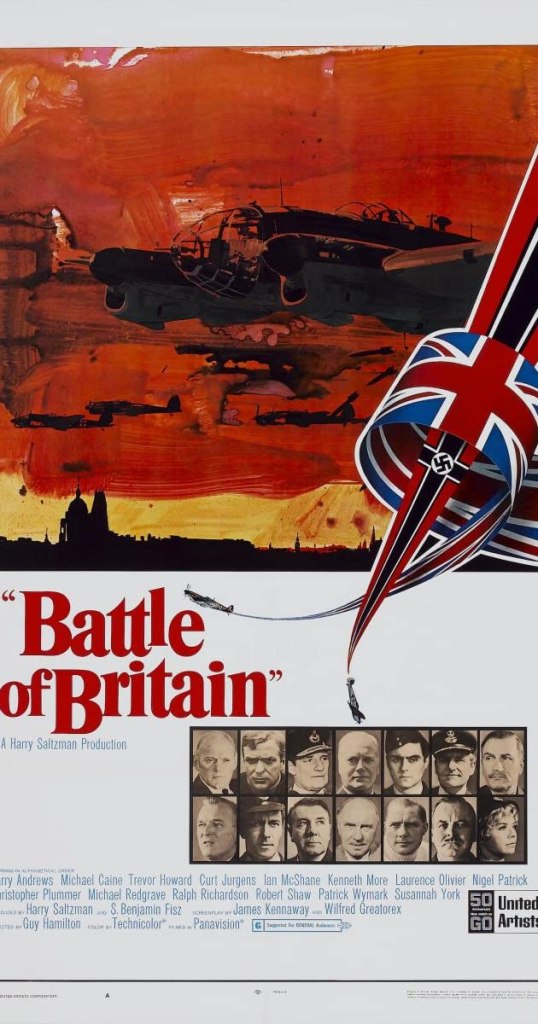
BATTLE OF BRITAIN (1969) One star
Never in the field of motion pictures were so few scenes owed by so few to so many.

— Harry Saltzman

As far as we know, Harry Saltzman never actually said that, nor did Winston Churchill or, for that matter, Yogi Berra and Yogi the Bear.

Anyway, that would-be quote came to mind several times during Battle of Britain and it’s been on my mind preparing this review inside my ripped, twisted brain.

Just look at the cast: Harry Andrews, Michael Caine, Trevor Howard, Curt Jurgens, Ian McShane, Kenneth More, Laurence Olivier, Nigel Patrick, Michael Redgrave, Ralph Richardson, Robert Shaw, Patrick Wymark, Susannah York, Michael Bates. Anyway, we get the point and to fill in the rest of the cast might take every bit as long as Battle of Britain.

Battle of Britain lasts approximately 2 hours, 12 minutes, and yeah, that’s exactly right, very little screen time for each actor since there’s so many of them.

Regardless, the planes get all the good lines in Battle of Britain.

Beyond the planes, though, Michael Caine’s dog gives the best dramatic performance. Unfortunately, I couldn’t even find the dog’s name in the seemingly neverending end credits.

Battle of Britain invested so much into the planes that it forgot about the characters, the people, you know, the reason why audiences engage with any successful motion picture spread. They spent so much on the planes, in fact, they couldn’t even afford subtitles for the German dialogue spoken often throughout Battle of Britain, for crying out loud.

I am not always the biggest fan in the world of these cast-of-thousands World War II epics and Battle of Britain joins The Longest Movie, Boring! Boring! Boring!, and A Movie Too Long in the cinematic wreckage of bloated, ponderous war movies.

It especially doesn’t help when the musical score for Battle of Britain has me thinking that’s what it must feel like to be trapped inside a tuba for a two-hour concert.

The Kinks’ incredible, indelible concept album Arthur (Or the Decline and Fall of the British Empire) came out two weeks before Battle of Britain in October 1969 and coincidentally, I put Arthur on almost immediately after Battle of Britain. Arthur provided the emotional and intellectual content missing from Battle of Britain, as well as a great sense of humor and sharp wit, not to mention tunes out the wazoo.

Arthur lasts all of 49 minutes, 17 seconds, and travels from the Victorian era to World War I to World War II to post-war England to Australia in a mere 12 songs. Ray Davies proved himself once again to be one of the great storytellers in popular music on this album, from opener “Victoria” and “Shangri-La” to “Mr. Churchill Says” and closer “Arthur.”

I get more from one song on Arthur than all of Battle of Britain; for example, these rather cinematic lyrics from “Some Mother’s Son,” Some mother’s son lies in a field / Someone has killed some mother’s son today / Head blown up by some soldier’s gun / While all the mothers stand and wait / Some mother’s son ain’t coming home today / Some mothers son ain’t got no grave / Two soldiers fighting in a trench / One soldier glances up to see the sun / And dreams of games he played when he was young / And then his friend calls out his name / It stops his dream and as he turns his head / A second later he is dead / Some mother’s lies in a field / Back home they put his picture in a frame / But all dead soldiers look the same.

Robin and Marian (1976)

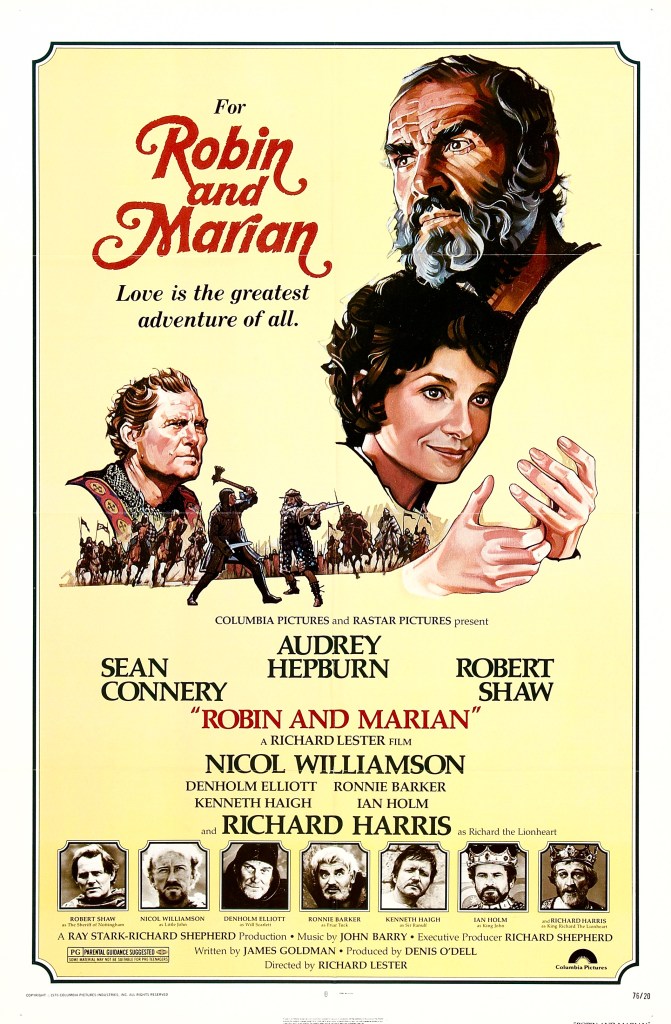
ROBIN AND MARIAN (1976) ****
Richard Lester’s Robin and Marian definitely made a strong first impression.

I placed it on my top 10 films list for 1976, based on just viewing it a single time on cable TV many years ago.

Granted, Robin and Marian crossed my mind several times in recent months, especially after Robin and Marian star Sean Connery died last Halloween and then after I watched both the Disney (1973’s Robin Hood) and the Mel Brooks (1993’s Robin Hood: Men in Tights) takes on the legendary old warhorse. Disney and Brooks both left me feeling often unimpressed and ultimately supremely disappointed, for very different reasons, and I started thinking instead about superior Robin Hood films The Adventures of Robin Hood and Robin and Marian, both of which I first encountered during childhood or teenage years.

The Adventures of Robin Hood remains my favorite take on Robin Hood and I’ve watched it numerous times over the years. Of course, it helped that The Adventures of Robin Hood ranked among the select few titles Grandma Sisney had on VHS and I played it — along with Indiana Jones and the Temple of Doom and Fun in Acapulco — so many times before Grandma took over her TV for a day of game shows and soap operas. There’s always been something so indelible about Errol Flynn’s Robin Hood that I judge all others portraying Robin Hood against Flynn’s standard, Claude Rains and Basil Rathbone make incredibly satisfying villains, and Olivia de Havilland’s Maid Marian simply radiates a MOST BEAUTIFUL WOMAN IN THE WORLD AT THIS VERY MOMENT glow. Plus, it’s hard to forget the colors (and costumes) that argue for three-strip Technicolor superiority.

Robin and Marian left a mark for similar reasons — Connery and Audrey Hepburn both carry some of the same appeal as Flynn and de Havilland do in their iconic roles. Flynn was just a month shy of 29 years old when The Adventures of Robin Hood first came out in May 1938 and similarly, De Havilland was two months shy of a mere 22. However, Connery and Hepburn play older Robin Hood and older Maid Marian — please consider both Connery and Hepburn were in their mid-40s during Robin and Marian and each had a solid 15-20 years of stardom behind them. Connery and Flynn both have an undeniable robust humor and physicality (both men seemed tailor-made for James Bond, for example) and Hepburn could make claims on de Havilland’s radiant MBWITW glow several times during her career, from Roman Holiday and My Fair Lady to Robin and Marian.

Anyway, I finally watched Robin and Marian for a second time and it holds up as a great movie, right behind only The Adventures of Robin Hood in the Robin Hood cinematic pantheon.

Because of centering around middle age characters, Robin and Marian plays different notes and takes on a greater emotional range than any other Robin Hood film I have ever seen.

It’s definitely not the lusty adventure like The Adventures of Robin Hood. Sure, Robin and Marian has sword fights and scenic vistas and soaring music and horses and romantic clinches and every prerequisite of the genre, as well as King John, King Richard the Lionhearted, the Sheriff of Nottingham, Little John, Friar Tuck, Will Scarlett, and Sherwood Forest, but they’re all — both people and places, and every plot event — suffused with melancholy.

To be fair, though, Lester and Connery inject enough good humor and spirit into Robin and Marian to help it avoid being a more downbeat experience like the 1991 Robin Hood starring Kevin Costner. And the scenes between Connery and Hepburn are simply flat-out appealing, rooted in seeing two of the most attractive, most ebullient performers to ever grace the screen share time with each other (and us audience members).

It should also be mentioned that supporting players Nicol Williamson, Richard Harris, Denholm Elliott, and Ian Holm contribute to an absolute dynamite cast.

Didn’t we always ponder how it all turned out for Robin Hood, Maid Marian, the Sheriff, Little John, Friar Tuck, and Will Scarlett?

Lester’s film, with a screenplay written by James Goldman (writer of the play, film adaptation, and TV movie version of The Lion in Winter), answers those very questions, but do we viewers feel comfortable with the answers? Are we prepared to see Maid Marian as a nun because Robin Hood, off on his damn crusades and holy wars with Richard and Little John, didn’t write her for the last 20 years? We also found out that she attempted suicide. He’s back, though, and it’s obvious that Robin Hood and Maid Marian are destined to be together. They might initially hate it and initially fight it, she invariably more than he, but they are pulled together rather than apart.

All roads lead toward a final showdown between Robin Hood and the Sheriff (Robert Shaw). They fight like two worn-out, downtrodden men with many, many battles behind them and none ahead of them, who have resigned themselves to their final destiny. They fight because it’s their duty, or their almost perverse obligation to each other as hero and villain. They really don’t want to be fighting each other at this precise historical moment, it feels like, BUT THEY MUST FIGHT TO THE DEATH. There’s none of the joy in this fight that can be found in great film sword fights like the one, for example, between Robin Hood (Flynn) and the Sheriff (Rathbone) in The Adventures of Robin Hood. This final showdown, just like Robin and Marian overall, gives us something that’s different from any other purely adventure movie. All the main players have lived through considerable pain, considerable disappointment, and the film serves a reminder (from early on and throughout) there’s flesh-and-blood and real-life experience behind every legend, every song, every ode, every hymn, every myth.

Maid Marian gives Robin Hood (and us) some final words, “I love you. More than all you know. I love you more than children. More than fields I’ve planted with my hands. I love you more than morning prayers or peace or food to eat. I love you more than sunlight, more than flesh or joy or one more day. I love you more than God.”

Jaws 2 (1978)

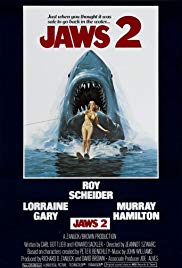
JAWS 2

JAWS 2 (1978) Two stars
When you watch JAWS 2, you just get the feeling that human star Roy Scheider wasn’t a happy camper during the film’s production.

Then you read more about the film and you find out that it’s true.

Scheider had a multi-picture agreement with Universal, makers of the JAWS films, and when he left THE DEER HUNTER, Universal made a deal with Scheider that if he did JAWS 2, it would be counted as the two films remaining on his contract. Fundamental problem: Scheider did not want to appear in JAWS 2.

We can feel Scheider’s resentment on the screen.

Scheider clashed with director Jeannot Szwarc to the point that it produced a physical confrontation between the men. They even carried it over into letters.

Scheider: “Working with Jeannot Szwarc is knowing he will never say he is sorry or ever admitting he overlooked something. Well, enough of that shit for me!”

Szwarc: “Time and pressure are part of my reality and priorities something I must deal with.

“You have been consulted and your suggestions made part of my scenes many times, whenever they did not contradict the overall concept of the picture.

“If you have to be offended, I deplore it, for no offense was meant. At this point in the game, your feelings or my feelings are immaterial and irrelevant, the picture is all that matters.”

When you’re watching JAWS, you don’t get the sense of a troubled production.

We do throughout JAWS 2.

Despite all that behind-the-scenes hullabaloo, also including a change of director and more technical difficulties with that damn mechanical shark, JAWS 2 became a huge financial success as it racked up nearly $78 million at the box office. Why? A hard sell advertising campaign centered around the immortal tagline “Just when you thought it was safe to go back in the water”; “Merchandising, merchandising, where the real money from the movie is made,” in the words of SPACEBALLS; and, let’s face it, at that point in time, folks wanted more of the shark and JAWS 2 delivers “more shark.”

In fact, I give the shark in JAWS 2, oh, let’s see here, three stars, maybe three-and-a-half stars on a charitable day.

The people in JAWS 2, though, sink to one star.

Averaging out both numbers gives JAWS 2 two stars.

Yes, the characters in JAWS 2 (and the following sequels) suck.

The fundamental difference between JAWS and its sequels: JAWS gives audiences three great characters in Chief Brody (Scheider), Matt Hooper (Richard Dreyfuss), and Quint (Robert Shaw). Amity mayor Larry Vaughn (Murray Hamilton), why he’s not too far behind. You care about the characters in JAWS.

Brody and Vaughn return in JAWS 2, but they’re competing against the shark and other less interesting human characters.

Instead of the core of adults in JAWS, we have an endless array of teeny boppers in JAWS 2 who just can’t hold a candle to Hooper and Quint. Dreyfuss did not return for the sequel, as he and JAWS director Steven Spielberg made CLOSE ENCOUNTERS OF THE THIRD KIND. And it’s quite obvious why Quint’s not back for JAWS 2.

All we need to know about the plot of JAWS 2 is that it’s the namesake of “The Jaws 2 Syndrome,” or when a sequel repeats the worst element of the original movie. We all know that Chief Brody will have to take out the shark, but the ringer it runs him through en route does more than try our patience, it’s blowed up real good.

Jaws (1975)

day 23, jaws

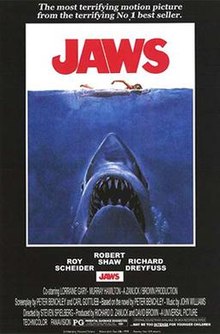
JAWS (1975) Three-and-a-half stars
Steven Spielberg’s JAWS wanted to do for sharks what Alfred Hitchcock’s PSYCHO did for showers 15 years earlier.

Like PSYCHO, JAWS became a game-changing motion picture and it’s been analyzed, overanalyzed, parodied, and satirized, and it spawned many clones and rip-offs with just about every animal turned into a relentless killer.

It’s known as the first summer blockbuster film (released on June 20, 1975), I mean it even says so in the Guinness Book of World Records, “Not only did people queue up around the block to see the movie, it became the first film to earn $100 million at the box office.”

Before 1975, summers were traditionally reserved for dumping insignificant fluff.

Based on Peter Benchley’s best-selling novel, JAWS tells a pulp story: a great white shark terrorizes Amity Island, a summer resort community, and transplanted city policeman Sheriff Brody (Roy Scheider) wants to close off the beaches but he runs into much resistance from Mayor Larry Vaughn (Murray Hamilton), who of course fears the loss of tourist revenue more than he does a great white shark. Eventually, though, Brody, along with preppy Ichthyologist Matt Hooper (Richard Dreyfuss) and grizzled old man of the sea Quint (Robert Shaw), attempts to hunt down and kill the great white aboard Quint’s ship, the Orca.

The film and the novel are different in several fundamental ways: Hooper and Brody’s wife do not have an affair in the film; Mayor Vaughn’s squeezed by the mafia in the novel and not simply local business interests; newspaper man Harry Meadows plays a bigger role in the novel; Quint’s made a survivor of the World War II USS Indianapolis; Hooper escapes death in the film; Quint dies by drowning in the novel; in the film, Brody kills the shark by shooting a compressed air tank inside the creature’s jaws, of course.

Spielberg said that he rooted for the shark the first time he read Benchley’s novel because he found the human characters unlikeable.

Normally, books are credited for having stronger characterizations than their screen adaptations.

That’s not the case with JAWS.

In fact, none of the subsequent JAWS films could match the characterizations of Brody, Hooper, and Quint and performances by Scheider, Dreyfuss, and Shaw. We have three indelible characters who stay within our hearts and minds just as much as the image of the great white shark.

Scheider and Dreyfuss appeared to have great chemistry together, just like there seemed to be real tension between Dreyfuss and Shaw.

Universal had Scheider bent over a barrel after he dropped out two weeks before filming started on THE DEER HUNTER, due to “creative differences,” and so they forced Scheider into starring in JAWS 2. Scheider’s performance in JAWS 2 suggests a very, very unhappy person and his conflicts with director Jeannot Szwarc must have only contributed to Scheider’s apparent misery.

Dreyfuss passed on JAWS 2 because Spielberg did not direct it; they made CLOSE ENCOUNTERS OF THE THIRD KIND together instead. Of course, there were obvious difficulties in Quint returning for JAWS 2.

JAWS 2 gives us a bunch of teeny boppers and repeats the basic plot of the first movie, JAWS 3-D sinks even more into a morass of mediocrity (how bad must you be to be disowned by the next JAWS film), and JAWS THE REVENGE, well, it gives us the first shark movie designed for geriatric consumption. To be honest, JAWS THE REVENGE defies the suspension of disbelief beyond belief and becomes one of the worst bad movies ever made.

Necessity became the mother of invention for JAWS, because of the numerous technical difficulties with the mechanical shark that became known as Bruce, named after Spielberg’s lawyer, or alternately “the great white turd.” Spielberg wanted to show the shark a lot sooner, but instead the film took on more Val Lewton proportions than the average horror movie. JAWS relies heavily on John Williams’ famous musical score to substitute for the shark.

The JAWS sequels utilized the mechanical shark far more often and much earlier on, honestly to their detriment. Less is more and more is less.

I always love it when horror movies take on more than just being a horror movie. At times, especially when our three protagonists are stuck on that damn boat together, JAWS becomes grand adventure and an unexpected comedy.