
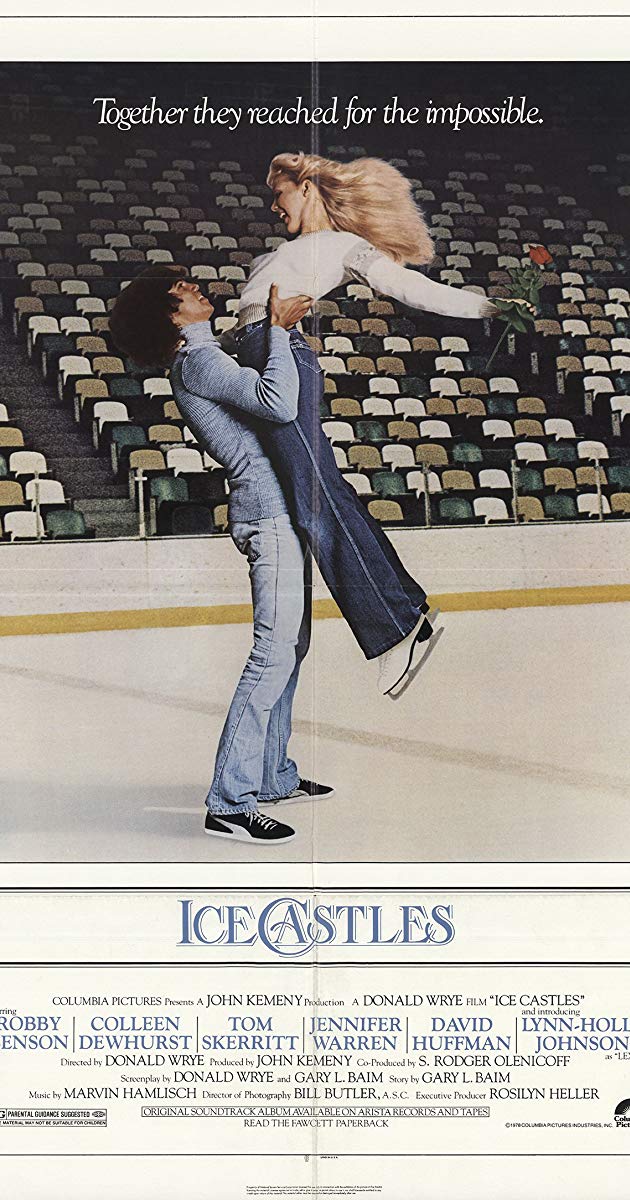
Ice Castles (1979)

ICE CASTLES

ICE CASTLES (1978) **

Not that I have a problem with either figure skating or movie romance — I like THE CUTTING EDGE, for example — but ICE CASTLES is not a very good movie and that’s because it makes one (like yours truly) mad due to its relentlessly manipulative nature.

We know entering ICE CASTLES that it centers on a blind figure skater and her personal and amateur figure skating travails. Naturally, she does not start out the movie blind, so that means we are waiting for her freak accident. That makes it the pièce de résistance of the picture and that makes the picture quite sick and perverse because her disability itself becomes more important than her state before or after her disability.

When skater-on-the-rise Alexis “Lexie” Winston tries a difficult triple jump and takes a mighty fall, we see it drawn out in explicit slow motion. None of her other jumps play out in this fashion. She ends up with a blood clot in her brain and loses 90 percent of her sight. There goes her shot at the 1980 Winter Olympics, right?

Director and screenwriter Donald Wyre and fellow screenwriter Gary L. Baim undercut their own movie with such a focus on the accident.

They gave first-time actress and former amateur figure skater Lynn-Holly Johnson one helluva challenge for her debut. Let’s see here, her 16-year-old character goes through not only a debilitating accident, but she breaks up with her jealous boyfriend (Robby Benson), hooks up with a television reporter (David Huffman) who helped out her career and made all her figure skating cohorts upset by all her publicity, argues with her father (Tom Skerritt) at different points throughout the picture, eventually hashes it out with her former boyfriend, and makes her triumphant comeback — despite her blindness — for a grand finale. Johnson gives a good performance and it’s certainly better than her work in subsequent films THE WATCHER IN THE WOODS, FOR YOUR EYES ONLY, and WHERE THE BOYS ARE ‘84.

Benson can be one of the most irritating movie actors and he’s especially awful with emotional scenes; he so often turns them into bad soap opera with fake anger his dread specialty. Benson does that a handful of times during the last half of ICE CASTLES, especially in the scene at the dinner table when the four main characters (I have not mentioned Colleen Dewhurst as rink operator and trainer Beulah Smith, but she’s the fourth main character) are debating whether or not Lexie should return to competition. The melodrama hits its high point when Benson’s Nick Peterson feasts on the line “Don’t give me that. Not trying is pointless and cruel. Not trying is wondering your whole life if you gave up too soon. Who the hell needs that?” It’s all so phony baloney, but it’s nowhere as bad as Benson in HARRY & SON. In that horrible movie, I wanted Paul Newman’s character Harry to punch out his son Howard as played by Benson. Time Out London called it “a curiously indigestible phenomenon, like being forced to eat five courses of avocado by an overbearing dinner-party host.” One of Benson’s immortal lines in HARRY & SON, “Want a Cherry Coke, pa?”

American adult contemporary singer Melissa Manchester performed her two nominated songs at the 1980 Academy Awards ceremony: “Through the Eyes of Love (Theme from Ice Castles)” and “I’ll Never Say Goodbye” from THE PROMISE, another soap opera. “It Goes Like It Goes” (wow, oh wow, what a title) beat out both Manchester numbers for “Best Original Song.” “Rainbow Connection” from THE MUPPET MOVIE was obviously robbed. For many years, the Academy seemed to nominate the most forgettable songs 90 percent of the time.

I promise that I’m not a hater of figure skating or movie romance, but I will often bristle at manipulation and melodrama — ICE CASTLES, despite some good elements at work, offers large portions of both manipulation and melodrama.

Then again, RogerEbert.com writers Christy Lemire, Sheila O’Malley, and Susan Wloszczyna contributed to a 2017 piece titled “Through the Eyes of Love: On the Timelessness of ‘Ice Castles.’” But, then again, so what?

Roller Boogie (1979)

ROLLER BOOGIE

ROLLER BOOGIE (1979) *1/2

Hot on the heels of reviewing THANK GOD IT’S FRIDAY, here’s another one where it’s a soundtrack in search of a movie.

Or, in other words, a gimmick in search of a movie. ROLLER BOOGIE belongs to a specific time and place of quickie exploitation flick: post-SATURDAY NIGHT FEVER boogie down and roller skating, hence that genius title.

ROLLER BOOGIE should have been a better film. I mean, director Mark L. Lester went on to make CLASS OF 1984 and COMMANDO, two films that go above-and-beyond in going over-the-top and that’s both films’ best virtue by far.

Not in ROLLER BOOGIE, though, which earns a ‘PG’ from the MPAA. It should have been ‘R.’

I’ll give one example.

Early on in the picture, we’re talking first few minutes here, our female lead Terry Barkley (Linda Blair) gets dressed and we sense there’s a missing nude scene, like they filmed one but left it on the cutting room floor. This early scene establishes the awkwardness that we sense around Blair’s character all movie.

We find Blair, who was in her late teens when she made ROLLER BOOGIE, in her transition period, between her breakout in THE EXORCIST (1973) and later exploitation films like CHAINED HEAT and SAVAGE STREETS. Maybe it’s because I watched ROLLER BOOGIE after her later films that I felt like the 1979 film teases us with possibilities that it ultimately did not want to pursue, undoubtedly for commercial reasons. The one song that should have been written for Blair: “I’m Not a Girl, Not Yet a Woman,” which was instead written for Britney Spears at the turn of the 21st Century. Rick James wrote “Cold Blooded” (title song for his 1983 album) about his relationship with Blair. “Cold Blooded” hit No. 40 on the Billboard Hot 100.

Upon further reflection, ROLLER BOOGIE does go above-and-beyond in recycling grand old cliches and stereotypes, pilfering from both the Mickey Rooney-Judy Garland “Let’s put on a show” movies of the late 1930s and early ‘40s and the Frankie Avalon-Annette Funicello BEACH PARTY movies of the early ‘60s in addition to SATURDAY NIGHT FEVER and the disco and roller skating fads more contemporaneous with ROLLER BOOGIE.

Like THANK GOD IT’S FRIDAY, ROLLER BOOGIE rattles off characters and scenes we have seen many times before.

Terry develops a romance with roller boogie master Bobby James (Jim Bray), who, get this, comes from another socioeconomic class than rich girl and musical genius Terry. Bray makes both his film debut and finale, basically playing a fictional version of himself … not all that well. He does skate convincingly, of course, and he does possess a great smile, but in any scene that requires any emotion whatsoever Bray absolutely falls flat on his face. Bray apparently had already earned 275 trophies for his skating before he made ROLLER BOOGIE. For his acting, though, Bray received “Dishonourable Mention” from the Stinkers Bad Movie Awards; Robby Benson won “Worst Actor” for WALK PROUD. Blair lost “Worst Actress” to Barbra Streisand in THE MAIN EVENT.

Then we have Franklin (Christopher S. Nelson), who’s this hopeless rich snob always lusting after Terry’s bod. We’ve seen this character archetype before, like Collins Hedgeworth (Paul Linke) in GRAND THEFT AUTO and Spaulding Smails (John F. Barmon Jr.) in CADDYSHACK. You remember Spaulding? He’s the snotty but spectacularly slobby grandson of Judge Smails (Ted Knight). In a classic scene, Spaulding wants a hamburger, no, a cheeseburger, a hot dog, and a milkshake … before Judge Smails sets the impetuous lad straight, “You’ll get nothing, and like it.” Well, there’s nothing that funny or worthwhile in ROLLER BOOGIE. Franklin’s scenes drag ROLLER BOOGIE down.

Cartoon gangsters lean on Jammer Delaney (Sean McClory), the owner of roller boogie rink Jammers. Nobody would ever believe this plot thread, but this here old Jammer, why he’s the last property owner holding out. Jammer’s sitting on a relative gold mine and he’s standing in the way of progress. We have seen this old cinematic war horse trotted out for everything ranging from BLACK BELT JONES (where property owner Scatman Crothers died from the weakest punch in cinematic history) to WHO’S THE MAN? Cartoon gangsters rarely ever bode well for a motion picture spread and they do not for ROLLER BOOGIE. I do not want to write another word on the plot.

Kimberly Beck’s next screen credit would be as final girl Trish Jarvis in 1984’s FRIDAY THE 13TH: THE FINAL CHAPTER. She famously said of the FRIDAY THE 13TH series: “I had never seen any of the FRIDAY films. And I didn’t want to see any of them. I still have never seen any of them. I just don’t like that kind of genre at all. And this was not even a B-movie, it was really just a C-movie.” Unfortunately, we do not have a quote from Beck detailing her experience playing Terry’s best friend Lana, who does really fill out her outfits rather nicely in ROLLER BOOGIE. She provides one of the fleeting pleasures of the movie. Sometimes, you take it wherever you can find it and ask questions never.