

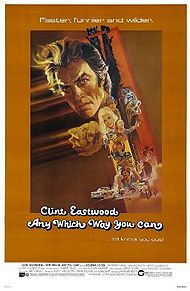
ANY WHICH WAY YOU CAN (1980) Three stars
If I believed in feeling any guilt whatsoever about feeling pleasure, I might call ANY WHICH WAY YOU CAN a guilty pleasure.
It’s another one of those sublimely ridiculous movie packages that I can’t help but not to like. I mean, it could play on a double bill with ROAD HOUSE.
We all have “guilty pleasures,” and they form one of the most rewarding experiences that we can have at the movies.
If you describe ANY WHICH WAY YOU CAN as a movie with a little bit of everything, that’s still selling it short. I mean, it’s not every day that you have Clint Eastwood in a comedic role, an orangutan named Clyde (played by Buddha and C.J., although there’s no screen credit) who steals every scene that he’s in, a concluding fight scene that can go head-to-head with the later ROCKY sequels and THEY LIVE, a buffoonish motorcycle gang, Ruth Gordon (1896-1985) in what can only be called the “Ruth Gordon” role, and a country song played seemingly every few seconds.
This is the only motion picture that starts with an Eastwood and Ray Charles duet on a little ditty over the opening credits named “Beers for You.”
Personally, I feel the movie could have used more Clyde scenes — more “Right Turn Clyde,” more flipping the bird, more smashing cars, et cetera — and fewer scenes between Eastwood and his real-life partner at the time Sondra Locke. Locke generally became the weak link in Eastwood’s films of the period, and both EVERY WHICH WAY BUT LOOSE and ANY WHICH WAY YOU CAN dramatically prove that as Eastwood demonstrates better chemistry with the orangutan than Locke.
Back to Clyde and Buddha and C.J. Buddha and C.J. assumed the Clyde role for the sequel since Manis — who alone played the role in EVERY WHICH WAY BUT LOOSE — apparently had grown too much between films. Manis returned to his act in Las Vegas.
Reports have it Buddha alone played the role in ANY WHICH WAY YOU CAN and C.J. came on in publicity because Buddha was caught stealing doughnuts on the set near the end of filming and he was brought back to his training facility and beaten for 20 minutes, according to the book “Visions of Caliban: On Chimpanzees and People” by Jane Goodall and Dale Peterson.
Buddha then died soon after of a cerebral hemorrhage.
C.J. went on to star in Bo Derek’s TARZAN THE APE MAN and a NBC sitcom named MR. SMITH.
Executive producer Ed Weinberger said of C.J. in the Washington Post, “It’s a Buddha-like presence. He has wisdom about him. You have to know the animal; I’m in love with him. I’d have him in my house any time.”
MR. SMITH lasted all of 13 episodes from Sept. 22 through Dec. 16 in 1983 and finished a dismal 95th in the Nielsens.
So much for a talking orangutan and who knows if Weinberger had C.J. over at his house after the show flopped big time.
I remember loving ANY WHICH WAY YOU CAN as a young child. It was an affinity for Clyde. He’s what I remembered about the movie for many years before I revisited it decades later.
Not every movie I loved in childhood holds up revisited in adulthood. For example, CANNONBALL RUN, an entertainment I found to be an endurance contest several years back. (For the record, I recently watched SMOKEY AND THE BANDIT, another childhood favorite, again and it held up. I enjoyed Burt Reynolds, Sally Field, Jerry Reed, and Jackie Gleason.)
ANY WHICH WAY YOU CAN is not quite at the same high level as COMMANDO, LONE WOLF McQUADE, and ROAD HOUSE.
That’s because it’s a little flabby with a running time of 1 hour, 56 minutes. Granted, that concluding fight scene between Eastwood and William Smith eats up a good 10 percent of a nearly two-hour experience.
LONE WOLF McQUADE and ROAD HOUSE do have similar run times, but fewer bad scenes than ANY WHICH WAY YOU CAN.
The great director Howard Hawks (1896-1977), born the same year as Ruth Gordon, said that a good movie is “three great scenes and no bad ones.” Not sure that he had movies like ANY WHICH WAY YOU CAN in mind, which does have three great scenes but also some bad ones.
ANY WHICH WAY YOU CAN, though, is one of those sequels better than the original.
 Attack of the Killer Librarian