Schlock (1973)

SCHLOCK

SCHLOCK (1973) ***

Schlock (/SHläk/): cheap or inferior goods or material; trash.

For quite some time as I watched it, I could not make heads or tails out of John Landis’ 1973 extremely low-budget feature film debut SCHLOCK.

I mean, I understood that it’s a good old-fashioned spoof of good old-fashioned monster movies, sure, from the moment I read a plot synopsis and that its title speaks louder than a thousand words, you bet, but it kept veering between tones. Our title character (played by none other than Landis himself) seemed menacing and imposing one moment and then funny the very next. He’s the missing link and “The Banana Monster” and the poster promises “A love stronger than KING KONG.”

There was one sequence though in particular that changed my tune about SCHLOCK.

Schlock (blanking on his full name right now) watches DINOSAURUS! from 1960 and THE BLOB from 1958 in a movie theater, both classics directed by Irvin S. Yeaworth and produced by SCHLOCK producer Jack H. Harris. We see choice scenes from both films, like a dinosaur fight and that classic moment in THE BLOB when its title character attacks first the projectionist and then the patrons to rudely interrupt the showing of DAUGHTER OF HORROR (renamed from DEMENTIA). Showing THE BLOB also provided Landis an opportunity to work Steven, er, Steve McQueen into his little $60,000 movie.

Not only that, but Schlock learns about vending machines and cleans out a candy counter. Bet he loved them jujubes with his sharp teeth. I love what Schlock does when this incredibly tall man sits in the seat one row in front of him. If only life could be that way. Then again, proper authorities cannot handle Schlock.

At the point Schlock went movie watching, I learned to stop worrying and like (not love) SCHLOCK.

Landis’ love for SEE YOU NEXT WEDNESDAY starts out early in his directorial career, by promoting it with “First, BIRTH OF A NATION! Then, GONE WITH THE WIND! 2001: A SPACE ODYSSEY! LOVE STORY! SEE YOU NEXT WEDNESDAY! And now … SCHLOCK!” A line spoken in 2001 turned into a running gag throughout most Landis films and even the music video for Michael Jackson’s “Thriller.”

So many low-budget movies have a great back story.

Landis and crew, including makeup artist Rick Baker early in his career, made SCHLOCK during 12 days in the summer of 1971, but it was not released until 1973. Johnny Carson found out about the film and he booked Landis on “The Tonight Show.” With this spotlight opportunity, Landis showed clips from SCHLOCK, which helped the first-time director find a distributor in Jack H. Harris Enterprises. Harris put up $10,000 if Landis put 10 minutes of running time on SCHLOCK.

I enjoyed SCHLOCK every bit as much as the Joan Crawford classic TROG (1970) and the similarly low-budget KING KUNG FU (1976).

Of course, I did not forget, but I will see you next Wednesday.

An American Werewolf in London (1981)

AN AMERICAN WEREWOLF IN LONDON

AN AMERICAN WEREWOLF IN LONDON (1981) Three stars

The 1980s were a golden age for comedy horror: GREMLINS, GHOSTBUSTERS, RE-ANIMATOR, EVIL DEAD II, FRIGHT NIGHT, LITTLE SHOP OF HORRORS, and KILLER KLOWNS FROM OUTER SPACE.

I’d put AN AMERICAN WEREWOLF IN LONDON among the second tier of 1980s comedy horror films, below every film listed in the opening paragraph. Do not fear, though, because it’s still a good movie.

AMERICAN WEREWOLF specializes in dark comedy, very very very dark, even beyond morbid especially when a dead Jack Goodman (Griffin Dunne) haunts best friend David Kessler (David Naughton) as Mr. Kessler becomes the title character. Jack tells David that he must kill himself before he kills others and that he’s under the werewolf’s curse. Jack still has that same way with words he had when he was alive; that’s why David tells Jack, “I will not be threatened by a walking meatloaf.” Poor, poor Jack.

Of course, all this started when David and Jack, two American college students on a walking tour, stop at the Slaughtered Lamb. We’ve all heard of the Wrong Gas Station, a hallmark of many horror movies, but the Slaughtered Lamb represents the Wrong Drinking Establishment. You have to be real thirsty or hungry or both to stop at the Slaughtered Lamb. The regulars don’t exactly warm to no bratty Americans in the first place, but the irrepressible Jack sticks his foot in his mouth big time when he blurts out about a pentagram. The conspiratorial patrons give Jack and David the boot, although Jack and David are told very specifically to stay on the road and not to go into the moors. I believe that I last saw that setting in the 1939 Basil Rathbone Sherlock Holmes movie HOUND OF THE BASKERVILLES. I love the moors in the movies.

Of course, we all know that David and Jack don’t stick to the road and go exactly where they’re not supposed to go.

1981 featured three good wolf movies: THE HOWLING premiered March 13, WOLFEN July 24, and AMERICAN WEREWOLF August 21. For the record, I prefer both WOLFEN and THE HOWLING over AMERICAN WEREWOLF, and that’s an indication just how great of a year it was for movies about wolves. All three have their own distinct qualities, though both Joe Dante’s THE HOWLING and John Landis’ AMERICAN WEREWOLF pursue laughter far more than Michael Wadleigh’s WOLFEN.

All three stand out for their special effects: Rob Bottin and Rick Baker, who previously worked together on Dante’s PIRANHA, battled for werewolf transformation superiority and Baker’s makeup work on AMERICAN WEREWOLF earned him the first Academy Award for Best Makeup, as he beat out Stan Winston on the comedic craptacular HEARTBEEPS. The overshadowed WOLFEN did some innovative things with sound and image to depict the world of the wolf.

At this point in Landis’ career, the controversial director was on a major roll with a three-picture run of NATIONAL LAMPOON’S ANIMAL HOUSE, THE BLUES BROTHERS, and AMERICAN WEREWOLF. This was before TWILIGHT ZONE: THE MOVIE, when actor Vic Morrow and child actors Myca Dinh Le and Renee Shin-Yi Chen were killed in a helicopter accident during filming in July 1982.

The National Transportation Safety Board reported a couple years later: “The probable cause of the accident was the detonation of debris-laden high temperature special effects explosions too near a low-flying helicopter leading to foreign object damage to one rotor blade and delamination due to heat to the other rotor blade, the separation of the helicopter’s tail rotor assembly, and the uncontrolled descent of the helicopter. The proximity of the helicopter to the special effects explosions was due to the failure to establish direct communications and coordination between the pilot, who was in command of the helicopter operation, and the film director, who was in charge of the filming operation.”

(If you want to watch something fucked up, you can find “Vic Morrow’s Death Video” on YouTube. The rotor blades decapitated Morrow and Le and the right landing skid crushed Chen to death. All three died instantaneously. For this reason and the fact that it’s not very good, I cannot watch Landis’ installment in TWILIGHT ZONE: THE MOVIE and skip ahead on the DVD to the Joe Dante and George Miller portions of the program.)

Despite being acquitted of involuntary manslaughter after a nine-month jury trial over 1986 and 1987, Landis’ reputation rightfully took a major hit … and every single thing you can find about the incident makes Landis seem like the ultimate asshole director, worse than Hitchcock, worse than Kubrick, worse than Lang, worse than Preminger, worse than Woody Allen, worse than any other director in relentless pursuit of perfection. Landis broke California child labor laws by hiring both child actors without their required permits, in addition to his reckless behavior filming the nighttime helicopter sequence. None of this should have ever happened and Landis served not a single second of time for his crimes.

TRADING PLACES and COMING TO AMERICA both were hits directed by Landis. He also directed the nearly 14-minute music video for Michael Jackson’s “Thriller,” a job Landis earned after Jackson saw AMERICAN WEREWOLF. It is widely considered the greatest musical video of all-time.

Back to AMERICAN WEREWOLF.

AMERICAN WEREWOLF represents a throwback to the horror movies of the 1930s, especially the ones from Universal, updated with gore, nudity, and profanity of a modern era.

Like several other films from the 1980s, it deftly balances laughs and scares just right so often.

AMERICAN WEREWOLF, though, falls shy of greatness: There’s a lot to love, especially in the first 30 minutes, but I’ve never loved its ending (full half-point deduction alone for this deficiency) and I just cannot believe the savvy Landis did not choose Warren Zevon’s “Werewolves of London” — Lon Chaney Sr. and Jr. references on top lyrics “You hear him howling around your kitchen door / You better not let him in / Little old lady got mutilated late last night / Werewolves of London again” and “He’s the hairy-handed gent who ran amuck in Kent / Lately he’s been overheard in Mayfair / You better stay away from him / He’ll rip your lungs out, Jim / I’d like to meet his tailor.” In other words, Zevon’s dark sense of humor would have fit AMERICAN WEREWOLF, just like a wolf suit.

No matter how many times I’ve heard CCR’s “Bad Moon Rising” and Van Morrison’s “Moondance,” they still thrill and AMERICAN WEREWOLF uses them perfectly, especially pairing Morrison’s lyrics “Well, I want to make love to you tonight / I can’t wait ’til the morning has come / And I know now the time is just right / And straight into my arms you will run / And when you come my heart will be waiting / To make sure that you’re never alone / et cetera” with the escalation in David’s relationship with friendly nurse Alex (the alluring Jenny Agutter).

I’ll end this review with a warning to stick to the original and please do not watch AN AMERICAN WEREWOLF IN PARIS.

King Kong (1976)

KING KONG 1976

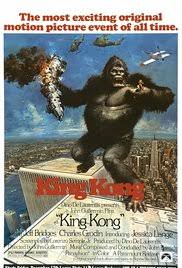
KING KONG (1976) Three-and-a-half stars
Of course this 1976 KING KONG cannot hold a candle to the 1933 version, one of the all-time screen classics.

If and when you and I can get past that fact, admittedly not an easy hurdle, the 1976 version stands out for being a great entertainment.

Jeff Bridges and Jessica Lange are improvements over Bruce Cabot and Fay Wray, respectively, in the male and female leads and Charles Grodin’s not far below what Robert Armstrong did in a similar role.

Of course, you can immediately tell when this movie was made by all the contemporaneous dialogue (especially from Lange) and Grodin plays an executive with Petrox Corporation, a fictional American oil company referencing the “pet rock” phenomenon. This KONG is more bound to 1976 than the original is to 1933.

Beset with production issues of a wide variety, including a complicated legal battle between Paramount, Universal, RKO, and the Cooper estate before filming even started (at one point, both Paramount and Universal had KONG projects lined up), and a first-time leading lady, as well as practical effects that often look more dated than what Willis O’Brien accomplished in 1933, KONG 1976 still works on a basic level.

It is fun.

The stories around the film, though, are more interesting than the finished product and help explain why the hype for the film took on epic proportions before its December 17 premiere.

Italian producer Dino DeLaurentiis (1919-2010) had the Carl Denham quotes in real life: “No one cry when JAWS die,” he said in Time. “But when the monkey die, people gonna cry. Intellectuals gonna love Kong. Even film buffs who love the first Kong gonna love ours.”

Or how about this one about Barbra Streisand told by Roger Ebert: “It’s-a no good, have two monsters in one movie.”

Unfortunately, when Meryl Streep auditioned for the Jessica Lange part, Dino said to his son in Italian that she was “too ugly” for the role; Streep understood Italian and replied in Italian to Dino, “I’m sorry I’m not beautiful enough to be in KING KONG.” We are printing legends, and that only seems appropriate for KING KONG.

Dino talked more smack about JAWS with ORCA THE KILLER WHALE (1977).

Gotta love Dino, whose mouth bit off more than his productions could chew.

Rather than Universal’s competing KONG movie (not released until Peter Jackson’s remake in 2005), the public first received A*P*E, an American / South Korean co-production with its Grade Z special effects, an early appearance for future TV mother Joanna (“Growing Pains”) Kerns, and an infamous shot where the ape uses the middle finger to show his disgust with the helicopters shooting at him.

Either that or he’s just showing his disgust at being trapped in that damn gorilla suit in a shitty movie.

A*P*E would later be topped, in the KING KONG ripoff department, by the Shaw Brothers’ MIGHTY PEKING MAN, the best of the King Kong ripoffs.

There’s also KING KUNG FU from 1976, where a gorilla trained in martial arts wreaks havoc on Wichita, Kansas. Financial constraints forced the makers into not being able to finish their film until 1987.

A*P*E invaded movie screens in October 1976, beating DeLaurentiis’ KONG by a good two months. MIGHTY PEKING MAN came out April 10, 1977, and Quentin Tarantino’s Rolling Thunder Pictures re-released the film on April 23, 1999.

Carlo Rambaldi, Glen Robinson, and Frank Van der Veer won a Special Achievement Award from the Academy of Motion Picture Arts and Sciences for the visual effects in KING KONG, believe it or not.

Legendary make-up artist Rick Baker played Kong, or he’s the man in the ape suit. The original plan had been for KONG ’76 to feature a 40-foot high mechanical ape, but that mechanical monster worked even less than Bruce the Shark in JAWS. JAWS director Steven Spielberg worked around the frequent mechanical failure to make an even better film than if the mechanical shark had been fully operational.

That’s not exactly the case with KONG ’76, partially because musical cues would not be a proper substitute for an ape like John Williams’ musical score proved to be for the shark or even Harry Manfredini’s score for the psycho killer in FRIDAY THE 13TH.

In other words, you have to see the ape.

“KING KONG offered the one chance to do a really perfect gorilla suit,” Baker said. “With the money and the time, it could have been outstanding. Unfortunately, it wasn’t. There were compromises and enforced deadlines.”

Let’s face it, KONG director John Guillermin, he’s no Spielberg.

At the same time, though, I give KONG ’76 and JAWS both three-and-a-half stars. Why?

A) Because life (and my brain) work in mysterious ways.

B) Because star ratings are basically arbitrary.

C) Because both films tap into the same primordial appeal and work as great entertainments for a couple hours each.