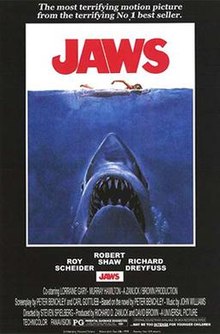
Jaws in 3D (1975 / 2022)

JAWS IN 3D (1975 / 2022) ****
When I first read the announcement Jaws 3D would be released to theaters in early September 2022, I mistook it for the Jaws 3-D from 1983 and I thought why in the bloody hell anybody would unleash that bloody awful movie once again … Just when you thought it was safe to go back in a movie theater … because there couldn’t be that much interest really in a third-rate Jaws movie.

I watched Jaws for the first time on the big screen in June 2020, sitting between my wife Lynn on the left and my mom on the right. We ate lunch beforehand at a place called Sharky’s Pub and Grub, and they might even have a Jaws poster. Just when you thought it was safe to go into a restaurant. My stepdaughter Emily and her friend watched E.T.

Jaws is another one of those movies that I would stop and watch every time I would come across it on cable TV, whether it played on TBS or TNT or part of a Jaws marathon 4th of July weekend on one of the premium channels.

Anyway, I decided to watch Jaws in 3D on Saturday, Sept. 3, which just happened to be National Cinema Day. $3 tickets for every showing, every showtime, every format. I had never seen the multiplex so busy; the theater had all hands on deck, and apparently 8.1 million people attended theaters across the nation on that day. Despite not being the biggest 3D fan, I thought why not bloody Jaws, of course a movie not originally in 3D, at that relatively budget price. There was a decent-sized crowd for this 47-year-old blockbuster pioneer, and they remained mostly quiet except for a couple of the most famous shock moments.

I thought it was a great experience, not only because I got to keep the glasses.

I long considered Jaws a very good movie, an ideal one to watch on cable TV when you just want to laze around and watch a movie, but after the last two times I’ve seen it in a movie theater, Jaws has dramatically increased in stature. It’s a great movie.

First and foremost, I appreciate Roy Scheider as Police Chief Martin Brody, Robert Shaw as Quint, and Richard Dreyfuss as Matt Hooper more every single time I watch Jaws.

Three great characters, three great performances, and they are something the other three Jaws films obviously lack. Scheider returns as Brody for Jaws 2, but it’s not the same.

George Burns (The Sunshine Boys) beat out Brad Dourif (One Flew Over the Cuckoo’s Nest), Burgess Meredith (The Day of the Locust), Chris Sarandon (Dog Day Afternoon), and Jack Warden (Shampoo) for Best Supporting Actor at the 1976 Academy Awards, but none of them approach Shaw’s work in Jaws.

Shaw makes an unlikable character likable by not even trying to be likable, and we feel his death scene more than just about any other in movie history. It is truly a horrifying moment, and despite the fact that I’ve watched Jaws 50, 75, 100, however many times, I still don’t want to see Quint lose his grip and slide right into the mouth of that great white shark.

Recently, I mentioned the incredible chemistry between Fred Ward and Kevin Bacon in Tremors. Scheider and Dreyfuss have a similar chemistry as Brody and Hooper, and I’m glad Jaws made Hooper infinitely more likable, excised Hooper’s extramarital affair with Brody’s wife, and let him survive along with Brody in the movie.

Shaw and Dreyfuss are great together, especially when they’re landing jabs and throwing shade at each other.

At one point in Jaws, Hooper describes the shark, and he could just as well be talking about Jaws itself and its capacity to make thrills, What we are dealing with here is a perfect engine, an eating (thrill) machine. It’s really a miracle of evolution. All this machine does is swim and eat and make little sharks (thrills), and that’s all.

Of course, that’s not all with Jaws, a truly scary classic that also generates lots of laughter and lots of emotion.

More American Graffiti (1979)

MORE AMERICAN GRAFFITI

MORE AMERICAN GRAFFITI (1979) *

I missed the point of MORE AMERICAN GRAFFITI, the 1979 sequel to George Lucas’ highly influential smash hit from 1973, AMERICAN GRAFFITI.

Sure, I realize we are intended to catch up with John Milner (Paul LeMat), Steve and Laurie Bolander (Ron Howard and Cindy Williams), Debbie Dunham (Candy Clark), Carol “Rainbow” Morrison (Mackenzie Phillips), and Terry “The Toad” Fields (Charles Martin Smith) at different points in the 1960s, but I don’t know if the film had any other greater purpose than attempting to cash in on the AMERICAN GRAFFITI name for another box office bonanza.

You’re right: Richard Dreyfuss and Curt Henderson did not return for the sequel. He’s only the main character in AMERICAN GRAFFITI, for crying out loud. Just like there’s no Dreyfuss and Matt Hooper in JAWS 2. Like his friend Steven Spielberg did not direct JAWS 2, Lucas does not direct MORE AMERICAN GRAFFITI. Unlike Spielberg, though, Lucas had far more involvement with the AMERICAN GRAFFITI sequel, including editing duties.

We have Milner on New Year’s Eve 1964, The Toad in Vietnam on New Year’s Eve 1965, Debbie in San Francisco on New Year’s Eve 1966, and Steve and Laurie on New Year’s Eve 1967.

We shuffle between the four different New Year’s Eve days and director and screenwriter Bill L. Norton gussies up the 1965 and 1966 scenes with grainy newsreel style footage (1965) and split screen (1966). That helps us identify which year we’re seeing, for sure, but otherwise, both gimmicks do not work. Especially the split screen, a technique already overplayed after WOODSTOCK and Brian DePalma films like CARRIE. In MORE AMERICAN GRAFFITI, split screen takes away from every scene it’s used.

The original AMERICAN GRAFFITI focused on a single long day in 1962 and that made the parallel adventures of Curt, Milner, The Toad, and Steve much easier to follow and less distracting. Automobiles cruising the main drag and car radios playing Wolfman Jack’s radio show unified just about every scene.

AMERICAN GRAFFITI also proved to have a theme: It showed Curt, Milner, and The Toad all outside their comfort zones and getting to know somebody beyond their accustomed social circle: intellectual and future college boy Curt and the tough guy car club the Pharaohs, the James Dean “Rebel Without a Cause” Milner and a young teenage girl dumped off on him by her older sister and older friends, and the geeky and socially awkward Toad and the blonde bombshell Debbie. They all form a greater understanding of each other.

Lucas did not get across the theme in a pretentious, heavy-handed, preachy way. Just about every scene in AMERICAN GRAFFITI worked on some level, and it especially seemed incredibly accurate about what life was like in 1962.

Meanwhile, in MORE AMERICAN GRAFFITI, hardly any scenes work and the film never builds up any momentum. It seems to mark off the list of every cliche of the era and maybe it just feels that way even more after one million ‘60s nostalgia trips. MORE AMERICAN GRAFFITI plays like a Time Life movie.

MORE AMERICAN GRAFFITI loses steam early on when Debbie and her loser man friend Lance Harris (John Lansing) are pulled over and he’s busted for just a little joint by Officer Bob Falfa (gratuitous Harrison Ford cameo appearance) after a chase that feels like it takes forever … and that’s immediately followed by Steve and Laurie playing the Bickersons.

Considering how little works in MORE AMERICAN GRAFFITI, it’s even greater insult to injury when the final shot teases us with the death of a main character.

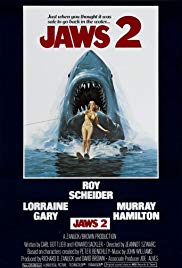
Jaws 2 (1978)

JAWS 2

JAWS 2 (1978) Two stars
When you watch JAWS 2, you just get the feeling that human star Roy Scheider wasn’t a happy camper during the film’s production.

Then you read more about the film and you find out that it’s true.

Scheider had a multi-picture agreement with Universal, makers of the JAWS films, and when he left THE DEER HUNTER, Universal made a deal with Scheider that if he did JAWS 2, it would be counted as the two films remaining on his contract. Fundamental problem: Scheider did not want to appear in JAWS 2.

We can feel Scheider’s resentment on the screen.

Scheider clashed with director Jeannot Szwarc to the point that it produced a physical confrontation between the men. They even carried it over into letters.

Scheider: “Working with Jeannot Szwarc is knowing he will never say he is sorry or ever admitting he overlooked something. Well, enough of that shit for me!”

Szwarc: “Time and pressure are part of my reality and priorities something I must deal with.

“You have been consulted and your suggestions made part of my scenes many times, whenever they did not contradict the overall concept of the picture.

“If you have to be offended, I deplore it, for no offense was meant. At this point in the game, your feelings or my feelings are immaterial and irrelevant, the picture is all that matters.”

When you’re watching JAWS, you don’t get the sense of a troubled production.

We do throughout JAWS 2.

Despite all that behind-the-scenes hullabaloo, also including a change of director and more technical difficulties with that damn mechanical shark, JAWS 2 became a huge financial success as it racked up nearly $78 million at the box office. Why? A hard sell advertising campaign centered around the immortal tagline “Just when you thought it was safe to go back in the water”; “Merchandising, merchandising, where the real money from the movie is made,” in the words of SPACEBALLS; and, let’s face it, at that point in time, folks wanted more of the shark and JAWS 2 delivers “more shark.”

In fact, I give the shark in JAWS 2, oh, let’s see here, three stars, maybe three-and-a-half stars on a charitable day.

The people in JAWS 2, though, sink to one star.

Averaging out both numbers gives JAWS 2 two stars.

Yes, the characters in JAWS 2 (and the following sequels) suck.

The fundamental difference between JAWS and its sequels: JAWS gives audiences three great characters in Chief Brody (Scheider), Matt Hooper (Richard Dreyfuss), and Quint (Robert Shaw). Amity mayor Larry Vaughn (Murray Hamilton), why he’s not too far behind. You care about the characters in JAWS.

Brody and Vaughn return in JAWS 2, but they’re competing against the shark and other less interesting human characters.

Instead of the core of adults in JAWS, we have an endless array of teeny boppers in JAWS 2 who just can’t hold a candle to Hooper and Quint. Dreyfuss did not return for the sequel, as he and JAWS director Steven Spielberg made CLOSE ENCOUNTERS OF THE THIRD KIND. And it’s quite obvious why Quint’s not back for JAWS 2.

All we need to know about the plot of JAWS 2 is that it’s the namesake of “The Jaws 2 Syndrome,” or when a sequel repeats the worst element of the original movie. We all know that Chief Brody will have to take out the shark, but the ringer it runs him through en route does more than try our patience, it’s blowed up real good.

Jaws (1975)

day 23, jaws

JAWS (1975) Three-and-a-half stars
Steven Spielberg’s JAWS wanted to do for sharks what Alfred Hitchcock’s PSYCHO did for showers 15 years earlier.

Like PSYCHO, JAWS became a game-changing motion picture and it’s been analyzed, overanalyzed, parodied, and satirized, and it spawned many clones and rip-offs with just about every animal turned into a relentless killer.

It’s known as the first summer blockbuster film (released on June 20, 1975), I mean it even says so in the Guinness Book of World Records, “Not only did people queue up around the block to see the movie, it became the first film to earn $100 million at the box office.”

Before 1975, summers were traditionally reserved for dumping insignificant fluff.

Based on Peter Benchley’s best-selling novel, JAWS tells a pulp story: a great white shark terrorizes Amity Island, a summer resort community, and transplanted city policeman Sheriff Brody (Roy Scheider) wants to close off the beaches but he runs into much resistance from Mayor Larry Vaughn (Murray Hamilton), who of course fears the loss of tourist revenue more than he does a great white shark. Eventually, though, Brody, along with preppy Ichthyologist Matt Hooper (Richard Dreyfuss) and grizzled old man of the sea Quint (Robert Shaw), attempts to hunt down and kill the great white aboard Quint’s ship, the Orca.

The film and the novel are different in several fundamental ways: Hooper and Brody’s wife do not have an affair in the film; Mayor Vaughn’s squeezed by the mafia in the novel and not simply local business interests; newspaper man Harry Meadows plays a bigger role in the novel; Quint’s made a survivor of the World War II USS Indianapolis; Hooper escapes death in the film; Quint dies by drowning in the novel; in the film, Brody kills the shark by shooting a compressed air tank inside the creature’s jaws, of course.

Spielberg said that he rooted for the shark the first time he read Benchley’s novel because he found the human characters unlikeable.

Normally, books are credited for having stronger characterizations than their screen adaptations.

That’s not the case with JAWS.

In fact, none of the subsequent JAWS films could match the characterizations of Brody, Hooper, and Quint and performances by Scheider, Dreyfuss, and Shaw. We have three indelible characters who stay within our hearts and minds just as much as the image of the great white shark.

Scheider and Dreyfuss appeared to have great chemistry together, just like there seemed to be real tension between Dreyfuss and Shaw.

Universal had Scheider bent over a barrel after he dropped out two weeks before filming started on THE DEER HUNTER, due to “creative differences,” and so they forced Scheider into starring in JAWS 2. Scheider’s performance in JAWS 2 suggests a very, very unhappy person and his conflicts with director Jeannot Szwarc must have only contributed to Scheider’s apparent misery.

Dreyfuss passed on JAWS 2 because Spielberg did not direct it; they made CLOSE ENCOUNTERS OF THE THIRD KIND together instead. Of course, there were obvious difficulties in Quint returning for JAWS 2.

JAWS 2 gives us a bunch of teeny boppers and repeats the basic plot of the first movie, JAWS 3-D sinks even more into a morass of mediocrity (how bad must you be to be disowned by the next JAWS film), and JAWS THE REVENGE, well, it gives us the first shark movie designed for geriatric consumption. To be honest, JAWS THE REVENGE defies the suspension of disbelief beyond belief and becomes one of the worst bad movies ever made.

Necessity became the mother of invention for JAWS, because of the numerous technical difficulties with the mechanical shark that became known as Bruce, named after Spielberg’s lawyer, or alternately “the great white turd.” Spielberg wanted to show the shark a lot sooner, but instead the film took on more Val Lewton proportions than the average horror movie. JAWS relies heavily on John Williams’ famous musical score to substitute for the shark.

The JAWS sequels utilized the mechanical shark far more often and much earlier on, honestly to their detriment. Less is more and more is less.

I always love it when horror movies take on more than just being a horror movie. At times, especially when our three protagonists are stuck on that damn boat together, JAWS becomes grand adventure and an unexpected comedy.