The Wild Geese (1978)

THE WILD GEESE (1978) *
We’ve seen The Wild Geese many times before and we’ve also seen it done a lot better many times before — the rounding up of the mercenary troops for their new mission, the basic training, the jail break, the great escape, the big double cross, the death scenes, etc.

If we pool our collective resources, undoubtedly we could brainstorm 50 or 100 titles easily and recall their overall plots and specific individual developments.

Worse, far worse, infinitely worse even, how do I describe the pace of The Wild Geese?

I thought about saying it moves at a snail’s pace, but then I quickly realized that it more accurately moves like a three-toed sloth dipped in molasses. This is one action movie that does not require slow motion because it’s already slow enough.

In fact, I am hard pressed to come up with an action movie that moves slower than The Wild Geese. I just can’t do it and I don’t want to ever find out if any do exist in this great big universe.

Anyway, we have the first 30 minutes to meet our stars Richard Burton, Richard Harris, and Roger Moore, then around the 45-minute mark it’s basic training and finally around one hour in we get into the main action. I almost said jump, but that’s way too much activity for The Wild Geese. To be fair, The Wild Geese picks up the pace in the last hour to such a degree that only two of the three sloth toes are molasses drenched. Guess what, though, it’s still dull as dishwater.

Yes, indeed, there’s not an exciting moment to be found in The Wild Geese.

Of course, that incredible pace might have something to do with the fact Burton, Harris, and Moore were in their late 40s (Harris) and early 50s (Burton, Moore) when they made The Wild Geese. Harris and especially Burton are not the least bit convincing in their action hero roles. Moore was nearly halfway through his run playing British secret agent James Bond, so he’s more credible than his counterparts and looks much less a fool than either Harris or Burton.

It is ironic that Burton, Harris, and Moore are playing middle-aged mercenaries and the film drops mercenary dialogue routinely during a 135-minute spread, because the three main actors fit the adjective definition of mercenary — primarily concerned with making money at the expense of ethics.

It seems like they paid Burton, Harris, and Moore by the word during The Wild Geese, because they yap and yammer constantly, their barrage of banter only interrupted by the generic requirements of the action movie. Granted, it takes a (long) while before the prerequisite explosions and gunfire.

By my reckoning, a long, long, long, long, long, long while and The Wild Geese lives up only to the geese portion because it is something foul alright. Wild, however, it is most certainly not.

The Dark (1979)

THE DARK (1979) *

Be afraid, very afraid, not of the dark but of The Dark, a laughable thriller that only increases in being laughable until one of the most ridiculous conclusions in cinematic history.

See, I’m not afraid of sleeping in the dark, not afraid of being in a cemetery late at night, not afraid of being home alone in an old house, not afraid of admitting or being wrong, et cetera. In all honesty, though, I hated working alone late nights at the Neosho Daily News office and avoided it as much as possible, except Friday nights during football season. Once corporate killed the Sunday edition and made Tuesday our next paper, though, I started going home after the game, uploaded photos online, and wrote the gamer the next day.

Anyway, The Dark tells the story of a killer who strikes every night in the Los Angeles area and earns the cheap nickname ‘The Mangler.’ What’s a killer without a cheap nickname? This one is a nightmare for the police, because of his unusual strength, his seeming lack of any discernible pattern in his killing, his ability to leave no forensic evidence behind, and, predating Austin Powers, he shoots frickin’ laser beams from his frickin’ eyes. We eventually find out that he even grows stronger with every killing.

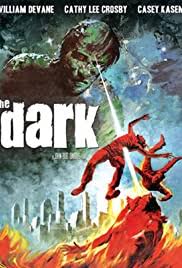
The killer and his laser beams look awesome on the poster for The Dark and I grade that promo artwork three-and-a-half stars. In the actual movie, though, the killer and his laser beams absolutely positively suck. These special effects alone impeded the advancement of all technology. When our killer unleashes his laser beams on several anonymous policemen in the grand finale, he clearly misses the mark but the policemen nonetheless take a mighty fall. In all seriousness, just thinking about these scenes now, I haven’t laughed this loudly since Richard Burton’s telekinesis in The Medusa Touch.

Just think all one had to do was light the killer on fire and BOOM! KABOOM! KABLOOEY! Just thinking about the killer’s demise now, I haven’t laughed so heavily since the paragraph before.

The Dark wastes a relatively distinguished cast — William Devane, Cathy Lee Crosby, Richard Jaeckel, and Keenan Wynn — and I find it ironic that fired director Tobe Hooper (replaced by John Cardos) later directed a flop horror film titled The Mangler.

Please remember, though, to be afraid, very afraid, of The Dark, especially since it’s possible that one’s head may explode from convulsive laughter.

The Medusa Touch (1978)

THE MEDUSA TOUCH (1978) *1/2
I could only empathize with Richard Burton’s character in The Medusa Touch in one way.

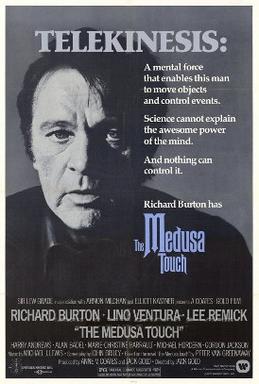
At some point during The Medusa Touch, I realized that I was seeing a cinematic disaster before my very eyes and I began staring right back at the screen especially when Burton’s John Morlar trotted out his telekinetic powers. Through my telecinematic eyes, I flashed back on Billy the Kid Vs. Dracula when the Old Count, played by veteran John Carradine, overacted with his eyes just like Burton did 12 years later. I laughed at both films more than I have at films that were aiming to make me laugh and failed.

Whether or not one appreciates The Medusa Touch boils down to how one feels about the film’s heavy flashback structure and the Burton lead performance.

I don’t know, personally speaking, I soured on the flashbacks by about the third time Lino Ventura’s French detective Monsieur Brunel encountered a character who recalled a past event, normally a disaster, involving John Morlar at various evolutionary stages in his telekinesis. We know, though, with dread certainty that whenever there’s a flashback, somebody’s going to die. Morlar’s parents, his wife and her lover, Morlar’s neighbor, Morlar’s enemies at school, et cetera. Of course, the deaths grow progressively in number and more sensational until Morlar crashes planes into buildings and reduces cathedrals to rubble.

As far as Burton’s performance, I never felt much of anything for John Morlar and that blame falls on the shoulders of the man who could be both one of the best and one of the worst actors in the world before his death in 1984. I feel even more admiration for Sissy Spacek’s work as the title character in Carrie, after watching Burton go down in flames in The Medusa Touch. Spacek creates such overwhelming empathy for her character that we get caught up in the predominantly teenybopper melodrama and we truly care about what happens to Carrie White. We don’t want to see any more misfortune befall this character, and we are on her side when the pigs’ blood flies late in the picture. Morlar could not even rouse me to a superficial hatred that immediately disappears at the end credits, and by all rights he should have. I just heard Burton mouthing dialogue and being guilty of worse overacting with his telekinesis.

Not only does Morlar have telekinesis, he’s apparently unstoppable. Nobody can kill him in this picture, though two main characters give it the old college try. Morlar takes a licking and keeps on ticking. Simply unbelievable. Morlar spends almost the entire movie in a hospital bed on life support and that helps explain why Burton gives his performance basically in flashback; it should be mentioned though Morlar’s brain occasionally causes the attached monitor to go schizoid. Nobody casts a star the stature of Burton and then have him bed ridden for the film’s duration.

Between telekinesis and invincibility, I found little to believe in during The Medusa Touch. I just wanted it to be over so I could quickly begin the healing process.

Exorcist II: The Heretic (1977)

day 100, exorcist ii the heretic

EXORCIST II: THE HERETIC (1977) Three-and-a-half stars
There’s movies that are hated and then there’s EXORCIST II: THE HERETIC, a movie that received hate on an epic, violent level since it’s considered the worst sequel ever made and one of the worst films ever.

Sequels are often penalized for being too much like the original and then ironically enough, EXORCIST II has been lambasted for being nothing like the original mass phenomenon known as THE EXORCIST.

EXORCIST II director John Boorman admitted to not even liking the original film and his sequel is a direct challenge to the film that came before it.

I just want to know, did Boorman and fellow director William Friedkin ever get into a shouting match that degenerated into fisticuffs?

In a 2017 interview with IndieWire, Friedkin said, “I saw a few minutes of EXORCIST II, but that was only because I was in the Technicolor lab timing a film that I had directed — I forget which one — and one of the color timers at Technicolor said, ‘Hey, we just made a a print of EXORCIST II, would you like to have a look at it?’ I said OK. I went in, and after five minutes, it just blasted me. I couldn’t take it. I thought it was just ridiculous and stupid. But that was only five minutes, so I can’t make an ultimate judgement about it. It just seemed to me to have nothing to do with THE EXORCIST.”

Friedkin was also famously quoted, “And I looked at half an hour of it and I thought it was as bad as seeing a traffic accident in the street. It was horrible. It’s just a stupid mess made by a dumb guy — John Boorman by name, somebody who should be nameless, but in this case should be named. Scurrilous. A horrible picture.”

Boorman articulated on EXORCIST II in a 2005 interview with Film Freak Central, “The film that I made, I saw as a kind of riposte to the ugliness and darkness of THE EXORCIST — I wanted a film about journeys that was positive, about good, essentially. And I think that audiences, in hindsight, were right. I denied them what they wanted and they were pissed off about it — quite rightly, I knew I wasn’t giving them what they wanted and it was a really foolish choice. The film itself, I think, is an interesting one ­— there’s some good work in it — but when they came to me with it I told John Calley, who was running Warners then, that I didn’t want it. ‘Look,’ I said, ‘I have daughters, I don’t want to make a film about torturing a child,’ which is how I saw the original film. But then I read a three-page treatment for a sequel written by a man named William Goodhart and I was really intrigued by it because it was about goodness. I saw it then as a chance to film a riposte to the first picture. But it had one of the most disastrous openings ever — there were riots! And we recut the actual prints in the theatres, about six a day, but it didn’t help of course and I couldn’t bear to talk about it, or look at it, for years.”

Boorman lived out the Jean-Luc Godard quote “In order to criticize a movie, you have to make another movie.”

The critical (and audience) reaction to EXORCIST II seems based on whether or not you liked or hated THE EXORCIST. If you liked it, you hated EXORCIST II; if you hated it, you liked EXORCIST II.

For example, BBC critic Mark Kermode called EXORCIST II the worst film ever made because it trashed the greatest film ever made (THE EXORCIST). Leonard Maltin called it a “preposterous sequel” and Gene Siskel, who rated it no stars, chimed in with “the worst major motion picture I’ve seen in almost eight years on the job.” Siskel ranked THE EXORCIST No. 3 on his Top 10 list for 1973, behind only THE EMIGRANTS / THE NEW LAND and LAST TANGO IN PARIS.

Pauline Kael, a fan of Boorman and a Friedkin detractor, wrote of the original, “The demonic possession of a child, treated with shallow seriousness. The picture is designed to scare people, and it does so by mechanical means: levitations, swivelling heads, vomit being spewed in people’s faces. A viewer can become glumly anesthetized by the brackish color and the senseless ugliness of the conception. Neither the producer-writer, William Peter Blatty, nor the director, William Friedkin, show any feeling for the little girl’s helplessness and suffering, or for her mother’s. It would be sheer insanity to take children.”

Kael on the sequel, “This picture has a visionary crazy grandeur (like that of Fritz Lang’s loony METROPOLIS). Some of its telepathic sequences are golden-toned and lyrical, and the film has a swirling, hallucinogenic, apocalyptic quality; it might have been a horror classic if it had had a simpler, less ritzy script. But, along with flying demons and theology inspired by Teilhard de Chardin, the movie has Richard Burton, with his precise diction, helplessly and inevitably turning his lines into camp, just as the cultivated, stage-trained actors in early-30s horror films did. … But it’s winged camp — a horror fairy tale gone wild, another in the long history of moviemakers’ king-size follies. There’s enough visual magic in it for a dozen good movies; what it lacks is judgment — the first casualty of the moviemaking obsession.”

When I finally caught up with EXORCIST II in the late ’00s, I liked it and liked it enough that it held a spot on my top 10 list for 1977 for a few years. Yeah, I seem to be one of those crazy, wacky people who likes both THE EXORCIST and EXORCIST II. I’ll go ahead and be a heretic, and I’ll step up in defense of THE HERETIC.

— First and foremost, I have never seen a dull or non-visually captivating and compelling John Boorman film. His credits include POINT BLANK, DELIVERANCE, ZARDOZ, EXORCIST II, EXCALIBUR, and THE EMERALD FOREST. As Kael said in her review, EXORCIST II has enough visual magic in it for a dozen good movies. I mostly enjoy EXORCIST II on the level of a first-rate sound and light show. I see the film’s looniness as a virtue, but I can see where that would be a problem with viewers who love the Friedkin picture. Never even on a dare (let alone a review) do I hope to have to explain the plot of EXORCIST II.

— Boorman’s beef with THE EXORCIST centered on its treatment of Regan. Blair earned an Academy Award nomination for Best Supporting Actress for her work in THE EXORCIST, although credit should be given to stunt double Eileen Dietz and actress Mercedes McCambridge, who performed the most controversial scenes (Dietz) and provided the voice of the demon (McCambridge). EXORCIST II gives us a Blair in a transitional period between her child star past and her exploitation film future. She’s absolutely radiant, glowing even in EXORCIST II.

“Finally, one day, the script appears,” Blair said of EXORCIST II. “And I felt like, ‘Wow, this project is amazing, it’s perfect, it’s fabulous.’ They presented a really good next step, for the film, for the project, for Regan. You give me these amazing actors. Richard Burton, for me, that was what got me. To work with Richard Burton, that’s still, to this day, is one of the highlights of my life.”

— Ah yes, Burton (1925-84), an actor reputed to be one of the best actors on his best days and one of the worst actors on his worst days. You can virtually smell the alcohol on Burton during EXORCIST II, so you can guess which end of the Burton performance spectrum covers EXORCIST II. However, I’ll take a Burton train wreck performance over Sir Laurence Olivier’s later “take the money and run” career work in, for example, MARATHON MAN, THE BOYS FROM BRAZIL, and DRACULA, where Olivier (1907-89) stands out for his mannered (tortured) accent.

— I am fascinated by sequels that go in the opposite direction or even comment and criticize the previous entry, like BACK TO THE FUTURE 2 and GREMLINS 2: THE NEW BATCH. They’re far more interesting than sequels that are more or less just inferior copies of the original film, like, for example, JAWS 2 and OMEN II and many, many, many others.

I would even say that EXORCIST II has a more original, more daring vision than THE EXORCIST.