
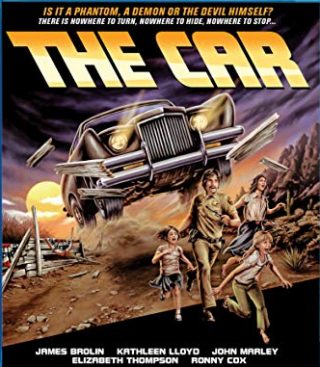
The Car (1977)

THE CAR

THE CAR (1977) *

The Devil and cars were huge in the movies of the 1970s.

Building on the momentum of ROSEMARY’S BABY in 1968, we saw THE BROTHERHOOD OF SATAN, THE EXORCIST (the biggest hit of them all that spawned many imitators and successors), THE DEVIL’S RAIN, THE DEVIL WITHIN HER, BEYOND THE DOOR, BEYOND THE DOOR II, THE OMEN and DAMIEN: OMEN II, and THE AMITYVILLE HORROR.

As far as cars, we had TWO-LANE BLACKTOP, DUEL, THE SUGARLAND EXPRESS, GONE IN 60 SECONDS, DEATH RACE 2000, THE GUMBALL RALLY, EAT MY DUST, GRAND THEFT AUTO, and SMOKEY AND THE BANDIT.

THE CAR, directed by Elliot Silverstein and distributed by Universal, combines The Devil and cars to make one stupefying, awful, patently ridiculous horror movie.

Yes, that’s right, a homicidal maniac automobile seemingly possessed … or just having a really, really, really bad day. Maybe the latter was just me watching THE CAR.

This movie just doesn’t know when to quit and it starts early with the murders of two bicycling teenagers in the majestic desert of Utah. We’re talking first few minutes and the film wastes absolutely no time in establishing its basic pattern. Maybe I should have turned off the subtitles, because they provided the evocative forewarning “Ominous instrumental music.” I knew the bludgeoning music was coming, though, because I’ve seen a movie or two before, especially a horror movie. Ominous instrumental music indeed, especially when it sounds like 50 horror film musical scores piled up into one super bad score. Forget the killer car next time, I want the movie about the killer musical score. Tagline: “They could not believe their ears, until it was too late. … THE MUSICAL SCORE FROM HELL will make your eardrums bleed. Coming soon to a theater near you.”

Every 10-15 minutes, at least, we are beaten with a ridiculous death scene or, barring that, a scene of peril just for variety. That ominous instrumental music, all them close-ups of the customized 1971 Lincoln Continental Mark III (built by George Barris, who previously brought us the Batmobile for the 1966 BATMAN), and Silverstein’s overall poor handling of action. At times, the vehicles look like they’re being artificially sped up.

Unfortunately, in between those violent scenes, we are served a steady diet of banalities and unpleasantries, only adding insult to injury.

For example, just about every scene with veteran character actor R.G. Armstrong (1917-2012) applies the unpleasant extra thick. He beats on his wife and insults just about everybody in sight. Never mind his slurs against Native American character Chas (played by Henry O’Brien in his final feature film). He’s a nasty old man. Honestly, why is his character Amos not killed? You’re right, it must have something to do with the explosives needed for the grand finale … and, before that, Sheriff Everett (John Marley) needs to be killed rather than Amos so Wade (James Brolin, who seems to be hired when Sam Elliott is unavailable), our main human protagonist, can take charge. It all makes sense.

Our title character is maddening to the nth degree and we have already touched on why, but let’s pursue it more.

Sure, it can kill a main character by driving through her house in the ultimate display of supernatural power. This character, Lauren (Kathleen Lloyd), the lover of the protagonist, turns her back to the window as she speaks to Wade on the phone. This means, however, that we can see the car coming straight for her through her window. This scene is supposed to be a highlight, a real heart breaker or at least a real tense moment since we see the murderous car well before her, but, like virtually every other scene in THE CAR, it’s laughably bad in a bad way.

Just like the scene that establishes the car’s need for revenge against Lauren. Safe on the hollowed grounds of a cemetery, Lauren really lets our title character have it, resorting to chickenshit and a son of a bitch. That’s obviously going too far, even before she tosses a tree branch at it. She asked for her auto demise. I should mention that she’s a school teacher whose marching band students were chased into that cemetery by you know who. We have seen that scene archetype before, namely in Alfred Hitchcock’s 1963 classic THE BIRDS. THE CAR just drags this entire sequence out.

Then again, dragging it out describes the entire movie.

Our title character is especially maddening because it wastes two perfect opportunities to flatten Wade like a pancake. What’s that all about? We get the feeling that were it any other character and not the protagonist, it would be “Sayonara, sucker!” The first opportunity even gives us a cut from Wade in danger in the desert to being safe in a hospital bed. I hate cheap tricks like that.

Was there anything I liked about THE CAR? Fleeting moments, like glimpses of the Utah scenery as seen through filming locations St. George, Snow Canyon, Zion National Park, Glen Canyon, Hurricane, the Mount Carmel Tunnel, and Kanab. I would have preferred a 96-minute nature documentary on this area over THE CAR.

I knew I was in trouble when THE CAR starts out with a quote from Church of Satan leader Anton LaVey (1930-97) and The Satanic Bible.

LaVey also previously had a hand in the making of THE DEVIL’S RAIN, another godawful horror movie.

Sometimes, it seems like even the Devil just can’t buy a break.
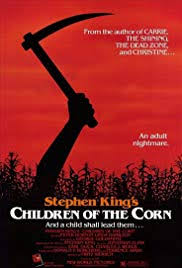
Children of the Corn (1984)

CHILDREN OF THE CORN

CHILDREN OF THE CORN (1984) One star

CHILDREN OF THE CORN is yet another textbook example of a film that cannot be taken seriously although it would love to be considered a serious film. We know that ‘cause we read an opening title like STEPHEN KING’S CHILDREN OF THE CORN, bashing us over the head this film wants to be a major event in our lives rather than a borderline incoherent, rambling supernatural thriller with pseudo-religious hogwash and brutal thriller machinations as its main selling points.

I will be the first to admit my ambivalence toward Stephen King, as well as Tom Clancy, John Grisham, Laurel Hamilton, Dean Koontz, and every other author who seems to have built-in access to a guaranteed mass audience every single time they publish even their napkins. Kmart, Walmart, and your friendly local supermarket determine the ultimate literary value of a select few writers and the rest of us hacks wallow in anonymity and simmering jealousy.

Fortunately, and unfortunately, I am well-versed in Stephen King film adaptations, probably just as much as you are at home. For every successful adaptation, like STAND BY ME and THE SHAWSHANK REDEMPTION, there’s absolute doggerel like CUJO, MAXIMUM OVERDRIVE, and DREAMCATCHER that rate among the most torturous movie experiences. In fact, I’d rate DREAMCATCHER high up among my top five worst movie theater experiences. One day, I’ll have to sit down and concentrate on that list.

CHILDREN OF THE CORN rates as bad King film adaptation. The rabid cult following may disagree but they’re not writing this review.

First and foremost, this is another King adaptation with religious poppycock galore. I traditionally despise religious fanaticism in the movies ‘cause it’s used by filmmakers as a cheap exploitation tactic. I hated, hated, hated this approach in films like AMITYVILLE II: THE POSSESSION, CARRIE, and THE OMEN. Are we supposed to cheaply laugh at somebody’s faith ‘cause they’re overzealous suckers and we’re in on the know and the joke they’re suckers?

How are we supposed to react to the evil corn, the pontification, and the music recycled from THE OMEN every time our filmmakers — led by director Fritz Kiersch — want us to pay attention. I have what’s called “bad laughs” and lots of them over the running time of CHILDREN OF THE CORN.

There’s a gruesome opening scene: The kids of Gatlin, Nebraska (introductory title: “GATLIN, NEBRASKA — THREE YEARS AGO”), kill their fathers and mothers and grandfathers and grandmothers and “The Blue Man.” See, a couple shady little individuals calling themselves Isaac and Malachi are instructed by “He Who Walks Behind the Rows.”

At this point, we should make a crucial distinction that just might save your life or at least guide you toward a better movie rental: In Nebraska, corn fields command kids to kill all the adults and make them sacrificial fodder. Meanwhile, in Iowa, corn fields instruct farmers to build a baseball diamond and they will come, well, except for Ty Cobb.

Anyhoo, Isaac (John Franklin) establishes a tyrannical regime of kids opposed to “sex, drugs, and rock ’n’ roll.” He’s a babbling pseudo-religious visionary with bad make-up. I laughed at Isaac’s pontification more than I have at some comedians over an entire career, because Isaac is a power-hungry miniature twit.

Malachi is the brute enforcer, a red-headed Jason Voorhees minus the hockey mask. He’s played by Courtney Gains, one of the best faces of 1980s movies. Sure we all remember Courtney Gains. George Constanza remembers him as the evil video store clerk in a “Seinfeld” episode. Gains appeared in BACK TO THE FUTURE, THE ‘BURBS, CAN’T BUY ME LOVE, and SECRET ADMIRER. For example, he tried cutting in on George McFly with Lorraine Baines at the Enchantment Under the Sea dance in good ole 1955. I’d rather talk more about Courtney Gains and his career than go back to reviewing CHILDREN OF THE CORN.

Where was I again? Who am I?

Anyway, Peter Horton and Linda Hamilton play our resident clean-cut wholesome All-American couple taking a trip inside a clean-cut wholesome All-American nightmare only found within a bad horror movie. These young lovers violate the Number One rule of interstate travel: ALWAYS STAY ON THE HIGHWAY. It’s almost like they never watched THE HILLS HAVE EYES.

This is yet another one of those “Of course” movies, because we say of course, they find a run down gas station with no telephone. Of course, the gas station owner’s a diabolical, shady old man in cahoots with the evil kiddos. Of course, the husband Burt (Horton) sees and hears something OVER THERE, always OVER THERE, and checks it out while the wife Vicky (Hamilton) wants to leave. Of course, they never do leave (until the end of the movie) and must fight through a living Hell to survive.

Next time, however, I suggest they drive through Iowa and find the Buddy Holly Crash Site near Clear Lake. It’s a long walk to the shrine of Holly, Ritchie Valens, and the Big Bopper, but a must if you love rock ‘n’ roll.

Back to the old man who’s the gas station attendant. He’s played by R.G. Armstrong in not one of his finest screen moments. Armstrong plays the role of a character whose function is that of the corpse in a self-contained murder sequence in a horror film, where it takes untold minutes to reach a destination we already predetermined in our heads after having watched countless self-contained murder sequences in horror films. Armstrong (1917-2012) must have rapidly slipped in his old age, considering that he survived THE BEAST WITHIN just a couple years before.

There’s also a little girl named Sarah, another pint-sized visionary. Her endearing and redeeming character trait is that she draws pictures of everything. Of course, Malachi wants to curb her artistic inclinations and of course, Isaac defends her visionary gifts, conflict among the ranks of the evil kiddos that only escalates during CHILDREN OF THE CORN.

I’d rather have looked at an exhibit of Sarah’s illustrations than watch CHILDREN OF THE CORN.

That’s because CHILDREN OF THE CORN bludgeons us with every cheap shock tactic of the bad horror movie.

There’s a lot of thunder and lightning, fire and brimstone, and loud music. And there are way too many scenes built on tight framing so we’re supposed to be scared on cue by an unexpected object jumping into the frame. The scariest accomplishment, however, of CHILDREN OF THE CORN is that it developed a cult following.