Black Christmas (1974)

BLACK CHRISTMAS

BLACK CHRISTMAS (1974) Three stars

Watching BLACK CHRISTMAS for the first time, one might be surprised just how many standards of the slasher film can be seen during this 1974 Canadian chestnut from director Bob Clark.

Let’s see, we have an opening shot later repeated by John Carpenter’s HALLOWEEN, a killer who racks up a rather impressive body count, POV shots from the killer’s perspective, obscene phone calls from the killer following every killing, plot twists (including the location of the caller), “The Final Girl,” and a shock ending, as well a holiday theme. BLACK CHRISTMAS basically synthesized elements that were already present during previous films like PSYCHO, PEEPING TOM, and Mario Bava movies BLOOD AND BLACK LACE and TWITCH OF THE DEATH NERVE into a single horror film narrative.

The plot also echoes “The Babysitter & The Man Upstairs” urban legend, so we already know the location of the caller. Still, the characters do not, so it’s a jolt hearing “The call is coming from inside the house.” Several movies, notably BLACK CHRISTMAS and WHEN A STRANGER CALLS, have relied on this angle for their chills and thrills.

A real-life case has been credited for inspiring the urban legend.

On Mar. 18, 1950, 13-year-old babysitter Janett Christman was raped and strangled to death in Columbia, Missouri, three days before her 14th birthday. Mr. and Mrs. Ed Romack found the body when they returned home, but, fortunately, their 3-year-old son Gregory was still alive, sleeping in his room. From the AP story, “Prosecuting Attorney Carl Sapp said blood was smeared through the house, indicating the girl put up a terrific struggle. … Footprints were found in a sleet-covered area near a broken window in the house. Police believe the intruder crawled through the window. The state highway patrol also is processing fingerprints found at the scene.”

More from the report, “An electric iron cord was twisted around the girl’s throat. Her scalp had been pierced several times by an instrument, apparently similar to a small lead pipe.”

Christman may have attempted to call the police around 11 p.m. the night of her death. Columbia policeman Roy McCowan took a call from a frightened girl who told him to “come quick.” “I urged her to calm down and just tell me where she was,” he said. “Then there was silence — not the sound of a receiver being hung up — just silence.” The Romacks’ phone was discovered “improperly placed on the instrument.”

Christman’s murder remains unsolved.

Just a few years earlier in Columbia, Stephens College student Marylou Jenkins, a white woman, was raped and murdered with an electric cord (reportedly from a lamp) twisted around her throat. An all-white jury convicted black man Floyd Cochran of the crime and he was executed Sept. 26, 1947 in the Missouri State Penitentiary Gas Chamber in Jefferson City. Cochran was originally arrested for murdering his wife with a shotgun and then he confessed to raping and murdering Jenkins.

For his last meal, Cochran ordered but did not partake in consuming a T-bone steak, french fries, scalloped corn, cream gravy, bread, butter, cake, and coffee. He died at the age of 36.

From 1938 through 1989, Missouri put to death 40 inmates in the gas chamber at Jefferson City, with John Brown the first on Mar. 3, 1938 and George “Tiny” Mercer the last on Jan. 6, 1989. Mercer was the first person from Missouri executed since 1965.

Just about seemingly every horror movie in existence shoots for a slambang ending, so we leave it discussing just what happened inside our heads or with all our friends and loved ones who have also seen this movie. BLACK CHRISTMAS gives us a rather unconventional ending, in that we are left unsure of the fate of protagonist Jess (Olivia Hussey) as she’s alone in the sorority house with the killer. Also, we never find out the real identity of the killer other than he’s named “Billy” and very rare indeed is the horror movie (especially a slasher) without a great big reveal in the grand finale. You just might have to be a fan or at least more forgiving of an ambiguous ending to appreciate BLACK CHRISTMAS. Either way, though, it will be discussed.

Like the later HALLOWEEN, BLACK CHRISTMAS thrives on atmosphere. That’s what they both do best and why fans appreciate them all these decades later.

Both films have rather distinguished casts for low-budget horror movies. Hussey came to fame during her teenage years for her performance as Juliet in Franco Zeffirelli’s 1968 ROMEO AND JULIET. Keir Dullea played astronaut Dave Bowman in both 2001: A SPACE ODYSSEY (1968) and later 2010 (1984); Dave uttered the famous words, “Open the pod bay doors please, HAL.” Margot Kidder (1948-2018) appeared previously in Brian De Palma’s 1973 shocker SISTERS and subsequently made her fame as Lois Lane in four Superman movies. Character actor John Saxon’s six-decade career includes ENTER THE DRAGON, TENEBRAE, A NIGHTMARE ON ELM STREET, and FROM DUSK TILL DAWN.

Director, screenwriter, and producer Clark (1939-2007) is best known for his two radically different nostalgia pieces, PORKY’S and A CHRISTMAS STORY. Yes, please wrap that magnificently designed brain around the fact that Clark directed both BLACK CHRISTMAS and A CHRISTMAS STORY. Louisiana born Clark found his greatest success up north in Canada. PORKY’S supporting actors Doug McGrath and Art Hindle both appear in BLACK CHRISTMAS.

Kidder almost steals the show in BLACK CHRISTMAS as the drunken, profane sorority girl Barb. She rips into her dialogue with extra relish. Hussey makes for a good entry point and rooting interest. Saxon knows how to maximize his screen time.

For horror movie fans who have not yet seen BLACK CHRISTMAS, I fully recommend amending it immediately.

Night of the Lepus (1972)

NIGHT OF THE LEPUS (1972) Three stars

Janet Leigh (1927-2004) famously said that she never took another shower after her iconic scene in PSYCHO.

Wonder what she said after her performance in William F. Claxton’s NIGHT OF THE LEPUS.

Reportedly, Leigh said “I’ve forgotten as much as I could about that picture.”

Well, Claxton ain’t quite Hitchcock and NIGHT OF THE LEPUS ain’t quite PSYCHO, but this 1972 picture certainly deserves a far better reputation. Like PLAN 9 FROM OUTER SPACE, it’s simply just too darn entertaining to be anywhere near the “worst movie ever made.”

After all, it’s not every day that you see a bad movie featuring Leigh, Stuart Whitman, Rory Calhoun (1922-99), DeForest Kelley (1920-99), Paul Fix (1901-83), and a cast of all-star killer rabbits. They’re playing it straight and not condescending to the material. Give them at least that much credit.

The single biggest gripe against NIGHT OF THE LEPUS: The killer rabbits are not scary. I don’t know if there’s ever been a single review of NIGHT OF THE LEPUS that’s gone without making a major note about the premise itself and then the botched execution of that bad idea.

Claxton and crew obviously worked very hard to make the homicidal rabbits more imposing and terrifying. They constructed miniature sets for regular-sized rabbits to run wild through, filmed them from angles conducive to making the rabbits appear larger-than-life, and cooked up very convincing guttural noises for our furry friends when they’re in full-on beast mode. Basically, our title characters look like they’re running wild on the set of a Western filmed in the back lots of Arizona … and I believe that’s exactly what happened.

Maybe one day they’ll cross NIGHT OF THE LEPUS with THE TERROR OF TINY TOWN.

As far as rabbits not being scary, I do believe these complainers have not encountered that dynamite rabbit from MONTY PYTHON AND THE HOLY GRAIL and Ted “Theodore” Logan’s brush with the Easter Bunny from Hell in BILL AND TED’S BOGUS JOURNEY.

Rabbits can be scary. In theory, anything could be scary, if done right.

Honestly, I don’t know if I could handle a truly scary killer rabbit picture.

The producers did their best to obscure the nature of the killers in promoting NIGHT OF THE LEPUS, apparently booking on the fact that millions did not know the Latin word for rabbit.

They believed that people would not waste their time and money on a killer rabbit picture.

Idiom: “A fool and his money are soon parted.”

Well, here we are at least 47 years after the release of NIGHT OF THE LEPUS and I received a DVD copy of the film for an early Christmas present. It’s a gift that’s already kept on giving.

On first re-watch, I enjoyed NIGHT OF THE LEPUS all over again and I actually enjoyed it more at the age of 41 being able to see all its flaws more clearly than when I first watched the film in late prepubescence. I enjoyed all the melodramatic efforts to make the rabbits scary (especially the bloody aftermath of rabbits on the rampage scenes), all the scientific mumbo-jumbo, all the scenes of the rabbits on their attack route (Pamplona with rabbits and no people), all the blatantly obvious set-ups for blatantly obvious payoffs, the ridiculous final plan to exterminate the rabbits and restore natural order, and I especially loved watching the all-star cast diligently keep a straight face through all the silliness and earn their paychecks.

It’s still a notch below such contemporaneous classics as FROGS, GODZILLA VS. THE SMOG MONSTER, and INVASION OF THE BEE GIRLS.

Frenzy (1972)

FRENZY

FRENZY (1972) Four stars
Legendary director Alfred Hitchcock (1899-1980) used the theme of the falsely accused several times: THE LODGER (1929), MURDER! (1930), THE 39 STEPS (1935), YOUNG AND INNOCENT (1937), THE TROUBLE WITH HARRY (1955), THE WRONG MAN (1956), NORTH BY NORTHWEST (1959), and, for the last time, FRENZY.

FRENZY, Hitchcock’s penultimate film in a 53-film career that lasted from silent through sound, found Hitchcock returning to not only one of his favorite themes but also to his native land of England for the third and final time since his exodus to Hollywood that began in 1940 with REBECCA, Hitchcock’s only Academy Award for Best Picture winner.

I have not seen every one of Hitchcock’s falsely accused movies (MURDER! and THE TROUBLE WITH HARRY have eluded me thus far in life), but I believe it is safe to say that Richard Ian “Dick” Blaney (Jon Finch) in FRENZY presents us with the Hitchcock falsely accused protagonist with the greatest odds against him in proving his innocence during the movie. Blaney’s not an inherently likeable character, he’s not played by a big charismatic movie star like Henry Fonda or Cary Grant, so it does take some time for this Blaney to grow on us. We have all had stretches in our lives where we’ve been down on our luck and it seems everything’s against us. Blaney has it even worse.

We viewers know Blaney’s not the killer. That’s because we are shown the true identity of “The Necktie Killer,” a serial killer and rapist terrorizing London town, early on in the picture, Blaney’s friend Bob (Barry Foster). Blaney definitely seems like the most obvious suspect as the circumstantial evidence piles up against him, with a little help from his old friend Bob. We root for Blaney to prove his innocence and for Bob to be caught because this “Necktie Killer” is one of the nastiest pieces of work that we have ever seen on a movie screen.

FRENZY takes it down to the very end of the movie before playing its final hand. The film is a reminder why Hitchcock is still called “The Master of Suspense” decades after his death.

Where did the themes of the falsely accused and fear of the police come from in Hitchcock? A childhood experience, of course.

One day, Hitchcock’s father decided upon an unique punishment for the troublesome young lad. You can just imagine how much of a devious little brat Hitchcock was as a child.

“I must have been about 4 or 5 years old,” Hitchcock told Francois Truffaut in 1966. “My father sent me to the police station with a note. The chief of police read it and locked me in a cell for five or 10 minutes, saying, ‘This is what we do to naughty boys.’”

Truffaut followed up with the question why did Hitchcock’s father punish him.

“I haven’t the faintest idea,” Hitchcock said. “As a matter of fact, my father used to call me his ‘little lamb without a spot.’ I truly cannot imagine what it was I did.”

Hitchcock was in his early 70s when he made FRENZY, and it’s not a work that one would necessarily associate with an older man. It pulsates with a certain anger, especially through the down-on-his-luck protagonist, and that’s a state associated with younger men.

There’s a rape and murder sequence in FRENZY that’s even more unsettling than anything in PSYCHO, since it goes on far longer than any of the murders in PSYCHO.

Anthony Shaffer’s screenplay also expresses a tremendously morbid sense of humor that befits Hitchcock. For example, a doctor in a pub says, “We haven’t had a good juicy series of sex murders since Christie. And they’re so good for the tourist trade. Foreigners somehow expect the squares of London to be fog-wreathed, full of hansom cabs and *littered* with ripped whores, don’t you think?”

In the midst of all this murder and mayhem, we get an unique relationship between Chief Inspector Tim Oxford (Alec McCowan) and his wife (Vivien Merchant) that’s both funny and touching. Mrs. Oxford serves her husband a variety of culinary delights and then dishes up her own take on the case of “The Necktie Killer” and these Blaney and Bob characters.

FRENZY is a powerful work by a grand master, one of many great films by Hitchcock.

Tourist Trap (1979)

TOURIST TRAP


TOURIST TRAP (1979) Three stars

TOURIST TRAP belongs to a rather fine and distinguished horror movie tradition I’ll call “American Gothic” (forget the famous 1930 painting by Grant Wood).

Other films that fit the bill are several Universal productions, Val Lewton productions beginning with CAT PEOPLE, HOUSE OF WAX, PSYCHO, NIGHT OF THE LIVING DEAD, THE LAST HOUSE ON THE LEFT, TEXAS CHAINSAW MASSACRE, EATEN ALIVE, THE HILLS HAVE EYES, and FUNHOUSE. As you can see, directors Wes Craven (1939-2015) and Tobe Hooper (1943-2017) both liked this mode.

“American Gothic” horror films are heavy on atmosphere, whether they’re filmed in black & white or color. They often delight in exposing the darker underbelly of American society after such happenings as the closing of the local slaughterhouse or the roadside wax museum that once existed on the right side of the road before it was bypassed. They sometimes take on the disintegration of the family unit or any number of issues plaguing our society. “American Gothic” films are rich in metaphorical readings.

Since it belongs to such a fine tradition, you’ll be able to recognize TOURIST TRAP right off the bat and see that it’s a dab of HOUSE OF WAX layered on top THE HILLS HAVE EYES or any of the seemingly hundreds of horror movie plots that begin with car trouble and the wrong gas station and end after several deaths.

Later on, you’ll note that it’s also a pinch of PSYCHO and a dash of TEXAS CHAINSAW MASSACRE — Chuck Connors plays wax museum proprietor Mr. Slausen in the grand old Anthony Perkins as Norman Bates style (a hallmark “American Gothic” element)  and production designer Robert Burns worked on both TEXAS CHAINSAW and THE HILLS HAVE EYES.

Just like the Bates Motel had seen better days before PSYCHO, so had Mr. Slausen’s “Slausen’s Lost Oasis.” Nowadays, Mr. Slausen’s wax museum would have been profiled by Roadside America, the guide to “uniquely odd tourist attractions,” and it could have survived and even thrived off this exposure.

If you find wax figures, mannequins, human replicas, et cetera, repellent or they weird you the fuck out, then you will enjoy TOURIST TRAP.

I especially recommend seeing the film before stopping in at Jesse James Wax Museum right off the highway in Stanton, Missouri.

It’s your patriotic duty.

TOURIST TRAP creates a creepy, claustrophobic atmosphere transcendent of the standard issue plot.

From the brilliant opening scene all the way to the bitter end about 90 minutes later, there’s somebody eyeball stalking the protagonists in every scene in TOURIST TRAP.

That somebody’s usually a wax figure, mannequin, human replica, etc., and that’s just creepy, for lack of a better word.

For many years, TOURIST TRAP itself met the fate of “Slausen’s Lost Oasis,” seemingly forgotten and consigned to being a relic of a bygone era of horror movies. Never mind Stephen King’s recommendation in his 1981 book “Danse Macabre.”

The film has made a comeback in recent years.

Cinemassacre’s “Monster Madness” featured TOURIST TRAP in 2014.

In July 2018, Joe Bob Briggs opened “The Last Drive-In with Joe Bob Briggs” by showcasing TOURIST TRAP.

It just goes to show you that nobody can ever keep an “American Gothic” horror film down for too long.

Psycho (1960)

day 22, psycho

PSYCHO (1960) Four stars
Oh, to get into any one of the seven DeLorean DMC-12s used in BACK TO THE FUTURE and rev that sonuvabitch up to 88.8 MPH with the date set for June 16, 1960, the release date for Alfred Hitchcock’s PSYCHO.

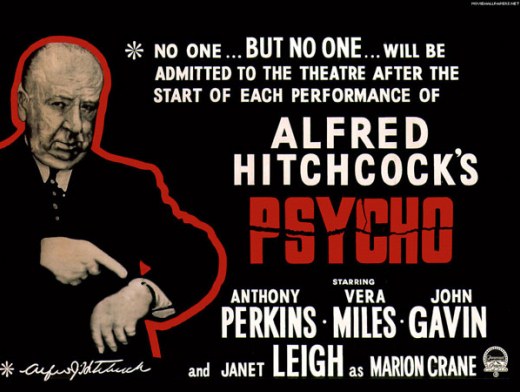
I’d go find the nearest theatre where it’s playing and put down the 69 cents. Of course, I would be sure to arrive early and hang around the lobby if necessary since Hitchcock made sure theaters enforced a strict “no late admission” policy.

Hitchcock even wrote a beautiful note, “Surely you do not have your meat course after your dessert at dinner. You will therefore understand why we are so insistent that you enjoy PSYCHO from start to finish, exactly as we intended that it be served.

“We won’t allow you to cheat yourself. Every theatre manager, everywhere, has been instructed to admit no one after the start of each performance of PSYCHO. We said no one — not even the manager’s brother, the President of the United States or the Queen of England (God bless her).

“To help you cooperate with this extraordinary policy, we are listing the starting times below. Treasure them with your life — or better yet, read them and act accordingly.”

Gotta love that Hitchcock and his ripped, twisted sense of humor.

Anyway, I would go back in time to see PSYCHO just to observe others’ reactions to it, to see their shock, to see their absolute terror at certain moments. They would not have possibly known all the surprises in store for them, while viewers for the last nearly 60 years have not had the benefit of watching PSYCHO with a clean slate. Since its release, PSYCHO has been analyzed, overanalyzed, parodied, satirized, and its famous shower scene long ago replaced the Odessa Steps sequence from BATTLESHIP POTEMKIN (1925) as the most fetishized scene in movie history.

Every time I watch PSYCHO, I am gobsmacked by just how audacious Hitchcock and gang were in making it. Start the movie with a love affair in a seedy hotel? Check. Show the heroine in her bra multiple times? Check. Kill off the heroine played by a big movie star halfway through the film? Check. Start out with the theft of $40,000 and more or less drop it after the death of the heroine? Check.

That’s just the tip of the iceberg.

Of course, none of that might seem the least bit audacious in 2018, but please keep in mind the Motion Picture Production Code dominated Hollywood movies from the early 1930s through 1968. PSYCHO helped chip away at that damn archaic code.

Everybody knows the plot by now. Marion Crane (Janet Leigh) steals $40,000 from her employer’s client and she’s on the lam hoping to get together with her lover Sam (Sam Loomis, played by John Gavin). We hear the voices that are inside her head (her mind and by extension our minds are obsessed with the money) and Hitchcock once again proved he’s the Master of Suspense by making a policeman’s stop and Marion’s drive in the pouring rain as tension-filled as any of the death scenes. With the rain beating down on her poor, weary windshield wipers, a conscience-stricken Marion stops at the famous Bates Motel with its 12 cabins and 12 vacancies.

There we meet proprietor Norman Bates (Anthony Perkins), a fictional character in Robert Bloch’s novel and Hitchcock’s film with roots in the real-life Wisconsin murderer and grave robber Ed Gein (an inspiration for THE TEXAS CHAINSAW MASSACRE’s Leatherface). Gein, for example, loved to make wastebaskets from human skin. Unlike later slasher movie super villains Michael Myers and Jason Voorhees, Norman speaks and he does not wear a mask. This makes Norman Bates far more fascinating than any of the slasher film madmen descended from PSYCHO.

Norman loves taxidermy and he’s got mother issues.

Otherwise, he seems like a good, old-fashioned All-American boy.

Oh, what happens to Marion? Let’s just say that in real life, Leigh stopped taking showers for years, preferring a bath after the fate of her character in PSYCHO.

Sam teams up with Marion’s sister Lila Crane (Vera Miles) and they try and track down Marion. Of course, all roads lead them and poor, poor Detective Arbogast (Martin Balsam) to Bates Motel and Norman Bates and his dear old mother.

In arguably his most audacious move, Hitchcock substituted protagonists from Marion Crane to Norman Bates. Perkins gives one of the great performances, one that will be discussed and cherished for centuries. He walks away with the movie.

The HALLOWEEN sequels continued to add more and more back story to the detriment of Michael Myers. Near the end of PSYCHO, Hitchcock gives us a phony baloney psychiatrist (Simon Oakland) and his phony baloney explanation for Norman Bates, but it’s taken to such an extreme that it plays like a parody. We could have done without this sequence, though, unlike the rest of the movie.

Early on in this review, I shared a note from Hitchcock. Now we go full circle.

A woman complained to Hitchcock that the PSYCHO shower scene had such a deleterious effect on her daughter that the young girl refused to shower.

Hitchcock replied, “Then Madam I suggest you have her dry cleaned.”

The Fly (1986)

DAY 5, THE FLY

THE FLY (1986) Four stars
I absolutely love it when a horror movie takes on more than just merely being a horror movie. These movies rank among the most pleasurable viewing experiences.

For example, George Romero’s DAWN OF THE DEAD (1978), a horror movie or a zombie picture that also passes through action and adventure, black comedy, silent and slapstick comedy, drama, gore galore, cinematic and social satire, surrealism, survivalism, and melodrama in addition to being great at the basic level of being a horror movie. All those extra traits put DAWN OF THE DEAD in the upper echelon.

Another example is David Cronenberg’s THE FLY (1986). It works on the most basic horror movie level but reaches greatness because it’s also a few other things it didn’t have to be. It grosses us out at times (rather, make that many times) but it also zaps us straight in the heart with its central storyline.

We’ve seen lots and lots of scientists over the years in loads and loads of pictures, but Jeff Goldblum’s Seth Brundle is one of those that sticks with you and stays in your mind. He’s not Colin Clive’s Dr. Frankenstein and he’s not Jeffrey Combs’ Herbert West, two other great cinematic scientists who embody more of the mad scientist archetype than Brundle. Brundle is more of the lovable eccentric that puts you in mind of what Albert Einstein must have been like in real life. We come to know this cinematic scientist more than just about any that spring to mind.

Brundle invents a teleportation device and he’s inspired to teleport himself one night after having successfully tried everything from Geena Davis’ stocking to a baboon. Of course, unbeknowst to him, a darn pesky housefly joins Brundle in the pod and throws a monkey wrench variable into this grand scientific experiment. Over the rest of the movie, Brundle transforms into Brundlefly.

Some viewers took what happened to Brundle as a metaphor for AIDS, but director Cronenberg said that his original intent was for an analogy for disease itself, terminal conditions such as cancer, and aging. This is one of the main sources for the emotional heft of THE FLY, because most of us grow old and die from a disease. Most of us are afraid, very afraid, indeed, it seems, and THE FLY plays on our fears.

On top of that, there’s a great tragic love story between Goldblum’s Brundle and Davis’ Veronica Quaife.

I highly doubt anybody expected such a moving love story coming in, especially considering Cronenberg’s previous films like SCANNERS and VIDEODROME.

And, let’s face a fact: Horror movies have not always been a great source for love stories.

Chris Walas deserved his Academy Award for Best Special Effects Make-up, but it’s the pleasant surprise love story and Brundle himself that elevate THE FLY.

Goldblum and Davis were a real-life couple, boyfriend and girlfriend during the making of THE FLY, and they were married from 1987 to 1990. They met during TRANSYLVANIA 6-5000 and later made a third movie together, EARTH GIRLS ARE EASY. For both actors, THE FLY would be their break into the mainstream and honestly, neither performer has ever done anything better.

Goldblum would play variations on scientists in seemingly every appearance for the next 30 years, in everything from JURASSIC PARK and INDEPENDENCE DAY to POWDER and THE LIFE AQUATIC WITH STEVE ZISSOU. It’s a role that fits him well and we can say that it’s become the Jeff Goldblum role just as we can say that Dabney Coleman (think NINE TO FIVE) and Hal Holbrook (think ALL THE PRESIDENT’S MEN) have come to develop their own respective roles.

Davis moved on to director Renny Harlin in both her personal and professional life, and her career never quite recovered after such flops as SPEECHLESS, CUTTHROAT ISLAND, and THE LONG KISS GOODNIGHT, the latter pair directed by Harlin. Davis’ career took off for a few years after THE FLY with hits like BEETLEJUICE, THELMA & LOUISE, and A LEAGUE OF THEIR OWN and an Academy Award for Best Supporting Actress for THE ACCIDENTAL TOURIST.

This is the rare remake that has obscured the original, which was made in 1958, directed by Kurt Neumann, and starred Vincent Price.

Goldblum wrote Price a letter telling one of the great hams in history, “I hope you like it as much as I liked yours.” Price, touched by the letter, went to see the remake and unfortunately, he did not quite return Goldblum’s affection for the original and called the remake “wonderful right up to a certain point … it went a little too far.”

In addition to both FLY movies, there’s been a lot of great fly moments throughout history, both screen and sound.

I’ll briefly guide you through three of them.

Norman Bates (Anthony Perkins), his stare, his voiceover, and a fly in the final moments of PSYCHO (1960): “They’re probably watching me. Well, let them. Let them see what kind of a person I am. I’m not even going to swat that fly. I hope they are watching. They’ll see. They’ll see and they’ll know, and they’ll say, ‘Why she wouldn’t even harm a fly.'”

Hungarian animator Ferenc Rofusz’s THE FLY (1980) won the 1981 Academy Award for Best Animated Short and it follows a fly on its journey from the woods to a house and finally on death’s end of a fly swatter. Oh, sorry, did I spoil that for you or the fly? Since it’s only three minutes long, this animated short might be a replacement if you have no desire to sit through 96 minutes of THE FLY (1986). In fact, you can watch the animated one 32 times in a row to substitute for the experience of the live-action flick.

English rock band Wire released the song “I Am the Fly” on its 1978 album CHAIRS MISSING and it features the great lines “I am the fly in the ointment / I can spread more disease than the fleas which nibble away at your window display / Yes, I am the fly in the ointment / I shake you down to say please as you accept the next dose of disease.”