Orgy of the Dead (1965)

ORGY OF THE DEAD (1965) ****
Officially, Stephen C. Apostolof (1928-2005) is the director of Orgy of the Dead, but it bears so many of the trademarks of its screenwriter, Edward D. Wood Jr., that it could play as the back end of a doubleheader with the immortal Plan 9 from Outer Space directed by Wood.

Loopy dialogue? Check. How about “Torture, torture! It pleasures me!” “A pussycat is born to be whipped.” “If I am not pleased with tonight’s entertainment, I shall banish their souls to everlasting damnation!” “Q: Is it some kind of college initiation? A: It’s an initiation alright, but not to any college as you or I know it!”

Criswell as narrator? Check. On top of being the narrator, Criswell stars as The Emperor, giving him more screen time than Plan 9 and he’s the source of most of the quotes in the above paragraph. Yeah, anyway, here’s the epic narration to open the film in true Wood (and Criswell) style, “I am Criswell. For years, I have told the almost unbelievable, related the unreal, and showed it to be more than a fact. Now I tell a tale of the threshold people, so astounding that some of you may faint. This is a story of those in the twilight time. Once human, now monsters, in a void between the living and the dead. Monsters to be pitied, monsters to be despised. A night with the ghouls, the ghouls reborn from the innermost depths of the world.”

Questionable acting? Check. Continuity errors galore? Check. Shoddy visual effects stemming from a micro budget? Check.

Unlike Plan 9 though, Orgy of the Dead features about one dozen bizarre topless dance sequences and that ultimately gives it the edge over Plan 9.

I love a film where the nominal protagonists have the only proper names. Of course, one of them answers to Bob and he’s a writer looking for inspiration. Boy, does he ever find it. Otherwise, in addition to The Emperor, we have The Black Ghoul and the bevy of dancers, Hawaiian Dance, Skeleton Dance, Indian Dance, Slave Dance, Street Walker Dance, Cat Dance, Fluff Dance, Mexican Dance, and Zombie Dance (great Cramps song). That’s all the plot synopsis necessary.

Orgy of the Dead, though, also leaves plenty enough room for poorly costumed Mummy and Wolfman as imperial henchmen. Pat Barrington essays a double role as Bob’s lady friend Shirley and the Gold Girl. The Gold Girl calls to mind Shirley Eaton’s infamous golden paint demise in the 1964 Bond film Goldfinger. At first, I thought they were saving the good girl’s nudity for last, like the bodaciously buxom good girl Debra Blee in the 1982 sex comedy The Beach Girls, but that’s not true in Orgy of the Dead since Barrington also played the Gold Girl.

Even the taglines for Orgy of the Dead (Titty Dance of the Dead describes the film more accurately) are incredible, especially “Are you heterosexual?” and “In Gorgeous ASTRAVISION and Shocking SEXICOLOR!” Shocking sexy color, indeed.

Blackenstein (1973)

BLACKENSTEIN (1973) No stars
Blackenstein just might possibly be the worst horror movie I have ever seen and off the top of my head, that means it competes alongside such turkey bombs as Jaws: The Revenge, Monster a Go-Go, and Robot Monster. Now, that would be one way to do a horror movie marathon.

Poor Eddie. Dude lost both arms and both legs in Vietnam and he’s bullied in a Veterans Hospital near the beginning of Blackenstein over ice cream. He does have the love of the lovely Dr. Winifred Walker, who hooks Eddie up with the brilliant surgeon and DNA researcher Dr. Stein. Dr. Stein can attach new limbs to Eddie and he’ll be walking just like you and I in no time says this preeminent doctor. Not so fast, my fiend, not with Dr. Stein’s dastardly assistant Malcomb around.

This super creep Malcomb falls instantly in love, well he calls it love anyway, with Dr. Winifred, and by the way, the actor who plays Malcomb (Roosevelt Jackson) gives one of the most subtle performances ever. He does not foreshadow any upcoming plot developments by staring a hole right through Dr. Winifred the first half-dozen scenes they share. That’s why I called him super creep just a couple moments ago, because he’s super creepy.

Malcomb declares his lust, er, love for Dr. Winifred, Dr. Winifred tells Malcomb no because she loves Eddie, Malcomb becomes all spurned and switches Eddie’s DNA with that of a caveman, and Eddie becomes, you guessed it, the title character. That’s when Blackenstein really takes a dive for the dumpster, as it departs from soap opera to horrible horror with soul music interludes that quite frankly belong in another movie.

Blackenstein first wanted to cash in on the coattails of the 1972 hit Blacula and I have read that American International, one of the best exploitation film outlets, chose Scream Blacula Scream over Blackenstein. Gene Siskel reviewed Blackenstein in 1975, when distributors tried passing it off as Black Frankenstein with their fervent Malcomb-like desire to siphon off the success of the Mel Brooks satire / affectionate tribute Young Frankenstein. Siskel managed to be extremely generous when he rated Blackenstein one-half star.

Blackenstein, in short, has got no soul and that’s why it failed then and fails now or any moment in time. Not only does it have no soul, which is certainly bad enough, it’s got no joy of filmmaking like Edward R. Wood’s Plan 9 from Outer Space and Ray Dennis Steckler’s The Incredibly Strange Creatures Who Stopped Living and Became Mixed-Up Zombies, both of which are somehow considered worse than Blackenstein. The director of Blackenstein should be glad we cannot remember his name without an Internet search party.

Message from Space (1978)

MESSAGE FROM SPACE

MESSAGE FROM SPACE (1978) *

It took two tries to make it all the way through Kinji Fukasaku’s MESSAGE FROM SPACE, one of the first of many STAR WARS rip-offs that only make you appreciate more what George Lucas and gang did in their movies.

How does MESSAGE FROM SPACE rip off STAR WARS? Let us count the ways. A soap, er, space opera, characters named Meia and Hans, a robot, interplanetary strife and destruction, aerial dogfights in space, laser beams, and a musical score by Kenichiro Morioka that should have been enough for grounds for a lawsuit from 20th Century Fox, John Williams, and the London Symphony Orchestra.

I struggled through MESSAGE FROM SPACE and it was a real cinematic endurance contest to get through its 105 minutes. I only made it through about 30 minutes the first try.

At one point in time, I thought about cutting MESSAGE FROM SPACE a little slack for its often lousy special effects, until I read that MESSAGE FROM SPACE cost $5-6 million. Okay, that’s about half of what 20th Century Fox spent on STAR WARS the previous year, but the budget for MESSAGE FROM SPACE apparently established a record (long since broken, of course) for largest budget for a Japanese movie. There went the slack, she be gone.

Vic Morrow (1929-82) sadly found himself at that stage in his career when he appeared in awful movies like HUMANOIDS FROM THE DEEP, GREAT WHITE, and MESSAGE FROM SPACE. Work is work is work, right? In MESSAGE FROM SPACE, Morrow plays a character named General Garuda and receives top billing in the cast above Sonny Chiba. Garuda Indonesia is the airline of Indonesia. Morrow seems to be drinking in every scene and if you had to act with an imitation R2-D2 named Beba, you’d be a full-blown alcoholic too.

This is one of those films not exactly helped out by a bad dubbing job.

I am normally one equipped with more empathy and enthusiasm than the average cinematic pleasure seeker for movies like MESSAGE FROM SPACE. I mean, for crying out loud, I have given four stars to INFRA-MAN, DRUNKEN MASTER, and PLAN 9 FROM OUTER SPACE, three incredibly ridiculous movies that immediately came to mind.

I just found scant pleasure to be experienced from MESSAGE FROM SPACE.

Hard to believe, right, when MESSAGE FROM SPACE features eight Liabe seeds. They resemble walnuts, glowing, magical walnuts that are the unifying plot device; bet Nuts.com would do killer business with a MESSAGE FROM SPACE remake. Rather than The Force, MESSAGE FROM SPACE only manages doze nuts. Bad joke, I know right, but the bad movie made me do it. I promise, I promise, I would never write anything like that otherwise.

Laserblast (1978)

LASERBLAST

LASERBLAST (1978) Two-and-a-half stars

LASERBLAST is a clunky piece of low-budget junk, but it is not without its charms.

For example, LASERBLAST takes a pot shot at STAR WARS, literally when our teenage protagonist Billy Duncan (Kim Milford) blows up a STAR WARS billboard on the side of the road with his laser cannon. It blows up real good. For that matter, just about everything blows up real good in LASERBLAST.

We’ll get back to that later.

For now, however, I’d like to touch on a couple of the contemporaneous pot shots taken at JAWS.

THE GIANT SPIDER INVASION, which came out a few months after JAWS in 1975, has Sheriff Jeff Jones (Alan Hale Jr.) say over the CB radio of the spider, “You ever see the movie JAWS? It makes that shark look like a goldfish!”

THE HILLS HAVE EYES includes a ripped poster of JAWS.

ORCA: THE KILLER WHALE has a killer whale kill a great white shark early on in the proceedings.

Coincidentally, both THE HILLS HAVE EYES and ORCA were released on the same day (July 22) in 1977.

Anyway, back to LASERBLAST, a quickie exploitation picture made to cash in on the teenybopper science fiction craze between STAR WARS movies. It later became known for being one of the worst movies ever made, especially after Mystery Science Theater 3000 lampooned LASERBLAST in a 1996 episode.

I feel almost bad for giving a mixed review to LASERBLAST, especially after writing positive reviews for THE KILLING OF SATAN, TROLL 2, THE TERROR OF TINY TOWN, and PLAN 9 FROM OUTER SPACE. Almost. Believe it or not, all four of those other films have a higher IMDb rating than LASERBLAST.

LASERBLAST surrenders itself to filler scenes that just scream out TACKY SEVENTIES. It feels like a bloated production even at 80-85 minutes.

David W. Allen (1944-99) worked on 48 films in visual effects or puppetry or stop motion animation over nearly a 30-year career. His notable credits include FLESH GORDON, THE HOWLING, CAVEMAN, Q: THE WINGED SERPENT, THE STUFF, WILLOW, and GHOSTBUSTERS II.

Allen’s alien stop motion work in LASERBLAST received better reviews than any other aspect of the film.

Unfortunately, the stop motion aliens do not have more screen time in LASERBLAST.

Milford is not exactly playing the greatest hero in the history of cinema. For example, he’s the first and only hero ever to be picked on by screen nerd extraordinaire Eddie Deezen; both Milford and Deezen made their screen debuts in LASERBLAST. Milford (1951-88) became known for his work in the musicals “Jesus Christ Superstar” and “The Rocky Horror Picture Show.” He plays most of the movie without a shirt.

Let’s face it, Billy Duncan has a bad, bad, bad life: His mother always seems to be going to Acapulco, his girlfriend’s grandpa freaks out on him and runs poor, poor Billy off, two dope-smoking cops love writing up Billy for speeding tickets, and Chuck (Mike Bobenko) and Froggy (Deezen) bully him. Froggy, by the way, has seen STAR WARS five times, according to one of the dope-smoking deputies (played by veteran character actor Dennis Burkley in the early stages of his career).

Billy’s life changes for the better when he finds that darn laser cannon in the desert. As it says on the poster, Billy was a kid who got pushed around then he found the power.

Billy, of course, uses the laser cannon to blow up a bunch of stuff real good before the stop-motion aliens come for him.

One car blows up about five times in LASERBLAST. They give us just about every conceivable angle.

Yes, it’s that kind of a movie.

Keenan Wynn and Roddy McDowall (his last name spelled “McDowell” in the credits) make glorified cameo appearances.

LASERBLAST is bad enough that McDowall’s Peter Vincent could have played it on the TV series “Fright Night” featured in FRIGHT NIGHT.

On the bright side, LASERBLAST is considerably better than “The Star Wars Holiday Special,” which has gone down in history as the biggest STAR WARS rip-off of them all.

Plan 9 from Outer Space (1959)


PLAN 9 FROM OUTER SPACE (1959) Four stars
Discourse around Ed Wood’s 1959 feature gives us two options: it’s either the worst movie ever made or it’s so bad that it’s actually good.

Having recently watched PLAN 9 twice, once near the 60th anniversary of the film’s initial release on July 22, I find that I disagree with both options, especially the first one.

It’s a great movie, because I traditionally equate personal enjoyment with greatness and I enjoy the living dead out of PLAN 9.

Wood’s films have been called “accidental avant-garde” or Wood didn’t know what he was doing and this sheer ineptitude created something arguably more bizarre. Wood’s films, like Ray Dennis Steckler’s THE INCREDIBLY STRANGE CREATURES WHO STOPPED LIVING AND BECAME MIXED-UP ZOMBIES and RAT PFINK A BOO BOO, exist in their own realm despite taking on many genres.

For example, in PLAN 9, we have horror, science fiction, action, adventure, and drama.

Sure, that seems like nothing special because a lot of movies yesterday and today and tomorrow mix and match genres, but just wait until you see PLAN 9.

What other movie would begin with a spiel from a psychic named “The Amazing Criswell” (1907-82) who became infamous for making “wildly inaccurate predictions.” (Aside from another Ed Wood film, of course.)

Criswell sets the tone for the rest of the movie right from the very start, “Greetings, my friend. We are all interested in the future, for that is where you and I are going to spend the rest of our lives. And remember my friend, future events such as these will affect you in the future. … My friend, can your heart stand the shocking facts about grave robbers from outer space?”

Wood had originally planned for GRAVE ROBBERS FROM OUTER SPACE to be his title, but financier J. Edward Reynolds, a devout Southern Baptist, found GRAVE ROBBERS offensive and Wood changed it to the title we all know and love. Wood and several cast members were even baptized at Reynolds’ church.

Taking into consideration the fascinating nature of the cast and Wood himself, you understand why Tim Burton’s fantastic ED WOOD focused so much time on PLAN 9.

— Criswell, given name Jeron Criswell King, became a fringe celebrity in Hollywood and he cut an entertaining figure at parties with his predictions. Criswell appeared on late night TV (he predicted 1966 on Johnny Carson), published his predictions in both magazines and newspapers, and wrote three books — “From Now to the Year 2000,” “Your Next Ten Years,” and “Forbidden Predictions” — and made a record titled “The Legendary Criswell Predicts Your Incredible Future” (which can be found online). Criswell’s friend and fellow PLAN 9 cast member Paul Marco released Criswell’s song “Someone Walked Over My Grave” after Criswell’s 1982 death, apparently because Criswell wanted it released that way.

— Finnish-American actress Maila Nurmi (1922-2008) became better known as “Vampira,” who hosted horror movies on her own series, “The Vampira Show,” from 1954-55 on KABC-TV in Los Angeles. Vampira is a combination of Morticia Addams, the Dragon Lady from “Terry and the Pirates,” and the evil queen from “Snow White.” Vampira sued horror movie host Elvira for $10 million for “infringing upon her trademark, public reputation and ability to market her lucrative character.” “The character was ripped off,” Vampira’s attorney Jan Goodman said. “Hopefully, my client will be fairly compensated and Cassandra Peterson will continue with her character and share the proceeds with my client.” The court ruled in favor of Elvira, “‘Likeness’ means actual representation of another person’s appearance, and not simply close resemblance.” Vampira played a silent role in PLAN 9 reportedly because she wanted absolutely nothing to do with the dialogue written by Wood.

— Hollywood legend Bela Lugosi (1882-1956) found his roles diminished greatly because his dependence on morphine and methadone for his sciatic neuritis became known by Hollywood producers. Lugosi and Wood struck up a friendship, and Wood cast Lugosi in GLEN OR GLENDA? and BRIDE OF THE MONSTER. Wood filmed Lugosi picking a flower in front of Tor Johnson’s home, which became Lugosi’s final work on film because the great actor died five months before production on PLAN 9 began. Lugosi’s absence obviously left a major hole in PLAN 9 and chiropractor Tom Mason stepped in for Lugosi in a way that predates the Bruce Lee subterfuge in GAME OF DEATH. It’s just as effective as GAME OF DEATH, as well, to get that out of the way. Mason stalks through his every scene in PLAN 9 with a cape over his face, a classic Lugosi gesture borrowed from his final performance as Dracula in ABBOTT AND COSTELLO MEET FRANKENSTEIN (1948). Legend has it that Lugosi was even buried in his cape.

— Swedish professional wrestler Tor Johnson (1902-71) appeared in 31 movie roles over nearly 30 years, mostly as a weightlifter or a strongman. Wood let the hulking Johnson speak in PLAN 9 and you will quickly realize why Johnson’s other roles were non-speaking. In fact, you might wish that he was mute like both Lugosi and Vampira in PLAN 9, but I find his dialogue as Inspector Daniel Clay strangely endearing, just like the movie itself, especially his line “I’m a big boy now, Johnny.” Johnson scared Groucho Marx on “You Bet Your Life” in 1954, where he weighed 387 pounds “soaking wet.” Groucho said, “With those measurements, you oughta be twice as attractive as Jayne Mansfield.” Johnson — played by fellow former professional wrestler George “The Animal” Steele in ED WOOD — also became a Halloween mask.

— Character actor Duke Moore (1913-76) had the distinction of his entire character actor career being spent in Ed Wood productions: CROSSROADS OF LAREDO, FINAL CURTAIN, NIGHT OF THE GHOULS, PLAN 9, THE SINISTER URGE, and TAKE IT OUT IN TRADE. In PLAN 9, he plays Lt. Harper, who’s not a very responsible gun owner. Lt. Harper touches his gun underneath his hat, holds it on top of his trench coat, and even points it at himself several times. According to Internet Movie Database trivia, Moore pointed the gun at himself deliberately to see if Wood would notice. Of course, Wood did not.

— Speaking of character actors, Lyle Talbot (1902-96) appeared in more than 150 films over a 56-year career. Talbot’s daughter Margaret wrote a book on her father called “The Entertainer: Movies, Magic and My Father’s 20th Century,” as Lyle worked in a carnival, as a hypnotist’s assistant, in theater, in the movies, and on TV. Lyle played Joe Randolph in 71 episodes of “The Adventures of Ozzie and Harriet” from 1956 to 1966. Lyle’s son, Stephen, played Gilbert on “Leave It to Beaver” (1957-63) and later became a journalist and documentarian. You will notice Lyle Talbot real quick in PLAN 9 because of the level of his performance.

— Dudley Manlove (1914-96, not Manlike, please, Auto Correct) has a voice that will make you think he’d be great in radio. Sure enough, looking up Manlove today, I discover that he worked on radio stations in Oakland and San Francisco. Manlove plays Commander Eros in PLAN 9.

— Independently wealthy, openly gay, and sex change seeking theatrical actor John “Bunny” Breckinridge (1903-96) made his only film appearance as “The Ruler” in PLAN 9.

Breckinridge’s obituary, “John ‘Bunny’ Breckinridge, an eccentric and troubled San Francisco millionaire who entertained grandly, served time in jail for vagrancy and was sued by his mother for lack of support, died Tuesday, November 5th, 1996 of heart failure in a Monterey nursing home. …

“Mr. Breckinridge, the great grandson of U.S. Vice President John Breckinridge and of Wells Fargo Bank founder Lloyd Tevis, was born in Paris. He spent time at Eton College and Oxford University in England and at the Atascadero State Hospital for the criminally insane.

“He was known for his flamboyant lifestyle, outrageous comments and penchant for perfume and costume jewelry. He performed in Shakespearean plays in England before coming to San Francisco in the late 1920s.

“He married the daughter of a French countess in 1927. The couple was divorced in 1929.

“‘I was a little bit wild when I was young, darling, but I lived my life grandly,’ he said.”

Bill Murray played Breckinridge in ED WOOD, so they’ve both got that going for them.

— Fumbling, bumbling, stumbling cop Kelton, played by Paul Marco (1927-2006), appeared in three Ed Wood productions and they form the “Kelton Trilogy” — BRIDE OF THE MONSTER, PLAN 9 FROM OUTER SPACE, and NIGHT OF THE GHOULS. Marco introduced Breckinridge to Wood, as the circle of friends around Wood expanded into his movies.

— Gregory Walcott (1928-2015) long regretted that he ever had anything to do with PLAN 9 FROM OUTER SPACE. From a 2000 Los Angeles Times article, “Drawbacks like this [Lugosi being dead] didn’t faze Ed Wood. He used a home movie of Lugosi and an impersonator. He used non-union crews and borrowed equipment. Walcott agreed as a favor, not even telling his agent, but regretted it instantly and for years thereafter. Virtually every reference guide labels PLAN 9 FROM OUTER SPACE the worst movie ever made.”

By the time (2000) that his old hometown of Wilson, North Carolina held a two-day Gregory Walcott Film Festival, Walcott (given name Bernard Mattox) had made peace with both Wood and PLAN 9.

“I didn’t want to be remembered for that,” Walcott said in the Times. “But it’s better to be remembered for something than for nothing, don’t you think?

“So I guess I owe Ed Wood an apology after all these years. Thanks, Ed.”

— Conrad Brooks (1931-2017), along with Walcott and Marco, appeared in Tim Burton’s ED WOOD and then, in his 80s, appeared in the 2015 PLAN 9 FROM OUTER SPACE remake directed by John Johnson and featuring such notables as Brian Krause, Camille Keaton, Mr. Lobo, and James “Angry Video Game Nerd” Rolfe.

Brooks, who played Patrolman Jamie in PLAN 9, was the last of the surviving Ed Wood actors.

— Wood (1924-78) unfortunately did not live to see the cult following that built up around PLAN 9 since 1980 when authors Harry and Michael Medved named it the “worst film ever made” in their book “The Golden Turkey Awards.” That pronouncement got the ball rolling.

Tim Burton’s rather feel good film only reinvigorated interest in both Wood and his filmography. ED WOOD treats PLAN 9 like a sacred text and jumps off the life story and filmography at that point. Wood’s later career included erotica, pornography, and even sexual education movies; Wood also wrote many pulp crime, horror, and sex novels.

ED WOOD (which undoubtedly cost more than all of the real Ed Wood’s films combined) also skips Wood’s alcoholism, but, hey, at least it does not skimp on his love of angora. (It’s also the most affectionate tribute from one director to another that I have ever seen, the film’s biggest strength.)

There’s even a Church of Ed Wood and if you go to www.edwood.org, you will have to click OK to “www.edwood.org says To answer your first question — yes, we’re serious!

“Woodism is a pop-culture-based religion created in 1996 by Reverend Steve Galindo. We follow the late cult director Edward D. Wood Jr., and we look to him as a savior. We at The Church of Ed Wood use Ed and his films to inject spirituality into those who get little fulfillment from more mainstream religions like Christianity. By looking at his films and his life, we learn to lead happy, positive lives. We strive for acceptance of others and of the self.”

I first encountered BRIDE OF THE MONSTER and PLAN 9 FROM OUTER SPACE around 12 years ago when Rob Zombie hosted “TCM Underground” on Turner Classic Movies, a show that I definitely miss since not having cable TV after the 2012 Election. I taped both movies, as well as Zombie’s bookend intros and outros for both, and that’s how I watched PLAN 9 twice recently.

I don’t write over 2,000 words on just any movie, so that only shows how much I love PLAN 9 FROM OUTER SPACE.

I love all the errors (boom mics visible, night-and-day day-and-night shifts during scenes), the cheesy special effects (love them flying saucers), the incongruous stock footage, the cast of goofball characters, the loopy dialogue, and, of course, Criswell’s narration.

BRIDE OF THE MONSTER (1955) Three stars; ED WOOD (1994) Four stars; PLAN 9 FROM OUTER SPACE (1959) Four stars

The Terror of Tiny Town (1938)

THE TERROR OF TINY TOWN

THE TERROR OF TINY TOWN (1938) Three-and-a-half stars

This is obviously the shortest Western ever made.

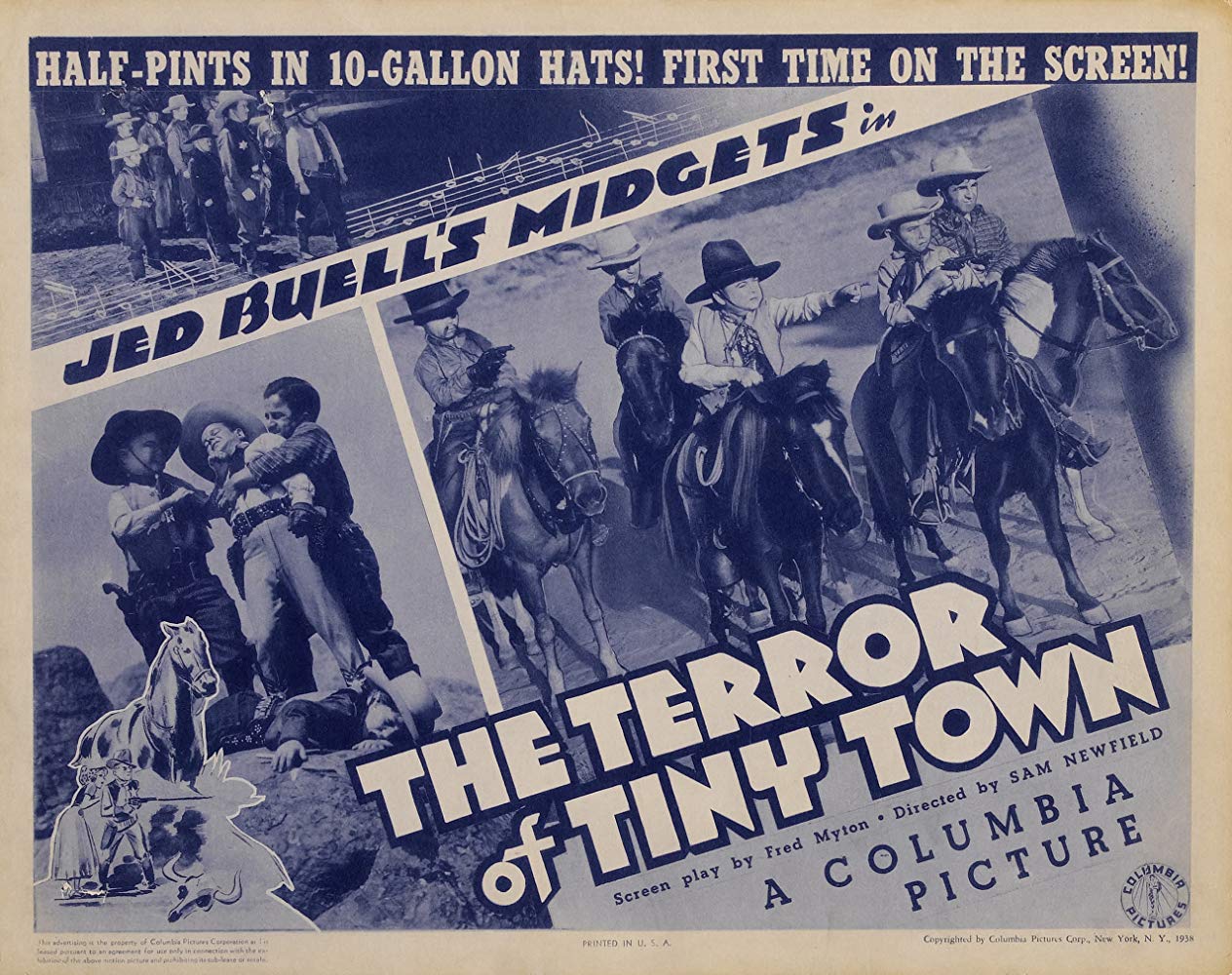
THE TERROR OF TINY TOWN owns the distinction of being the world’s only known Western musical starring midgets, hence the cheap wisecrack about it being the shortest Western ever made. We can be sure there’s many Westerns shorter than 62 minutes.

Exploitation film producer Jed Buell put out a casting call and he more or less put together the cast of the Munchkins before THE WIZARD OF OZ. We see just one non-vertically challenged cast member and that’s in the opening sequence.

Our announcer begins, “Ladies and gentlemen and children of all ages, we’re going to present for your approval a novelty picture with an all-midget cast, the first of its kind to ever be produced. I’m told that it has everything, that is everything that a Western should have.”

During this introduction, our hero Buck Lawson (Billy Curtis) and our villain Bat Haines (‘Little Billy’ Rhodes) just about shoot it out over who’s the star of the picture.

Buck Lawson, “I’m the hero. After this picture’s out, I’ll be the biggest cowboy star in Hollywood.”

Bat Haines, “I’m the villain. I’m the toughest hombre that ever lived, and I ain’t afraid o’ the biggest one o’ you. I’m the Terror of Tiny Town, and that’s the star part.”

Finally, the announcer, who could have been qualified to broker world peace or at least peace in the Middle East, gets Buck Lawson and Bat Haines to agree to let the motion picture play and prove who’s the star.

Judging by their subsequent careers, Curtis (1909-88) easily won.

You may remember him from his role as Mordecai in Clint Eastwood’s HIGH PLAINS DRIFTER.

Frankly, I was floored after looking up Curtis’ screen credits.

He appeared (mostly uncredited) in THE WIZARD OF OZ, MEET JOHN DOE, HELLZAPOPPIN’, SABOTEUR, BUCK PRIVATES COME HOME, LIMELIGHT, THE COURT JESTER, THE INCREDIBLE SHRINKING MAN, and PLANET OF THE APES, plus a multitude of TV shows. Apparently, Curtis hit on Judy Garland during the making of THE WIZARD OF OZ.

Curtis made his debut in THE TERROR OF TINY TOWN.

THE WIZARD OF OZ marked his third role and his first not in a Western. Curtis appeared in THREE TEXAS STEERS — a John Wayne picture — between TINY TOWN and OZ.

You can see why Curtis enjoyed the most successful career in TINY TOWN, because he gives the least stilted line readings.

If you watch THE TERROR OF TINY TOWN, please do not hunt me down if you hated all 62 minutes and then want to give me a piece of your mind because TINY TOWN sucked.

I’ll tell you a little secret right now: THE TERROR OF TINY TOWN, it’s not exactly a good movie and you can just ignore the three-and-a-half stars rating because these are not normal circumstances. I love it and enjoy it a great deal because it’s bad on an epic scale … it belongs in a special place in cinematic history alongside such infamous features as REEFER MADNESS and PLAN 9 FROM OUTER SPACE. I find all of them good for their own distinct reasons.

The announcer proved to be correct, in that THE TERROR OF TINY TOWN does have everything that a Western should have, at least plot wise. They filmed this basic plot a million times before TINY TOWN, I have no doubt. I mean, our villain pits two families against each other and the townspeople must organize to defeat “The Terror of Tiny Town,” and it all leads to an explosive final act. This basic plot was ancient many years before 1938.

Bottom line: THE TERROR OF TINY TOWN is a novelty picture, for sure, and I enjoy the novelty. If we’re being honest, every film exploits some form of novelty.

I find immense enjoyment from the sight gag of characters entering a saloon under the swinging doors, for example, and the ridiculous final showdown between hero and villain.

Unlike ZORRO THE GAY BLADE, TINY TOWN plays its Western musical story straight and does not beat us over the head with either its gags or its premise, at least after the credits and the announcer scene. It’s not a nudge-nudge wink-wink comedy like ZORRO THE GAY BLADE. It’s more funny than it might be otherwise because it’s played straight. The actors made no effort to be campy, but their stilted line readings help THE TERROR OF TINY TOWN achieve bad movie infamy.

Trivia: Jerry Maren (1920-2018) played one of the townspeople in THE TERROR OF TINY TOWN and he was the last surviving WIZARD OF OZ cast member and the last surviving Marx Brothers film cast member.