
Grand Hotel (1932)

GRAND HOTEL (1932) ***
MGM once boasted More stars than there are in Heaven and as I typed out those words, sounds and images from Grand Hotel played on the motion picture spread inside my head.

Of course, because Grand Hotel put Greta Garbo, John Barrymore, Joan Crawford, Wallace Beery, and Lionel Barrymore — five good old-fashioned movie stars — together. A commercial and critical success, Grand Hotel gave Hollywood a casting model still with us today, as well as the custom that a luxurious setting must host our stars. They even named the movie after this luxurious setting.

Part of the appeal of watching Grand Hotel to this very day — nearly 90 years after the film’s original release, for crying out loud — derives from drawing parallels between the real-life performer and their character, especially true for Garbo, John Barrymore, and Crawford.

Top billed Garbo (1905-90) plays ballerina Grusinskaya, but it’s virtually impossible to not draw the parallels with the actress herself when we hear the famous words, I want to be alone. Or I think Suzette, I’ve never been so tired in all my life. Yes, I listened to the Kinks’ “Celluloid Heroes” so many times before I watched Grand Hotel that the song informed every second of seeing Garbo in arguably her most famous movie role, Don’t step on Greta Garbo as you walk down the Boulevard / She looks so weak and fragile, that’s why she tried to be so hard / But they turned her into a princess / And they sat her on a throne / But she turned her back on stardom / Because she wanted to be alone.

Garbo appeared in eight films after Grand Hotel, her final one being George Cukor’s Two-Faced Woman in 1941. That one came with the slogan Go Gay with Garbo! Her first talking picture, 1930’s Anna Christie, simply hyped Garbo Talks!

John Barrymore (1882-1942) first made his motion picture fame as Dr. Henry Jekyll and Mr. Edward Hyde in the 1920 Dr. Jekyll and Mr. Hyde. Barrymore’s life played out like Jekyll and Hyde, seeing that his matinee idol looks earned him the nickname ‘The Great Profile’ and benefited him in romantic lead parts in Grand Hotel (as the formerly wealthy Baron Felix von Gaigern, who specializes in thievery and gambling with Garbo his potential mark) and Twentieth Century (arguably his best performance as tempestuous temperamental theatrical director Oscar Jaffe) before many years of heavy drinking finally wore him down into a shell of his former self. John Barrymore died 10 years after Grand Hotel premiered, at the age of 60 from pneumonia and cirrhosis of the liver. He’s more famous today for being Drew Barrymore’s grandfather, but his acting talents are well-preserved on celluloid and I’d start (and possibly finish) with Dr. Jekyll and Mr. Hyde, Grand Hotel, and Twentieth Century.

Crawford (1904-77) has remained a divisive figure some 50 years after her final movie — Trog in 1970 — embodied by the essay The Feminine Grotesque: On the Warped Legacy of Joan Crawford by Angelica Jade Bastien that reappeared on RogerEbert.com during Women’s History Month. No lesser authority than Crawford herself described her Grand Hotel character Flaemmchen as “the little whore stenographer,” and the actress’ eternal divisiveness stems in part from her infamous reputation for sleeping her way to the top. Bette Davis said of her arch rival, She slept with every star at MGM. Of both sexes.

Kansas City (Missouri)-born Beery (1885-1949) shared the 1933 Academy Award for Best Actor — with Fredric March from Dr. Jekyll and Mr. Hyde — for his performance as the title character in the feel good heartstring yanker The Champ. The Champ premiered Nov. 21, 1931. Grand Hotel premiered 143 days later and Beery plays a character, General Director Preysing, who proves to be a complete 180 from The Champ. Beery chews through the scenery not only on Grand Hotel but every other movie MGM had in production at that moment in time.

John’s older brother Lionel Barrymore (1878-1954) etched his place in history as the epitome of villain, Mr. Henry F. Potter from It’s a Wonderful Life. So to see him play such a likable character in Grand Hotel might be a great shock for most viewers who are only familiar with Barrymore through It’s a Wonderful Life. He’s definitely a scene stealer in Grand Hotel.

Ironically enough, Lionel Barrymore presented Beery with his Oscar statuette. Barrymore won Best Actor the previous year for his performance in A Free Soul.

I must admit, though, that I prefer International House, taglined in 1933 as ‘The Grand Hotel of Comedy’ and released by Paramount, over Grand Hotel. International House gives us a cast that includes famous gold digger Peggy Hopkins Joyce, W.C. Fields, George Burns and Gracie Allen, Rudy Vallee, and Bela Lugosi, plus Stoopnagle and Budd, Baby Rose Marie, and Cab Calloway. We have Calloway and his band performing “Reefer Man,” Fields smoking opium and driving his American Austin automobile through this grand hotel in Wuhu China, Doctor Burns and Nurse Allen bantering, and plenty more Paramount pre-Code shenanigans stuffed into a 70-minute cinematic confectionery. By comparison, Grand Hotel, lasting more than 110 minutes, seems awful staid and stodgy.

That said, Grand Hotel serves a lasting reminder of how powerful star power used to be.
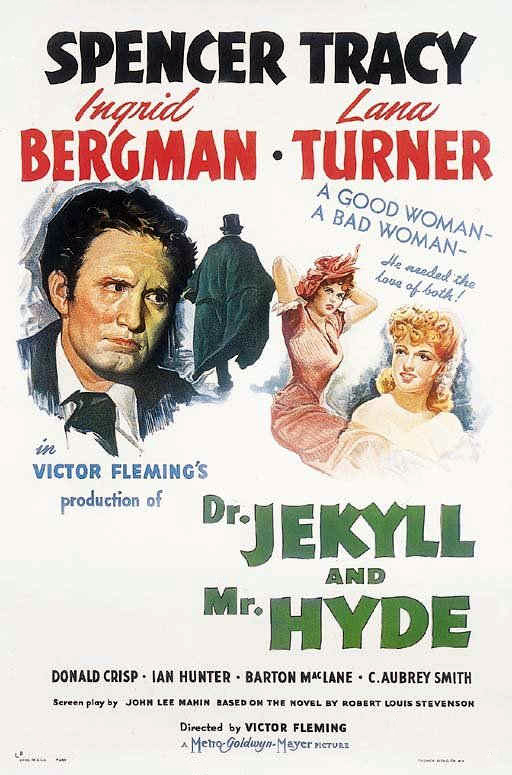
Dr. Jekyll and Mr. Hyde (1941)

DR. JEKYLL AND MR. HYDE (1941) **
Casting the wrong actor can be fatal to any motion picture.

Take for instance the 1941 horror film Dr. Jekyll and Mr. Hyde directed by Victor Fleming (credited director for Gone with the Wind and The Wizard of Oz) and starring Spencer Tracy, Ingrid Bergman, and Lana Turner, who are wrong for three of the four main roles.

Tracy (1900-67) could play the idealistic Dr. Jekyll in his sleep, but he’s simply not believable as the malevolent Mr. Hyde and that’s a major strike against the film because the duality of man theme flies right out the window without a convincing Mr. Hyde.

Bergman (1915-82) sought out the bad girl role Ivy Pearson and she’s plainly just wrong for a lower class trollop and saloon girl, even before Casablanca, Gaslight, and The Bells of St. Mary’s placed Bergman in the popular imagination as the ideal woman. Ironically, Bergman and Tracy dated during Dr. Jekyll and Mr. Hyde and director Fleming reportedly fell in love with her. Her image as the ideal woman cracked and her career in America ended for the better part of a decade circa 1949 after her affair with married Italian director Roberto Rossellini dominated headlines.

Turner (1921-95) plays against type as the good girl Beatrix Emery and she becomes such a nonentity during Dr. Jekyll and Mr. Hyde that we forget she’s even in the picture. Turner later made her enduring fame playing a femme fatale, a la The Postman Always Rings Twice.

Throughout cinematic history, more than 120 adaptations of Robert Louis Stevenson’s 1886 novella Strange Case of Dr. Jekyll and Mr. Hyde exist, with seemingly a major one every decade.

I vote for the superiority of the 1931 version produced by Paramount, directed by Rouben Mamoulian, and starring Fredric March and Miriam Hopkins. It blows the MGM version made 10 years later right straight out of the water and it’s not even close. Ditto for March and Hopkins, as well as Mamoulian, in comparison against Tracy, Bergman, and Fleming.

The 1931 Dr. Jekyll and Mr. Hyde benefited from being made before the Production Code that came into play around 1934 and being made at Paramount rather than MGM.

Hopkins’ Ivy showing March’s Jekyll her leg still stands up as one of the great erotic moments. March never fails to convince us as both Dr. Jekyll and Mr. Hyde, and he deserved to win the Academy Award for Best Actor for his performance. Mamoulian’s creativity shines throughout.

In the early ’30s, Paramount released such films as Morocco, Unfaithful, Dishonored, Tarnished Lady, Tabu, Million Dollar Legs, Horse Feathers, Island of Lost Souls, She Done Him Wrong, Murders in the Zoo, I’m No Angel, Duck Soup, and Design for Living. Paramount also distributed Fritz Lang’s 1931 all-time classic M in March 1933.

By comparison with the wild-and-crazy Paramount, where the Marx Brothers and Mae West once held court, MGM seemed awful stodgy and strange films like Tod Browning’s Freaks, Mark of the Vampire, and The Devil-Doll feel like aberrations on the studio’s permanent record. The folks around MGM reportedly treated Freaks cast members like, well, freaks.

So, in essence, if you have a chance and you’ve not seen it before, please go find the 1931 Dr. Jekyll and Mr. Hyde and watch it as soon as possible.

It (1927)

IT (1927) ***1/2

“Hey, old timer, have you seen IT?”

“Yeah.”

“I bet, though, knowing you, that you liked the crusty old TV version from, like what, 1890 better than the new one.

[Silence for a couple beats]

“Well, which one did you prefer?”

“Neither.”

“What?”

“That’s right, I prefer the 1927 IT starring legendary ‘It’ girl Clara Bow over any Stephen King adaptations called IT. Boom!”

— Theoretical conversation circa ‘18


That quality possessed by some which draws all others with its magnetic force. With ‘It’ you win all men if you are a woman and all women if you are a man. ‘It’ can be a quality of the mind as well as a physical attraction.

— Definition of ‘It’


Clara Bow obviously had ‘It’ and she displays it throughout IT, the film that officially made her a sensation after it was released on February 19, 1927.

Bow’s 1927 can stand against Babe Ruth’s — .356 average with 158 runs scored, 29 doubles, eight triples, 60 home runs, 165 RBI, 137 walks vs. 89 strikeouts, and 110 victories and a 4-0 World Series sweep against Pittsburgh — and Charles Lindbergh’s, for his legendary nonstop flight from New York City to Paris.

Bow (1905-65) made six films in 1927: IT, CHILDREN OF DIVORCE, ROUGH HOUSE ROSIE, WINGS, HULA, and GET YOUR MAN.

She helped pave the way for every female sex symbol to come. For example, her skirt flew up during IT, a good 28 years before Marilyn Monroe’s most famous movie bit in THE SEVEN YEAR ITCH. WINGS also features a brief — I mean brief — Bow boob flash. Blink and you’ll miss it.

She also inspired a millinery fashion craze, for crying out loud.

From the June 10, 1927 edition of the St. Louis Dispatch — advertising Clara Bow Vacation Hats for $1.25 each — “Smart and clever are these Clara Bow Hats that are fashioned of a good quality felt in twelve attractive modes. In black, white, pink and all the Summer shades — trimmed with applique of felt in contrasting colors as well as soid effects. Are soft and crushable, easily packed in handbag or trunk.” Each hat purchased came with a 8 x 10 photograph of Bow wearing that hat. No additional charge.

In the August 16 edition of the Minneapolis Star Tribune, Clara Bow Hats were being sold for 98 cents and each hat came with a copy of Bow’s signature. Apparently, there were 12 styles and colors of hats.

From the June 19 Nebraska State Journal, “In Gold’s smart millinery collections you’ll find ‘it’ — the cutest cleverest group of Clara Bow hats and every one of ‘em has ‘it.’ These perky little felt novelties are only $1.45 but they look like a million dollars worth of Clara Bow’s vivacity.”

Bow also became tabloid fodder, like this report from the Los Angeles Times during the making of WINGS, “Clara Bow, Paramount star, is becoming destructive. The queen of the flappers wrecked one perfectly good Ford while learning to drive one for certain sequences in “Wings,” the road show which tells the story of the American Ace in France. Miss Bow plays the part of an ambulance driver. “Wings” is being directed by William Wellman, himself a flyer during the war.” The reports and the rumors became wilder.

Bow retired from acting in 1933 to move to a ranch in Nevada, where she focused her energies on being a wife and a mother.

IT provides an early example of a concept film and it uses product placement — plugging Cosmopolitan Magazine and giving source material writer Elinor Glyn a cameo where she expounds on ‘It.’

IT features a plot that’s older than the Hollywood hills: A salesgirl, Betty Lou (Bow), sets her sights on wealthy (and handsome) playboy Cyrus T. Walham (Antonio Moreno), who’s her boss. There’s plot complications left and right — not convolutions, though — like so many romantic comedies but this is a movie that moves easily beyond its plot because of the style of director Clarence Badger, the witty dialogue and inter-titles, and both the incredible style, spunk, and star power of Bow.

“I don’t go to church. Kneeling bags my nylons.” — ACE IN THE HOLE

“Alright, I’ll go manicure my gloves.” — BUGSY MALONE

“She gave me a smile I could feel in my hip pocket.” — FAREWELL, MY LOVELY

Supporting character Monty Montgomery (William Austin) gets one of the all-time great lines, “I feel so low, old chap, that I could get on stilts and walk under a dachshund.” File it alongside the three lines quoted right above.

Monty proved to be a pleasant surprise, a supporting character who at least made me smile from his very first to his very last appearance. Monty creates the film’s biggest laughs and in a different way than Bow, he’s nearly as unforgettable. I would argue his eyes are just as memorable. What could otherwise be melodramatic mugging benefits from the parameters of silent cinema and his reactions — especially his astonished double takes — are worth their weight in comic gold. He’s a genuine hoot. That statement works for IT as a whole. In movie terms, IT definitely has “it.”

The Warriors (1979)

THE WARRIORS

THE WARRIORS (1979) Three-and-a-half stars

David Patrick Kelly belongs in the Actors Who We Love to Hate Hall of Fame, right alongside such performers as Thomas F. Wilson (for his work as 1955 Biff, 1985 Biff, alternate 1985 Biff, 2015 Biff, Griff, and Buford “Mad Dog” Tannen in the BACK TO THE FUTURE trilogy) and Michael Moriarty (Q: THE WINGED SERPENT).

You might remember Kelly from COMMANDO as Sully, the creep who John Matrix promised to kill last because, you know, Matrix liked Sully … well, Matrix lied and Sully took a great fall. Or maybe DREAMSCAPE starring Dennis Quaid and Kate Capshaw, where the name of Kelly’s would-be presidential assassin, Tommy Ray Glatman, suggests Lee Harvey Oswald, John Wilkes Booth, and James Earl Ray.

Kelly made his motion picture debut as Luther in Walter Hill’s 1979 cult classic THE WARRIORS and Kelly plays a great creep right straight out of the box. Hill later cast Kelly as (a different) Luther in 48 HOURS.

Luther assassinates charismatic, visionary street gang leader Cyrus (Roger Hill) in an early scene and the Warriors from Coney Island are framed as the assassins. The police and every street gang in New York City want them Warriors bad, real bad. The Warriors’ long, harrowing journey back home makes up the vast majority of the movie.

Kelly delivers the goods in every scene that he’s in.

Swan (Michael Beck), the leader of the Warriors, and Luther, the leader of the Rogues, are finally face-to-face late in the picture. Thankfully, because everything’s been leading up toward showdown, Swan asks Luther the burning question we’ve been wanting to ask him ourselves, you know, why’d you do it, why’d you waste Cyrus? In an answer that makes THE WILD ONE proud, Luther says, “No reason. I just … like doing things like that!”

Just a few minutes earlier, Kelly begat the world the famous “Warriors, come out to play,” made famous by the way he said it.

Kelly alone earns THE WARRIORS three stars.

THE WARRIORS is a chase movie, predominantly on foot, and a survival of the fittest movie. It’s one of those great entertainments where you can find deeper messages or merely just sit back and enjoy Hill’s ability to stage larger-than-life action scenes, the colorful characters, and the approximately 90-minute tour of large city street gangs.

In addition to our title characters, we have the Turnbull AC’s, the Orphans, the Baseball Furies (they naturally brandish baseball bats and Kiss-like face paint, combining two of Walter Hill’s two loves), the Lizzies, the Punks, the Rogues, the Riffs (Cyrus’ former gang), the Boppers, the Boyle Avenue Runners, the Electric Eliminators, the Gladiators, the Hi-Hats, the Hurricanes, the Jones Street Boys, the Moonrunners, the Panzers, the Saracens, the Satans Mothers, the Savage Huns, the Van Cortland Rangers, and there’s a whole slew of gangs listed in Hill’s original script.

These gangs have a meeting in the Bronx and that’s when Luther kills Cyrus. All hell breaks loose with our title characters, eight gang members, at the center of the mayhem. The Warriors have more than 20 miles to go from the Bronx to their Coney Island home. It takes about 2 hours via mass transit, so THE WARRIORS feels like it plays out in real time.

Another stylistic flourish in a film overflowing with them involves a female DJ (face of Lynne Thigpen, voice of Pat Floyd) who’s the voice of the street gangs. “All right now, for all you boppers out there in the big city, all you street people with an ear for the action, I’ve been asked to relay a request from the Gramercy Riffs. It’s a special for the Warriors, that real live bunch from Coney, and I do mean the Warriors. Here’s a hit with them in mind.” Her apology to the Warriors at the end comes in the form of Joe Walsh’s “In the City.”

Real-life violence, allegedly inspired by seeing THE WARRIORS itself, unfortunately soured the reaction to the film in early 1979. Tony Bill, who produced his own gang film (BOULEVARD NIGHTS) that was protested in early 1979, said in People Magazine, “It makes sense that a movie that basically glorifies violence would attract violence.” Co-screenwriter David Shaber said THE WARRIORS was Sesame Street compared to a Sam Peckinpah movie (like THE WILD BUNCH). Paramount VP Gordon Weaver said of the violence, “[It’s] the sort of thing that happens at rock concerts, high school basketball games and any place where diverse groups meet. It could have happened anywhere.”

Similar controversies unfortunately later swirled around such films as DO THE RIGHT THING, NEW JACK CITY, and BOYZ N THE HOOD.