Odds and Odds: The Vikings, Dolls, The Monster Squad, Scream Blacula Scream

ODDS AND ODDS: THE VIKINGS, DOLLS, THE MONSTER SQUAD, SCREAM BLACULA SCREAM
Richard Fleischer’s The Vikings calls to mind epic grand adventure pictures Captain Blood, The Adventures of Robin Hood, The Sea Hawk, and The Sea Wolf, not to mention The Seventh Voyage of Sinbad from the same year (1958) and John Boorman’s Excalibur from 1981.

Kirk Douglas’ lust for life recalls Errol Flynn’s in Captain Blood, Robin Hood, and Sea Hawk and Janet Leigh’s incredible beauty compares with Olivia de Havilland’s in Captain Blood and Robin Hood, as well as Helen Mirren’s in Excalibur. Never mind that Leigh and Mirren play characters named Morgana; however, their beauty and first name are where their characters’ similarities begin and end.

In other words, The Vikings belongs to the fine cinematic tradition of swashbucklers, hair-raisers, cliff-hangers, nail-biters, period costume pieces, and historical fiction.

Of course, it doesn’t hurt that it has an uncredited Orson Welles narrate. The Vikings, in Europe of the eighth and ninth century, were dedicated to a pagan god of war, Odin. Trapped by the confines of their barren ice-bound northlands, they exploited their skill as shipbuilders to spread a reign of terror, then unequaled in violence and brutality in all the records of history. Good stuff.

Highlights include Douglas’ Einar and Curtis’ Eric having key body parts removed, the former his eye by a falcon and the latter his hand in a bout of capital punishment. These moments undoubtedly make The Vikings one of the most gruesome films in 1958 this side of the British classic Fiend Without a Face. Oh, that’s a golden oldie.

Naturally, one can’t go too wrong with any picture where Ernest Borgnine plays a character named Ragnar and spouts screenwriter Calder Willingham’s dialogue like a bountiful fountain, for example What man ever had a finer son? Odin could have sired him, but I did … and Look how he glares at me. If he wasn’t fathered by the black ram in the full of the moon my name is not Ragnar.

Back in the day, my friend would call on quotes from Airplane and Austin Powers for our amusement, and it’s a crying shame that we had no idea about The Vikings, because I think lines such as You sound like a moose giving birth to a hedgehog and The sun will cross the sky a thousand times before he dies, and you’ll wish a thousand times that you were dead would have perfectly fit a night of carousing, especially for two byproducts of a school with Vikings for its mascot.

Rating: Four stars.

— I finally got around to watching Stuart Gordon’s Dolls for the first time.

Finally, because I love Gordon’s first two features Re-Animator and From Beyond.

I must say that I wasn’t disappointed by Dolls, though it’s a step down from From Beyond and a good two or three from Re-Animator.

Alas, Dolls belongs to a slightly different but no less venerable tradition than Re-Animator and From Beyond, both of which cross mad scientists and low-budget exploitation (nudity, gore, etc.). Think Frankenstein meets Dawn of the Dead.

Dolls, meanwhile, recalls such touchstones as The Old Dark House and The Devil-Doll, not to mention the 1979 Tourist Trap. See if this plot sounds familiar: On a dark and stormy night, six people — a dysfunctional family (husband and father, wife and stepmother, and daughter / stepdaughter) and a young man with two hitchhikers — find the nearest house (The Old Dark House) and they have to fight to make it out of the other end of the motion picture alive because their kindly old hosts are magical toy makers with killer dolls (The Devil-Doll, Tourist Trap).

Like both Re-Animator and From Beyond, Gordon and Dolls screenwriter Ed Naha jump off from their basic old-fashioned plot structure with inspired moments of madness.

Dolls also predates Child’s Play by more than a year and rather than just one killer doll, it has a horde … but Child’s Play, created by Don Mancini, spawned Child’s Play 2, Child’s Play 3, Bride of Chucky, Seed of Chucky, Curse of Chucky, Cult of Chucky, and Child’s Play (2019), plus short films Chucky’s Vacation Slides and Chucky Invades and the TV series Chucky.

So, apparently, not all killer doll films are created equal.

Rating: Three stars.

The Monster Squad starts with an absolute genius idea: Take a group of kids, horror movie fans one and all, and have them do battle against Dracula, Frankenstein’s Monster, Wolf Man, Mummy, and Gill Man.

Yes, what an absolutely positively brilliant idea by screenwriters Shane Black and Fred Dekker, whose names ring a bell loud and clear for genre fans. Others will be familiar with their work regardless whether they know their names or not.

Black made his fame and fortune first for the script of the buddy cop picture Lethal Weapon and some of his other credits include Predator (he plays Hawkins), The Last Boy Scout, and The Long Kiss Goodnight.

Dekker’s other feature directorial credits are the fantastic Night of the Creeps and the not-so-fantastic RoboCop 3.

The Monster Squad gives us both protagonists and monsters that we like, and that goes a long way toward producing a memorable motion picture experience.

The Wolf Man gets his due for a change. The fat kid Horace kicks the Wolf Man in the groin and unleashes the film’s trademark line Wolfman’s got nards! In 2018, Andre Gower, one of the stars of The Monster Squad, directed a documentary named Wolfman’s Got Nards, which looks at the impact one little cult horror film made on fans, cast and crew, and the movie industry.

Anyway, in a movie filled with nifty little moments, I love it when the Wolf Man regenerates after he’s blown up real good.

On the site Drinking Cinema, I found a game for The Monster Squad so drink whenever: 1. Dynamite EXPLODES! 2. A monster dies! 3. You hear a sweet insult. 4. You learn a new monster fact. 5. The cops are having a really hard time figuring out that, um, hello, the perps are various Jack Pierce creations. 6. You see amazing dog acting. 7. You witness a patented Monster Slow-Walk. 8. There’s a monster scare!

I give The Monster Squad a slight deduction for the obligatory music video montage right around the midway point of the picture.

Rating: Three-and-a-half stars.

— Vampirism and voodoo go together rather well and their combination helps Scream Blacula Scream become one of those rare sequels I prefer over the original.

I thought William Marshall’s performance as the title character was the redeeming factor in Blacula and he’s every bit as good in Scream Blacula Scream. Marshall just has a commanding screen presence and he brings both a gravitas to a character and legitimacy to a movie that otherwise might be laughable with the wrong person in the main role. He’s equally effective in every guise of this character — the debonair Mamuwalde who has a definite charm with the ladies befitting an African prince (which he indeed was before the racist Dracula cursed him and imprisoned in a coffin until Blacula awakened in 1972 Los Angeles), the menacing Blacula with his fangs bared, and the more reflective Mamuwalde who hates the dreaded vampire curse.

A highly respectable box office return — not voodoo, no matter what the plot synopsis might read — brought Mamuwalde / Blacula / Marshall back.

In the first movie, Mamuwalde / Blacula comes to believe the lovely Tina’s the reincarnation of his long dead wife Luva. Well, it definitely helps that Vonetta McGee plays both Tina and Luva. By golly, doesn’t this plot thread just get you every single time?

In the sequel, Mamuwalde / Blacula believes in the voodoo powers of Lisa Fortier. She can provide a cure and exorcise the curse once and forever.

Scream Blacula Scream came out two weeks after Coffy and had it been made later in 1973 after Pam Grier busted out as a star playing Coffy, her Lisa Fortier character in Scream Blacula Scream would have undoubtedly been different. Grier plays a more traditional leading lady and screaming and shrinking damsel in distress in Scream Blacula Scream, and she’s definitely no shrinking violet in either Coffy or Foxy Brown. So if Scream Blacula Scream had been produced more in the aftermath of both Coffy and Cleopatra Jones, which came out a month after both Coffy and Scream Blacula Scream, surely American-International — one of the best exploitation film outlets — would have wanted Grier to play one badass mama jama vampire killer rather than her more stereotypical role.

Fair warning: Scream Blacula Scream ends on an extremely jarring note. I remember thinking, in the immortal song title of Peggy Lee, is that all there is? Despite the fact of that ending, you might be surprised to find that I am granting Scream Blacula Scream three-and-a-half stars. Yes, it is just that good.
Auto Pilot Cinema: The Airport Movies

AUTO PILOT CINEMA: THE AIRPORT MOVIES
When thinking of the worst series in movie history, I am tempted to start with Saw and Fast and the Furious then move back through time with The Omen and Amityville Horror and finally go way way way back to the Dead End Kids, er, Bowery Boys.

In piecing through all this cinematic carnage, I should not leave behind the four Airport movies that were churned out by Universal Pictures from 1970 to 1979. Maybe I should leave them behind.

Airport, based on Arthur Hailey’s 1968 novel of the same name, made a killing at the box office upon its late May release in 1970 and it even received 10, yes, believe it or not, 10 Academy Award nominations, including Best Picture, and 70-year-old Helen Hayes won Best Supporting Actress.

The three subsequent films — helpfully labeled 1975, ’77, and ’79 — got worse and worse, naturally, and the last film in the series, The Concorde … Airport ’79, is so bad (and so aggressively stupid) in fact that it could kill off any series. That’s despite the fact that it reportedly made $65 million, a much better take than, for example, Irwin Allen productions The Swarm ($7.7 million), Beyond the Poseidon Adventure ($2.1 million), and When Time Ran Out ($3.8 million). Regardless, Universal stopped making Airport movies after The Concorde and I’m almost dumbfounded why there’s not been a remake or a reboot loaded with today’s stars.

Hey, wait, did somebody mention stars? Yes, stars, that’s what these Airport movies were about — speculating which ones would emerge at the end of the picture relatively intact and which ones would die spectacularly. Grand Hotel in the sky, not exactly, since none of the careers in the Airport movies were at their peak like the ones in Grand Hotel, but the idea of stuffing the screen with stars in every scene applies just the same.

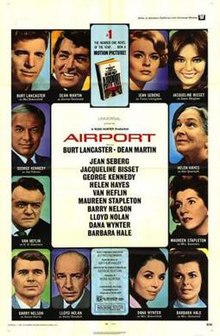
Airport: Burt Lancaster, Dean Martin, Jean Seberg, Jacqueline Bisset, George Kennedy, Hayes, Van Heflin, Maureen Stapleton, Barry Nelson, Dana Wynter, Lloyd Nolan.

Airport 1975: Charlton Heston, Karen Black, Kennedy, Efrem Zimbalist Jr., Susan Clark, Helen Reddy, Linda Blair, Dana Andrews, Roy Thinnes, Sid Caesar, Myrna Loy, Gloria Swanson.

Airport ’77: Jack Lemmon, Lee Grant, Branda Vaccaro, Joseph Cotten, Olivia de Havilland, Darren McGavin, Christopher Lee, Robert Foxworth, Kathleen Quinlan, James Stewart.

Airport ’79: Alain Delon, Susan Blakely, Robert Wagner, Sylvia Kristel, Kennedy, Eddie Albert, Bibi Andersson, Charo, John Davidson, Andrea Marcovicci, Martha Raye, Cicely Tyson, Jimmie Walker, David Warner, Mercedes McCambridge.

More like Hollywood Squares in the Sky? Yeah, believe so, especially since Davidson hosted a Hollywood Squares revival in the late ’80s.

Beside Airport in the titles, Kennedy (1925-2016) proved to be the connective tissue between all four pictures, meaning he’s the inverse of the Brody boys (Jaws) and the Griswold children (Vacation). Kennedy played Joe Patroni — first as mechanic, then as vice president of operations (1975), a consultant (’77), and finally an experienced pilot (’79). Regardless of position or rank, the character got worse and worse over the course of the films, not that he or the films started out all that hot. I found even his cigar was guilty of overacting in the original film and Patroni was so odiously obnoxious in the fourth film, especially after he utters the line that articulates the sexism of the entire series, They don’t call it the cockpit for nothing, honey. George Kennedy as sex symbol? Sure, I’ll believe anything, nearly anything except for, oh, the entire plot of The Concorde.

I’ll talk more about The Concorde and the original because they’re fresher in my memory. To be honest, though, I probably won’t even feel like discussing the original because …

Movies rarely come any dumber than The Concorde: Let’s see, this is going to be fun, not really, anyway TV reporter Susan Blakely comes across some highly incriminating evidence against defense contractor (and covert arms dealer) Robert Wagner. Wagner decides that he’s going to attempt to blow up real good the plane she’s on en route from Washington to Paris. Okay, okay, his plot to blow up the Concorde real good fails and they have dinner together in Paris during the middle section of the movie, because, you know, they have a history together and they still love each other. She still has this incriminating evidence, naturally, she’s going to eventually go public with it, of course, and what does he do? Kill her? He lets her walk away safe and unharmed, so he’ll have to go after the plane again. That’s right, she gets back on the Concorde for the final leg of the flight from Paris to Moscow. Guilt stricken, Wagner commits suicide very late in the picture and I believe it’s not because his secret’s been discovered and will be exposed regardless of whether he’s alive or not, but more that he’s one of the worst villains in cinematic history.

The Concorde is so laughable in so many ways, as if that whole plot discussed in the last paragraph wasn’t enough. The Concorde stops over in Paris for a night, and every single passenger gets back on the plane the next morning. They all seem way too calm and collected after the events of the first half of the movie. I would love to have just heard one character say ‘Hell no, I’m not getting back on that damn plane!’ They all deserved to die, but we know that’s not happening.

At one critical point during the first attack on the Concorde, the Übermensch George Kennedy proves that he’s truly The Übermensch by sticking his hand out the window of the Concorde and throwing a flare. Unbelievable, utterly unbelievable even in this preposterous movie. If only the first Airport had been the in-flight movie on The Concorde, especially that scene where Patroni discusses the effects of a bomb on a 707 and concludes, When I was a mechanic in the Air Force, I was being transferred on a MATS plane. At 20,000 feet, one of the windows shattered. The guy sitting next to it was about 170 pounds. He went through that little space like a hunk of hamburger going down a disposal, and right after him coats, pillows, blankets, cups, saucers. That was just a MATS plane, not the fastest plane in the universe.

I’m done, I can’t take it anymore, and I’m bailing out on the Airport movies.

Airport (1970) **; Airport 1975 (1974) **1/2; Airport ’77 (1977) *; The Concorde: Airport ’79 (1979) 1/2*

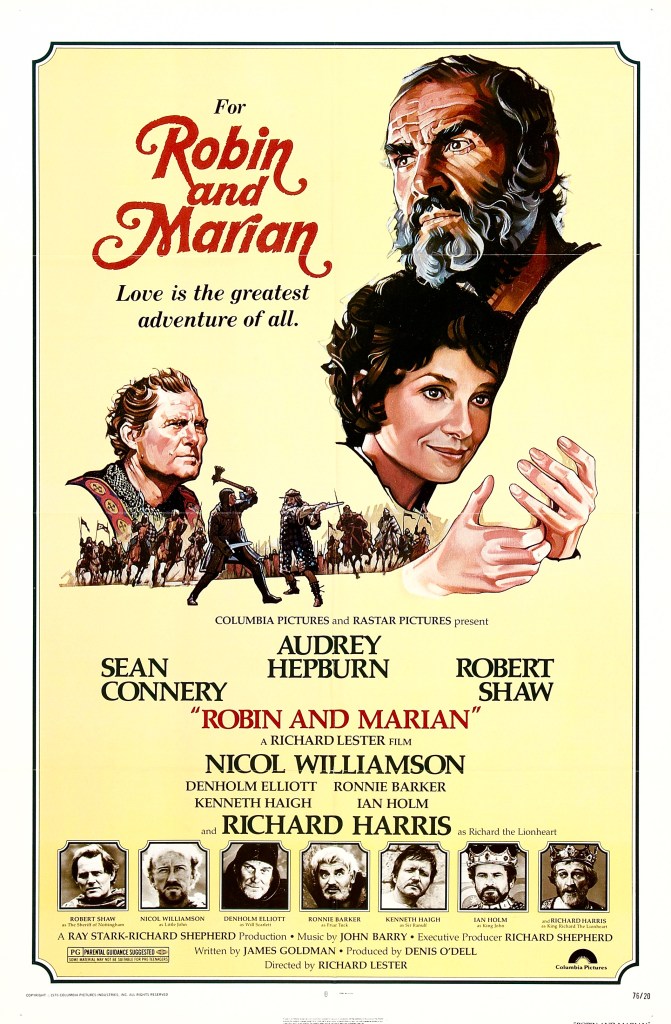
Robin and Marian (1976)

ROBIN AND MARIAN (1976) ****
Richard Lester’s Robin and Marian definitely made a strong first impression.

I placed it on my top 10 films list for 1976, based on just viewing it a single time on cable TV many years ago.

Granted, Robin and Marian crossed my mind several times in recent months, especially after Robin and Marian star Sean Connery died last Halloween and then after I watched both the Disney (1973’s Robin Hood) and the Mel Brooks (1993’s Robin Hood: Men in Tights) takes on the legendary old warhorse. Disney and Brooks both left me feeling often unimpressed and ultimately supremely disappointed, for very different reasons, and I started thinking instead about superior Robin Hood films The Adventures of Robin Hood and Robin and Marian, both of which I first encountered during childhood or teenage years.

The Adventures of Robin Hood remains my favorite take on Robin Hood and I’ve watched it numerous times over the years. Of course, it helped that The Adventures of Robin Hood ranked among the select few titles Grandma Sisney had on VHS and I played it — along with Indiana Jones and the Temple of Doom and Fun in Acapulco — so many times before Grandma took over her TV for a day of game shows and soap operas. There’s always been something so indelible about Errol Flynn’s Robin Hood that I judge all others portraying Robin Hood against Flynn’s standard, Claude Rains and Basil Rathbone make incredibly satisfying villains, and Olivia de Havilland’s Maid Marian simply radiates a MOST BEAUTIFUL WOMAN IN THE WORLD AT THIS VERY MOMENT glow. Plus, it’s hard to forget the colors (and costumes) that argue for three-strip Technicolor superiority.

Robin and Marian left a mark for similar reasons — Connery and Audrey Hepburn both carry some of the same appeal as Flynn and de Havilland do in their iconic roles. Flynn was just a month shy of 29 years old when The Adventures of Robin Hood first came out in May 1938 and similarly, De Havilland was two months shy of a mere 22. However, Connery and Hepburn play older Robin Hood and older Maid Marian — please consider both Connery and Hepburn were in their mid-40s during Robin and Marian and each had a solid 15-20 years of stardom behind them. Connery and Flynn both have an undeniable robust humor and physicality (both men seemed tailor-made for James Bond, for example) and Hepburn could make claims on de Havilland’s radiant MBWITW glow several times during her career, from Roman Holiday and My Fair Lady to Robin and Marian.

Anyway, I finally watched Robin and Marian for a second time and it holds up as a great movie, right behind only The Adventures of Robin Hood in the Robin Hood cinematic pantheon.

Because of centering around middle age characters, Robin and Marian plays different notes and takes on a greater emotional range than any other Robin Hood film I have ever seen.

It’s definitely not the lusty adventure like The Adventures of Robin Hood. Sure, Robin and Marian has sword fights and scenic vistas and soaring music and horses and romantic clinches and every prerequisite of the genre, as well as King John, King Richard the Lionhearted, the Sheriff of Nottingham, Little John, Friar Tuck, Will Scarlett, and Sherwood Forest, but they’re all — both people and places, and every plot event — suffused with melancholy.

To be fair, though, Lester and Connery inject enough good humor and spirit into Robin and Marian to help it avoid being a more downbeat experience like the 1991 Robin Hood starring Kevin Costner. And the scenes between Connery and Hepburn are simply flat-out appealing, rooted in seeing two of the most attractive, most ebullient performers to ever grace the screen share time with each other (and us audience members).

It should also be mentioned that supporting players Nicol Williamson, Richard Harris, Denholm Elliott, and Ian Holm contribute to an absolute dynamite cast.

Didn’t we always ponder how it all turned out for Robin Hood, Maid Marian, the Sheriff, Little John, Friar Tuck, and Will Scarlett?

Lester’s film, with a screenplay written by James Goldman (writer of the play, film adaptation, and TV movie version of The Lion in Winter), answers those very questions, but do we viewers feel comfortable with the answers? Are we prepared to see Maid Marian as a nun because Robin Hood, off on his damn crusades and holy wars with Richard and Little John, didn’t write her for the last 20 years? We also found out that she attempted suicide. He’s back, though, and it’s obvious that Robin Hood and Maid Marian are destined to be together. They might initially hate it and initially fight it, she invariably more than he, but they are pulled together rather than apart.

All roads lead toward a final showdown between Robin Hood and the Sheriff (Robert Shaw). They fight like two worn-out, downtrodden men with many, many battles behind them and none ahead of them, who have resigned themselves to their final destiny. They fight because it’s their duty, or their almost perverse obligation to each other as hero and villain. They really don’t want to be fighting each other at this precise historical moment, it feels like, BUT THEY MUST FIGHT TO THE DEATH. There’s none of the joy in this fight that can be found in great film sword fights like the one, for example, between Robin Hood (Flynn) and the Sheriff (Rathbone) in The Adventures of Robin Hood. This final showdown, just like Robin and Marian overall, gives us something that’s different from any other purely adventure movie. All the main players have lived through considerable pain, considerable disappointment, and the film serves a reminder (from early on and throughout) there’s flesh-and-blood and real-life experience behind every legend, every song, every ode, every hymn, every myth.

Maid Marian gives Robin Hood (and us) some final words, “I love you. More than all you know. I love you more than children. More than fields I’ve planted with my hands. I love you more than morning prayers or peace or food to eat. I love you more than sunlight, more than flesh or joy or one more day. I love you more than God.”

The Swarm (1978)

THE SWARM

THE SWARM (1978) One-half star

Many comedies wish they could make me laugh as hard as I do at the ridiculous disclaimer at the end of the 1978 Irwin Allen film THE SWARM: “The African killer bee portrayed in this film bears absolutely no relationship to the industrious hard-working American honey bee to which we are indebted for pollinating vital crops that feed our nation.”

Were the folks at Warner Bros. seriously afraid of alienating the American honey bee?

I’ve read that the American Bee Association considered suing Allen for defaming the honey bee … and that must be why we ended up with that jive disclaimer right before the end credits. But, honestly, why stop there? The director, writer, and actor guilds should have sued Allen for defaming their respective trades, because this has to be the worst use ever of a $21 million production budget (reports vary on the $), seven Academy Award winning actors (Michael Caine, Olivia de Havilland, Ben Johnson, Jose Ferrer, Patty Duke, Lee Grant, and Henry Fonda, but none of them earned for this movie), and 800,000 bees with their stingers removed.

I’ll never forget THE SWARM because it’s not easy forgetting one of the worst movies ever made. I caught it (not all of it, though) for the first time in either late 1997 or early 1998, home alone late afternoon during my freshman year of college. I returned from class and found this disaster pic flipping channels. It was somewhere in the middle and I watched the rest. The lousy special effects, the cornball everything (premise, plot, dialogue, acting, title), and that darn disclaimer stuck with me. …

I’ve caught up with THE SWARM a couple more times or I’ve watched it at an interval of once every 10 years. It still rates about the exact same as the first time watching it, though, but I guess I have watched it a couple more times after the first as a honest reminder of what a bad movie’s truly like.

Guess we should give a lot of blame for THE SWARM to Allen (1916-91). The Master of Disaster produced THE POSEIDON ADVENTURE, THE TOWERING INFERNO, THE SWARM, BEYOND THE POSEIDON ADVENTURE, and WHEN TIME RAN OUT, the last three of which helped kill off the disaster films that were so popular in the 1970s. THE SWARM earned $7.7 million, BEYOND THE POSEIDON $2.1 million, and WHEN TIME RAN OUT $3.8 million.

Allen also directed THE SWARM and BEYOND THE POSEIDON. In THE SWARM, he kills two genres in one movie, combining disaster with the killer animal genre that became a dominant exploitation staple after the incredible success of Steven Spielberg’s JAWS in 1975.

It was David Hannum, not P.T. Barnum, who came up with the legendary quote, “There’s a sucker born every minute.” Should have been Irwin Allen, though, because his films really take us for suckers one and all. Fortunately, we are better (smarter) than that.

Stirling Silliphant (1918-96) wrote the screenplay for THE SWARM and he wrote both of Allen’s biggest hits, THE POSEIDON and TOWERING INFERNO. He also won an Academy Award for his screenplay for Best Picture winner IN THE HEAT OF THE NIGHT. (Silliphant’s erratic credits include VILLAGE OF THE DAMNED, SHAFT IN AFRICA, and OVER THE TOP.)

Unfortunately, his work on THE SWARM will go down in infamy.

Helicopter pilot: “Oh my God! Bees! Bees! Millions of bees … (later on) Bees! Millions of bees!” Of course, it does not help matters that the bees sometimes look more like painted-on black dots.

There’s some dynamite exchanges in THE SWARM. I’ll highlight just one.

Dr. Crane (Caine): Are you endowing these bees with human motives? Like saving their fellow bees from captivity, or seeking revenge on Mankind?

General Slater (Richard Widmark): I always credit my enemy, no matter what he may be, with equal intelligence.

“No matter what he may bee,” maybe they should have stripped Silliphant of his Academy Award for writing that one.

There’s more howlers in THE SWARM: “Houston on fire. Will history blame me, or the bees?”; “I know people look at me and think that I’m just the man behind the aspirin counter, but inside I love you”; “They’re more virulent than the Australian Brown-Box Jellyfish”; “By tomorrow there will be no more Africans … at least not in the Houston sector.” This dialogue indicts inself.

THE SWARM is one time where calling a film a train wreck is literal.

A train wreck, by the way, that kills Olivia de Havilland, Ben Johnson, and Fred MacMurray, two of the film’s seven Academy Award winning actors. Johnson (1918-96) fared better later as the conductor in the horror film TERROR TRAIN. I really did not want to mention that de Havilland, Johnson, and MacMurray form a romantic triangle in THE SWARM. Let’s just get past that and move on immediately, unlike the movie.

Having such an all-star cast, by the way, backfires miserably for THE SWARM, because I start thinking about movies like ZULU (Caine), THE ADVENTURES OF ROBIN HOOD (de Havilland), THE LAST PICTURE SHOW (Johnson), DOUBLE INDEMNITY (MacMurray), THE MIRACLE WORKER (Duke), and ONCE UPON A TIME IN THE WEST (Fonda), for example, rather than what I am supposed to be watching.

Some of the stars have smaller roles than others. Yeah, and I almost forgot about Richard Widmark, Richard Chamberlain, and Slim Pickens, though I mentioned the always skeptical, always boneheaded General Slater played by Widmark. How could I forget though about Mr. Pickens? According to Cinemorgue Wiki, Pickens died cinematic deaths in THE LAST COMMAND, A THUNDER OF DRUMS, DR. STRANGELOVE, MAJOR DUNDEE, ROUGH NIGHT IN JERICHO, PAT GARRETT & BILLY THE KID, BEYOND THE POSEIDON, THE BLACK HOLE, and THE HOWLING. They missed an opportunity in not killing Pickens in THE SWARM. I mean, his death scenes in DR. STRANGELOVE and PAT GARRETT & BILLY THE KID are legendary.

I am rambling, just like THE SWARM itself.

When you watch THE SWARM, please try and keep in mind that Paul Zastupnevich received a nomination for the Academy Award for Best Costume Design. Unbelievable, just unbelievable, like THE SWARM.