Psycho (1960)

day 22, psycho

PSYCHO (1960) Four stars
Oh, to get into any one of the seven DeLorean DMC-12s used in BACK TO THE FUTURE and rev that sonuvabitch up to 88.8 MPH with the date set for June 16, 1960, the release date for Alfred Hitchcock’s PSYCHO.

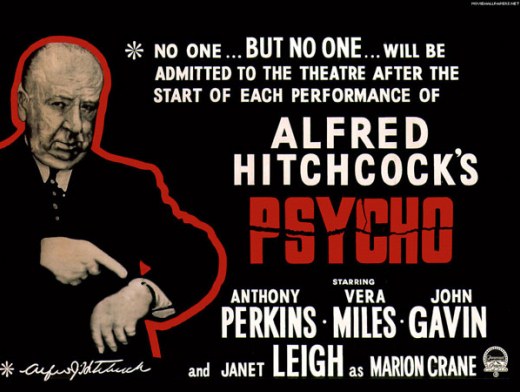
I’d go find the nearest theatre where it’s playing and put down the 69 cents. Of course, I would be sure to arrive early and hang around the lobby if necessary since Hitchcock made sure theaters enforced a strict “no late admission” policy.

Hitchcock even wrote a beautiful note, “Surely you do not have your meat course after your dessert at dinner. You will therefore understand why we are so insistent that you enjoy PSYCHO from start to finish, exactly as we intended that it be served.

“We won’t allow you to cheat yourself. Every theatre manager, everywhere, has been instructed to admit no one after the start of each performance of PSYCHO. We said no one — not even the manager’s brother, the President of the United States or the Queen of England (God bless her).

“To help you cooperate with this extraordinary policy, we are listing the starting times below. Treasure them with your life — or better yet, read them and act accordingly.”

Gotta love that Hitchcock and his ripped, twisted sense of humor.

Anyway, I would go back in time to see PSYCHO just to observe others’ reactions to it, to see their shock, to see their absolute terror at certain moments. They would not have possibly known all the surprises in store for them, while viewers for the last nearly 60 years have not had the benefit of watching PSYCHO with a clean slate. Since its release, PSYCHO has been analyzed, overanalyzed, parodied, satirized, and its famous shower scene long ago replaced the Odessa Steps sequence from BATTLESHIP POTEMKIN (1925) as the most fetishized scene in movie history.

Every time I watch PSYCHO, I am gobsmacked by just how audacious Hitchcock and gang were in making it. Start the movie with a love affair in a seedy hotel? Check. Show the heroine in her bra multiple times? Check. Kill off the heroine played by a big movie star halfway through the film? Check. Start out with the theft of $40,000 and more or less drop it after the death of the heroine? Check.

That’s just the tip of the iceberg.

Of course, none of that might seem the least bit audacious in 2018, but please keep in mind the Motion Picture Production Code dominated Hollywood movies from the early 1930s through 1968. PSYCHO helped chip away at that damn archaic code.

Everybody knows the plot by now. Marion Crane (Janet Leigh) steals $40,000 from her employer’s client and she’s on the lam hoping to get together with her lover Sam (Sam Loomis, played by John Gavin). We hear the voices that are inside her head (her mind and by extension our minds are obsessed with the money) and Hitchcock once again proved he’s the Master of Suspense by making a policeman’s stop and Marion’s drive in the pouring rain as tension-filled as any of the death scenes. With the rain beating down on her poor, weary windshield wipers, a conscience-stricken Marion stops at the famous Bates Motel with its 12 cabins and 12 vacancies.

There we meet proprietor Norman Bates (Anthony Perkins), a fictional character in Robert Bloch’s novel and Hitchcock’s film with roots in the real-life Wisconsin murderer and grave robber Ed Gein (an inspiration for THE TEXAS CHAINSAW MASSACRE’s Leatherface). Gein, for example, loved to make wastebaskets from human skin. Unlike later slasher movie super villains Michael Myers and Jason Voorhees, Norman speaks and he does not wear a mask. This makes Norman Bates far more fascinating than any of the slasher film madmen descended from PSYCHO.

Norman loves taxidermy and he’s got mother issues.

Otherwise, he seems like a good, old-fashioned All-American boy.

Oh, what happens to Marion? Let’s just say that in real life, Leigh stopped taking showers for years, preferring a bath after the fate of her character in PSYCHO.

Sam teams up with Marion’s sister Lila Crane (Vera Miles) and they try and track down Marion. Of course, all roads lead them and poor, poor Detective Arbogast (Martin Balsam) to Bates Motel and Norman Bates and his dear old mother.

In arguably his most audacious move, Hitchcock substituted protagonists from Marion Crane to Norman Bates. Perkins gives one of the great performances, one that will be discussed and cherished for centuries. He walks away with the movie.

The HALLOWEEN sequels continued to add more and more back story to the detriment of Michael Myers. Near the end of PSYCHO, Hitchcock gives us a phony baloney psychiatrist (Simon Oakland) and his phony baloney explanation for Norman Bates, but it’s taken to such an extreme that it plays like a parody. We could have done without this sequence, though, unlike the rest of the movie.

Early on in this review, I shared a note from Hitchcock. Now we go full circle.

A woman complained to Hitchcock that the PSYCHO shower scene had such a deleterious effect on her daughter that the young girl refused to shower.

Hitchcock replied, “Then Madam I suggest you have her dry cleaned.”

The Fly (1986)

DAY 5, THE FLY

THE FLY (1986) Four stars
I absolutely love it when a horror movie takes on more than just merely being a horror movie. These movies rank among the most pleasurable viewing experiences.

For example, George Romero’s DAWN OF THE DEAD (1978), a horror movie or a zombie picture that also passes through action and adventure, black comedy, silent and slapstick comedy, drama, gore galore, cinematic and social satire, surrealism, survivalism, and melodrama in addition to being great at the basic level of being a horror movie. All those extra traits put DAWN OF THE DEAD in the upper echelon.

Another example is David Cronenberg’s THE FLY (1986). It works on the most basic horror movie level but reaches greatness because it’s also a few other things it didn’t have to be. It grosses us out at times (rather, make that many times) but it also zaps us straight in the heart with its central storyline.

We’ve seen lots and lots of scientists over the years in loads and loads of pictures, but Jeff Goldblum’s Seth Brundle is one of those that sticks with you and stays in your mind. He’s not Colin Clive’s Dr. Frankenstein and he’s not Jeffrey Combs’ Herbert West, two other great cinematic scientists who embody more of the mad scientist archetype than Brundle. Brundle is more of the lovable eccentric that puts you in mind of what Albert Einstein must have been like in real life. We come to know this cinematic scientist more than just about any that spring to mind.

Brundle invents a teleportation device and he’s inspired to teleport himself one night after having successfully tried everything from Geena Davis’ stocking to a baboon. Of course, unbeknowst to him, a darn pesky housefly joins Brundle in the pod and throws a monkey wrench variable into this grand scientific experiment. Over the rest of the movie, Brundle transforms into Brundlefly.

Some viewers took what happened to Brundle as a metaphor for AIDS, but director Cronenberg said that his original intent was for an analogy for disease itself, terminal conditions such as cancer, and aging. This is one of the main sources for the emotional heft of THE FLY, because most of us grow old and die from a disease. Most of us are afraid, very afraid, indeed, it seems, and THE FLY plays on our fears.

On top of that, there’s a great tragic love story between Goldblum’s Brundle and Davis’ Veronica Quaife.

I highly doubt anybody expected such a moving love story coming in, especially considering Cronenberg’s previous films like SCANNERS and VIDEODROME.

And, let’s face a fact: Horror movies have not always been a great source for love stories.

Chris Walas deserved his Academy Award for Best Special Effects Make-up, but it’s the pleasant surprise love story and Brundle himself that elevate THE FLY.

Goldblum and Davis were a real-life couple, boyfriend and girlfriend during the making of THE FLY, and they were married from 1987 to 1990. They met during TRANSYLVANIA 6-5000 and later made a third movie together, EARTH GIRLS ARE EASY. For both actors, THE FLY would be their break into the mainstream and honestly, neither performer has ever done anything better.

Goldblum would play variations on scientists in seemingly every appearance for the next 30 years, in everything from JURASSIC PARK and INDEPENDENCE DAY to POWDER and THE LIFE AQUATIC WITH STEVE ZISSOU. It’s a role that fits him well and we can say that it’s become the Jeff Goldblum role just as we can say that Dabney Coleman (think NINE TO FIVE) and Hal Holbrook (think ALL THE PRESIDENT’S MEN) have come to develop their own respective roles.

Davis moved on to director Renny Harlin in both her personal and professional life, and her career never quite recovered after such flops as SPEECHLESS, CUTTHROAT ISLAND, and THE LONG KISS GOODNIGHT, the latter pair directed by Harlin. Davis’ career took off for a few years after THE FLY with hits like BEETLEJUICE, THELMA & LOUISE, and A LEAGUE OF THEIR OWN and an Academy Award for Best Supporting Actress for THE ACCIDENTAL TOURIST.

This is the rare remake that has obscured the original, which was made in 1958, directed by Kurt Neumann, and starred Vincent Price.

Goldblum wrote Price a letter telling one of the great hams in history, “I hope you like it as much as I liked yours.” Price, touched by the letter, went to see the remake and unfortunately, he did not quite return Goldblum’s affection for the original and called the remake “wonderful right up to a certain point … it went a little too far.”

In addition to both FLY movies, there’s been a lot of great fly moments throughout history, both screen and sound.

I’ll briefly guide you through three of them.

Norman Bates (Anthony Perkins), his stare, his voiceover, and a fly in the final moments of PSYCHO (1960): “They’re probably watching me. Well, let them. Let them see what kind of a person I am. I’m not even going to swat that fly. I hope they are watching. They’ll see. They’ll see and they’ll know, and they’ll say, ‘Why she wouldn’t even harm a fly.'”

Hungarian animator Ferenc Rofusz’s THE FLY (1980) won the 1981 Academy Award for Best Animated Short and it follows a fly on its journey from the woods to a house and finally on death’s end of a fly swatter. Oh, sorry, did I spoil that for you or the fly? Since it’s only three minutes long, this animated short might be a replacement if you have no desire to sit through 96 minutes of THE FLY (1986). In fact, you can watch the animated one 32 times in a row to substitute for the experience of the live-action flick.

English rock band Wire released the song “I Am the Fly” on its 1978 album CHAIRS MISSING and it features the great lines “I am the fly in the ointment / I can spread more disease than the fleas which nibble away at your window display / Yes, I am the fly in the ointment / I shake you down to say please as you accept the next dose of disease.”