Tremors (1990)

TREMORS (1990) ****
The title Tremors immediately conjures up such science fiction and monster movie touchstones from a long-gone era as Tarantula and Them!

Matter of fact, though it does not approach the suspense in Them, Tremors belongs filed right alongside the classic horror films of the ’30s and the science fiction films of the ’50s from predominantly Universal Studios.

Tremors also calls to mind The Birds, Jaws, and Night of the Living Dead at various times, obviously, but director Ron Underwood and screenwriters Brent Maddock and S. S. Wilson provide us with a talented ensemble cast playing quirky and likable characters, as well as interesting and intelligent monsters, nifty special effects that bring the monsters to life, and the ability to balance horror and humor, that Tremors becomes a minor classic with a fresh and funky vibe all its own.

Kevin Bacon and Fred Ward star as Val (short for Valentine) and Earl, two repairmen in the small town of Perfection, Nevada. Can you really call Perfection a small town when it’s Population 14 and Elevation 2135? Anyway, Bacon and Ward have incredible chemistry in Tremors and they’re every bit as good as Danny Glover and Mel Gibson in Lethal Weapon, for example. Their characters and their performances are stronger than what can be found within the average monster movie, and they form a strong human core at the epicenter of Tremors. We like these two characters a great deal and make an investment in their fate.

Finn Wilson is also quite good as seismology student (and potential Kevin Bacon romantic interest) Rhonda LeBeck. She’s not some dumdum, thankfully, and she fits right in alongside Val and Earl because she’s feisty and intelligent and resourceful and likable.

Supporting cast members Michael Gross, best known beforehand for playing Michael J. Fox’s dad on Family Ties, and Reba McEntire nearly steal the show as survivalist and prepper husband and wife Burt and Heather Gummer. Their scene in the basement when they do battle against one of the monsters earned a spot in the annals of unforgettable movie scenes next to the final scene in Road House.

Burt Gummer’s Gun Wall has, as matter of fact, its own fan page with the weapons listed: William and Moore 8 gauge, Heckler & Koch HK91, Colt AR-15 Sporter II, Remington 870, Winchester 1200 Defender, Winchester Model 1894, Winchester Model 70, Steyr-Mannlicher SSG-PII Rifle, Micro Uzi, Colt Single Action Army, Smith & Wesson Model 19, Beretta 92FS Inox, SIG-Sauer P226, Ruger Redhawk, Magnum Research Inc. Mark I Desert Eagle, M8 Flare Pistol, M1911A1, Walther P38, Luger P08, TT-33, Browning Hi-Power, Walther PPK, .600 Nitro Express, Browning Auto-5, Norinco Type 54, Ruger Mini-14, Uzi, Nambu Type-14, Ruger Mk1, Browning Hi Power, SIG-Sauer P228, .38 Derringer, Webley Mk1, S&W Model 66 3-inch barrel, S&W Model 66 4-inch barrel, S&W Model 686 5-inch barrel, Chinese SKS, Factory stock blued Ruger Mini-14, Auto Ordnance M1 Carbine with metal heat shroud, Mil-Spec M1 Carbine, M1 Carbine in aftermarket unfolding stock, and Ruger Mini-14 with Choate folding stock.

Okay, yeah, anyway, I’m glad that somebody went to such great lengths to keep organized stock of an inventory that could be considered a Dirty Harry dream come true.

There’s one super irritating, annoying character in Tremors — prankster Melvin Plug (Bobby Jacoby), a smug little teenage punk who never becomes a kill count statistic much to everybody’s chagrin who’s ever watched Tremors. He’s only a small blemish on the film, because we do get a certain satisfaction when Burt tells Melvin I wouldn’t give you a gun if it were World War 3 and eventually gives him a gun without bullets.

Tremors still comes equipped with such an inherent appeal in part because it’s one of those movies I would always sit and watch if I came across it on cable TV. I don’t know how many times I’ve watched it over the years, but I know it’s a lot and Tremors fits this definition of romp — a light fast-paced narrative, dramatic, or musical work usually in a comic mood.

Any way you define it, though, it’s a fun 96 minutes and I do know that, after writing this review, I do want to watch it once again.

Kingdom of the Spiders (1977)

KINGDOM OF THE SPIDERS (1977) ***
John ‘Bud’ Cardos’ Kingdom of the Spiders proved to be a pleasant surprise.

First, I remembered Cardos directed The Dark, one of the worst movies of 1979.

Second, I remembered the last time I saw Kingdom of the Spiders star William Shatner in a cowboy hat, yes, the absolutely ridiculous The Devil’s Rain, one of the worst movies of 1975.

Third, Kingdom of the Spiders starts out with the country number “Pleasant Verde Valley.”

Finally, Kingdom of the Spiders starts out slow, real slow, tipped off by No. 3.

Kingdom of the Spiders, though, kicks into high gear around the hour mark and it’s a whole lot of fun the final 35-40 minutes once the spiders attack Camp Verde, Arizona, and the tarantulas take complete control of the picture, hence being a pleasant surprise.

Kingdom of the Spiders borrows from such motion picture immortals as The Birds, Jaws, and Night of the Living Dead. That’s all part of the fun, when you enjoy something like Kingdom of the Spiders. Otherwise, it’s one more objection to a failure, like, for example, such bombs from the same era as The Giant Spider Invasion, Food of the Gods, and fellow 1977 release Empire of the Ants.

On the other hand, I have a weakness for Nature Attacks movies. There’s Frogs, starring killer amphibians, birds, insects, and reptiles, plus a crotchety old Ray Milland and a topless Sam Elliott. There’s Night of the Lepus, pairing a mutated killer rabbit infestation with a character actor infestation featuring Janet Leigh, Stuart Whitman, Rory Calhoun, and DeForest Kelley. There’s Squirm, where killer worms and a pair of redheads played by Don Scardino and the perky Patricia Pearcy wreak havoc on Fly Creek, Georgia, after one helluva storm. All of them are good fun and I’ve been known to call Frogs — great fun — better than The Godfather. Ditto for Godzilla vs. The Smog Monster.

Anyway, Kingdom of the Spiders works a thousand times more than The Giant Spider Invasion because it decides on real spiders — many spiders, how many exactly, how about 5,000, I mean that fact alone creates shivers down the spine — rather than a Volkswagen Beetle converted into a silly giant spider invasion. The Giant Spider Invasion doesn’t help itself when Alan Hale’s Sheriff exclaims, “You ever see the movie Jaws? It makes that shark look like a goldfish!” Giant mistake.

Also, the characters in Kingdom of the Spiders are far more likable than the ones in The Giant Spider Invasion. I mean, I eventually forgave Shatner for the cowboy hat — it’s better than the one he wore for The Devil’s Rain — and I even got over the fact that his character’s named “Rack Hansen.”

I remember an elementary school teacher calming the nerves of several pupils who were scared silly by a tarantula. She told us they’re harmless, they’re not poisonous anyway, they just look big and scary and very, very frightening indeed, and Kingdom of the Spiders brought me back 30 years to that moment in time. I’m just thankful our teacher did not show us Kingdom of the Spiders afterwards to counteract her moral lesson on tarantulas.

Fiend Without a Face (1958)

FIEND WITHOUT A FACE

FIEND WITHOUT A FACE (1958) ****

The 1958 British independent horror production FIEND WITHOUT A FACE contains everything this science fiction and horror fiend wants from a film of that era: a square but likeable hero (Marshall Thompson), a shapely heroine (Kim Parker), a mad scientist (Kynaston Reeves), townspeople who blame everything on the wrong people, atomic fallout, and horrible, terrifying stop motion animation monsters (created by the special effects team of Flo Nordhoff and Karl-Ludwig Ruppel) that are loads of fun.

It also has an evocative title.

The final 20 minutes or so of FIEND WITHOUT A FACE are phenomenal and push this film into the stratosphere.

The fiends of the title are floating killer brains who started as one brain materialized from the thoughts of Professor R.E. Walgate, a man who specializes in telekinesis. The nearby airbase’s nuclear power radar experiments have dire consequences and the original fiend escapes from Walgate’s lab and wreaks murder and mayhem on the surrounding community. The fiends replicate themselves through attacks on humans (looting their brains and spinal cords) and they remain invisible until the final 20 or so minutes after they crank up the nuclear power to DANGER! They must be stopped!

These fiends are one helluva brainstorm, literally. They have antennae and tentacles, and one can see their influence on later creature features creatures. (The ALIEN films leap to mind. George Romero must have watched at least the last 20 minutes of FIEND WITHOUT A FACE before he made the first NIGHT OF THE LIVING DEAD.)

When the fiends are shot in the brain (love that concept), they naturally gush out this great-looking brain glop and I honestly wish these death scenes lasted another 20 minutes. They are so much fun, and it’s just as great when our hero breaks out an axe. The fiends (love that word) finally turn into goo after our hero blows up their great power source real good.

When the fiends are in their invisible stage, we hear slurping sounds when they strike their victims’ brains and spinal cords. Awesome, totally awesome, because it’s not happening to us, of course.

Credited director Arthur Crabtree (reports have it that star Thompson worked on the film himself after Crabtree walked off the picture because directing sci-fi proved to be too much for his fragile little mind) and his team did a fantastic job with the fiends when they’re invisible or visible. FIEND WITHOUT A FACE pulls off the nifty little trick of building up high audience expectations toward a great final act, then it delivers the goods and maybe even exceeds expectations during that final act.

Believe it or not, FIEND WITHOUT A FACE apparently caused quite a storm of controversy when it was first released in early July 1958. The British Board of Film Censors demanded cuts be made before it would be certified for release and the picture still received an ‘X.’ It’s lucky to not have met the same fate as banned-for-many-years pictures like BATTLESHIP POTEMKIN (1926-54), FREAKS (1932-63), and ISLAND OF LOST SOULS (1932-58), for example.

Legend even has it that British Parliament discussed why the censors allowed FIEND WITHOUT A FACE to be released.

Over time, I’ve come to realize that I love 1950s horror and sci-fi: THE DAY THE EARTH STOOD STILL, THE THING FROM ANOTHER WORLD, HOUSE OF WAX, GODZILLA, THEM!, CREATURE FROM THE BLACK LAGOON, INVASION OF THE BODY SNATCHERS, THE INCREDIBLE SHRINKING MAN, ATTACK OF THE CRAB MONSTERS, FIEND, THE H-MAN, THE BLOB, THE FLY, HORROR OF DRACULA, PLAN 9 FROM OUTER SPACE, BUCKET OF BLOOD, and THE KILLER SHREWS all have made personal top 10 lists for their respective years and the decade also featured at least five of Hitchcock’s best works (STRANGERS ON A TRAIN, REAR WINDOW, THE WRONG MAN, VERTIGO, NORTH BY NORTHWEST) and other films that are horrifying in their own distinct ways, like film noir KISS ME DEADLY and war film FIRES ON THE PLAIN.

The Last House on the Left (1972)

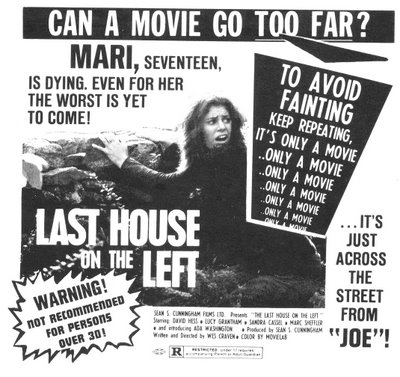
LAST HOUSE ON THE LEFT

THE LAST HOUSE ON THE LEFT (1972) Three stars
Former academic Wes Craven (1939-2015), who also did some work on pornographic films under different aliases, made a big bang with his feature debut THE LAST HOUSE ON THE LEFT, one of the great shockers of the seventies.

It’s an exploitative American modern take on Ingmar Bergman’s THE VIRGIN SPRING (1960), a film itself based on a 13th Century Swedish folk ballad. THE VIRGIN SPRING won the Academy Award for Best Foreign Language Film at the 1961 Academy Awards.

The film’s classic tagline, “To avoid fainting, keep repeating: It’s only a movie, only a movie, only a movie. …” Viewers had a variety of extreme reactions, of course which only helped to hype the film en route to $3.1 million in returns on a $87,000 budget.

Theaters and drive-ins showed LAST HOUSE in many different prints, because individual machinists took it upon themselves to make their own cuts. Normally, the most shocking bits would end up missing. Good luck finding an uncut version of the film.

It received some of the nastiest reviews imaginable, which made seeing the film again seem like more of an event, a happening. Writing for the New York Times, Howard Thompson said, “When I walked out, after 50 minutes (with 35 to go), one girl had just been dismembered with a machete. They had started in on the other with a slow switch blade. The party who wrote this sickening tripe and also directed the inept actors is Wes Craven. It’s at the Penthouse Theater, for anyone interested in paying to see repulsive people and human agony.” Roger Ebert wrote just about the only positive review at the time of the film.

I first watched it about 10 years back and I thought it was a powerful work. I wrote a very positive review somewhere and I gave it three-and-a-half stars. I found it less powerful after subsequent viewings.

Craven and crew made some appalling choices that create a split personality movie.

Watching LAST HOUSE for the first time, you might notice the buffoonish antics of the Sheriff (Marshall Anker) and the Deputy (Martin Kove). Their comedic relief never works and in fact they play like failed slapstick comedy dropped in from another movie. I noticed this element upon first viewing and it was the reason I graded THE LAST HOUSE ON THE LEFT three-and-a-half rather than four stars.

PSYCHO. Herrmann. SUSPIRIA. Goblin. HALLOWEEN. Carpenter.

Well, you’ll never find THE LAST HOUSE ON THE LEFT soundtrack filed alongside those indelible horror movie scores and their composers. That’s why I started a new paragraph.

David Hess, who plays the main villain Krug, wrote and performed four songs for the movie: “The Road Leads to Nowhere” (the best song of the bunch), “Wait for the Rain,” “Sadie and Krug (Baddies’ Theme),” and “Now You’re All Alone.”

Upon more viewings, this music stuck out like a sore thumb, one that poked me right straight in the eye. I’m not sure why I overlooked the music the first time around.

Krug the character, played by Hess the actor, would have killed Hess the singer and songwriter, just slit his throat for singing one of those ridiculous songs. Believe it or not, Hess wrote “Speedy Gonzales,” which became a big hit for Pat Boone in the year 1962.

I still deduct one-half star from LAST HOUSE for the rumbling bumbling stumbling cops and a good quarter star for them Hess songs.

Hess (1936-2011) is so good as the bad guy in LAST HOUSE that we can understand precisely why he became typecast as villain. He played one of the henchmen in Craven’s SWAMP THING.

Sandra Peabody and Lucy Grantham play Mari and Phyllis, who are kidnapped, tortured, raped, and murdered by Krug and company. They have the most difficult roles.

Filming LAST HOUSE proved to be a horrifying ordeal for Peabody, especially since Hess believed in method acting and even threatened assaulting her for real during a rape scene. Peabody dropped out from acting in 1974, after being cast in movies like VOICES OF DESIRE and MASSAGE PARLOR MURDERS! She went into screenwriting, producing children-orientated entertainment, and being an acting coach.

Fred Lincoln (1936-2013) played Weasel, one of Krug’s nasty associates, and LAST HOUSE marked Lincoln’s only non-pornographic role. Lincoln directed more than 300 films; the Internet Movie Database lists 340 directorial credits for the New York native.

Jeramie Rain, who played the vicious Sadie, was married to Richard Dreyfuss from 1983 to 1995 and their union produced three children. She once hitched a ride with real-life serial killers Charles Manson and Tex Watson. That’s fitting because LAST HOUSE seems to have been heavily influenced by the Manson Family and their murders.

Richard Towers and Eleanor Shaw, under different names, play Mari’s parents Dr. John and Estelle Collingwood, highly respectable upper middle class folk. Krug and his gang disguise themselves as traveling salesmen and they call upon the Collingwoods. Both parties eventually discover the others’ identities: The Collingwoods find out their guests killed their daughter and Krug and company discover that Dr. John and Estelle are Mari’s parents.

Dr. John and Estelle devise some elaborate booby traps and Craven displays his fondness for booby traps for the first time. Booby traps also played a role in both THE HILLS HAVE EYES and A NIGHTMARE ON ELM STREET. I believe that Craven should have directed at least the first HOME ALONE, given his predilection for booby traps.

This juxtaposition of seeing a socially respectable upper middle class couple getting down-and-dirty to exact revenge has been one of the most fascinating elements at work in LAST HOUSE. You just might find yourself asking, “What would I do if I found myself in a similar situation?”

Though it’s not a classic on the same level as both NIGHT OF THE LIVING DEAD and THE TEXAS CHAINSAW MASSACRE, LAST HOUSE is essential viewing for horror fans.

Night of the Living Dead (1968)

DAY 9, NIGHT OF THE LIVING DEAD

NIGHT OF THE LIVING DEAD (1968) Four stars
The other day on Facebook, I thought I saw a fan ask others not to bring politics into their appreciation of a classic on the NIGHT OF THE LIVING DEAD page.

Are you kidding?

As many fans would be quick to point out, George Romero’s films often have political themes and some of us fools love them even more for it.

I once wrote a review of the 2010 remake of Romero’s THE CRAZIES and lamented the fact the remake traded Romero’s sharp-edged content in for cheap trick, conventional jump scares.

That review included a mention of the scene in Romero’s original where a priest (infected by the virus) self-immolates because of soldiers rousing his flock, a harrowing moment that calls to mind Norman Morrison, the 31-year-old Baltimore Quaker pacifist who carried self-immolation out below Secretary of Defense Robert McNamara’s Pentagon office to protest American involvement in the Vietnam War, and the Buddhist monk Thich Quang Duc at a busy Saigon intersection to protest the corrupt South Vietnamese government’s persecution of Buddhist monks.

THE CRAZIES remake did not include such a scene, and that epitomized its lack of balls. (By the way, the references to the priest’s self-immolation in the movie, Morrison, and the Buddhist monk were all excised from the review that printed in the college paper, most likely for space considerations.)

Just thought it was strange that a Romero fan bitched about political conversation, because politics are part and parcel of each and every DEAD movie.

For example, it’s hard not to consider NIGHT OF THE LIVING DEAD in the broader context of 1968 (or any year) America.

The radio and TV news reports about flesh-eating ghouls in NIGHT OF THE LIVING DEAD would have been natural alongside such watershed events as the Tet Offensive, the My Lai Massacre, Lyndon B. Johnson’s announcement that he will not seek or accept presidential renomination, the assassinations of Martin Luther King and Robert Kennedy, and the riots riots riots all through a turbulent 1968.

(NIGHT OF THE LIVING DEAD was filmed in 1967 and officially released on October 1, 1968.)

When the black protagonist Ben (Duane Jones) gets mistaken for a ghoul, shot in the head and killed by a member of a white mob looking for ghouls, and thrown in a burn pile with the other ghouls at the end of the movie, of course viewers can draw parallels with MLK, Emmett Till, and numerous other horrifying incidents over the years. Or you can just take the scene at face value. Any way you read it, it’s a shocker of an ending.

Casting Jones as Ben changed the dynamic of the movie. Originally, this character was scripted as a white man (according to a 2010 article by Joe Kane that appeared in “The Wrap”), a resourceful but rough and crude-talking trucker. Jones brought a strong presence, an obvious intelligence, and an unmistakable rage to the part that would have been lacking with the original casting plan. The interactions between Ben and Harry Cooper (Karl Hardman) take on another dimension with the racial tension palpable between both men.

I’ll just go ahead and say it: NIGHT OF THE LIVING DEAD would have been a lesser movie without a black male in the lead.

At one point, again from the Kane article, the filmmakers thought about changing the ending to allow Ben to survive. Jones was not having any. “I convinced George that the black community would rather see me dead than saved, after all that had gone on, in a corny and symbolically confusing way,” he said. “The heroes never die in American movies. The jolt of that and the double jolt of the hero figure being black seemed like a double-barreled whammy.”

There’s a multitude of whammies in NIGHT OF THE LIVING DEAD.

Consider the plight of Mr. Cooper, his wife Helen (Marilyn Eastman), and their 11-year-old daughter Karen (Kyra Schon), who’s seriously ill after being bitten by one of the ghouls. Karen’s in the cellar for the duration of the movie.

Mr. and Mrs. Cooper, why you can just tell they do not get along very well. Understatement of the year. Nearly every word they say to each other, especially from her to him, carries an undercurrent of hostility. We feel there’s no love between the two.

Eventually, Karen dies and becomes one of the flesh-eating ghouls. She first eats her father and then bludgeons her mother with a trowel. The latter sequence calls to mind Detective Arbogast’s encounter with Mother in PSYCHO (1960).

You probably have noticed this sentence is the first mention of Barbra (Judith O’Dea), another main protagonist. She’s definitely the weak link in the movie, the epitome of the helpless female who spends nearly all her screen time in either panic mode or in a catatonic state. She’s not much of a help to anybody, and we delight in her fate near the end of the movie. (In the 1990 remake, Barbra’s more along the lines of Ellen Ripley in the ALIEN movies.)

Russell Streiner, one of the producers of the movie along with Hardman, plays Johnny and he’s absolutely fantastic during his screentime (just a few minutes) in the classic opening cemetery scene. He complains about virtually everything, he gives his uptight sister Barbra a hard time, and he delivers one of the great lines in horror movie history doing the latter, “They’re coming to get you, Barbra.”