Bill & Ted’s Bogus Journey (1991)

BILL & TED’S BOGUS JOURNEY (1991) ***1/2

A great supporting character can elevate a movie.

Take, for example, the Grim Reaper from BILL & TED’S BOGUS JOURNEY. I mean, it’s not every day that a supposedly lowbrow comedy puts a novel spin on a character and plot thread from Ingmar Bergman’s THE SEVENTH SEAL.

In that one, you might remember a medieval knight (Max von Sydow) plays a game of chess against a personification of Death (Bengt Ekerot) to prolong his life. The mere image of the knight and Death playing chess by the sea had become one of the most revered in movie history by the time BOGUS JOURNEY director Peter Hewitt, writers Chris Matheson and Ed Solomon, and Grim Reaper player William Sadler, as well as co-stars Keanu Reeves and Alex Winter, got their grubby little mitts on it.

In BOGUS JOURNEY, our two most excellent dudes Bill S. Preston Esquire (Winter) and Ted “Theodore” Logan (Reeves) find themselves in a most hellish predicament. They are killed by evil robot Bill & Teds, called the Evil Robot Usses by our poetic lead characters, and wind up in Hell. What else would happen to a pair of heavy metal fans? Bill & Ted, who quickly discover their album covers lied to them, man, are greeted by Granny Preston, an evil Easter Bunny, Colonel Oats, and eternal boot camp, a plight highlighted by infinity push-ups and verbal abuse, in their own personal Hell. Colonel Oats tells Bill & Ted they are silky boys and silk comes from the butts of Chinese worms.

Back to the Grim Reaper. “How’s it hanging, Death?” asks Ted.

Bill & Ted play The Reaper dude in a series of games, including Battleship, Clue, and Twister, because Death is a sore loser and Bill & Ted must win two out of three or was that three out of five. Nah, believe it’s best five out of seven. The Reaper finally relents, “I will take you back.”

Bill & Ted are the first to ever beat The Reaper, and before that the first to melvin him. “Ted, don’t fear the reaper.” Cue them celestial cowbells.

I love just about everything about the Grim Reaper in BOGUS JOURNEY and he contributes to BOGUS JOURNEY being a step up from EXCELLENT ADVENTURE.

Sadler should have been at least nominated for Best Supporting Actor for his performance here. No, instead, the Academy of Motion Picture Arts and Sciences saw fit to nominate Harvey Keitel and Ben Kingsley from BUGSY, Michael Lerner from BARTON FINK, Tommy Lee Jones from JFK, and winner Jack Palance from CITY SLICKERS. Keitel and Kingsley should have faced off against Sadler in a best-of-seven to see if we could get one less nomination for BUGSY. Colonel Oats would certainly have approved of Palance’s victory with his celebratory one-armed push-ups.

EXCELLENT ADVENTURE takes on time travel, historical figures, and historical fiction. Bill & Ted need to earn an A+ on their final report in history … and the future of the human race hangs in the balance. Literally, because in a mere 700 years in the future, humanity exists in an utopia built around the music of the Wyld Stallions, Bill & Ted’s most excellent rock band.

BOGUS JOURNEY adds depictions of the afterlife, Heaven, and Hell to the mix, and it gives us good and evil robot Bill & Teds in addition to living and dead Bill & Teds. Winter and Reeves compete with Michael J. Fox and Thomas F. Wilson for most permutations in a time travel comedy. Peter Sellers and Tony Randall would have been proud of all of them.

Additionally, the universe’s most brilliant scientific genius uses a single word vocabulary and that’s his name, Station. Station builds the “good robot usses” or “Station’s creations.”

I should not forget Joss Ackland as arch villain Chuck DeNomolos, who programs the evil robots to kill the good Bill & Ted because he hates their ideas and their insipid music. Don’t feel too bad for Chuck, because he gets a shot with Missy. Doesn’t just about everybody?

In the end, though, remember “You might be a king or a street sweeper, but sooner or later you dance with the reaper.”

That and, of course, “Be excellent to each other.”

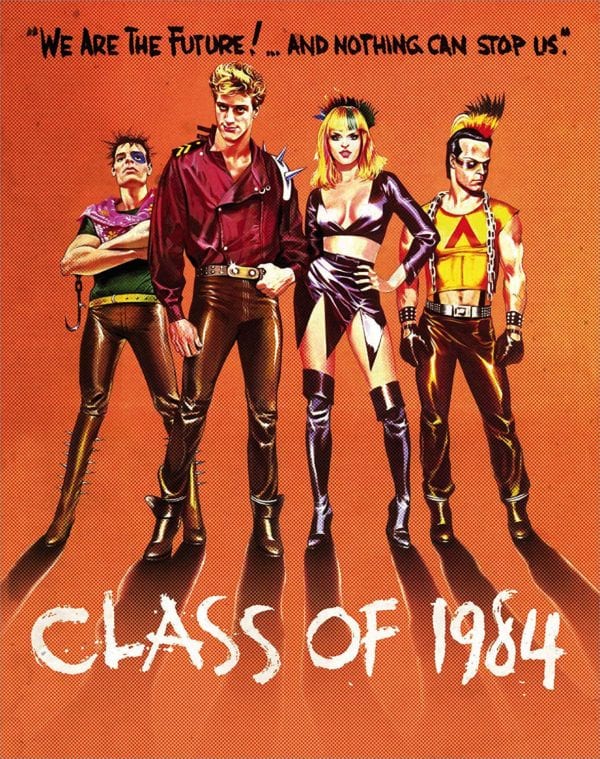
Class of 1984 (1982)

CLASS OF 1984

CLASS OF 1984 (1982) Three-and-a-half stars

Given its exploitation film content including gore, nudity, profanity, sex, and violence, CLASS OF 1984 will not be shown to new teachers or substitute teachers any school year soon.

Not that it should, but a little independent research never hurt anybody.

I don’t remember, though, if I first watched CLASS OF 1984 during or after my three years as substitute teacher in the late 00s. However, I do remember that it made a strong impact with its story of how an idealistic music teacher eventually gives into the dark side and murders his most unruly students at an inner city high school. It’s definitely the movie to see after DANGEROUS MINDS, LEAN ON ME, all that feel good uplifting claptrap.

Watching CLASS OF 1984 again in a decade since I substituted, it still brings on memories of the little punks who threatened violence, who said they would sue, who just ran their mouths incessantly, and who made getting through another day feel like an endurance contest from Hell. For every good student, it often seemed like there were two or three or twenty bad ones in every class. “I would love to punch you in the face,” one junior high student said. “Go ahead, give it your best shot,” the substitute teacher said. Thankfully, not every day substitute teaching was quite like that.

In that spirit, though, we return to our regularly scheduled review of CLASS OF 1984.

Be warned: This is a rough little movie, a nasty piece of work at times, but if you can make it through scenes like the biology teacher’s murdered rabbits and the rape of the music teacher’s wife, this 1982 update on the 1955 classic BLACKBOARD JUNGLE does have its merits.

The performances help lift this film above mere exploitation trash: Perry King as the music teacher, Roddy McDowall as the biology teacher, Timothy Van Patten as every teacher’s worst nightmare, and Michael J. Fox (in an early role) as one of the good students.

King makes for a likable protagonist and takes us from one end of the picture to the next. We are behind him every step of the way, and that’s critical during the film’s violent final act as enough has become more than enough for this music teacher. Those damn punks go too far, far enough for at least a couple exploitation films. Roger Ebert called the climax a cross between THE HUNCHBACK OF NOTRE DAME and BEYOND THE VALLEY OF THE DOLLS.

McDowall (1928-98) had a knack for supporting performances that almost steal a movie away from their nominal stars, and he displays that knack here in CLASS OF 1984, especially when he cracks and teaches his biology class by gunpoint. I bet you’ll remember how many chambers are in the human heart with a gun pointed at you, and I also bet that Richard Kiley (from BLACKBOARD JUNGLE) wishes he could have got a scene like that after the punks in his film had their way with his favorite jazz records. Damn kids, damn punks.

[Review resumed about two weeks later.]

To work properly, this genre requires a repugnant piece of work going up against the hero and Van Patten certainly provides that as teenage antagonist Peter Stegman. Audiences have been known to cheer his demise. Stegman’s personality profile on Villains Wiki, “A totally violent, sadistic, ruthless and mentally unstable teenager. He will hurt anyone who he thinks is threatening his authority over the school, or he will also kill them with no remorse or regrets.” In a different movie, Stegman’s piano-playing ability would have been exploited for a different kind of feel-good ending, not one where you feel good the bastard’s dead.

You can see why Fox became a superstar, even in a supporting performance.

CLASS OF 1984 director Mark L. Lester also directed TRUCK STOP WOMEN, WHITE HOUSE MADNESS, BOBBIE JO AND THE OUTLAW, GOLD OF THE AMAZON WOMEN, ROLLER BOOGIE, FIRESTARTER, and COMMANDO. Now, that’s some filmography and I’ll say that it’s close (real close) between CLASS OF 1984 and COMMANDO for his best work.

A movie like this needs a proper soundtrack.

Nearly two decades before AMERICAN GRAFFITI, BLACKBOARD JUNGLE made waves with its use of Bill Haley and the Comets’ “Rock Around the Clock.” What an opener!

Alice Cooper provides “I Am the Future” for CLASS OF 1984. Mr. Cooper has the ideal credentials for scoring a teenage rebellion pic: specifically “I’m Eighteen,” “School’s Out,” and “Teenage Lament ‘74” from his glory days. As far as mid-period solo Alice standards go, “I Am the Future” does not quite measure up against 1980’s “Clones” and 1983’s “I Love America,” but it still far surpasses Alice’s late 80s and early 90s hair metal period.

CLASS OF 1984 belongs to a branch of entertainment that includes such notables as not only BLACKBOARD JUNGLE but also BEYOND THE VALLEY OF THE DOLLS, OVER THE EDGE, ROCK ‘N’ ROLL HIGH SCHOOL, RIVER’S EDGE, and PUMP UP THE VOLUME, as well as the “Smells Like Teen Spirit” video.

Teen Wolf (1985)

TEEN WOLF

TEEN WOLF (1985) Three stars

During the review of SILVER BULLET, TEEN WOLF came to mind and then I looked up a rather negative review I wrote 10 years ago.

A decade later, I recommend TEEN WOLF for the very things I once mocked. Here’s the original two-star review (with only small edits):

“TEEN WOLF almost succeeds in spite of itself and I do mean in spite of itself.

“The film stockpiles a nuclear arsenal of cliches. Next time I see Kim Jong-Il I will ask him what he thinks of the film, in between our usual rap session ‘bout FRIDAY THE 13TH films. Let’s see, I’ll have to make a list otherwise my brain will explode and that cannot happen before Finals Week, let alone Dead Week.

“I’ll briefly mention 1) the Nebraska small town setting; 2) the loving, single widower and his teenage son protagonist on their own; 3) the teenage son protagonist feels he’s doomed to an eternity of being “average” until he finds out that he can be a teenage werewolf just like Michael Landon and the Cramps song before him; 4) the protagonist’s hipster and profiteer best friend; 5) the “fat guy” fifth wheel nicknamed, oh you’ll love this one, “Chubby”; 6) The Blonde = Bad Girl and The Brunette = Good Girl formula; 7)the protagonist lusts after the Blonde, actually succeeds in sleeping with the Blonde as the Wolf, and ends up realizing his undying love for the Brunette in the final act though she prefers “average” Scott Howard over the Wolf; 8) the Blonde’s Evil Overlord of Brooding Hot Shot boyfriend and the protagonist’s eternal foil; 9) the Evil Principal; 10) the wise guy head basketball coach who spits out incantations of advice rejected by Fortune 500 fortune cookie companies; 11) the scene where the protagonist faces down a wily old liquor store veteran who’s heard every scam ever to purchase some alcoholic contraband for a monster party; 12) The Monster Party; 13) The Big High School Dance; and I believe I’m done after this one, 14) The Big Game. Sorry, I apologize in advance for missing a few there.

“Once we grant the film’s central premise, that werewolf genes run down a family’s genetic line, which sounds too much like TWILIGHT for its own good before Taylor Lautner was even born, what’s wrong with a few generic movie standards? Nothing, absolutely nothing, except for when taken in tandem our friendly standards make for a generic motion picture spread. TEEN WOLF almost set the cliche land speed record.

“Michael J. Fox makes for a likable, charismatic protagonist and his energetic movie star performance lets us live through standard, predictable material. He enlists us on his side, whether he’s average small town boy lined up to inherit his father’s small town hardware store, Scott Howard, or his alter ego, ultra-cool and ultra-hip and dazzling slam dunker “The Wolf.” Fox essentially plays the Lon Chaney existential dread film werewolf crossed with John Travolta in SATURDAY NIGHT FEVER (at least for the big dance sequence and the big preparation for the dance sequence) and Julius Erving, as well as having issues with anger management and teenage angst.

“Do teen wolves get pimples? TEEN WOLF fails to address several burning questions. Especially not a PG-rated TEEN WOLF. Fox plays these scenes ‘bout as good as any actor possibly can and we stomach him through every predictable change like, for example, how Scott Howard transforms himself into above average when he’s the Wolf: He can dance, he can act, he can surf on slow-moving customized Wolf vans, and he can play mean basketball. Scott Howard eventually turns his back on ‘Wolf Mania’ and decides to be himself for The Big Game.

“James Hampton must have enjoyed playing a humble, sagely teenage protagonist’s old man in TEEN WOLF, considering his past as evil public relations man in THE CHINA SYNDROME and his future as evil federal regulatory agency man in PUMP UP THE VOLUME. Susan Ursitti breathes some fire into her standard issue role as the Brunette / Good Girl and this is both good and bad, good because it makes our lives relatively less boring and bad ‘cause we get even more frustrated by the wait for the inevitable dramatic (overdue) realization made by the protagonist that she’s meant for him, forever. The Bad Girl and her maligned Evil Overlord of Brooding Hot Shit boyfriend are the only characters who fail to entertain us, interest us, et cetera. They’re not very good performers and it’s painful waiting for their inevitable downfalls.

“Surely Teen Wolf’s impressive slam dunk artistry did not inspire Spud Webb, the 5’7” Atlanta Hawks point guard who prevailed in the NBA Slam Dunk Contest at the 1986 NBA All-Star Weekend in Dallas, besting his own Atlanta Hawks teammate, Dominique Wilkins. Michael J. Fox, why he’s short and he’s Canadian, two proverbial strikes against him, so naturally it takes a stunt double werewolf for him to slam dunk. I would have thought a werewolf’s claws would have made playing basketball like a proverbial artiste virtually impossible. Anything goes, in the movies.

“Hey wait, lovely lads and lovely ladies, I recollect another standard trotted out by TEEN WOLF. The montage. The “Winning Streak” Montage. The Car Surfing Montage. The Big High School Dance Montage. The Big Game Montage. Hyperkinetic action scored by a hyperkinetic rock song. For the big dance montage, we get a bad theme song namedropping “The Big Bad Wolf.” It’s an unwritten rule that any 1980s movie referencing itself in song, like PROM NIGHT and BETTER OFF DEAD, will turn out crap. When in doubt, filmmakers, yes, bring on a montage of hyperkinetic action (basketball, dancing, violence) scored by hyperkinetic rock music. TEEN WOLF competes with THE HEAVENLY KID and OVER THE TOP for montage land speed record. I bet the composers do not put TEEN WOLF down on their permanent record.

“Oh, now I remember a couple more standard tricks exploited by TEEN WOLF. Slow motion. BONNIE AND CLYDE and THE WILD BUNCH used slow motion to brilliant effect, as did early Bruce Lee karate films, but lesser films like BLACK BELT JONES made slow motion passé, not to mention its overuse on sports television. Want to see Teen Wolf slam dunk for what feels like the hundredth billionth time? Watch TEEN WOLF! Want to see “average” Scott Howard’s lay-up that barely makes it around the cup and in? Watch TEEN WOLF!

“Now, here we have a standard within a standard: late in the game, Scott Howard gets clotheslined on a final shot layup attempt by his eternal foil (at least for 90 minutes eternity) and his team, the Beavers, are down by one point and two made free throws will naturally win The Big Game for the Beavers.

“Howard steps to the free throw line … his eternal foil stares him down … he makes the first one, smoothly … the second free throw … it’s released … it’s looking good … it’s SLOW MOTION … slower and slower … oh no! … it hits the back of the rim … slower and slower and even slower motion … it touches almost every corner of the rim … and it finally rolls in … reaction shots galore … NO MORE SLOW MOTION … and the crowd storms the court in celebration of either the end of the Big Game, the end of the movie, the end of shooting the movie, or all three simultaneously. I’ll bet on all three ‘cause I know they were solid pros.

“Rod Daniel, oh what a director, this here Rod Daniel. TEEN WOLF perhaps represents the peak of Rod Daniel’s cinematic directorial career, TEEN WOLF up against the Dudley Moore-Kirk Cameron body switch masterpiece of dreck cinema LIKE FATHER LIKE SON and the BEETHOVEN sequel. I favor a slam-dunking, breakdancing Teen Wolf over a born again Kirk Cameron (Jesus couldn’t save Kirk Cameron’s acting) and Charles Grodin overshadowed by a dog. At least, Daniel had the decency not to direct TEEN WOLF TOO. On this or any other job, you win some, you lose some.”

Not sure what came over me when I wrote that review 10 years ago, especially since I have enjoyed TEEN WOLF many times over the years. A lot of the success of TEEN WOLF has to do with Michael J. Fox at the center. After all, with Jason Bateman in the title role instead, TEEN WOLF TOO proved to be a disaster, although that’s partly because TEEN WOLF did not require a sequel.

Back to the Future Trilogy (1985-90)


BACK TO THE FUTURE TRILOGY (1985-1990)
The BACK TO THE FUTURE trilogy stands up better now than when the films were originally released.

That’s partly because we’ve not seen any more sequels or remakes, retcons, reboots, and ripoffs.

The three films have been allowed to stand on their own.

They stand up tall and straight.

Once upon a time, I wrote that DAWN OF THE DEAD, THE TERMINATOR, and THE FLY are great films because they not only succeed at giving audiences satisfaction on genre terms but they also work on additional levels. For example, the satire that equates mall shoppers with zombies (DAWN OF THE DEAD), the romance between Kyle Reese and Sarah Connor (THE TERMINATOR), and the romance between Seth Brundle and Veronica (THE FLY). All three films have a lot going on for and in them.

The same greatness principle holds true for all three BACK TO THE FUTURE films: They’re all successful comedies that work on a deeper level, mostly thanks to time travel.

Speaking of time travel, I’m definitely a fan because I love THE TERMINATOR, TIME AFTER TIME, X-MEN: DAYS OF FUTURE PAST, and MEN IN BLACK 3 and enjoy BILL & TED’S EXCELLENT ADVENTURE, STAR TREK IV: THE VOYAGE HOME, and FREQUENCY, for example.

The BACK TO THE FUTURE films — especially PART II — play around with the paradoxes of time travel, both for comedic and dramatic effect. It allows certain actors to play multiple roles in different times — 1885, 1955, 1985, alternate 1985, and 2015.

BACK TO THE FUTURE starts with the inspiration of containing a time machine in a DeLorean and the movie revs up when that baby moves 88 mph because, as Christopher Lloyd’s Dr. Emmett “Doc” Brown says, “If my calculations are correct, when this baby hits 88 miles per hour, you’re gonna see some serious shit.”

We do.

Anyway, our teenage protagonist Marty McFly (played by a 23-year-old Michael J. Fox), he’s bummed out by his parents George (Crispin Glover) and Lorraine (Lea Thompson), a hopeless nerd picked on by eternal bully Biff Tannen (Thomas F. Wilson) for one parent and a drunk for the other.

Sitting at the dinner table with his family, Marty’s not too interested in how his parents met: Lorraine’s father hit George with his car and Lorraine nursed George back to health. Lorraine experienced a real Florence Nightingale effect.

However, no kid’s ever all that interested in how their parents met. Especially parents like George and Lorraine.

The DeLorean hits 88 mph and Marty ends up back in 1955 — Nov. 5, 1955, stuck there, without any plutonium to return.

BACK TO THE FUTURE then becomes an even greater movie when it takes on the premise of a teenager meeting their parents when they’re teenagers. Marty’s a lot more interested in how his parents met, that’s for sure.

Not long after their first meeting in 1955, Marty saves George from being hit by that fateful car. Marty’s knocked unconscious instead and Nurse Lorraine grows “amorously infatuated” (Doc’s words) with her future son rather than her future husband. She’s in hot pursuit, and we remember her 1985 self warning her teenaged son about girls that chase after boys.

Just be glad that Marty finds a younger Doc to sort it all out and get him “back to the future.”

We especially need Doc around for PART II to explain the movie’s convoluted plot.

PART II gives us a version of 2015 highlighted by technological advancements. It was great fun watching the 2015 scenes in 1989 based on future speculation and it’s still great fun watching them 30 years later as we reflect what they got right and what they got wrong. The Royals, not the Cubs though, won the World Series and Universal mercifully stopped at four JAWS films.

(The Cubs ended the longest world championship drought in North American professional sports history — only 108 years — by winning the 2016 World Series.)

Futurepedia even provided a list of the new technology: Air traffic control; auto-adjusting and auto-drying jacket; automatic dog walker; automated Texaco service station; barcode license plate; binocular card; bionic implants; Compu-Fax; Compu-Serve; computerized breastplate; cosmetic factory; data-court; dehydrated pizza; dust-repellent paper; flying circuits; fruit dispenser; hands free video games; holobillboard; holofilms a la JAWS 19; hoverboards; hovercam; hover conversion; hydrator; Identa-pad; Internet; Kirk Gibson Jr. Slugger 2000 adjustable bat; Litter Bugs; Master-cook; Mr. Fusion; multi-channel video screen; neon curbing; Ortho-lev; Pac Fax; portable thumb unit; power-lacing shoes; rejuvenation clinic; scene screen; skyway; slam ball; sleeping device; soda bottles with built-in straws; flying cars; tablet computer; thumb pad; tranquilization; transponder; U.S. Weather Service; video glasses and video telephone glasses; video simulacrum; video telephone.

PART II ends up back in Nov. 12, 1955 (Marty’s final day in 1955 in BACK TO THE FUTURE), so we have two Martys and two Docs running breathlessly around Hill Valley.

Given all the plot convolutions and time permutations in PART II, it’s fitting that the 1955 Doc faints during a scene late in the movie.

Lightning strikes the DeLorean and sends Doc back to 1885 near the end of PART II … and Marty tracks him down in PART III.

We get a Western comedy in a year that included Best Picture winner DANCES WITH WOLVES and QUIGLEY DOWN UNDER.

PART III finds employment for veteran character actors Pat Buttram (1915-94), Harry Carey Jr. (1921-2012), and Dub Taylor (1907-94) in the 1885 scenes. It’s nice to see and hear them codgers.

Their presence lets us know that PART III is a different kind of Western than DANCES WITH WOLVES and QUIGLEY DOWN UNDER, more like a TV Western.

Marty takes Clint Eastwood for his 1885 name.

PART III casts Mary Steenburgen as Doc’s love interest and we remember Steenburgen as H.G. Wells’ love interest in TIME AFTER TIME (1979). Wells wrote “The Time Machine.” In TIME AFTER TIME, Jack the Ripper uses Wells’ time machine to travel to modern day San Francisco and Wells follows and pursues Jack the Ripper. During his pursuit, Wells meets bank clerk Amy (Steenburgen) and falls in love with her. (In real life, McDowell and Steenburgen became married in 1980, separated in 1989, and divorced in 1990. They met and began dating making TIME AFTER TIME.)

The BACK TO THE FUTURE trilogy ends on a satisfying note.

More notes on BACK TO THE FUTURE:

— Michael J. Fox is one of the most likable actors of all-time. He was the first choice for Marty, but “Family Ties” producer Gary David Goldberg refused to allow Fox away from that show to make a movie. That’s why BACK TO THE FUTURE originally cast Eric Stoltz as Marty. Stoltz worked a few weeks on the film before director Robert Zemeckis and screenwriter Bob Gale realized there’s something wrong with Stoltz as Marty: He’s not the Marty they wanted. Stoltz lacked screwball energy and he played scenes more dramatically. They let Stoltz go and recast with Fox, who became free to make the movie. Fox did not have to reach very far to portray Marty, “All I did in high school was skateboard, chase girls, and play in bands. I even dreamed of becoming a rock star.”

For two months, Fox worked on “Family Ties” during the day and BACK TO THE FUTURE at night, giving him at most a few hours of sleep each day.

Re-shooting added $3 million to the film’s budget, a number more than made up for by grosses for all three films that have amassed nearly $1 billion in returns.

— Christopher Lloyd’s boundless madcap energy earns Doc a place in the annals of great mad scientists and nutty professors. He becomes more than that, though, over the course of three movies. We love Doc, perhaps more than any other character in the series.

— Thomas F. Wilson makes any variation on the bully, whether it’s Buford “Mad Dog,” Biff, or Griff Tannen and whether it’s 1885, 1955, 1985, alternate 1985, or 2015, a lovable asshole. We love to hate “Mad Dog,” Biff, and Griff, especially Biff. We love every time Biff screws up a phrase like “Make like a tree … and get out of here.” We love every time he’s doused in manure. We love every time he’s burned and showed up by our protagonists. How do you feel after learning Donald Trump inspired the Biff character?

— Crispin Glover proved to be the next evolution in screen nerd, taking off from Eddie Deezen and REVENGE OF THE NERDS. Glover stepped in that direction in FRIDAY THE 13TH: THE FINAL CHAPTER, but he gets a fuller character in BACK TO THE FUTURE.

— Lea Thompson is quite fetching in the 1955 scenes and her character unknowingly lusting after her future son fits into a career where she was attacked by The Great White Mother in JAWS 3-D, yelled at and embarrassed by her sexually frustrated and football obsessed boyfriend in ALL THE RIGHT MOVES, involved with a married police officer who should have arrested himself for his own sex crimes in THE WILD LIFE, and kissed by an animatronic duck in HOWARD THE DUCK. John Hughes at least gave her the name Amanda Jones in SOME KIND OF WONDERFUL, from the Rolling Stones song “Miss Amanda Jones.” What a career.

— Huey Lewis and the News’ “Power of Love” achieves being their only song that does not inspire my thoughts of giving the nearest person a pencil and having them stab my eardrums. For example, it seemed that for the longest time at the Pittsburg Subway I’d hear their hit song “The Heart of Rock & Roll.” Every damn single time. I survived by wisecracking, “If Huey Lewis is the heart of rock ’n’ roll, then rock ’n’ roll needs a defibrillator.” I suppose I think more positively of “Power of Love” from being in BACK TO THE FUTURE.

— Zemeckis produced some of the best mass entertainments for nearly a decade-and-a-half, everything from 1941 (directed by Steven Spielberg) and USED CARS to BACK TO THE FUTURE and WHO FRAMED ROGER RABBIT.

I just hope that Hollywood leaves those films alone and does not burden us with remakes, retcons, reboots, or any other ripoff.

Is that too much to ask?

BACK TO THE FUTURE (1985) Four stars; BACK TO THE FUTURE PART II (1989) Three-and-a-half stars; BACK TO THE FUTURE PART III (1990) Four stars