
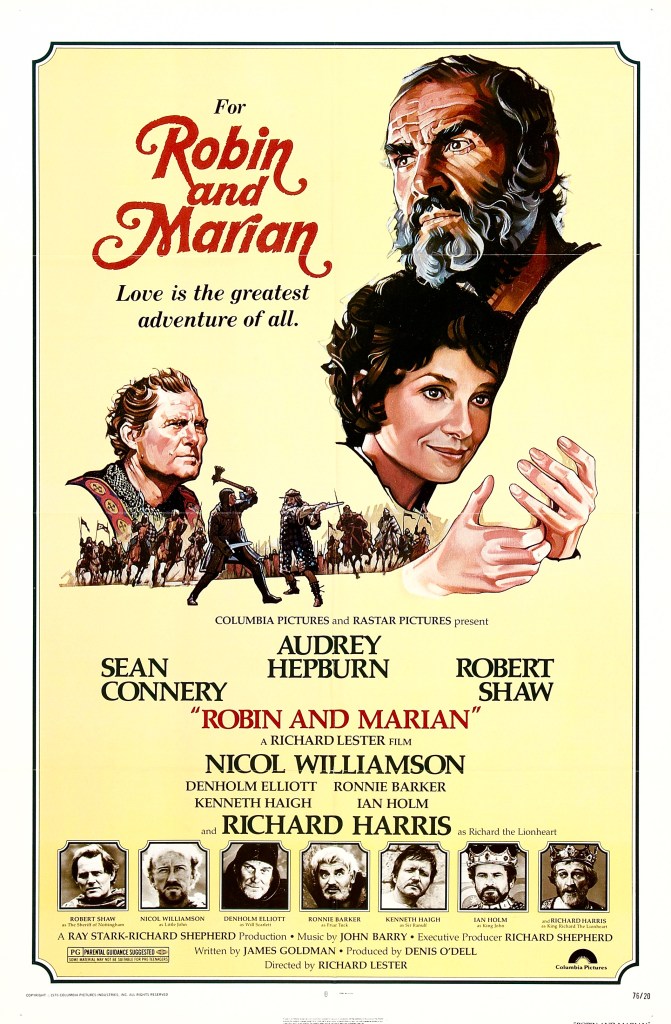
Robin and Marian (1976)

ROBIN AND MARIAN (1976) ****
Richard Lester’s Robin and Marian definitely made a strong first impression.

I placed it on my top 10 films list for 1976, based on just viewing it a single time on cable TV many years ago.

Granted, Robin and Marian crossed my mind several times in recent months, especially after Robin and Marian star Sean Connery died last Halloween and then after I watched both the Disney (1973’s Robin Hood) and the Mel Brooks (1993’s Robin Hood: Men in Tights) takes on the legendary old warhorse. Disney and Brooks both left me feeling often unimpressed and ultimately supremely disappointed, for very different reasons, and I started thinking instead about superior Robin Hood films The Adventures of Robin Hood and Robin and Marian, both of which I first encountered during childhood or teenage years.

The Adventures of Robin Hood remains my favorite take on Robin Hood and I’ve watched it numerous times over the years. Of course, it helped that The Adventures of Robin Hood ranked among the select few titles Grandma Sisney had on VHS and I played it — along with Indiana Jones and the Temple of Doom and Fun in Acapulco — so many times before Grandma took over her TV for a day of game shows and soap operas. There’s always been something so indelible about Errol Flynn’s Robin Hood that I judge all others portraying Robin Hood against Flynn’s standard, Claude Rains and Basil Rathbone make incredibly satisfying villains, and Olivia de Havilland’s Maid Marian simply radiates a MOST BEAUTIFUL WOMAN IN THE WORLD AT THIS VERY MOMENT glow. Plus, it’s hard to forget the colors (and costumes) that argue for three-strip Technicolor superiority.

Robin and Marian left a mark for similar reasons — Connery and Audrey Hepburn both carry some of the same appeal as Flynn and de Havilland do in their iconic roles. Flynn was just a month shy of 29 years old when The Adventures of Robin Hood first came out in May 1938 and similarly, De Havilland was two months shy of a mere 22. However, Connery and Hepburn play older Robin Hood and older Maid Marian — please consider both Connery and Hepburn were in their mid-40s during Robin and Marian and each had a solid 15-20 years of stardom behind them. Connery and Flynn both have an undeniable robust humor and physicality (both men seemed tailor-made for James Bond, for example) and Hepburn could make claims on de Havilland’s radiant MBWITW glow several times during her career, from Roman Holiday and My Fair Lady to Robin and Marian.

Anyway, I finally watched Robin and Marian for a second time and it holds up as a great movie, right behind only The Adventures of Robin Hood in the Robin Hood cinematic pantheon.

Because of centering around middle age characters, Robin and Marian plays different notes and takes on a greater emotional range than any other Robin Hood film I have ever seen.

It’s definitely not the lusty adventure like The Adventures of Robin Hood. Sure, Robin and Marian has sword fights and scenic vistas and soaring music and horses and romantic clinches and every prerequisite of the genre, as well as King John, King Richard the Lionhearted, the Sheriff of Nottingham, Little John, Friar Tuck, Will Scarlett, and Sherwood Forest, but they’re all — both people and places, and every plot event — suffused with melancholy.

To be fair, though, Lester and Connery inject enough good humor and spirit into Robin and Marian to help it avoid being a more downbeat experience like the 1991 Robin Hood starring Kevin Costner. And the scenes between Connery and Hepburn are simply flat-out appealing, rooted in seeing two of the most attractive, most ebullient performers to ever grace the screen share time with each other (and us audience members).

It should also be mentioned that supporting players Nicol Williamson, Richard Harris, Denholm Elliott, and Ian Holm contribute to an absolute dynamite cast.

Didn’t we always ponder how it all turned out for Robin Hood, Maid Marian, the Sheriff, Little John, Friar Tuck, and Will Scarlett?

Lester’s film, with a screenplay written by James Goldman (writer of the play, film adaptation, and TV movie version of The Lion in Winter), answers those very questions, but do we viewers feel comfortable with the answers? Are we prepared to see Maid Marian as a nun because Robin Hood, off on his damn crusades and holy wars with Richard and Little John, didn’t write her for the last 20 years? We also found out that she attempted suicide. He’s back, though, and it’s obvious that Robin Hood and Maid Marian are destined to be together. They might initially hate it and initially fight it, she invariably more than he, but they are pulled together rather than apart.

All roads lead toward a final showdown between Robin Hood and the Sheriff (Robert Shaw). They fight like two worn-out, downtrodden men with many, many battles behind them and none ahead of them, who have resigned themselves to their final destiny. They fight because it’s their duty, or their almost perverse obligation to each other as hero and villain. They really don’t want to be fighting each other at this precise historical moment, it feels like, BUT THEY MUST FIGHT TO THE DEATH. There’s none of the joy in this fight that can be found in great film sword fights like the one, for example, between Robin Hood (Flynn) and the Sheriff (Rathbone) in The Adventures of Robin Hood. This final showdown, just like Robin and Marian overall, gives us something that’s different from any other purely adventure movie. All the main players have lived through considerable pain, considerable disappointment, and the film serves a reminder (from early on and throughout) there’s flesh-and-blood and real-life experience behind every legend, every song, every ode, every hymn, every myth.

Maid Marian gives Robin Hood (and us) some final words, “I love you. More than all you know. I love you more than children. More than fields I’ve planted with my hands. I love you more than morning prayers or peace or food to eat. I love you more than sunlight, more than flesh or joy or one more day. I love you more than God.”

The In-Flight Double Feature: Airplane!, Airplane II: The Sequel

AIRPLANE!, AIRPLANE II: THE SEQUEL

AIRPLANE! contributed to the demise of the dominance of the disaster film just as much as beyond lackluster disaster films AVALANCHE, THE SWARM, WHEN TIME RAN OUT, BEYOND THE POSEIDON ADVENTURE, and AIRPORT ‘77 and THE CONCORDE … AIRPORT ‘79. It was like the decisive blow and disaster movies disappeared for many years.

AIRPLANE satirized disaster films in general and the AIRPORT series in particular. The team of Jim Abrahams, David Zucker, and Jerry Zucker ripped their ridiculous plot straight from the 1957 Paramount Pictures film ZERO HOUR starring an exclamatory title and Dana Andrews, Linda Darnell, Sterling Hayden, and Elroy “Crazy Legs” Hirsch. I watched ZERO HOUR (sans exclamation) after learning of the fact that it directly inspired AIRPLANE, and it’s scary how much AIRPLANE lifted from the earlier film. It is also fitting, because Arthur Hailey co-wrote the screenplay for ZERO HOUR and wrote the 1968 novel AIRPORT that became the beginning of the disaster film craze when AIRPORT hit box office gold upon its March 1970 release.

A decade later, millions were obviously clamoring for a sledgehammer attack on disaster films, because AIRPLANE finished behind only THE EMPIRE STRIKES BACK, 9 TO 5, and STIR CRAZY at the American box office in 1980.

Abrahams, Zucker, and Zucker not only had their way with disaster films, but they ripped to shreds both famous individual scenes (SATURDAY NIGHT FEVER, FROM HERE TO ETERNITY, KNUTE ROCKNE ALL-AMERICAN) and standard narrative devices. They especially had some devious fun with flashbacks and voice-over narration courtesy our rather square, good-looking protagonist with a troubled past (Robert Hays’ Ted Striker a perfect match for Dana Andrews’ Ted Stryker in ZERO HOUR. Andrews’ Stryker also brings to mind his troubled character 11 years earlier in THE BEST YEARS OF OUR LIVES).

In the process of satirizing movie genres, AIRPLANE created its own genre that has endured far longer than disaster films and gave birth to new old movie stars like Leslie Nielsen, Lloyd Bridges, Robert Stack, and Peter Graves, whose ability to play it straight at every moment made at least half the joke work.

(Disaster films have periodically made huge comebacks like when INDEPENDENCE DAY, TWISTER, and ARMAGEDDON became super blockbusters late in the apocalypse-minded 20th Century. Definitely not my favorite trend. For the record, I hate both TWISTER and ARMAGEDDON, and I have never managed to make it through INDEPENDENCE DAY in spite or more precisely because of all the hype and euphoric glee that came with it and still comes with it years later.)

Yes, we have seen virtually every movie genre under the sun parodied, quoted, and (less frequently) satirized. We have lived through all the immediate AIRPLANE imitations, the Z-A-Z Boys’ own movies, and everything from the works of the Wayans Brothers to Jason Friedberg and Aaron Seltzer. At some point, let’s say early in the 21st Century, I dreaded the parody movie even more than its various targets.

Most of these later parodies miss the satirical bent that gave AIRPLANE, TOP SECRET, and THE NAKED GUN, as well as Mel Brooks’ YOUNG FRANKENSTEIN, BLAZING SADDLES, HISTORY OF THE WORLD PART 1, and SPACEBALLS, their special verve. The later parodies seem far more willing to merely quote from a blockbuster movie and to just leave it at that. “You’ve seen it before and now, let’s see it again, only done less effectively.” Honestly, what’s the point and more precisely, what’s so funny about that?

For many years, I passed on AIRPLANE II: THE SEQUEL, especially after learning that Zucker, Abrahams, and Zucker were not involved. The boys apparently sent out a press release before the release of the sequel that stated just that.

The crack research team just unearthed this David Zucker gem from 2015: “Jim just said, ‘If your daughter became a prostitute, would you go and watch her work?’” That’s one way to look at THE SEQUEL, one of the cheaper, less essential AIRPLANE imitations out there. The addition of more stars (Raymond Burr, Chuck Connors, William Shatner) makes it even cheaper.

I laughed a couple and smiled a few times during THE SEQUEL, but mostly I watched this comedy that attempts maybe 500 jokes in an indifferent state. The laughs were front-loaded and I found it challenging to even remember them at the back end of the picture. Have you ever had that feeling, where you’re stuck in the middle of a movie thinking about how much you were enjoying it earlier and now you’re dreading it and the remaining seconds and minutes?

There’s almost nothing worse in the movie world than a comedy that fails, since most human life forms love to laugh, even or especially at the dumbest and corniest jokes. We are prepared to laugh during a comedy. We want to laugh. So, when you find very little or absolutely nothing to laugh at over 84 minutes, all this hostility builds up inside you and you get very upset about how you have wasted 84 minutes of precious time which you could have wasted on something else.

Never mind, I should have passed on THE SEQUEL and just watched AIRPLANE one more time.


AIRPLANE! ***1/2; AIRPLANE II: THE SEQUEL **

Monty Python’s The Meaning of Life (1983)

MONTY PYTHON’S THE MEANING OF LIFE (1983) Three stars

There’s a DVD bundle called “A Little Something to Offend Everybody” and it pairs Mel Brooks’ HISTORY OF THE WORLD PART I and MONTY PYTHON’S THE MEANING OF LIFE.

That’s fitting, because both films definitely fit that bill. For example, both have centerpiece musical numbers that flaunt their potential for controversy: “The Inquisition” in HISTORY OF THE WORLD and “Every Sperm is Sacred” in THE MEANING OF LIFE. Both films go highbrow, middlebrow, lowbrow, below the brow, and even more below the brow. Scatological and sexual jokes abound and Brooks and the Python troupe use just about every trick in the book for their assault on delicate sensibilities and community standards, and they especially indulge their willingness to go over the top in almost every single moment.

It seems like the Monty Python gang (Graham Chapman, John Cleese, Terry Gilliam, Eric Idle, Terry Jones, Michael Palin) made THE MEANING OF LIFE as a reaction to the intense controversy around LIFE OF BRIAN. “If you thought that was bad, well, you ain’t seen nothing yet,” that’s what it seems like they’re saying for all 90 minutes of THE MEANING OF LIFE.

I can hear some of you asking, though, do you get the meaning of life from the movie? Just think about the ridiculousness of that question.

Lady Presenter: Uh, try and be nice to people, avoid eating fat, read a good book every now and then, get some walking in, and try and live together in peace and harmony with people of all creeds and nations. …

The lady presenter (actually Palin in one of his almost 20 roles in the movie) then gets at the crux of the movie as she continues her speech: “And, finally, here are some completely gratuitous pictures of penises to annoy the censors and to hopefully spark some sort of controversy, which, it seems, is the only way, these days, to get the jaded, video-sated public off their fucking arses and back in the sodding cinema. Family entertainment? Bollocks. What they want is filth: people doing things to each other with chainsaws during Tupperware parties, babysitters being stabbed with knitting needles by gay presidential candidates, vigilante groups strangling chickens, armed bands of theatre critics exterminating mutant goats.”

If people truly want “filth,” THE MEANING OF LIFE delivers the goods.

The feature’s second sketch “The Third World” highlights a Catholic working class father (Palin) from Yorkshire, his wife (Jones), and their 63 children. He comes home and informs his family that he’s out of work because the local mill shut down, they are destitute, and that he must sell all 63 children for scientific experiments. He says, “Blame the Catholic Church for not letting me wear one of those little rubber things.”

The father eventually breaks into “Every Sperm is Sacred,” with the memorable chorus “Every sperm is sacred / Every sperm is great / If a sperm is wasted / God gets quite irate.” It turns into a production number straight out of an elaborate musical nominated for a multitude of awards, with even the children getting in on the act before they hit the streets.

The children obviously knew not what they were singing about at the time. Palin felt uncomfortable with one particular line and he originally delivered it “sock” in front of the children before “cock” was later dubbed in.

Beyond “Every Sperm is Sacred,” there’s “Penis Song” (I remember somebody once sang this crowd pleaser at karaoke) and “Christmas in Heaven.”

Quentin Tarantino said the Mr. Creosote sequence makes him nauseous and that says all there needs to be said about the explosive sequence.

I am not or have ever been offended by any of the content in THE MEANING OF LIFE. I think it’s an uneven grab bag of comedy, with hilarious bits, merely funny bits, and other bits where I admire the bits on an intellectual level but I do not laugh. That’s a bit too much of the word bit, but obviously THE MEANING OF LIFE deserves excess verbiage. It’s not as good (funny) as AND NOW FOR SOMETHING COMPLETELY DIFFERENT, THE HOLY GRAIL, and LIFE OF BRIAN.

Before THE MEANING OF LIFE officially starts, we get a bonus 17-minute pirate movie from Gilliam. The elderly British accountants of Crimson Permanent Assurance are fed up with corporate efficiency and they are not gonna take it anymore after the big corporation sacks one of the accountants. Their building turns into a pirate ship with filing cabinets for cannons, ceiling fans for broadswords, and paper spindles for short swords, and they attack The Very Big Corporation of America.

There were several pirate movies during the 1980s and I vote THE CRIMSON PERMANENT ASSURANCE one of the best, right alongside CASTLE IN THE SKY and THE PRINCESS BRIDE.


THE CRIMSON PERMANENT ASSURANCE (1983) Three-and-a-half stars

Young Frankenstein (1974)

YOUNG FRANKENSTEIN

YOUNG FRANKENSTEIN (1974) Four stars

Over a 20-year period from the late ‘60s to the late ’80s, Mel Brooks directed a series of inspired comedies: THE PRODUCERS, THE TWELVE CHAIRS, BLAZING SADDLES, YOUNG FRANKENSTEIN, SILENT MOVIE, HIGH ANXIETY, HISTORY OF THE WORLD PART I, and SPACEBALLS.

I’ll choose YOUNG FRANKENSTEIN as his best (i.e. my favorite) work.

It’s not his funniest work, per se, but you could put it on a DVD following FRANKENSTEIN, BRIDE OF FRANKENSTEIN, SON OF FRANKENSTEIN, and THE GHOST OF FRANKENSTEIN and it would be perfect. In fact, YOUNG FRANKENSTEIN nearly gives you the feeling that it’s a lost classic from Universal Studios during their reign of terror.

Brooks and co-writer and star Gene Wilder obviously loved Universal classics like FRANKENSTEIN. Brooks’ last feature film, DRACULA: DEAD AND LOVING IT, came in 1995, so Brooks took on Universal’s two most legendary monsters.

We can be sure the big boys at 20th Century Fox did not want YOUNG FRANKENSTEIN made in black & white. Some folks are guaranteed to say, “Black & white will never work again,” but what about every time it has worked over the years.

Wilder and Brooks based their characters on Mary Wollstonecraft Shelley’s original classic novel. They might as well have credited the screenwriters for the old Universal FRANKENSTEIN pictures.

All the technical people deserve their fair share of the credit for YOUNG FRANKENSTEIN: John Morris’ musical score, Gerald Hirschfeld’s cinematography, John C. Howard’s editing, Dale Hennesy’s production design, Robert De Vestel’s set decoration, Dorothy Jeakins’ costume design, and Edwin Butterworth’s, Mary Keats’, and William Tuttle’s work in the makeup department.

YOUNG FRANKENSTEIN benefits from using some of the same sets the original FRANKENSTEIN used.

Beyond the overall look and style of the picture, though, both the performances and the jokes are their usual grab bag that’s found in a Mel Brooks film.

Wilder’s obits called him “A Master of Hysteria” and he gave some of his defining performances in Mel Brooks comedies, namely THE PRODUCERS, BLAZING SADDLES, and YOUNG FRANKENSTEIN. There’s even the legendary “I’m hysterical and I’m wet” scene in THE PRODUCERS. Honestly, though, I prefer Wilder when he’s more calmer, more restrained and that patented hysteria did not work as well in his later pictures.

Wilder’s hysteria fits Dr. Frederick Frankenstein, the grandson of Victor Frankenstein, because British actor Colin Clive (1900-37) specialized in a bit of hysteria in FRANKENSTEIN and BRIDE OF FRANKENSTEIN.

Brooks himself does not appear as a main character in YOUNG FRANKENSTEIN, which differentiates it from later Brooks productions like SILENT MOVIE, HIGH ANXIETY, and HISTORY OF THE WORLD PART I.

Marty Feldman (1934-82) was perfect for the role of Igor (pronounced “EYE-gore”), Frankenstein’s hunchback compadre. Madeline Kahn (1942-99), Cloris Leachman, and Teri Garr insure that it’s not all about the boys — Kahn eventually makes a perfect bride for The Monster after being engaged to Frankenstein, Leachman plays a character and a name (Frau Blucher) loved by horses, and Garr’s cleavage deserves its own screen credit. Kenneth Mars’ police inspector Hans Wilhelm Friedrich Kemp calls to mind Dr. Strangelove in addition to his FRANKENSTEIN precursors. Gene Hackman makes a cameo as the blind hermit who befriends The Monster.

That brings us to The Monster, played by the great character actor Peter Boyle (1935-2006). I’ll make a case for Boyle being the second best actor to play The Monster, behind only the immortal Boris Karloff (1887-1969) who initiated the role. Boyle definitely gives a better performance than his TAXI DRIVER co-star Robert DeNiro did as “The Creation” in Kenneth Branagh’s MARY SHELLEY’S FRANKENSTEIN (1994). Of course, Boyle is the only Monster required to perform a soft-shoe number and he enjoys a domestic life.

Brooks practiced “saturation comedy,” a style where the jokes fly past fast and furious. It’s been said to not worry if you missed one joke because another one will be coming any moment. Brooks’ comedies are not quite as saturated as the works of the Zucker Brothers and Jim Abrahams during AIRPLANE!, TOP SECRET!, and THE NAKED GUN, which have jokes in virtually every inch of the frame. Saturation comedies are special because they believe in the intelligence of the audience, that we’re smart enough to get the jokes.

I’ll say that my favorite moment in YOUNG FRANKENSTEIN involves a revolving bookcase.